

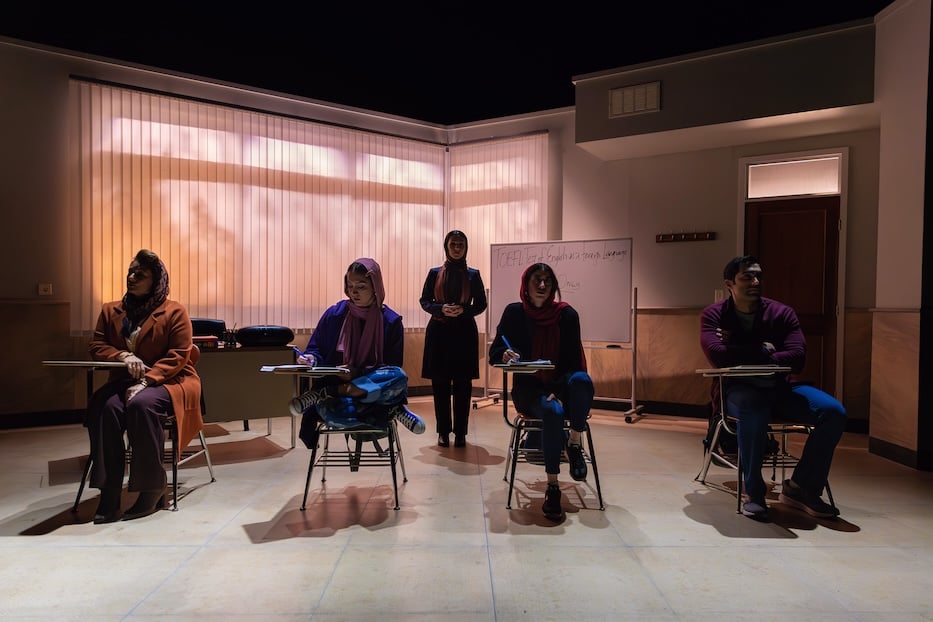
Long Wharf Theatre | Southern Connecticut State University | Theater
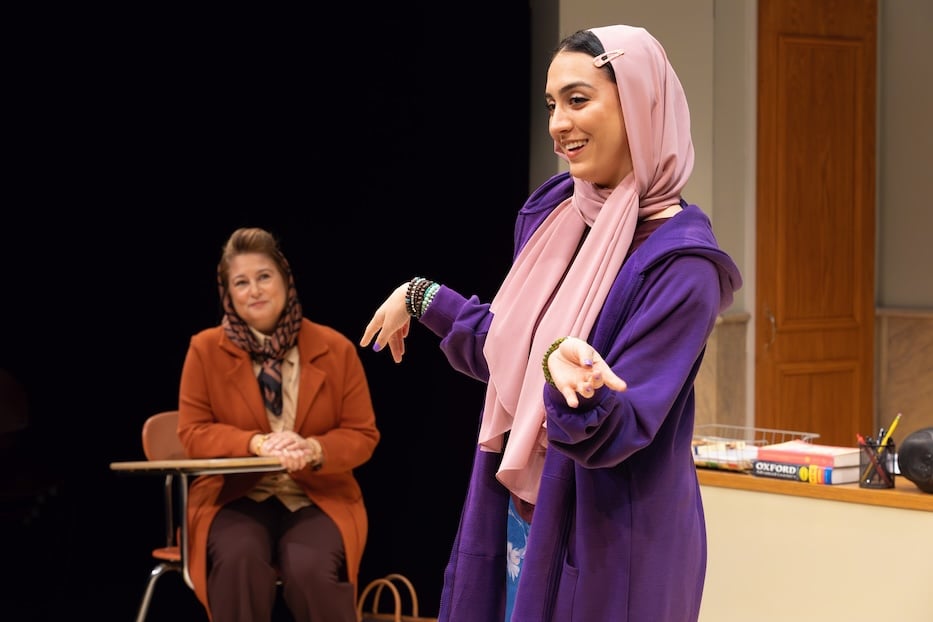
Nina Ameri as Roya and Aryana Asefirad as Goli in Long Wharf Theatre's production of Sanaz Toossi's English. Curtis Brown Photography Photos.
Goli is trying to explain the way English floats along the surface of language, but the words are half stuck. “English does not want to be poetry like Farsi,” she says, and hedges just a little. “It is like some rice.” A beat. “English is the rice.” It does not sink, she explains. A neat pink hijab, fixed in place with a rose-colored clip, frames her face. “English it stays on top of the water. It only wants to—”
For a moment, it seems as though she is caught between worlds, drifting from one to the other and then back again. She extends her arms and sways just slightly, her body a wobbly lyric. The classroom is quiet enough to hear a pin drop. Marjan, the teacher, smiles. “I couldn’t agree with you more,” she says.
That liminal space lives inside Sanaz Toossi’s English, which closed on Sunday after a sold-out run from Long Wharf Theatre at the Kendall Drama Lab at Southern Connecticut State University (SCSU). At a special performance and talkback with Noor Theatre’s Ariana Sarfarazi on Saturday night, it became clear how much of a gift it has given audiences in this moment, as the Iranian government seeks to silence its own people with intimidation, censorship, internet blackouts, and deadly state violence that has killed tens of thousands of people.
Long Wharf presented English, which won the 2023 Pulitzer Prize for drama, in partnership with TheaterWorks Hartford, where it was so popular that the theater extended it by a week in November of last year. Both performances were deftly directed by Arya Shahi, with a shared cast and creative team.
“The thing that’s been on my mind recently is how important it is for people to understand the humanity behind crisis and massacre,” said actor Neagheen Homaifar, who plays the character Marjan. “Unfortunately, one of the big things that’s talked about right now is the large-scale killing of Iranians in Iran by the government … Those are people. Each of the characters on this stage represents one of those human beings. They are not a caricature. They are not a stereotype. They are fully formed humans that are imperfect and beautiful and complex, just like you.”
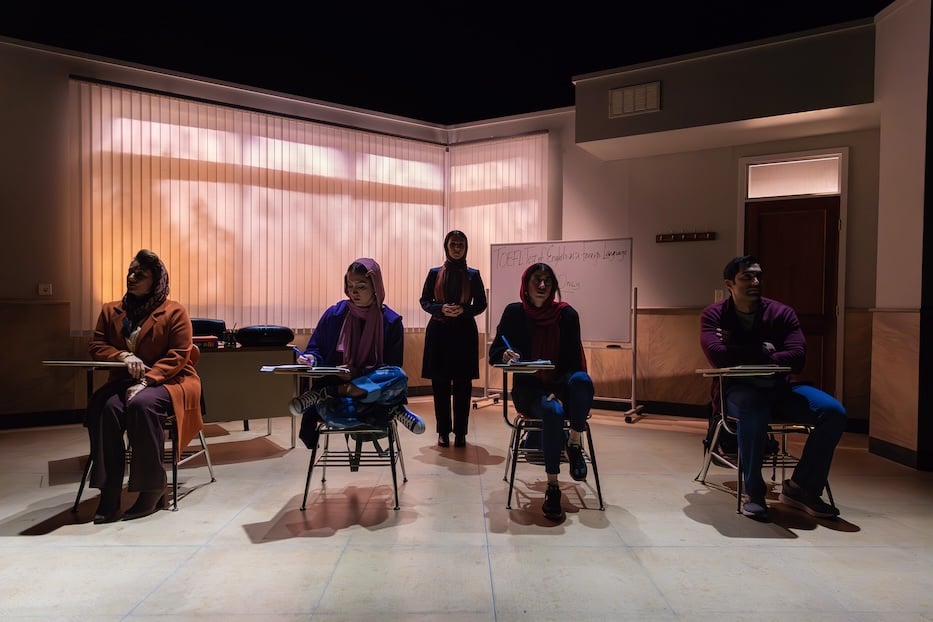
From left to right: Nina Ameri as Roya, Aryana Asefirad as Goli, Neagheen Homaifar as Marjan, Sahar Milani as Elham, and Afsheen Misaghi as Omid in Long Wharf Theatre's production of Sanaz Toossi's English. Curtis Brown Photography Photos.
So much of that is baked into the play itself. Set in a single classroom in Karaj, Iran, in 2008, English tells the story of four students preparing for the Test of English as a Foreign Language or TOEFL, which is often required for foreign study or work abroad. In the room, a whiteboard stands in the center of the floor like a challenge, emblazoned with the words English Only in dry-erase marker (a nod to set designer Sadra Tehrani). In the center of it all—blinds barely opened, desks neatly arranged, books stacked on the teacher’s desk—are the students.
There is Goli (Aryana Asefirad), who stands on the cusp of adulthood with a sweet, sometimes self-deprecating demeanor that belies how smart she actually is; Elham (Sahar Milani), a repeat test-taker who needs the TOEFL for medical school in Australia, and is as sharp as she is stubborn; Roya (Nina Ameri), a steely, sometimes-haughty older woman who is learning English for her Canadian-Iranian granddaughter, Claire, and grown son, Nader; and Omid (Afsheen Misaghi), whose near-perfect English surprises his classmates, and means he is at turns much maligned and much adored by different members of the class.
Charged with teaching all of them is Marjan (Neagheen Homaifar), whose own past and present, slippery with words she rarely speaks out loud, seem to shift just beneath the surface, tectonic plates that will not rest. When she asks, in an opening scene, “Why do we learn language?” what she is really asking is for the audience to lean in, and give themselves fully over to the world of the play, which is not so different from their world at all. If they do, she seems to promise, they will learn much more than whatever is in the lesson plan for the next several weeks.
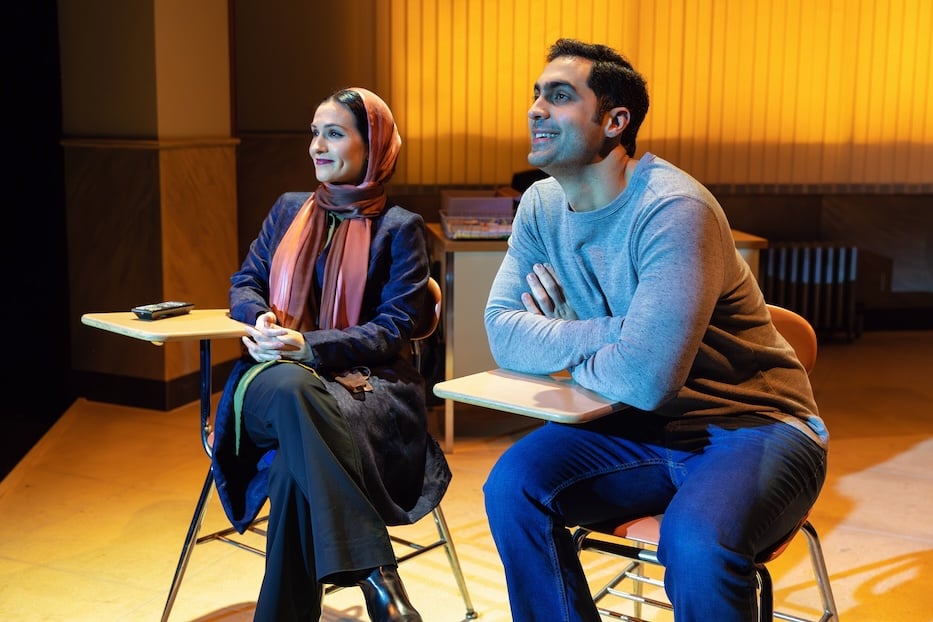
Neagheen Homaifar as Marian and Afsheen Misaghi as Omid in Long Wharf Theatre's production of Sanaz Toossi's English. Curtis Brown Photography Photos.
From those first moments, there’s an ease and quick, sharp humor to Toossi’s language, and the way it moves on the stage and between characters. At one point early on, for instance, Goli stands in the center of the room, trying to describe how to use an eye pencil. At first, she’s all in, that cool and excited friend you met in the high school bathroom. “I want big eyebrow but I take too much hair when I am young,” she says, and we feel it, that gentle striving that is both learning a language and learning to do makeup for the first time.
“The pencil is for make not real hairs,” she continues, and something begins to crack beneath the surface. But Goli charges forward, determined. “You do like—”
Here, language, both verbal and physical, is a tricky thing: She becomes unstuck by the exercise when she realizes that she has neither the words nor the mirror to correctly apply the pencil to her brows, resulting in a sort of zigzag line beside her eye. It’s a smart, tightly delivered parallel, and it lands: Marjan’s corrections work as laugh lines not because Goli is coming up short, but because we have all felt this lost in translation, whether in words or in another language entirely.
In another, Milani-as-Elham makes clear the split between believing in a language and learning it as a matter of necessity, a divide that throbs and pulses through much of the show. If Marjan, who has honed her language skills abroad, steps into English as an escape—“I always liked myself better in English,” she quips at one point—Elham pushes back against it, angry at the time and energy she must spend on it to prove she is worthy of acceptance to medical school.
As she takes the floor for the class’ show-and-tell, she displays a letter about her research, which is in gastroenterology. In the room, students listen, interested in what she has to say. Even as Marjan takes the letter away to prompt Elham, she is a study in strength and a quiet, pugnacious kind of pride. Her eyes blaze. She gesticulates, and her hands are at once balletic and forceful. Everything about her is intentional.
“I am not an idiot and also I am nice. And also I am care-y. I care about the world, and, and I am nice,” she says. In just seconds, the walls that she has spent days putting up fall down around her. Something in her shoulders relaxes. Her eyes seem softer. Then the scene shifts, Marjan moves on to a listening exercise, and they spring right up all over again.
As the play moves forward, this rift—and the sides that characters take, only sometimes temporarily—is a testament to both the depth and economy with which Toossi writes. Here, to be between languages is really to be utterly between worlds, swimming through a kind of emotional statelessness. If English, as Marjan suggests, really makes you a lighter version of yourself, how long until you are weightless, and simply float away?
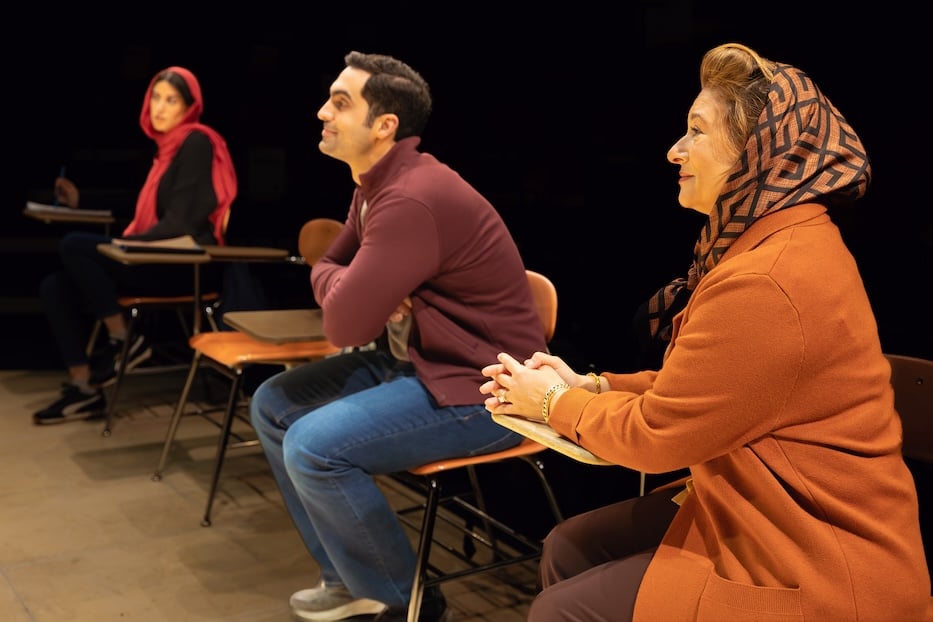
Nina Ameri as Roya in Long Wharf Theatre's production of Sanaz Toossi's English. Curtis Brown Photography Photos.
When Roya calls her son, leaving voicemail after voicemail in accented English, there’s an ache that is instantly relatable: she is suddenly your mom or grandmother, who still switches to Yiddish or Spanish or Russian or maybe even Farsi because it is so much easier to say both I love you and Get your act together in your mother tongue. When she says, “I am not mom, I am māmān,” you feel her grief, maybe because something like it lives inside you, too.
When Omid speaks in buttery, smooth, ribbons of English, it’s hard not to wonder who or what he has betrayed to get there, a heaviness that sits on him too. Misaghi does not miss: his whole body becomes a language of practice, facade and ambivalence, until something in him too starts to crack. But even there, Toossi injects a brightness that comes from the weirdness and hilarity of simply existing, from Ricky Martin (“it is a crash, inside the heart,” Goli says of his song “She Bangs”) to definite articles to the futility of practice exercises with scenarios that aren't helpful in actual conversation.
In this sense, English is a play about Iran and Iranians—these five characters are all regular humans, remarkable for their full human-ness—but it is also a play that is about culture, family, and belonging when home is itself a moving target. Like the artist’s 2022 play Wish You Were Here, which stunned and delighted audiences at the Yale Rep in 2023, Karaj is an unspoken character, always in the background.
But the setting is secondary. If it matters that the characters are in Iran at a specific time—2008 saw elections in the country, in which a conservative and authoritarian government retained the majority—it is not a work defined solely by its adherence to history. If anything, Sadra Tehrani’s classroom is a far more interesting container, and one that plays a much more significant role in the show, than the geographic location or even the time period.
It matches the original container for language, which is to say the script itself. During the play, characters switch between English and Farsi, using fast, unaccented English to signify the latter. Initially, it creates a kind of auditory on ramp, an expectation that a listener will and must adjust their own ear to absorb everything that they can. But it also feels like a statement, never heavy-handed, on the violence that English, and English speakers, have enacted over and over again to ensure the language’s global reach and dominance.
In this sense, Toossi understands—and gorgeously communicates, in a play that is all about communication—that language is as much a physical, mental and emotional construct as it is a spoken one. That it can be, as Elham herself says toward the end of the play, the sound of home, or of moving away from it.
Saturday, it also became a meditation on the poise and power of Iranian voices in this moment, from Noor Theatre’s work in supporting artists who identify as MENA/SWANA (as Sarfarazi explained, that’s the shorthand for Middle Eastern and North African and South West Asian and North African) to roles that feel fully formed and do not demand trauma of their characters.
Ameri, who plays Roya, remembered reading English for the first time and feeling amazed by the words in front of her. Prior to Toossi’s work, she often found herself auditioning for roles like “the ethnic friend, or hispanic, or anything other than white,” she said to knowing laughs from her fellow actors. “Or, ‘What are you? I don’t really understand.’ Or a terrorist, terrorist’s wife, terrorist’s girlfriend.”
English presented “just these people that were just regular characters who had lives and families and hopes and dreams and wants and just regular human experience,” she said. “And I thought, ‘Wow, this play is brilliant’ … it’s just so nice to be around for that, and to see that change happen.”
Homaifar, whose Marjan has a soft, pensive side that bubbles up as the play deepens, agreed. Speaking after the show, she recalled the brightness with which her family reacted to English after seeing her play an Afghan national who was hiding from members of the Taliban the year prior. At first, she was nervous, because she wasn’t sure what they would think of the show. Then she heard their laughter coming from the audience. “Then I could exhale,” she said.
Before the end of the night, it also became clear how deeply Toossi’s words resonated with Iranians both in the audience and in the cast, who spent tech rehearsals running scenes and preparing for the show, and then anxiously checking their phones to see if family members were still safe.
Asefirad, who plays Goli, remembered growing up speaking both English and Farsi, such that she refers to both of them as “my first and also my second language.” English was a play in which she could see herself clearly in multiple characters, including Omid.
“There’s always, like … my tongue gets tied,” she said, after reaching for a Farsi phrase, and watching Ameri jump in with the translation. “When I’m [speaking] in Farsi, my tongue gets tied. And when I’m speaking in English, my tongue gets tied. I’ve always just kind of been in this weird push-pull.”
“It’s a real experience and I think that it exists no matter what level of fluency,” Sarfarazi said. “Because even if you’re fluent in two languages, you have different personalities, because you have different identification of the language and the culture.”