

Culture & Community | Poetry | Arts & Culture
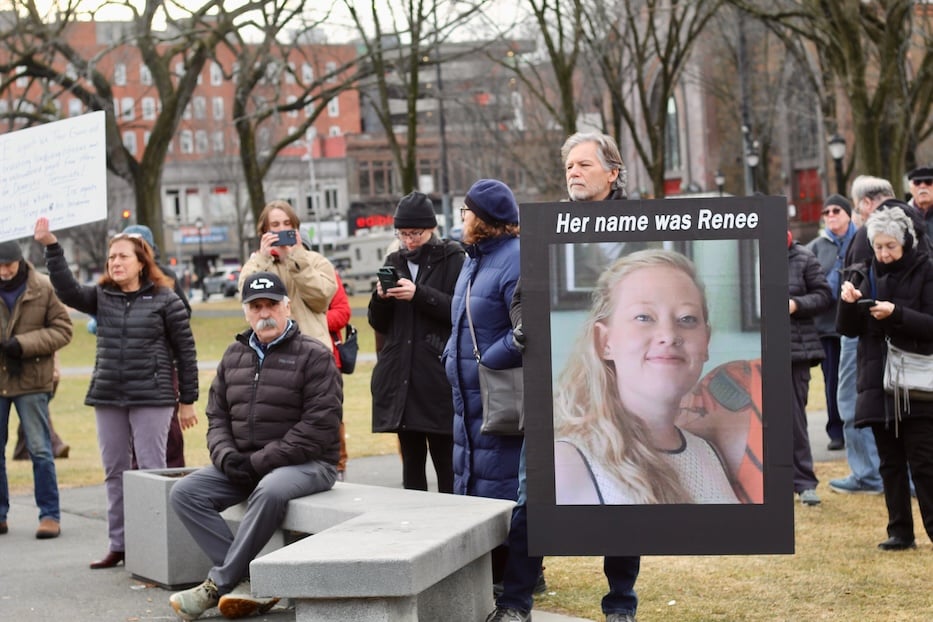
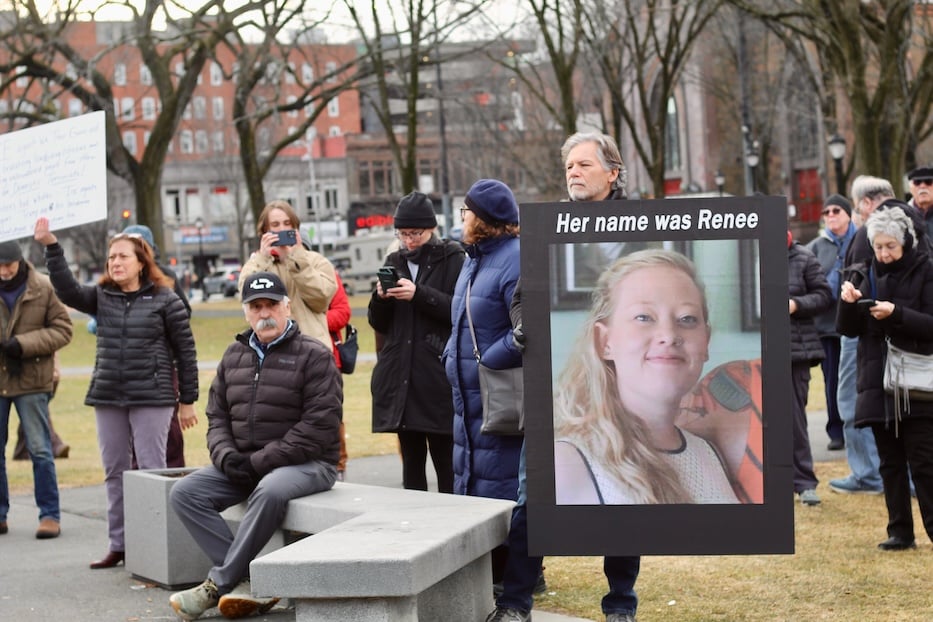
Attendees at an anti-ICE protest on the New Haven Green in January 2025. Lucy Gellman File Photos.
I became a wartime poet the day that Renee Nicole Good was shot and killed in her car, if not much earlier. Learning about her after she was murdered by secret police gave me the uneasy feeling of reading my own obituary, like a salamander creeping across the wet surface of my heart. I am also a poet, as you have seen, white and queer with a young child I adore. I try not to think about our children.
In the pictures memorializing her, Renee is smiling without teeth. An article on her murder notes that her dog was unharmed in the back seat of the car. Each frame of the short videos of her death is slowed down for analysis, making it all seem like it took much longer, but it was fast—fast. I do not think she suffered. Not like we’ll suffer. You will see.
War furnishes incredible suffering, and poets are known for their grasp of suffering, supposedly. I have loved many wartime poets (Czeslaw Milosz is one of my favorites), but I have never aspired to become one. For one thing, I am sick of discourse and I am always reluctant to join it. Discourse lacks physicality; discourse cannot encompass death like poetry can.
Wartime poets seem prone to discourse. Milosz was no exception. He was active in the literary underground in Nazi-occupied Warsaw, writing under the pseudonym Jan Syruć. After the war, Poland made him a cultural attaché and installed him in Paris, where he stirred up discourse professionally until he defected to the West in 1951. Fleeing Soviet-era repression, surveillance, and political violence. The salamander creeping across my heart again.
Martyrdom entails narrative drift. Already the words they use to describe her are changing, polarizing. As a poet, she would have known how corruptible language is, how it bends like willow and burns like oak. I wonder if she was writing about the occupation of her city by a paramilitary force. If she already knew what I am coming to, slowly, here. Renee.
To tell you the truth, I haven’t written much poetry lately. But I have not been idle. I have been writing shadow plays with my friends using an old projector. Throwing shadows on the wall in the shape of palm trees and snorting bulls and men falling into the mouths of whales. I have been teaching my friends to construct notebooks using the four-hole Japanese stab-binding technique that my friend Sylvie showed me in Boston.
We are cutting out pattern pieces for Archer work pants on each other’s dining room floors. And after the baby goes to sleep, we build a fire in the grate and take turns drawing each other in big sketchpads, looking anywhere we like.
I am aware of my artistic practice swiveling like an obelisk towards collectivity. It is practical to be vulnerable with those who are responsible for your life, in wartime and always. Writing plays together, drawing, working towards forms that would, Milosz said, “let us understand each other without exposing the author or reader to sublime agonies.” You should try it. Sketching each other’s feet in charcoal.
The forms of communication you develop when making art with your friends are good for coordinating systems of survival, protection, and mutual aid. This is valuable work, but I must warn you, you may be shot in your car with your dog unharmed in the back seat. You may be martyred, and haunt other people’s artwork, which could be interesting and sad. You will see.
What you will see is that your body has no tolerance for the body of your beloved being churned under horses’ hooves. That you cannot bear it for any length of time. That you will strain to catch the nightstick between your shoulder blades before it can fall upon the hanging head of your lover. Ideology comes afterward.
What I want to say to Milosz is: can we agree that trauma is not the harm, but the family’s response to harm, a response that forms much of what we call history? Can we agree that the names of the first casualties of the regime are recorded in gold, the last casualties in blood, and those in between are recorded in snow and overwritten by bootprints and the fluted tracks of deer?
He does not answer. Spirits gather like flocks of goats around Milosz, eating the canopy from around his bed. He speaks to them brusquely:
You whom I could not save
Listen to me.
Try to understand this simple speech as I would be ashamed of another.
My speech is becoming too complicated to understand. Let me try again to tell you: Milosz is dead. He died in Krakow, four years after returning to Poland. He had a Catholic funeral, and was buried as a devout, forced to wander. Thousands of people lined the streets.
I don’t know how Milosz learned that he could return to his homeland after 30 years of exile, but this is how I imagine it went: the gravedigger, taking a mouthful of dirt, tastes Milosz’s blood in the soil and calls the First Secretary of the Junta, who is shaving (he is always shaving). The First Secretary calls Milosz and tells him that it is time, now: that the soil of Poland is calling him back, and Milosz falls to his knees and weeps in a pinecopse. God sits in the branches above, swinging his legs.
It is time, now. Time to flee, to critique, to distribute illegal translations, to barricade the road. To make yourself vulnerable. Another wartime poet.