


Culture & Community | Arts & Culture | Theater | Yale Rep Theatre
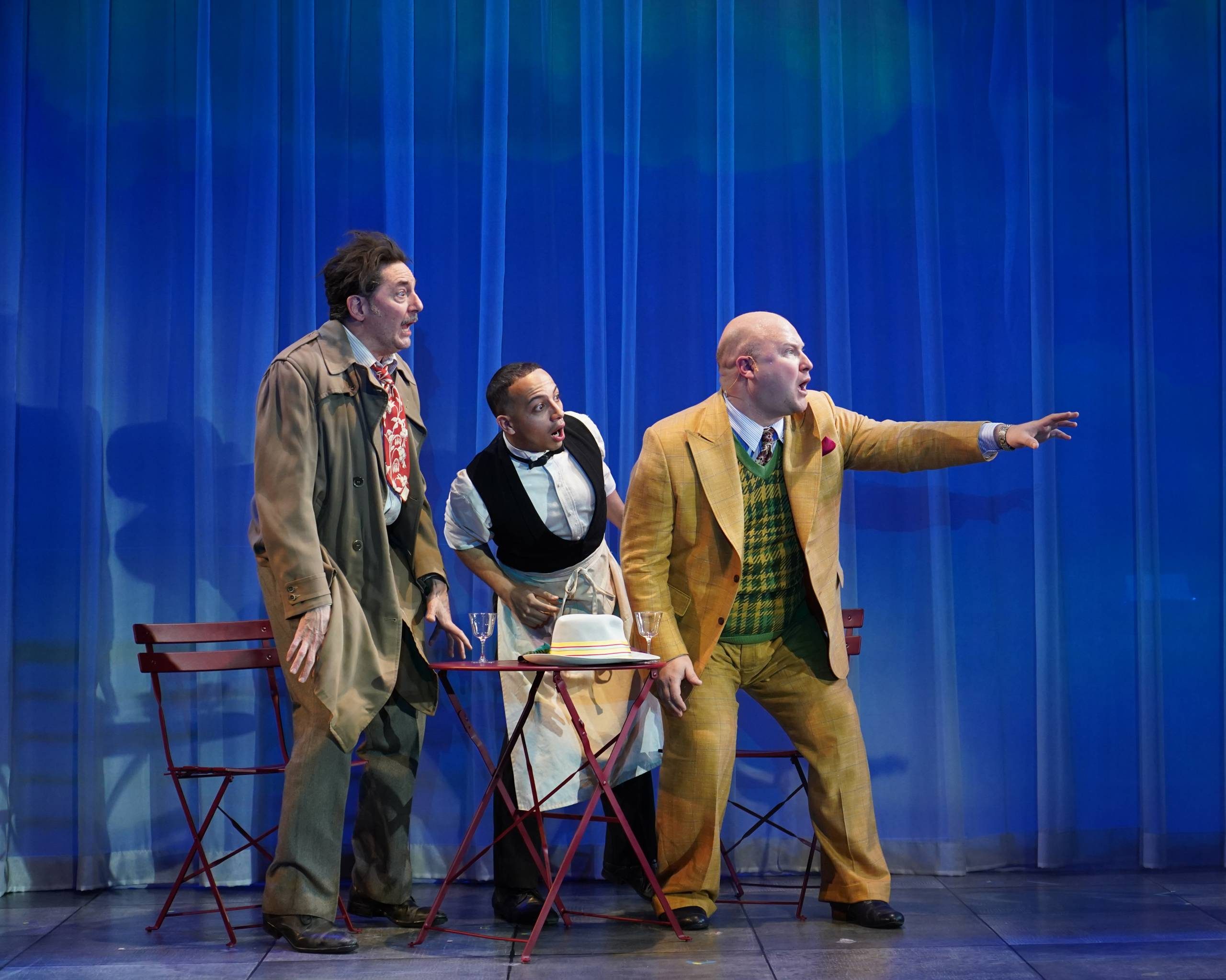
Reg Rogers, Jeremy A. Fuentes, and Phillip Taratula in a scene from Rhinoceros by Eugene Ionesco, translated by Derek Prouse, adapted by Frank Galati, choreographed by Emily Coates, and directed by Liz Diamond. Yale Repertory Theatre, March 6–28, 2026. Photo © Carol Rosegg.
Two friends, Berenger (Reg Rogers) and Gene (Phillip Taratula) catch up outside a cafe, blue sky stretching out behind them. They discuss the usual—money, relationships, alcoholism, personal grooming routines. Their banter remains unbroken even as birds flee across the skyscape and a rumble draws closer to the cafe. Only when the rumble turns to a roar, do they leap up and proclaim what they are seeing before them: “It's a rhinoceros!”
Thus begins the simple yet impactful premise of Eugene Ionesco’s Rhinoceros, running at the Yale Repertory Theatre through March 28. Directed by Liz Diamond, translated by Derek Prouse and adapted by Frank Galat, Rhinoceros is a play so prescient that were it written in 2026, it would be criticized for being too on the nose. Instead, its legacy helps this production pack a well-timed punch.
Performances run at the Yale Repertory Theatre at 1120 Chapel St. through March 28. Tickets and more information are available here.
Ionesco's 1959 comedy is a satirical representation of a community’s descent—maddeningly predictable, at that—into ideological submission. The story follows Berenger, an unremarkable man who becomes exceptional by believing what he sees. And what he sees, in this case, is a rhinoceros stampeding through his town.
Not long after the first sighting, Berenger and Gene have returned to more banal topics, as one does when one witnesses an astounding horror but has work in the morning. Just as the first rhinoceros fades from memory, however, another charges the cafe. It feels like an apt metaphor for the familiar barrage of “unprecedented” threats, from foreign conflicts to environmental catastrophe to a federal government that deals in alternative facts.
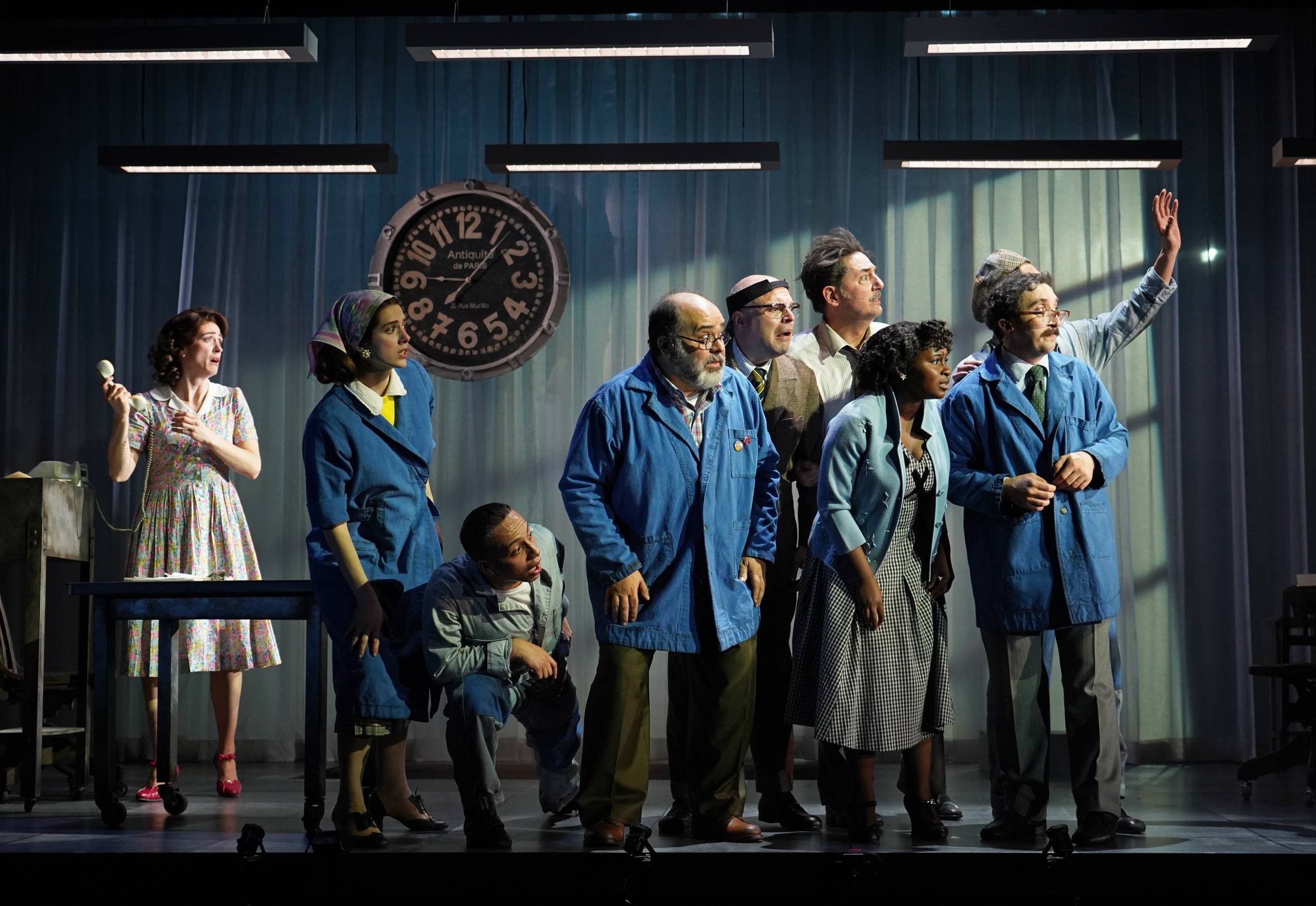
Members of the company in a scene from Rhinoceros by Eugene Ionesco, translated by Derek Prouse, adapted by Frank Galati, choreographed by Emily Coates, and directed by Liz Diamond. Yale Repertory Theatre, March 6–28, 2026. Photo © Carol Rosegg.
The next day, Berenger goes to his office, where his reality—the one where he saw two rhinoceroses—is immediately challenged. His coworker Botard (Richard Ruiz Henry) claims the rhinoceros is a hoax. He blames journalists (“They’re all liars. I don’t need them to tell me what to think. I believe what I see with my own eyes!”), witnesses (“You’ve got too much imagination. It was probably a flea run over by a mouse. People make mountains out of mole hills.”) and his fellow coworkers (“You’ve been producing this propaganda to get rumors started.”)
Botard’s denials ring out like a comment section taking on the most convenient argument for the moment and obscuring both truth and danger. When he finally sees a rhinoceros himself (after literally walking away from it and yelling “I don’t see anything. It's an illusion!”) he ruminates, “How can it be possible in a civilized country?”
The play shows us how. When the characters discover that the rhinoceroses were once people– that they are actually quite strong and free and happy, that they exist above the laws of men– they find themselves sympathetic, even intrigued.
Soon they start to ask: Are the rhinoceros so bad? Wouldn’t life be easier if I too were a rhinoceros?
Berenger moves through the story searching for an ally in his truth. He is a man, not a rhinoceros. The herd is growing and soon there may be no humanity left. He is met with ideology, justification, apathy and violence. And yet he resists.
The great success of the production is that its tasteful direction lets the play speak for itself. There is no pandering to the audience to make sure we understand the parallels to our own time. Diamond guides the story with humor and heart, supported by expert choices in performance and design.
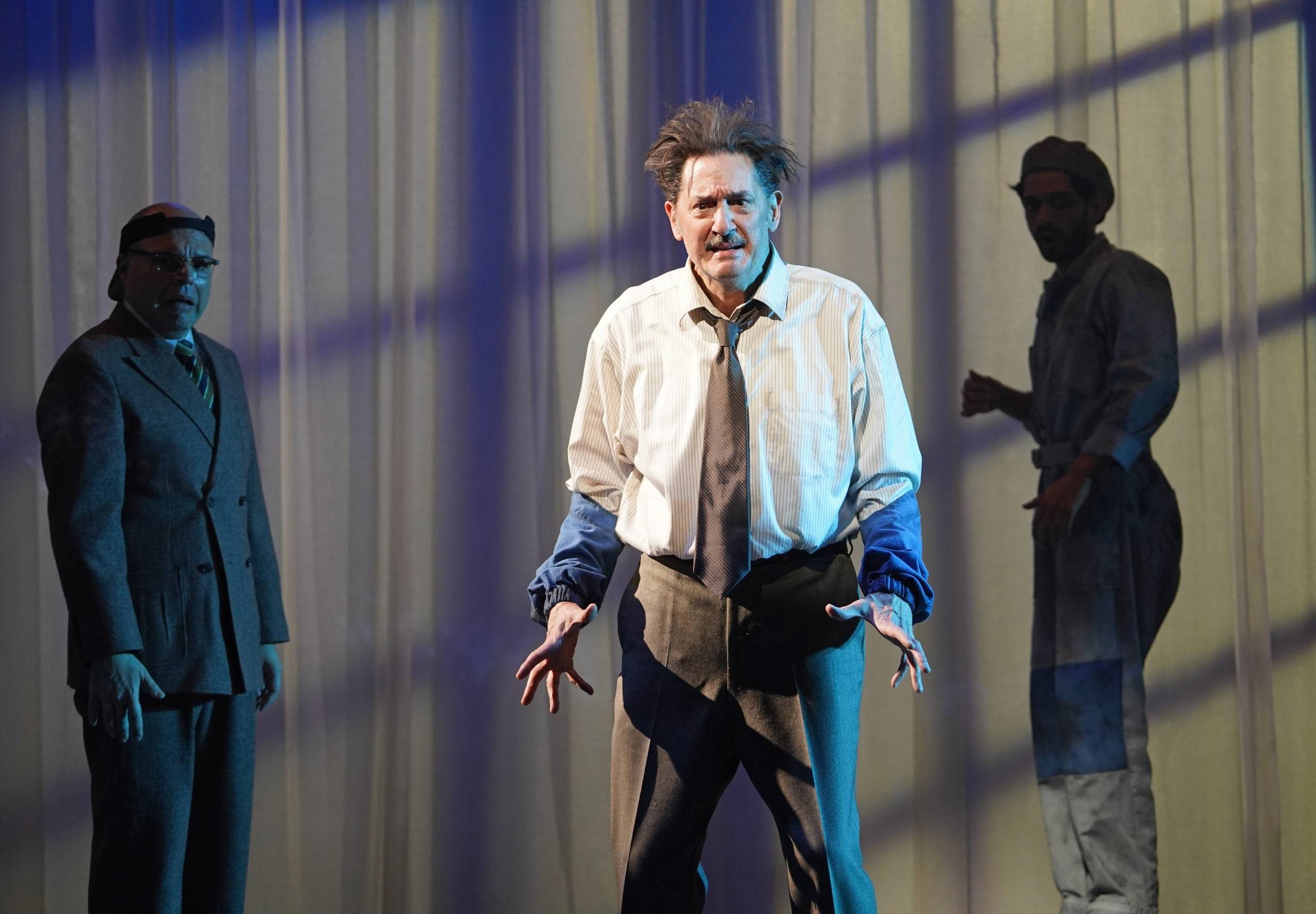
Reg Rogers (foreground) with Tony Manna and Ameya Narkar in a scene from Rhinoceros by Eugene Ionesco, translated by Derek Prouse, adapted by Frank Galati, choreographed by Emily Coates, and directed by Liz Diamond. Yale Repertory Theatre, March 6–28, 2026. Photo © Carol Rosegg.
The setting of a provincial French town is captured by scenic designer Jennifer Yuqing Cao 曹语晴 through evocative industrial elements— a large clock looming over the office workers, curtains and paneling reminiscent of shipping containers, restrained grays, blues, and whites used throughout. The style feels true to the setting while hinting at the malleability of when and where this story might take place. Ke Xu’s 许可 projections integrate perfectly as their subtle deployment made it look like the walls were shaking or the world distorting.
The late 50s costumes by Tricie Bergmann feel both rich and lived in. Pops of color bring our attention to important characters. Gene in his yellow suit and green pajamas as well as Daisy (Elizabeth Stahlmann), Berenger’s love interest, in pink shoes stand out in a sea of grey and white.
Reg Rogers as Berenger is devastating, funny, and deeply relatable. He is an “everyman” that you will root for, despite his flaws. He and Phillip Taratula as Gene have a deftness with Ionesco’s language that make their tête-à-têtes feel immediate and familiar.
Tarantula begins the play gliding around the stage commanding attention with delightful arrogance. As he transforms into a rhinoceros, he takes on a striking physicality, throwing his weight around the stage, stomping out the man he was before.
Will Dagger does a frustrating and funny performance as Dudard, the human embodiment of the New York Times. Elizabeth Stahlmann as Daisy plays subtext with glances and physicality to great effect. Meanwhile, Nicole Michelle Haskins’ brief appearance as Mrs. Boeuf lands the biggest laugh of the night by “falling” through the stage and riding away atop her husband.
The townsfolk are not presented as villains: they all have their reasons to submit. Instead they are deeply recognizable. Ionesco’s play is not about bad people joining a bad cause. It's about how hard it is to believe the worst. That the rhinoceroses are here. We’ve seen them. We are them. Unless we tell the truth, unless we do the absurd.
In a final monologue, Berenger stands alone on a darkened stage. He pleads to become a rhinoceros, to give in to the overwhelming tide. A hoard gathers behind him, the cast in sleek papier-mâché rhino masks, backed by a projection of a growing crowd. In a forceful turn he collects himself and with fury stares down the hoard and audience alike and roars “I am not capitulating!”