

Books | Culture & Community | Hamden | Poetry | Arts & Culture | Youth Arts Journalism Initiative | Migration
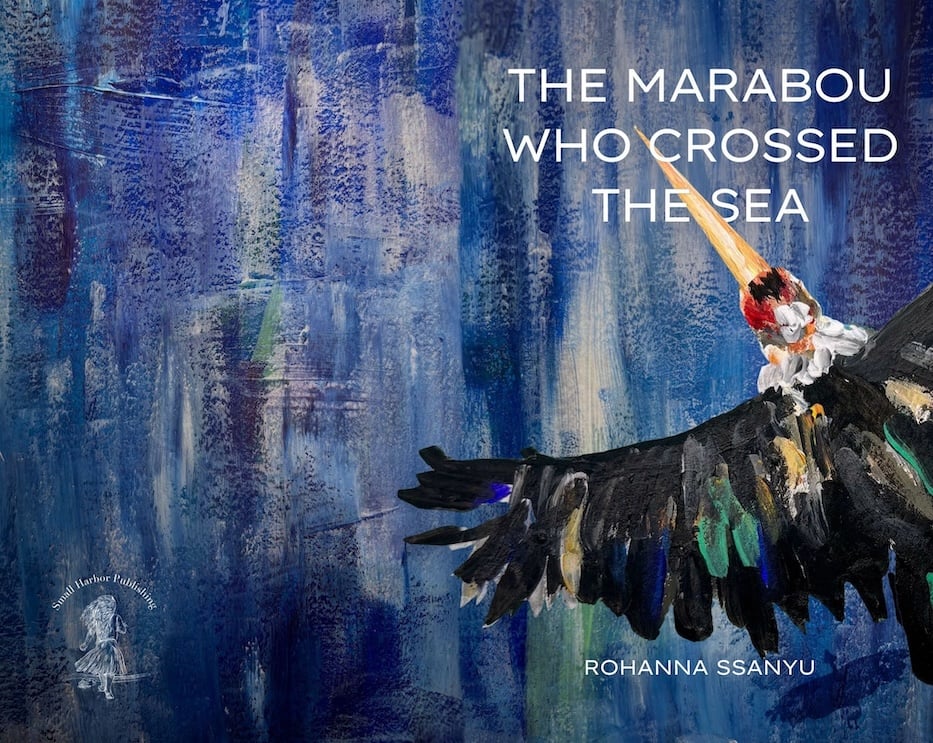
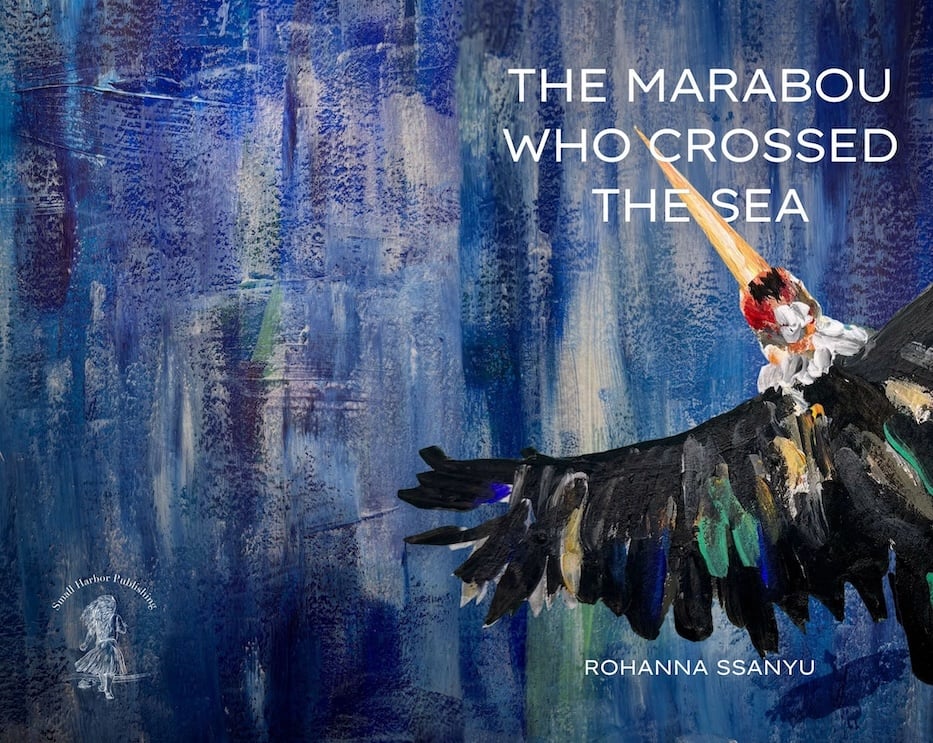
Cover art by author Rohanna Ssanyu and graphic designer Jessy Montoya.
The rotten papaya captivates Jonah, who in any other circumstance would play with its seeds.
He pauses, observing its state, before carrying the papaya to his cousins. Then he pronounces it dead. His cousins scowl and scoff at his reaction, but his older cousin, Beatrice, sincerely addresses his concerns. She picks up the papaya and insists on holding a funeral, marking the beginning of three days of mourning.
That story, titled “Death of the Papaya,” lives vibrantly in Rohanna Ssanyu’s poetry book The Marabou Who Crossed The Sea. Released in February 2026, the book takes the reader on a journey through her relationship with her Ugandan heritage through 25 poems. The book is a tale of Ssanyu becoming whole through reconnection to parts of herself she hadn’t accepted in her youth. It tells stories of her family and their separation from their home as well.
Ssanyu is a part of the Baganda tribe, an ethnic group in Uganda’s Buganda Kingdom, on her mother Rita’s side.
“As a child growing up in a small Connecticut town, I was not always the nicest to my mother,” Ssanyu said. “She was so very different, or at least, I felt she was so very different from the mothers of the friends that I had in town. I was ashamed the first time I went to Uganda because she wasn’t wrong, she was just different … Knowing that this was where my mother is from, I was ashamed that I had ever been ashamed of my mother when I was younger, because my mother is beautiful.”
That begins and ends with Ssanyu’s own story of journeying, and her mother’s. Ssanyu was born in Fairbanks, Alaska, in 1989 to a Missouri-born father and Ugandan mother. During those first years of her life, her father was working on his PhD and her mother worked as an au pair. They moved to Bethel when her dad, an ecologist, was offered a job position. She described it as “living in a bubble.”
“I did not appreciate what I was lacking in experience until after I left Bethel,” she said. Growing up, Ssanyu was one of just a handful of Black children in her town. Through her mother, Rita, she grew up listening to stories of Uganda in the 1970s, a decade before her mother left. Rita lived under the rule of Idi Amin, a military officer turned dictator from 1971-1979.
His regime was responsible for the expulsion of Asians in Uganda, the collapse of Uganda’s economy, and the murders of 100,000 to 500,000 civilians. She grew up with nightmares from stories of what happened to things that had happened to people around her.
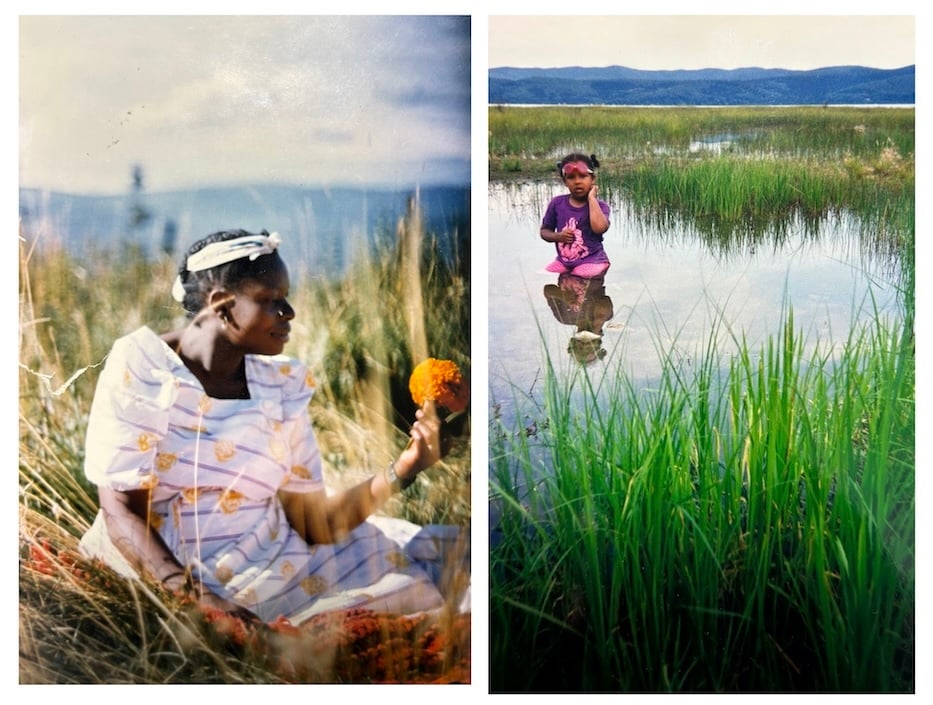
At left is Rohanna Ssanyu’s mother, Rita, as a young adult. At right is the author, age four, in Fairbanks. Photos courtesy of Ssanyu. The photo below is also courtesy of Rohanna Ssanyu.
Ssanyu’s disconnection from Uganda caused a lot of tension with her and her mother in her youth, she said. In 2008, she left Connecticut for college in Washington, D.C, returning to pursue history at Southern Connecticut State University (SCSU) and much later, writing at Albertus Magnus College. In between, in 2010, she visited her grandmother's house a few months before her passing. She walked through the yards her mother once did, looked up at the papaya trees her mother grew up with.
Enter the process that led to many of the poems in The Maribou Who Crossed the Sea. For a decade, Ssanyu has been teaching history in the New Haven Public Schools, including at the New Haven Adult Education Center since 2019. After several years in New Haven, she now lives in Hamden with her husband, who hails from the Dominican Republic, and their two young children (Spanish is the language family members use most besides English). But part of her has long wanted to reconcile the different parts of herself and put it all in writing.
That’s palpable in pieces like “The Death Of The Papaya,” one of the last poems she wrote for the book. The poem takes elements from three different generations: her mother’s, her own, and her children’s. The story reflects a typical Kiganda funeral, which is given for the piece of dead fruit.
On the first day, the character Jonah names the papaya Godfrey, and recites prayers while he and his cousins place jasmine on Godfrey’s corpse. On the second day, a swarm of flies surround Godfrey so the children burn the flowers around him, wash him with a sponge, and fill him with cotton. On the third day, the children build instruments out of cans, strings, and bones, creating a makeshift band.
As the band plays, Jonah’s cousin Alice sings in Luganda, a major language spoken in central Uganda. “Weraba, weraba. Otambule mirembe,” she sings, which means “Farewell, farewell. Travel in peace.” The ceremony evokes feelings of grief and sparks curiosity among the children. Jonah wonders who will lead Godfrey’s family, the children weep for him, a boy asks if he too will ripen. Alice speaks as the tree Godfrey came from, his mother, and asks for forgiveness.
The children place Godfrey in the hole and scoop dirt over him until Jonah’s grandmother comes, shooing the neighbors and telling the children to extinguish the fire. Jonah’s friends and family go to extreme lengths to put Godfrey to rest, one of his cousins even burning her finger on the fire. His cousin James imitates what he’s seen the adults in his village have done by beating tree bark.
.jpg?width=400&height=475&name=Author%20Photo%20(Rohanna%20Ssanyu).jpg) The beating of bark by James represents the process of creating a Kigandan bark cloth. Ssanyu said that choosing cousins to aid Baby Jonah was a decision she made thinking about her mother. Her mother, Rita, grew up around her first cousins in her village.
The beating of bark by James represents the process of creating a Kigandan bark cloth. Ssanyu said that choosing cousins to aid Baby Jonah was a decision she made thinking about her mother. Her mother, Rita, grew up around her first cousins in her village.
“It was watching my kids play last summer … they kind of understand the world and they kind of don’t understand the world at all,” Ssanyu said. “I imagined them playing with these cultural markers but like, not understanding all of it.”
When James frantically beats a piece of tree bark for Godfrey’s ceremony, he is using the wrong kind of bark, not fully knowing why he’s doing what he is. Ssanyu says the poem reflects her somewhat childish knowledge of Kigandan culture.
“When I was growing up, family members would come visit. We’re all scattered … it results in not really understanding everything,” she said.
“We don’t all get the chance to walk our parents’ path from before they were parents,” she continued. She remembered how her mother, nicknamed “Baby Rita” by her six older siblings, would walk from her home to an aunt’s house, going on adventures along the way. Rita would leave in the morning and not come home until late at night, often needing to be accompanied by one of the older children.
On those adventures, she would start conversations with people, asking lots of questions. Her inquisitive nature earned her another nickname, “Journa,” like a journalist. It was the inspiration for the name Baby Jonah. “She brought so much of her childhood to her life in the United States, whether she intentionally realizes or not.”
In the fifth poem, “I Write to My Mother From a Desk at Kololo School with a Borrowed Pen,” Ssanyu uses the idea of walking in her mother’s shoes as a moment to explore shared understanding.
Maama, this place
looks like you when you were young,
when you sang prayers into my ear,
when you wrapped me
in the esuuka you wore to wed.
For Ssanyu and Rita, the conflict came from more than the generational differences everyone faces. There was an added separation caused by the pair growing up in such different worlds. Ssanyu writes about her difficulty speaking Luganda and how it separated her from her mother and culture growing up.
Ssanyu said when writing the poem, the words “I’m sorry” occurred in many of the drafts. During the editing process, the words were removed as the poem itself feels like an apology.
While the book's animal namesake is not the core focus, Ssanyu references the Marabou stork, native to sub-Saharan Africa, several times. Ssanyu described the stork as dinosaur-like, like it “doesn’t belong and does belong all at once." She likened the behavior of the nearly five-foot birds to pigeons or seagulls—unfazed by the presence of humans, and unwilling to be moved or shrunken by them. Ssanyu recalled feeling haunted by the storks, even during more recent visits.
The Marabou is also the inspiration behind the book’s cover art, which Ssanyu painted last summer in between taking care of her children. First, she painted the blue background and the Marabou on separate pages, before pasting the cutout stork on the pages. With the help of her friend and graphic designer Jessy Montoya, the pair figured out a way to integrate the elements together.
“When I can’t write because I get overstimulated or overwhelmed, I paint. That is a relaxing, happy space for me,” she said.
Before the book's release, Ssanyu and Montoya discussed some of the stories in the book. In a recent email, Montoya said that he was drawn to the cut-up poems, describing them as collages of memory. In particular, he noted that the poems “Kampala” and “Time Traveler Catches the Akamba Bus” stood out to him for their descriptive nature.
“Rohanna’s paintings already captured the movement of the sea and the marabou in flight beautifully,” Montoya said. “My role was to refine the typography and visual hierarchy while preserving the movement, symbolism, and emotional quality of her artwork … I’m incredibly happy that more people are getting the opportunity to experience her talent.”
Despite Ssanyu’s aversion to the marabou, their environmental impact helps her to accept their presence. When marabou go into Kampala, they eat things like rats in landfills, reducing the chance of disease.
“Marabou” is also the title of her first poem in the book, which talks about a grandmother telling her grandchildren a story about the bird. Ssanyu wrote an earlier version of the poem with the same name while earning her MFA at Albertus Magnus College.
“I like the concept of like, this thing is becoming ugly, but making the environment less terrible … I think it shows that we can’t have beauty without ugliness, and I think every story is like that.”
The book also features several poems and references to Ssanyu’s grandmother. In the poem “Cousins,” she writes about how she couldn’t attend her grandmother's funeral in 2010, only a few months after she visited Uganda for the first time. Despite the children of her grandmother being scattered across the globe, her family rallied for all of them to attend the funeral. Much like the children in “Death of a Papaya,” an event that can be considered tragic is accidentally transformed into a celebration of life.
“I want readers to see the beauty in a thing as ugly and imperfect as the marabou."
In a phone call, Lauren Anderson, founder of Possible Futures Bookspace, reflected on the reading and Ssanyu’s presence in New Haven. Ssanyu held a book reading and art event at the bookspace, which is on Edgewood Avenue, in March.
"I genuinely think the world becomes a better place every time a person puts poetry into it,” she said, “and I'm grateful to Rohanna, for finding the time and the space to do her creative work, even while she is working diligently as an educator with adults across our city, and just as a mom."
Ssanyu will be having a poetry and art event at the Pardee-Morris House at 325 Lighthouse Rd., August 9 from 2-3:30 p.m. Learn more about that here. This article comes from the ninth and current cohort of the Arts Council's Youth Arts Journalism Initiative (YAJI). From June 29 through August 21, YAJI students pitch, report, write and edit stories with Arts Paper Editor Lucy Gellman, Program Assistants Abiba Biao and Grayce Howe and Mentor Ruby Szekeres. Naiyanna White is a rising senior at the New Haven Adult & Continuing Education Center.