

Culture & Community | Dance | Fair Haven | Arts & Culture
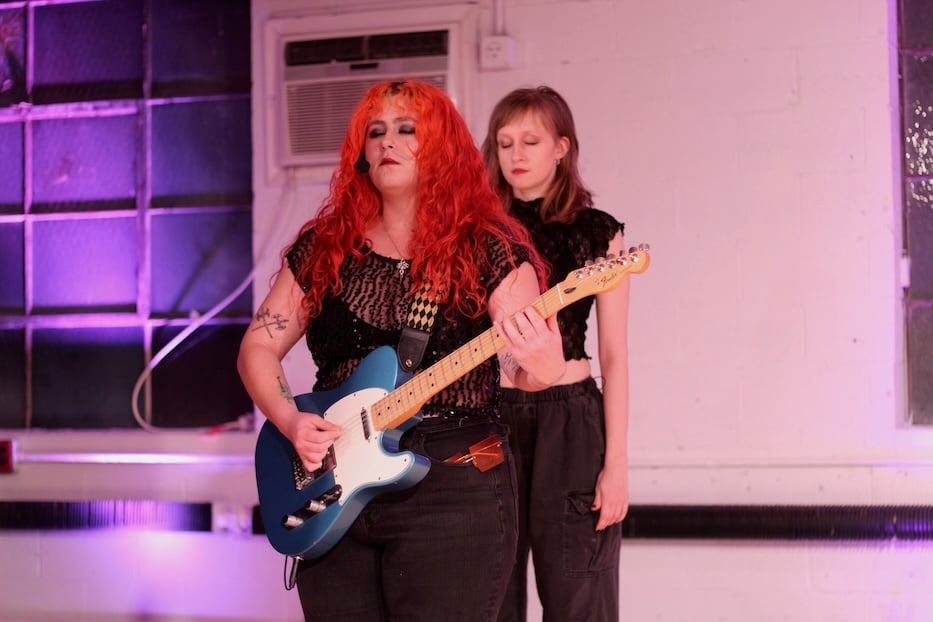
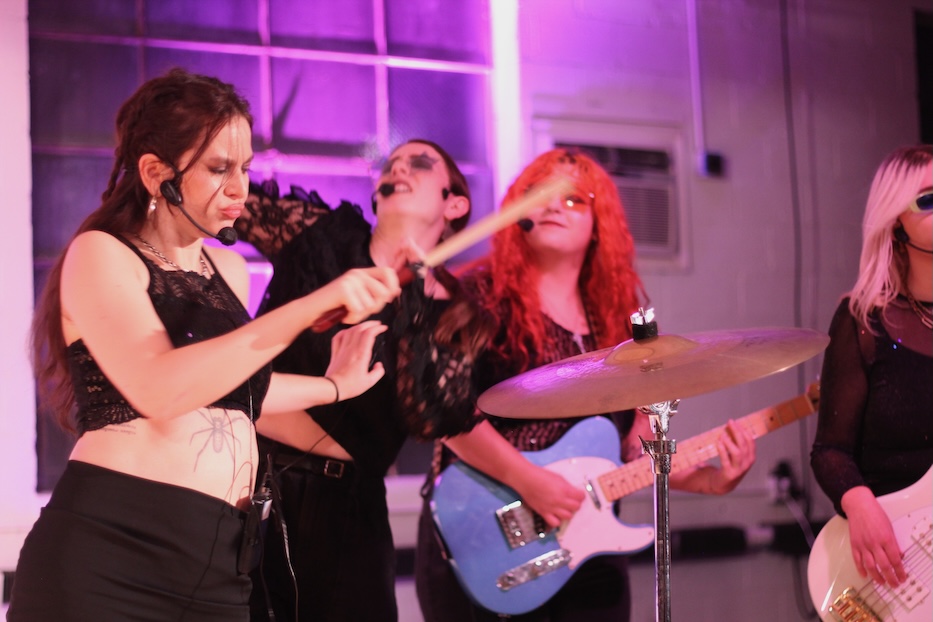
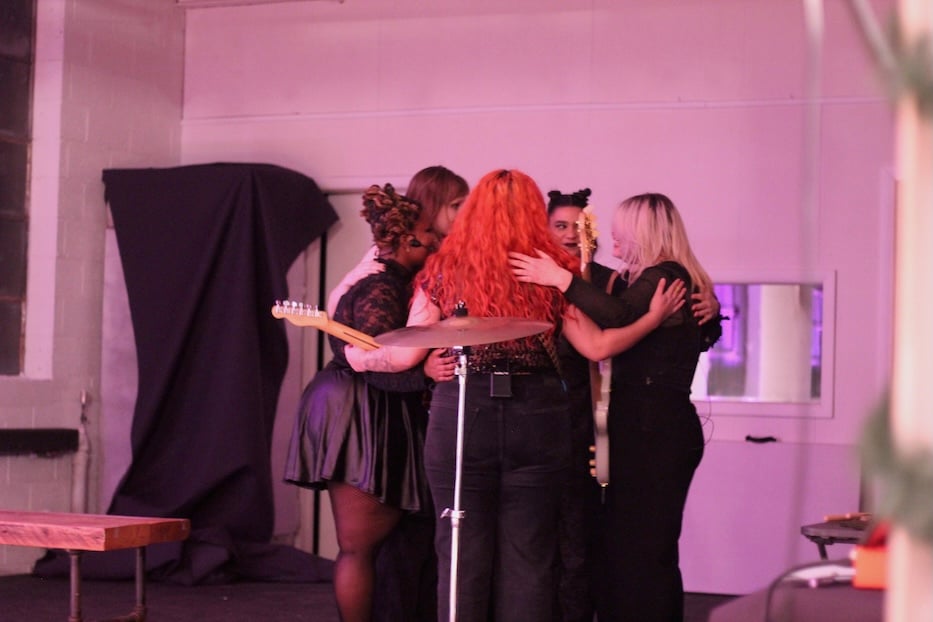
Top: Maya Harrison and Megan Gessner. Bottom: Maria Clara Laet, Alexis Robbins, Maya Harrison, and Christie Echols. Lucy Gellman Photos.
Beneath strands of twinkling white lights, seven performers had transformed an old Fair Haven warehouse into a stage. Bass guitar swelled over a sprung wood floor, fuzzy and electric in a haze of pink and purple lighting. At least four pairs of tap-clad feet, syncopated and strong, filled in the rhythm section. Dancers, in the throes of the sound, rotated their bodies and extended their arms. As they parted, scattering to all sides of the wood floor, Demiah Latreece emerged from the bunch, walking forward with complete certainty.
“All the troubles/All the visions/That are living inside your head,” she sang, and the audience hung onto each word. “Fill your hours/With an ur-gent need/That you’d rather dre-e-ad—”
That soul-stirring sound came to CitySeed’s James Street building Saturday night, as dancers, musicians, tap students, friends, and creative family gathered for the The Mercy Velvet Project’s second annual fundraiser, a works-in-progress showing that doubled as a celebration of the project’s growth. The propulsive brainchild of performer and choreographer Alexis Robbins and musician Christie Echols, the work is an evolving rock opera that pays homage to “Live In Vain,” a 1999 album from the short-lived band Mercy Velvet of which Robbins’ father, Mark Robbins, was a member. Read more about that here.
Robbins, who is based in New Haven, is the project’s artistic director; Echols is the associate and musical director. In addition, performers include Latreece (vocals), Maya Harrison (electric guitar and vocals), and Megan Gessner, Isabella Serricella, and Maria Clara Laet (dance, percussion, and vocals). Unlike other works, in which artists may be siloed by discipline, Mercy Velvet’s cast does a little of everything: dancers stand in for drums, dabble on the cymbal, and occasionally sing. Musicians move about the stage, and vocalists weave in choreography before the night is over.
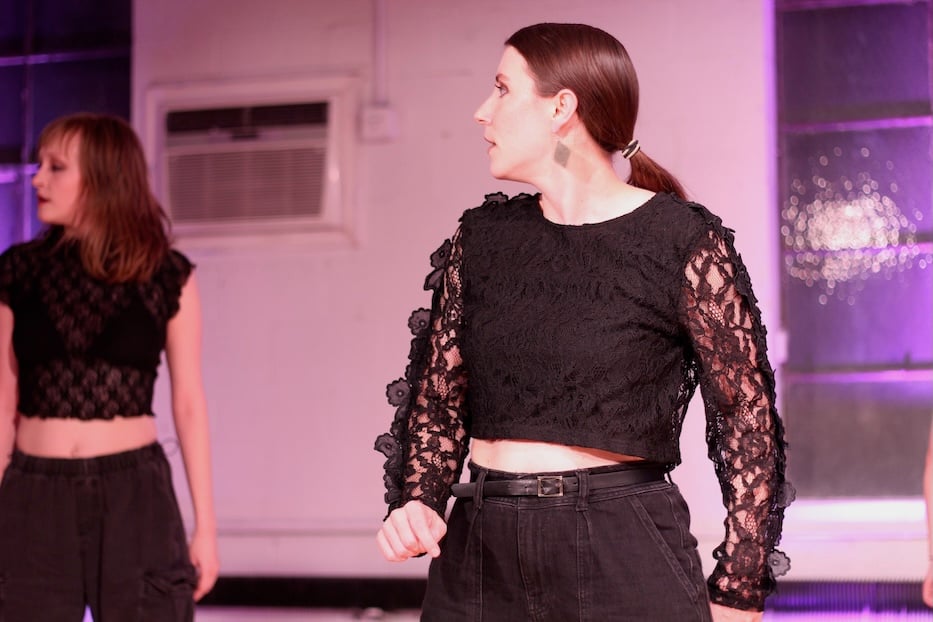
Alexis Robbins: "It’s both a big sigh of relief to have gotten to this point and it’s like, ‘Oh, wow! We’re really doing the thing!’"
“It’s both a big sigh of relief to have gotten to this point and it’s like, ‘Oh, wow! We’re really doing the thing!’” said Robbins with a laugh shortly before performing, as attendees milled around CitySeed’s first floor space nibbling on savory treats from her mom, Kathy Meier, and sweet ones from Katalina’s owner Katalina Riegelmann. “I’m so grateful that I’ve gotten to this point in making the work that I want to make and that people are coming along for the ride."
"At the end of the day, it’s tap dance and live instrumentation coming together with a totally badass group of women and femmes," she added. "It's about holding each other and giving back to each other."
It has taken a village (or in Echols’ words, “a whole city”) to get this far. After first presenting the work as a loose concept in October 2022—that performance was at the Hill Museum of Arts in New Haven—the project has changed shape several times, with performances in New York and New Haven along the way. This year, cast members held residencies at the creative incubator NXTHVN and Music Back Then Performance Center, where they were able to keep building out the show.
None of that work has been free. Since a winter fundraiser at Katalina’s last year, Robbins has raised $20,000, just a fraction of the funds that she has spent paying artists for their time and labor. Now, she’s in the creative homestretch—she hopes to premiere the work in New Haven next summer—but is trying to raise another $40,000 to get there. This fall, she said, the collaboration of A Broken Umbrella Theatre and CitySeed made the fundraiser possible.
A Broken Umbrella, which is working towards its own space in the city’s Beaver Hills neighborhood, lent Robbins the sprung wood floor and helped her load it into the building (Robbins said that ensemble member Ryan Gardner, who is a carpenter in the scene shop at the David Geffen School of Drama, was especially helpful in getting it into the building). CitySeed gave her the space mostly for free, with the caveat that she would have to pay for heat.
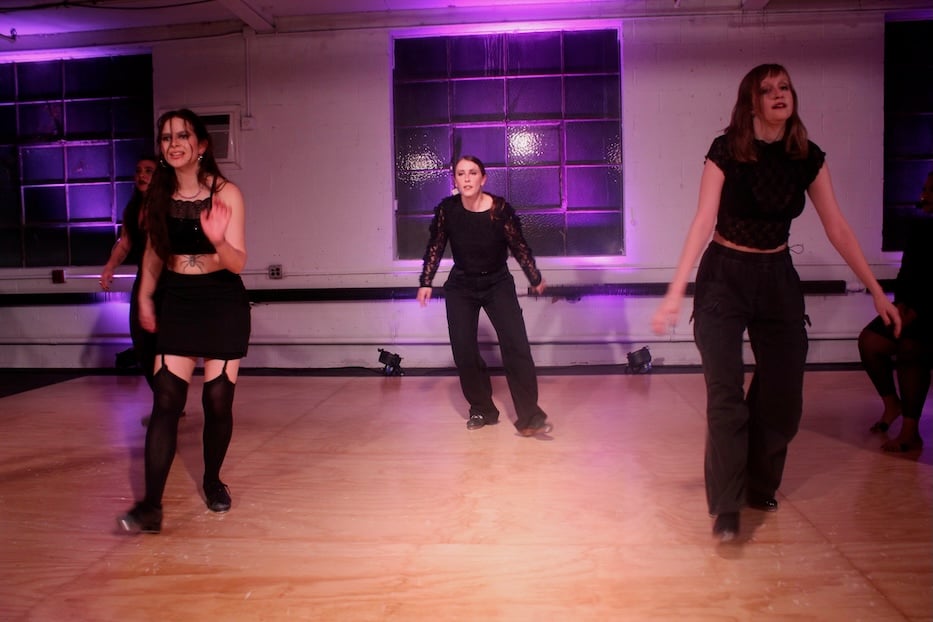
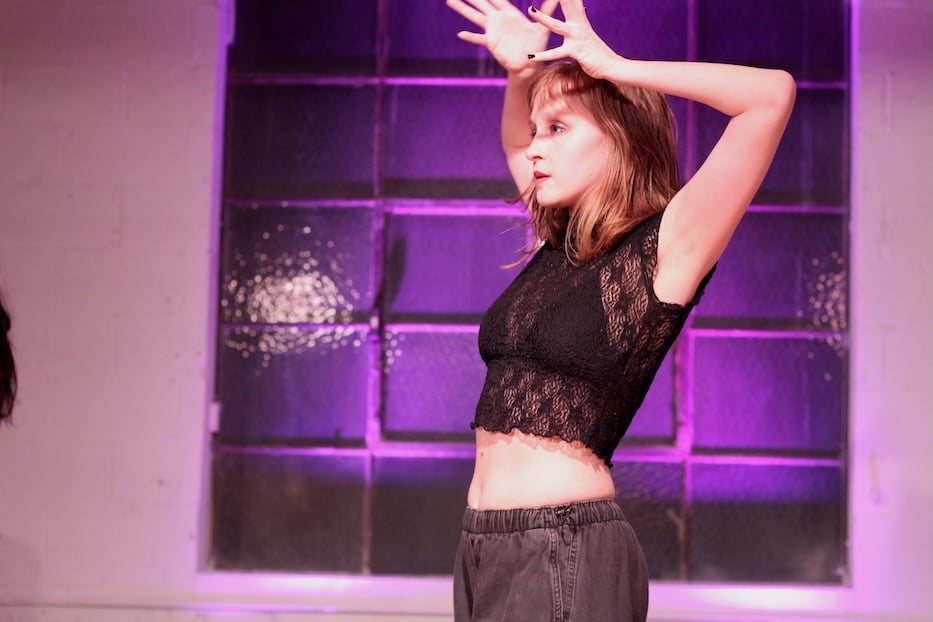
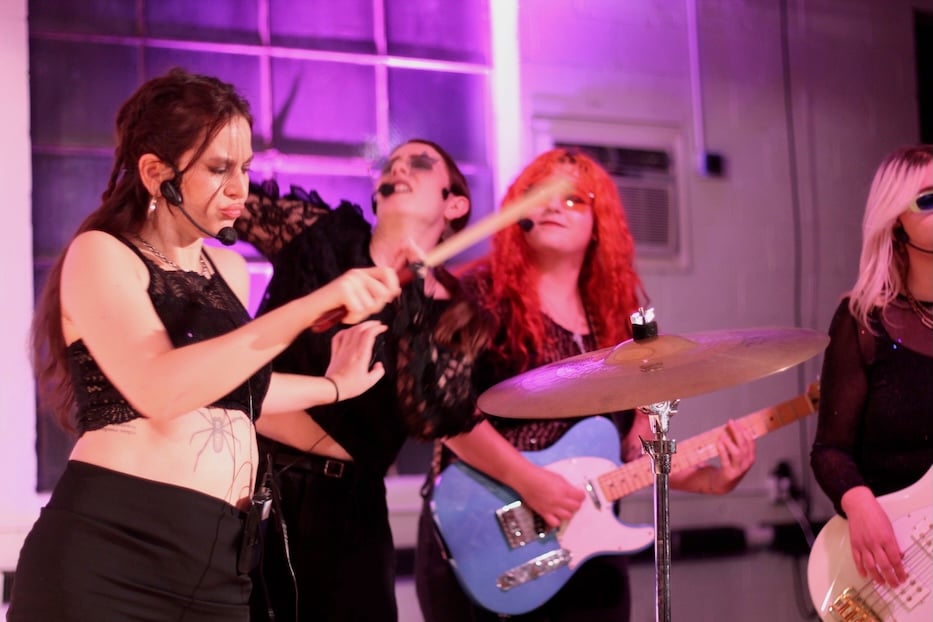
Top: Isabella Serricella, Maria Clara Laet, Alexis Robbins and Megan Gessner. Bottom: Gessner.
Saturday, a robust community came out to support as performers took the stage for five numbers, in what will ultimately be a nine-number, 80-minute show. As the seven artists gathered in a huddle to the right of the sprung wood floor, arms on waists and shoulders in a continuous chain, attendees slipped into their seats, some snagging a second glass of wine or dainty, doll-sized frosted cupcake before sitting down.
Around them, Robbins had transformed the space, with the floor-turned-stage, strings of soft, twinkling lights, rows of seats and pink and purple lighting that turned the room into a kind of DIY theater (that's also owing to A Broken Umbrella, who proved that it could be done with a newly devised play about pizza earlier this year). After introductory remarks from Shilarna Stokes, a lecturer in theater, dance and performance studies at Yale (and the doting mom of one of Robbins’ faithful students), the room fell to an expectant silence.
In the front row, Robbins’ longtime student Joe Feikeita, himself an artist and a cultural dreamer, sat on the literal edge of his seat.
Then, there was an explosion of fuzz-kissed sound, and dancers were making their way onto the floor, with a sort of frenzy and furor that spilled out into the house. They triangulated, packed in tightly and dancing all the while, then broke apart just as quickly, limbs slicing through the air. Over the guitar, feet became a percussion section fit for an orchestra. At the front of the group, Gessner tipped her head back, and rolled her shoulders, a movement that extended down to her hips. Then just as quickly as they had come together, performers fanned out across the floor, and Latreece stepped into the spotlight.
After walking to the lip of the stage, dressed in a black leather skirt and lacy top (think grunge, but classier) she seemed to take stock of the moment, then joined in the dancing herself. One moment, it was just her head and shoulders moving to the sound; the next, it was her whole body, as she stomped, twirled, and sank into deep lunges that both dancers and musicians mirrored. Then, within seconds, she was on the move again.
“All the love/All the love/That you’re feeling deep down inside,” she sang, and it had a kind of sharp and metallic edge to it that fit the bass like a glove.“If you just let it grow then you know/You wouldn’t have to hide—”
Dancers made their way across the floor, a riot of sound that somehow still hit every downbeat, too controlled to be called a cacophony. For a moment, they huddled beside Harrison, whose long, hydrant-red hair poured down past her shoulders. They arched their long backs, watching Latreece from across the floor as if they were meeting for the first time, scoping out a friend or foe (a Hamilton/Burr vibe if you will, but give it more grrrl power).
“Don’t you know you’re not alone/You are part of humankind?” they sang out, turning it into an invitation. They'd decided on friend.
There was a pause. Echols’ rich, deep voice held down the words, making them seem rounded out, and somehow more whole. In the room, bathed in a royal purple light, several creative movers and shakers—CitySeed’s Sarah Miller, A Broken Umbrella’s Rachel Alderman, Jes Mack, and Brandon Fuller, Riegelmann, who has taken classes from Robbins for years—looked on with bated breath to see what would happen next.
Then Latreece, remembering herself, nearly shouted them back, that sharpness returning at the edge of her voice. Her head bobbed wildly, and everyone began to jump at once.
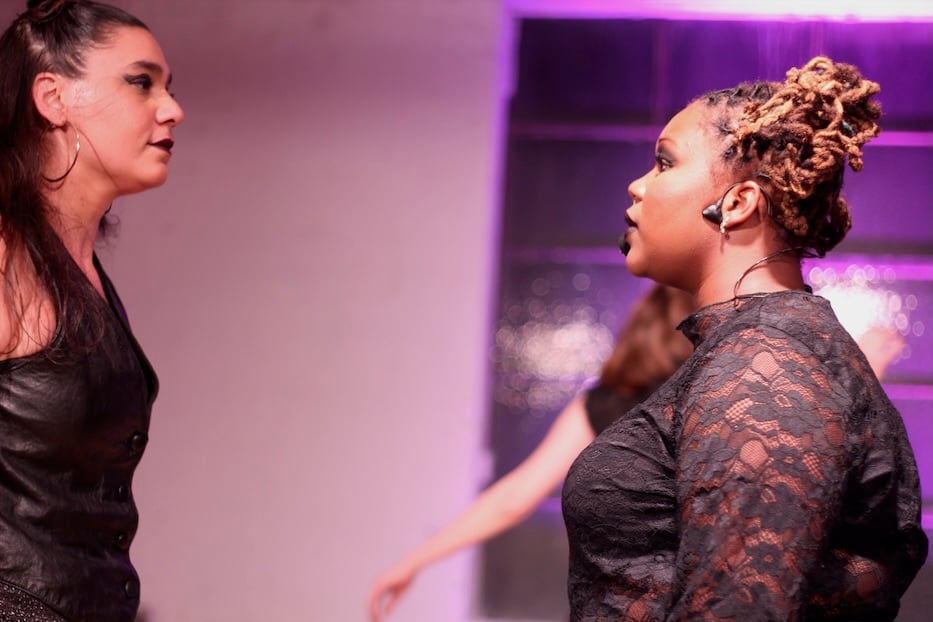
Isabella Serricella and Demiah Latreece.
It was a burst of sound and movement that rarely stopped for the next 30 minutes. In “How Do You Feel?,” which performers workshopped at NXTHVN at the beginning of this year, Echols’ voice started off as a lone thread, floating through the space with the occasional thrum and twang of the bass beneath it. As she offered up the words, the scrape and clack of shoes entered the fray, building until the floor was a container, sound pressing out to all of its edges.
As they moved through the song, artists let the lyrics wrap them in sound and meaning, until lines like “Got to find the time/To meet you halfway” and “Got to feel the comfort/In giving our hearts away” felt like meditation. On the wood floor, dancers spoke in a language of extended fingertips, windmilling arms, and feet moving so fast they were sometimes airborne. Orbiting their moving bodies, Echols and Harrison held it down, building out a methodical soundscape.
Rarely, if ever, did every member of the group stop moving. By “Life is So Strange,” guitarists and dancers were experimenting with layered timing and voices, so that the lyrics felt less like 90s rock and more like a Gregorian chant, unfixed in space and time. In “Story of an Hour,” they transformed into excited electrons, buzzing around each other with a bounce and ebullience normally reserved for a kid’s birthday at a trampoline park. By the time they finished, the audience was quiet for a beat before bursting into ecstatic applause.
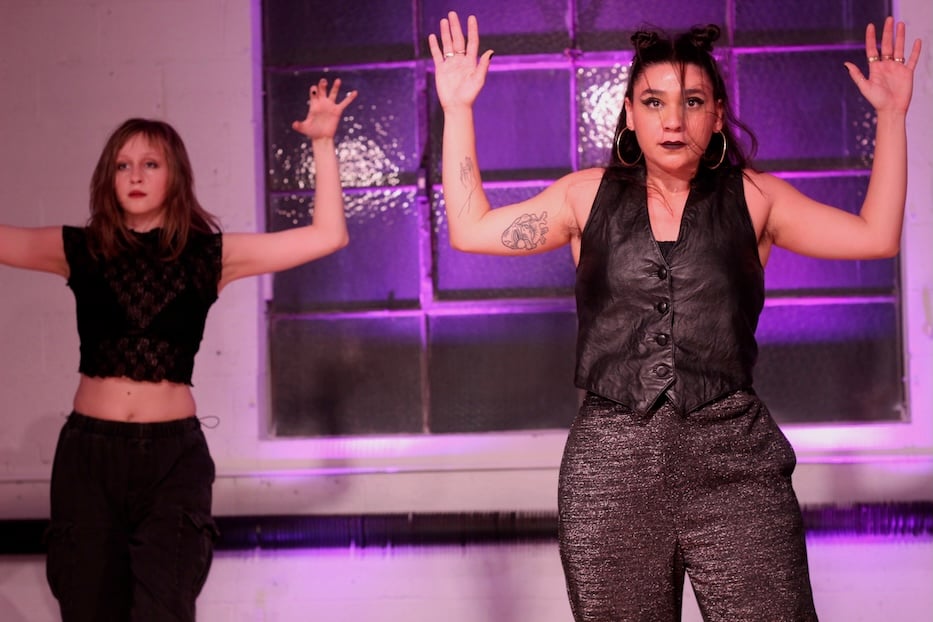
Megan Gessner and Isabella Serricella.
Throughout, performers made clear the magic of the work: they are all triple threats (and then some), willing to bend the boundaries of any one genre for something that is much more conceptually and sonically interesting. Tap may be the foundation (and what a foundation!), but here, it’s not the be all and end all—artists also fold in lyrical and contemporary movement, experiment with music, and aren’t afraid to break out of their respective art forms.
The result is an in-the-works opera that isn’t just about mercy, but also about community—how and why and when we gather, and how we take care of each other in the process—as an antidote to social isolation. Performers throw spaghetti at the wall to see if it sticks. They dip into different modalities of music and movement. They give themselves over to it too, breaking into smiles that seem giddy, almost childlike, at certain moments in the show.
At one point, for instance, Laet sauntered over to the cymbal, experimenting with its sound as she and other dancers donned silly sunglasses, and began to contort themselves à la a nineties rock band taking itself entirely too seriously. At another, Robbins did double percussion, dancing as she also beat together a pair of drumsticks that had somehow made their way into her hands. Another, and all four dancers shared the floor, tapping in time with each other until it was not just a conversation, but a steady heartbeat. It meant that an audience member could feel energy shift as each left the stage one by one, and Laet was left standing alone.
“It’s amazing,” Mark Robbins said before the performance, a sentiment he echoed afterwards as attendees sprang to their feet for a standing ovation, whistles and cheers filling the room.
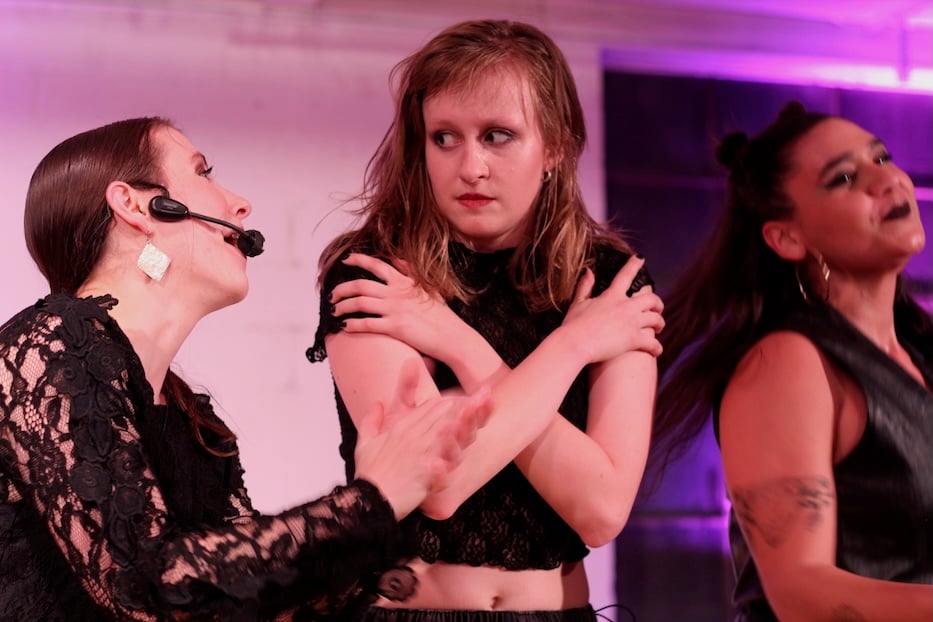
Alexis Robbins, Megan Gessner and Isabella Serricella.
It also gives the album a whole new afterlife. Twenty-six years ago, "Live In Vain" came together through Mercy Velvet's lyricist Deb Lili and her husband, guitarist Lou Lili. After the band had recorded the tracks, Deb’s cousin—who happened to be Grammy-winning producer Tony Maserati—mixed the CD in Brooklyn.
“And then it came out,” Mark Robbins remembered. For a brief while, the band prepared to play shows with the songs from “Live In Vain,” and “Alexis went to a lot of the rehearsals.” And then one day after rehearsal, the Lilis announced that they were getting a divorce. That was it. The CDs, which were never digitized, sat largely unattended in storage.
In that sense, this Mercy Velvet is both indebted to its source material and has created something completely of its own. The songs, once part of the elder Robbins’ sonic DNA, now live on in his daughter and her collaborators. In the process, artists have given a great gift to their audiences: a chance to reflect on the nature of mercy itself.
“It gives me life. It brings life. It gives life to others,” Echols said in brief, impromptu remarks after the performance. Ultimately, she said, the cast is asking “what does it mean to give and receive mercy? … That’s something we need now, more than ever.”