

Music | Arts & Culture | Yale University | Yale Schwarzman Center
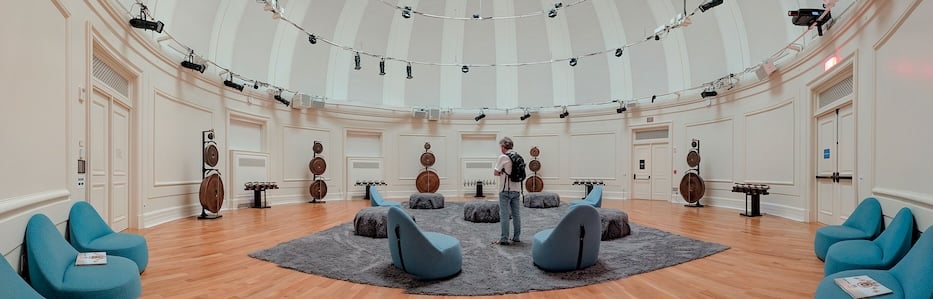
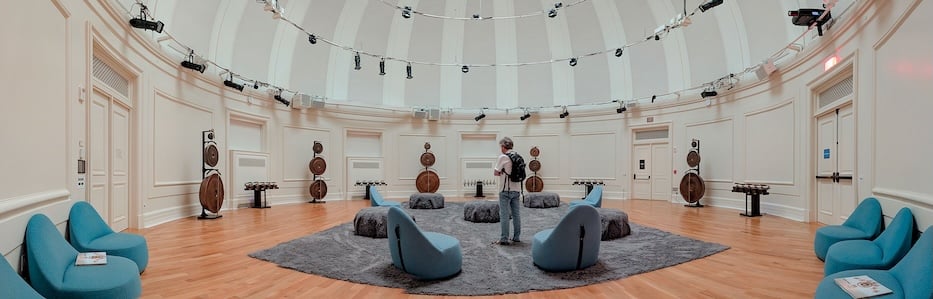
Gamelatron, Sonic Immersion installed in the Dome at the Yale Schwarzman Center. Aaron Taylor Kuffner Photos.
The Yale Schwarzman Center Dome is a unique architectural space—a theater-sized curved room with a massive domed ceiling and ornate circular skylight. Its current offering, which is on view through October 10, is Gamelatron, Sonic Immersion by Brooklyn artist Aaron Taylor Kuffner.
It is a new type of musical performance for the dome, where the soaring vaulted space is transformed into an environment awash with natural light and resonating with undulating, overlapping, and interjecting gong tones that play Kuffner’s site-specific composition.
But the artist isn’t there and it is not a recording, instead, the music is acoustic and is being played “live” in real time without him.
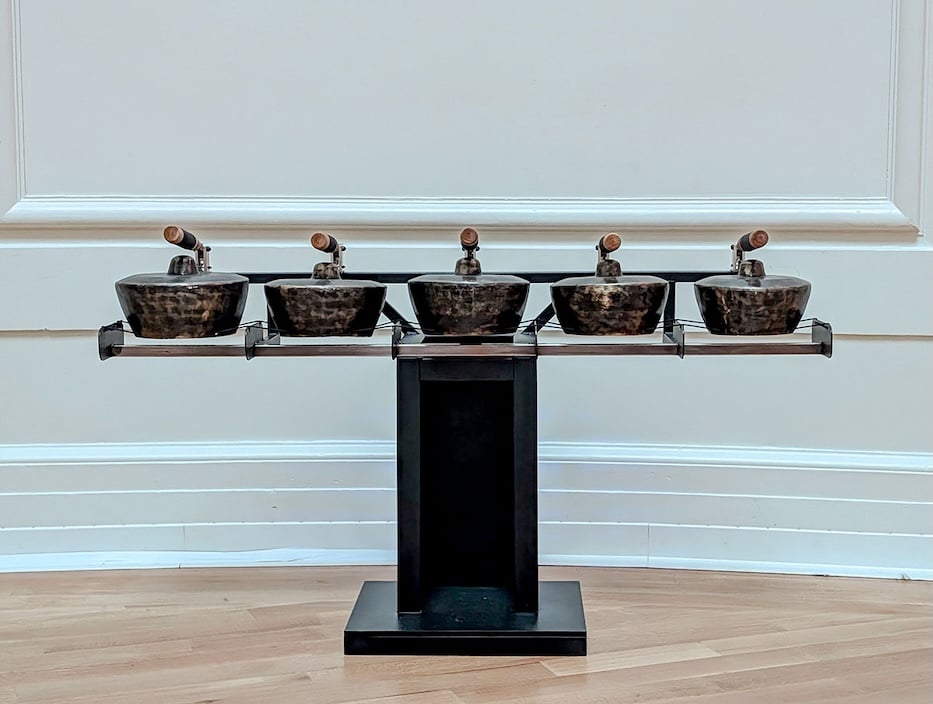
Various tones, ranging from light and cheerful to deep and undulating, radiate from instruments whose sculptural forms simultaneously conjure the contemporary and ancient. Gongs made of patinated bronze, steel, and brass, which are retrofitted by the artist with anodized aluminum, are the sonic elements. Teak wood electromagnetic mallet mechanisms are then connected to a physical Java-based computing system on powder-coated steel and bronze mounting sculptures.
Kuffner succinctly summarizes how this works in a written statement about the piece: “Through a physical computing system, electromagnetic mallets strike the instruments with precision, transforming 10 freestanding sculptural ‘towers’ and ‘racks’ into a living, breathing mechanical orchestra.”
After Kuffner finishes creating the musical compositions using the computing system, those commands are saved and are then used to guide the mallets in playing the song, “A Java- based application stores the songs and calibrations. I can make the mallets hit the gongs harder or softer and also hold for longer or shorter times. So I calibrate all the gongs to give them their settings, sort of their minimum strike and maximum strike.”
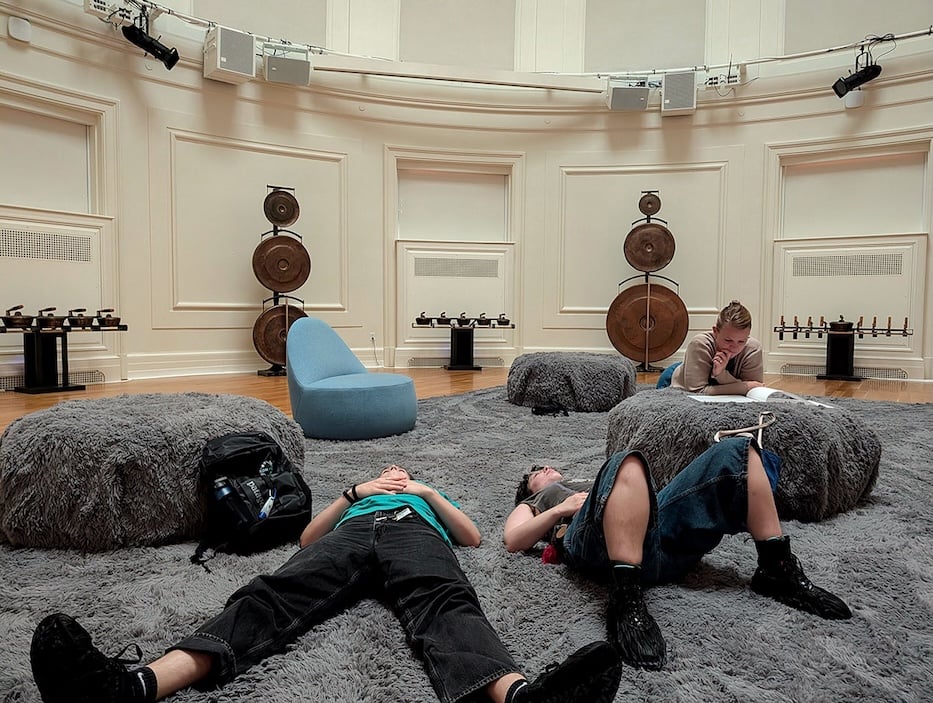
Gamelatron, Sonic Immersion installed in the Dome at the Yale Schwarzman Center. Aaron Taylor Kuffner Photos.
Visually, visitors are surrounded by these resonant sculptures, which hug the curved walls of the dome. Smaller gongs that resemble pots are mounted horizontally in groups (“racks”) of five and these grouped gongs alternate along the walls with larger-than-life vertical towers made of three disk-shaped gongs, descending in size from bottom to top.
Gongs tune themselves based on their shape. This means Kuffner hammers each gong to set its tone, a skill he learned in Indonesia. Emily Sause elaborates on this in her 2018 article “The Ghostly Gongs of Gamelatron: An Interview with Aaron Taylor Kuffner:”
On a journey with no clear objective, he explored the beaches and jungles before finding resonance among artisans known for hand-pounding the instruments of gamelan, a musical ensemble of primarily percussive instruments, and an emblem of Indonesian tradition,” adding, “After years working with the craftsmen to learn their trade and absorb their knowledge, he returned to the US deeply impacted by this work, and with a newfound skill. He linked up with Eric Singer to build the first version of the Gamelatron.
In Gamelatron, Sonic Immersion, this Indonesian tradition intertwines with conceptual contemporary art practices and technical ingenuity to create an acoustic performance absent the performer. Arguably, the artist’s absence is a material (or medium) he uses to facilitate an unmediated connection between the visitor and the “visceral power” of vibrating gongs. Essentially, his absence creates space for people to be more present.
“With this piece, I am very intentionally not here because I don’t want anyone to have to go through me in order to encounter resonance,” he said in an interview for this article. “The artwork is far more impeccable than I am. This gives the piece an opportunity to commune directly, and I think it gives each person more agency to utilize the energy they are receiving in the way that is best for them in that moment.”
Importantly, these resonant sound elements are acoustically playing compositions that Kuffner wrote and performed in the Dome without an audience on August 26 of this year. Since Kuffner is new to Yale, he relied on Jennifer Harrison Newman, the space’s associate artistic director, and staff to learn more about how the space is used and who uses it.
For the artist, that input is a conceptual touchstone for this installation’s site-specific qualities: “For me it’s important that the artwork I make is like an offering, I’m relying on Jennifer and staff to inform me about this community.”
Kuffner’s offering is communal and aims to create a sanctuary space. “What matters is that you have a way to commune with the divine, with the thing that’s beyond yourself, a wholeness … So being in this space, I walk in: the acoustics of it, the arch, the drama of it, the domed shape. This architecture, this situation is communing with the divine.”
“I want this room to be part of the instrument,” he added. “Domes have a sonic character … I see that as being a special ingredient you want to lean into.” Rather than using artificial lighting, the artist also leaned into the changing natural light of the skylight so the installation “feels spacious and gentle and encourages a part of you that is at rest and is also curious about the beyond.”
The word “resonance” is key in describing Gamelatron, Sonic Immersion not only because it is a word the artist uses, but because it best describes the embodied way one experiences this work. Resonance—defined as the result of a vibration, a quality of evoking response, a state of being—is something this installation can produce in a way that recorded music cannot. It also may be valuable to briefly contrast resonance with ambience, which is defined as existing or present on all sides.
In a digital age and with AI nipping at our collective heels, one could argue that there is a glut of ambience and scant resonance in our daily lives. At the heart of Sonic Immersion is the body, the real world, and acoustic sound’s ability to connect the two. A phenomenon that can only be truly experienced in person and is best experienced in community with others.
That Kuffner sees his installations as community offerings is a resonant gesture, one that has the power to shift an individual’s focus from a private screen or earbud cocoon to a shared, embodied sound environment. Gamelatron, Sonic Immersion is an offering with the Yale students, faculty, and staff as well as the broader New Haven community in mind. For the students, a second piece—Kuffner’s Gamelatron Auric Obsidian, 2026—will be at the Good Life Center, Yale’s student well-being center, creating resonance for them through spring 2027.
Since the Schwarzman Center building is only open to people matriculating or working at Yale, staff are working to include greater New Haven through programming such as yoga and meditation led by community practitioners; and they have made Sonic Immersion open and free to the public on Saturdays from noon to 4:00 pm through October 10.
To learn more about community events, visit the Schwarzman Center’s website here. Please note that any unattributed quotes are from an on-site conversation between the author, Terri C. Smith, and artist Aaron Kuffner.