

Culture & Community | Arts & Culture | Theater | Yale Summer Cabaret | Youth Arts Journalism Initiative
Allyse Corbin and Nate Britton Photos, courtesy of Yale Summer Cabaret.
“Holiness” reads a screen on the stage in bold white font. Before it are three women in draped cloth and ivy. “Holiness” they repeat, unsynchronized. They yearn and pray and reach for their god, Dionysus. They are the followers, the maenads, the Bacchae.
This is what audiences saw on opening night of Bacchae [or, Present Madness] at the Yale Summer Cabaret this past Thursday, as the season opened with a show that is unapologetically alive and invites the audience into its ecstatic chaos. Performances, which run at 217 Park St. through Saturday, leaves the audience with a newfound sense of wonder. Tickets and more information are available here.
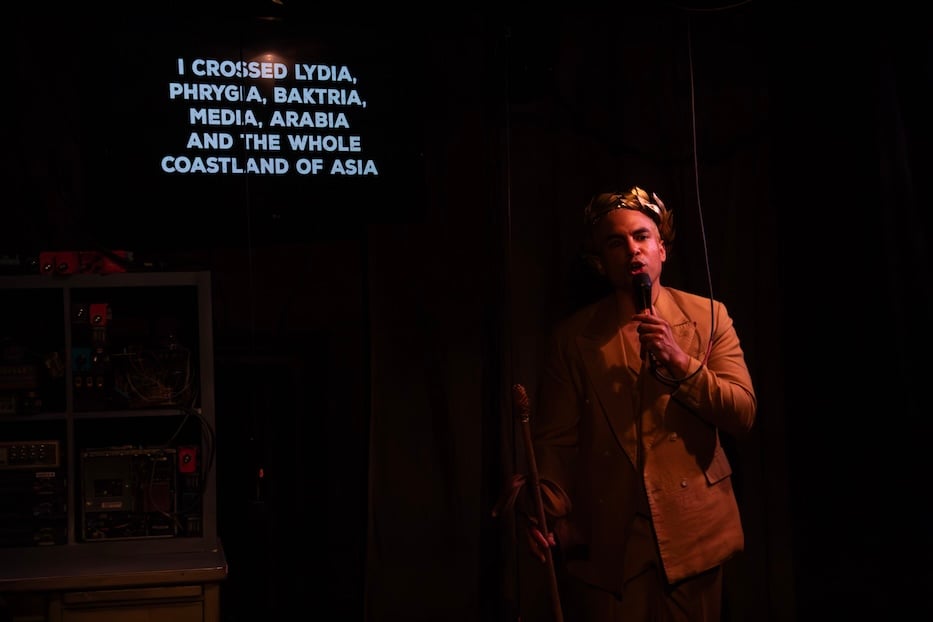
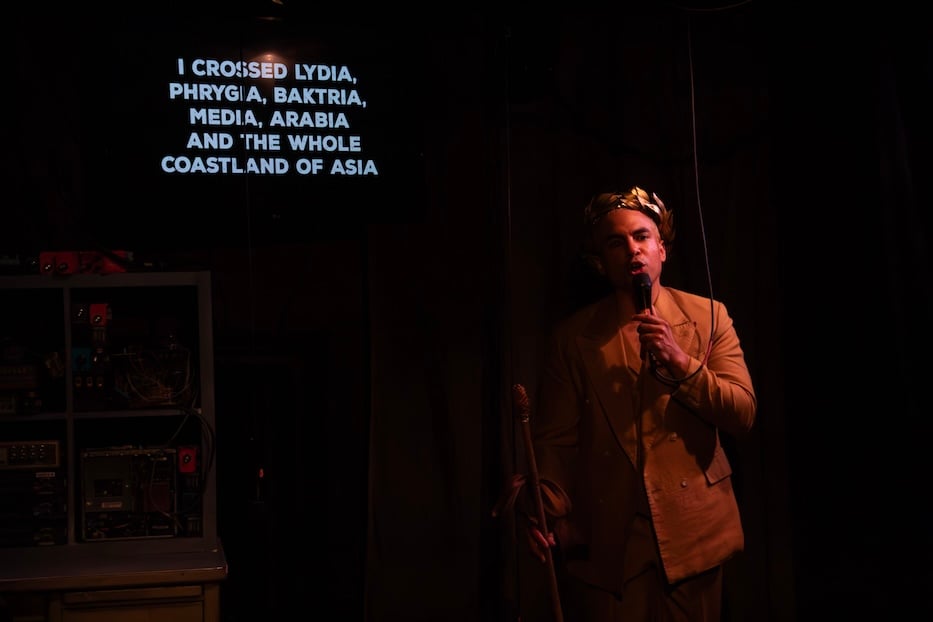
The Yale Summer Cabaret is a student-run theatrical company within the David Geffen School of Drama at Yale University, with a mission of experimentation, diversity, and inclusion through theater and the dramatic arts. This summer’s season is called “Spectra,” and its mission is to introduce more accessibility to theatrical art. Thursday’s performance, for instance, came equipped with monitors on either side of the set, displaying captions of the dialogue to make the art more accessible.
The Summer Cabaret team includes Co-Artistic Directors Alex Vásquez Dheming, Nate Britton, and Bobby Marcus, Producing Director Quinn Felisa O’Connor, and Managing Director Raekwon Fuller.
“The tagline is ‘art and access intertwine,’” said O’Connor in an interview Thursday. “I’m a disabled theater maker, and it has always been a really big part of my practice to try and investigate how accessibility can actually be an artistic asset rather than something that’s a legal obligation that companies or productions are ‘forced’ to provide.”
While “The Bacchae” is an ancient story (and one that has lived at Yale before, in other dramatic forms), the madness within it is still present today. Created and directed by Timothy Hartel, this version is heavy on the commingling of art forms, creating a container in which dance and theater collide to deliver a refreshing rendition of Euripides’s tragedy.
Allyse Corbin and Nate Britton Photos, courtesy of Yale Summer Cabaret.
The play begins as Dionysus (John Maria Gutierrez), god of sex, wine, theater, and rebirth, returns to Thebes, the hometown of his mortal mother, Semele. He comes to wreak havoc, offended that his aunts, Agave (Emma Steiner), Ino (Oliver Parsons), and Autonöe (Kristen St Louis), deny that their nephew is the son of Zeus, and claim his followers to be foolish. In retaliation, Dionysus possesses all of the Theban women, and lures them to Kithairon, a mountain where these women, the Bacchae, perform rituals for Dionysus.
The king of Thebes, Agave’s son Pentheus (Jack Kelley), is outraged by all of this dionysian worship, and wages war on this god, who is also his cousin. Their grandfather Cadmus (a winning Ameya Narkar), is not a devout worshipper of Dionysus, but is open minded and not opposed to adopting this worship when urged by the elderly prophet Tiresias (Narkar). As these characters beg, pray, and kill, no obvious villain emerges above them all. They are all flawed characters, but their actors and dancers bring them to life with expertise and technique.
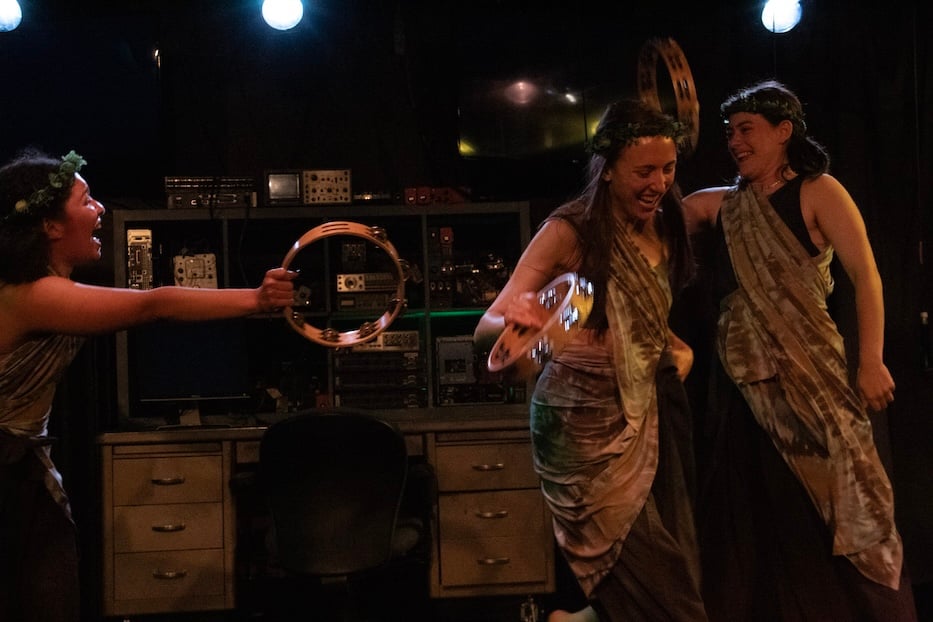
On opening night, Parsons, St Louis, and Steiner shone as the Bacchae, or “maenads,” entranced followers of Dionysis. In their ivy crowns and draped fabric dresses, they prayed, danced, chanted, and shook tambourines in the name of Dionysus. One could see the pure focus in their eyes, the yearning in their voices, and the panic that ensued once they broke out from their god’s spell.
As the Greek god of theater himself, meanwhile, Gutierrez made a refreshing Dionysus. With diction, agility, and wit, they moved with control, demanding the attention of the audience and the bacchae. Their voice is like their character, passionate and authoritative, something supernatural.
Narkar, a third year actor at the School of Drama whose recent credits include Lysander in Elm Shakespeare Company’s 2025 production of A Midsummer Night’s Dream, brought a wisdom to both Tiresias and Cadmus, a performance that ranged from comical to urgent, depending on the character and the scene. He effectively conveyed the relationships that his characters have to each other—and to the other characters onstage—making a double cast that could have been confusing, quite entertaining.
As Cadmus, he especially had stage chemistry with Kelley, who delivered an impressively nuanced Pentheus. The audience could see past the young king's anger and arrogance in time to see insecurity and a yearning for control and the love of his mother.
And what is a cast, meanwhile, without its crew? Scenic designer Britton, who is also a co-artistic-director for the season, is a second-year MFA candidate in projection design at the school. As the show’s scenic designer, Britton was tasked with designing the set of the production.
The finished product was an office desk and chair, piled with a tangled heap of wires and outdated technology, with three microphones hanging from wires on the ceiling, for actors to speak into. Britton said the drapery of the wires was meant to add “a touch of Greek scenery,” as this is still very closely aligned to the original myth of Dionysus and the Bacchae.
“Wires are something that I got really interested in and the way that a wire can represent a vein, and the way a nest of technology can resemble a body or organs, and I really wanted to paint with that idea,” said Britton.
Taken together and in its composite parts, Bacchae [or, Present Madness] brought new perspective to Park Street, as it leads its audience to question whether it is (read: we are) blindly devoted to anything the way the Bacchae are to Dionysus. The brainwashed, possessed nature of these women resembles all of us as humans, in our desperate attempts to find solace in such a chaotic world. The result is a play that may be soaked in history, but also feels like it is right for right now.
“Given our current state of things all over the world, I think there is this question of wrath, of anger, of ‘What do we worship? What do we pray to? What do we need to do when we’re at our wits end?’” said Gutierrez, who plays Dionysus in the show. “I think that’s something that I am considering within my dionysian situation.”
Olivia Tapia Ko is a graduate of the Arts Council's Youth Arts Journalism Initiative and a rising junior at New Haven Academy.