

Co-Op High School | Creative Writing | Culture & Community | Education & Youth | Arts & Culture | New Haven Public Schools
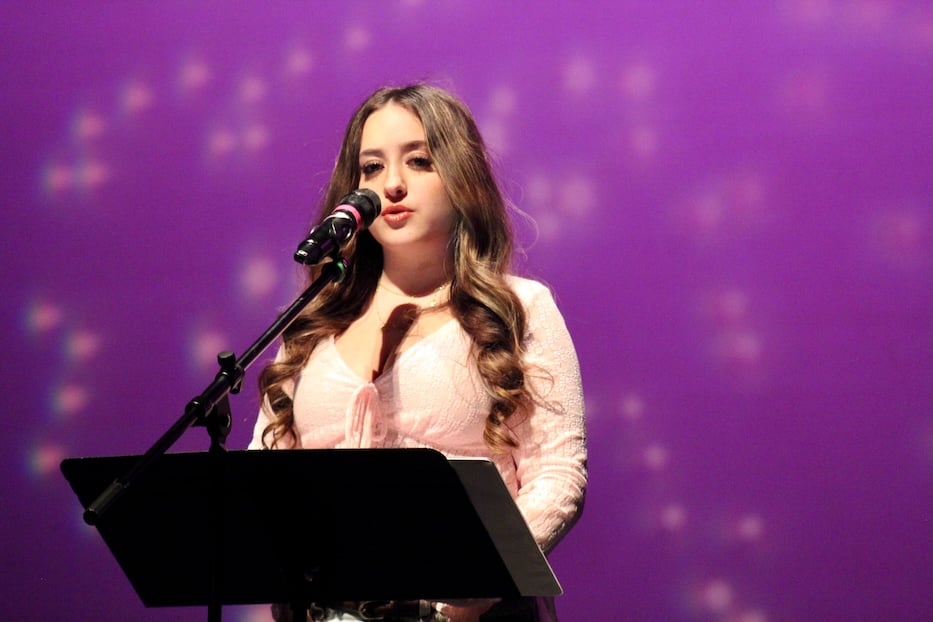
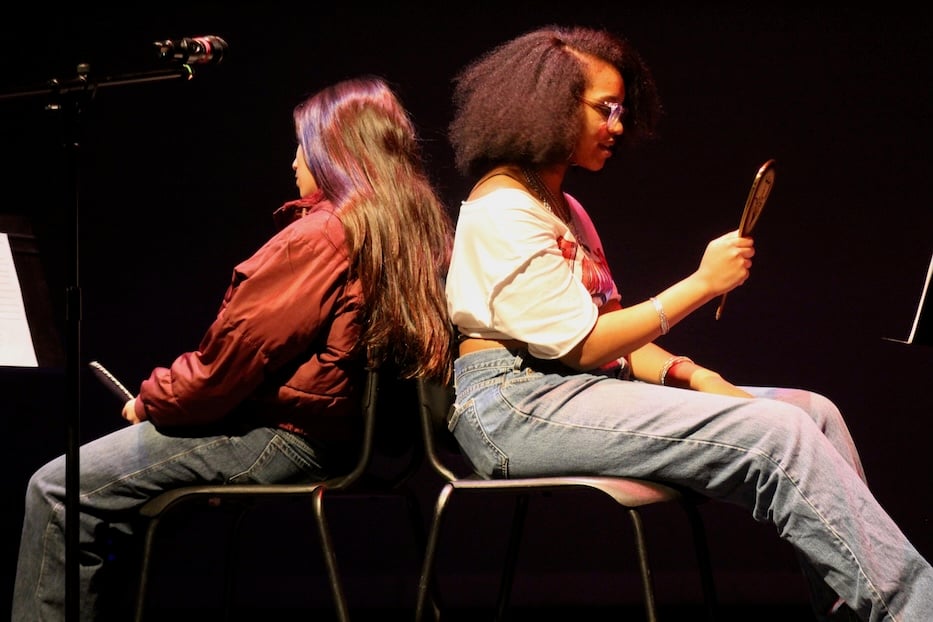
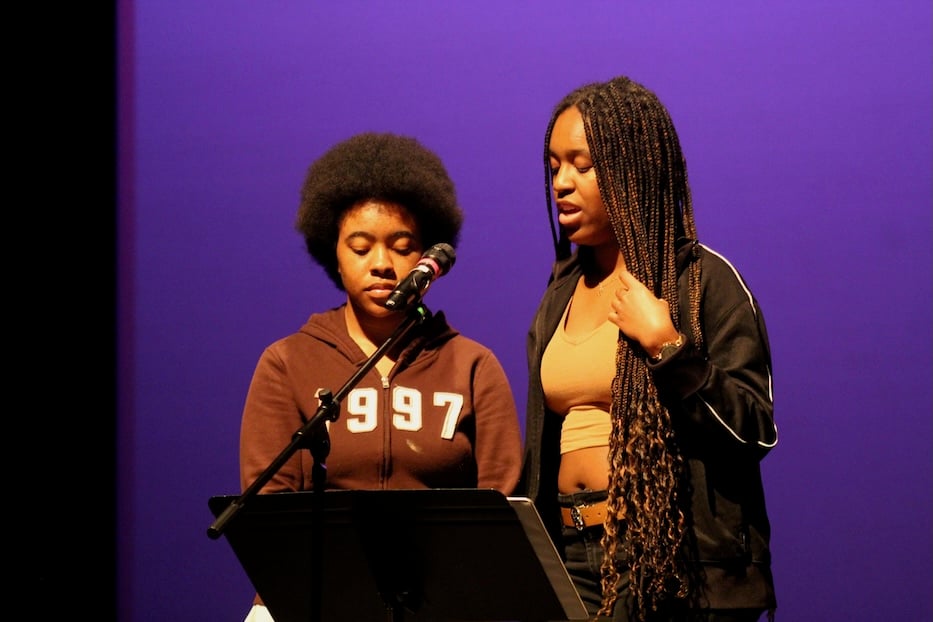
Top: Writer Cayla Stanton, who is also the vice president of the school's chapter of the National Honors Society. Bottom: Haelynne Diaz and Jayla Bosley, theater students who brought "Point Of View" to life. Lucy Gellman Photos.
Cayla Stanton conjured a lush springtime in New Haven, letting Persephone be her guide. Mikayla Holley looked back to the story of Icarus, and rethought everything she knew about flying too close to the sun. A’myah Murphy realized that she could tether the Medusa story to her own life, with tight lyricism that conjured the woman with a crown full of snakes. Sumia Faizi took a beat, then soared from Achilles to Hector to Heracles while never leaving College Street.
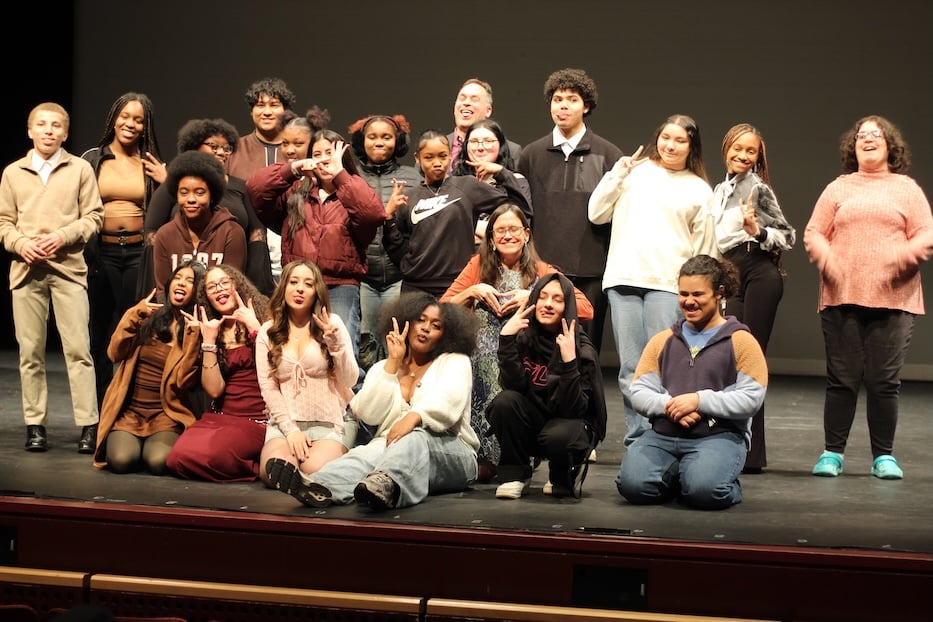
All of them are creative writers at Cooperative Arts & Humanities High School, where students and teachers are working together to reimagine performance for the quietest art in the building. Many have also looked to mythology to make sense of the world around them, where a shifting tech landscape can make human connection feel precious and precarious all at once. Last week, that was front and center in “Creative Writing’s Divine Dialogue,” an hour-long showcase at the school’s 177 College St. home.
“We’re trying to make a name for ourselves in creative writing,” said Stanton, who organized the event with Holley and teachers Catherine Yates, Benjamin Nelkin, Trenity Webber and Janie “Ms. A” Alexander. “It’s been really hard to build audiences back up since Covid. We’ve been doing a lot to redeem our art.”
“People love to love writers, but they don’t always celebrate them,” Yates said. A showcase like this, meant to fête and amplify student voices at a time when they are often muted or ignored, flips that script.
Part of that is building performances around a theme and inviting peers from other arts disciplines in, which doesn’t often happen at the school. This year, Holley and Stanton—who also lead Co-Op’s chapter of the National Honors Society—asked their peers to submit ideas that the two could build a showcase around.
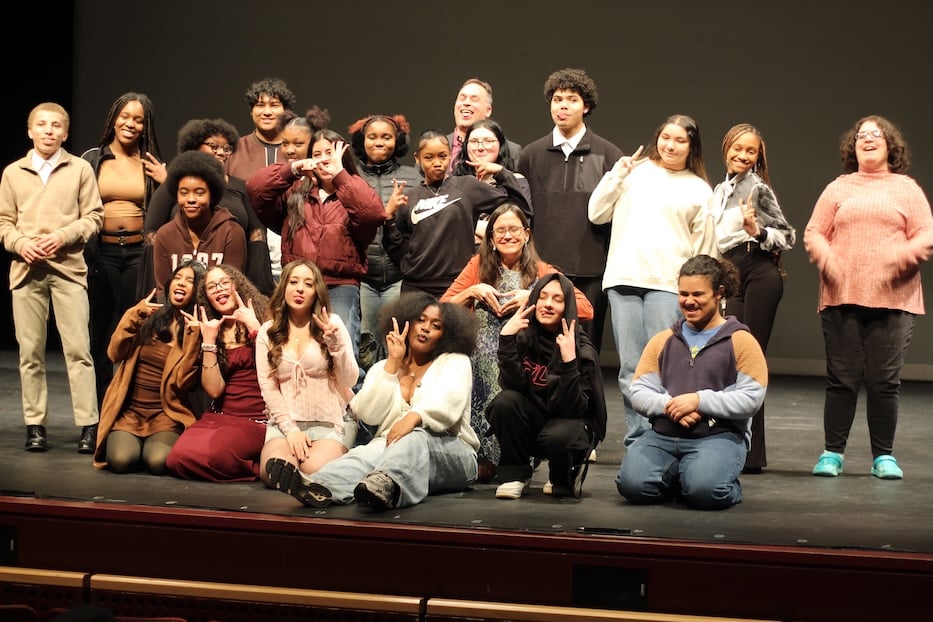
Neither was especially surprised that mythology won out, Stanton said: these students are part of a generation that grew up with Rick Riordan’s Percy Jackson books, a series that made centuries-old tales feel new and thrilling for young readers.
It also builds on a moving history of readings for the department, which for years presented a showcase based on the student publication Metamorphosis (the next issue drops in the spring). A year or so ago, creative writing students proposed folding in other arts disciplines, working closely with the theater department for lighting and sound. They added costumes for skits like “The Golden Apple Show” that transformed College Street into the Garden of Hesperides for just a few minutes. For classmates who felt shy presenting work, theater students like Jayla Bosley and Haelynne Diaz also stepped up to read.
“Our art is the only art, other than visual arts, where we’re really performing our own work,” Holley said. So to change up the format and all some razzle-dazzle felt right on time.
As students took the stage, all of those new elements worked, creating whole worlds (and teachings) around short fiction, poetry, monologue and dialogue. As Faizi, just a freshman, leaned into the mic, she conjured a universe of interiority within her ribcage, collapsing the imagery of a room in a home onto the language of a human body. If a listener closed their eyes, they could see it, moving up and down with the tempo of uneven, tentative breath.
My ribs aren’t warriors / They break easily
The keys of my ribs are lost / My heart is free for everyone to steal
The keys are lost / The keys / Are lost
Panic makes its way through / Easily creeping in to choke my heart
Onstage, Faizi read with a calm, even cadence, the weight of her words measured as they pushed past the mic, and into the audience. In the world of the poem, war was raging inside her body, Her heart was choking, deprived of the sustenance it so needed. She struggled to contend with this war-ready visitor at the doorway to her heart, trying to be let in.
And then, she noticed that someone else was there, in the room with her. Her tone shifted. The anguish dissolved from her voice. She looked out at the audience for just a moment, then back down to something closer to the mic. In the auditorium, a listener could have heard a pin drop.
Wait! Why am I telling you all of this?
You came in, didn’t you?
The latest installment of "Myth-ly Cults," from writers Reann Toussaint and Jaiden Rogers. Both are juniors at the school.
That was true again in Reann Toussaint and Jaiden Rogers’ “Myth-ly Cults,” as the two built a whole, fictionalized world inside the small space and time of a rest stop somewhere in Southern California. In the story, partners Clementine and Max are on a road trip, when they swing through the town where Clementine grew up. As the two students jumped between narrative and dialogue, conjuring an encounter with an old flame, they had members of the audience on the edge of their seats.
“You told him I was your friend?!” the character Max seethed, and it felt like the two could have been right there on the stage. “We’ve been dating for what, like six years now?!”
“Listen, I’ve been avoiding talking about my family because they just aren’t great to talk about,” Clementine replied, and it was instantly relatable.
After the performance, Yates noted that the two are an example of how young writers, given the space to do so, can flourish and also help create community: they’ve been reading installments from the same story for three years now, creating a plot that their readers (or during the reading, listeners) are genuinely invested in at this point.
And indeed throughout, students cheered each other on with a pep and enthusiasm that put the Harvard-Yale game to shame. When Julian Gasca walked on for his poem “I Just Want To Sleep,” theater teacher Sumiah Gay burst into preemptive applause, with a laughter-laced shout of “Me too!” Students, taking her lead, followed until the room was filled with clapping.
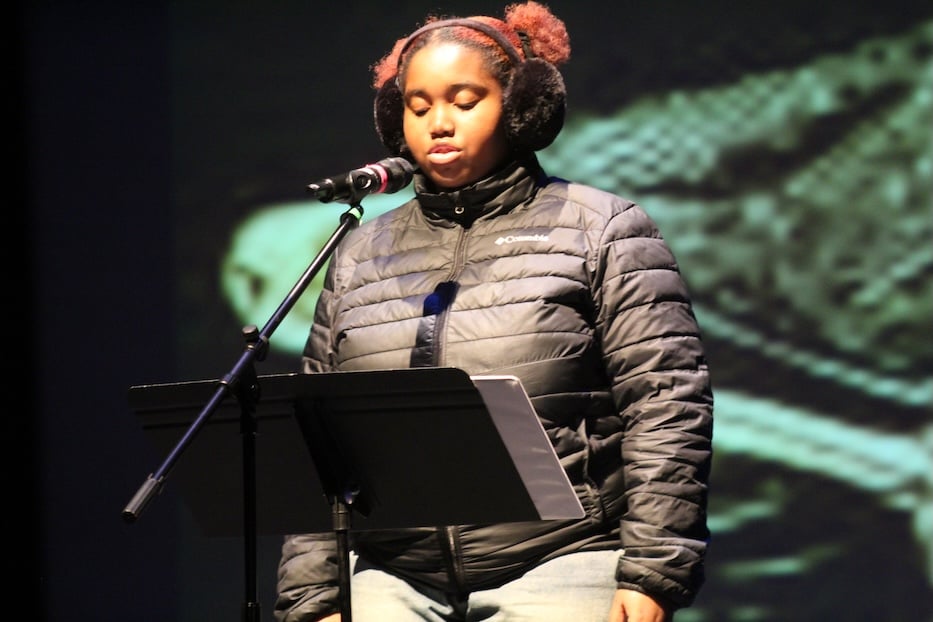
When junior A’niyah Smith reimagined the dybbuk—an evil and predatory spirit that has its roots in old-world Jewish folklore—in “Speak for Me,” students gave low murmurs of agreement to turns of phrase like “they pierce my tongue with needles of uncertainty” and “stalking my blood like an ocean of sharks.”
By the time Diaz and Bosley had come on as high school students, sitting back-to-back for Stanton’s “Point Of View,” the cheers were wear-splitting and wondrous all at once. The skit, which places two monologues beside each other to show the harm of negative self-talk, became a cautionary tale in an audience full of students who may pick apart their appearance or behavior on a daily basis.
As senior Samuel Franco closed it out with “Yama-Uba’s Fury,” looking not to Greek mythology but to Japanese folk tales, an exuberant shout of “I know him!” went up from the front row, where Max Hoffman sat with a group of choir students. Franco, interested in shifting narratives, told the story not from the third person, but the first, putting himself in the shoes of an old, rapaciously hungry Japanese forest witch.
The emcees, too, emerged from their roles as organizers to read, pulling the audience in with their ability to spin myth and metaphor into mid-afternoon magic. Holley, who hopes to attend Howard University in the fall, explored the myth of Icarus and Daedalus, asking herself what it meant to take a risk in her poem “The Fall.”
In the myth, Icarus’ giddy risk-taking is reckless, and marks the premature end of his life, as he flies too close to the sun, and the wax wings that have carried him to freedom melt in the heat. Back in New Haven, Holley thought about risk-taking in terms of her college applications, in which she was elbow-deep as she and Stanton planned the showcase.
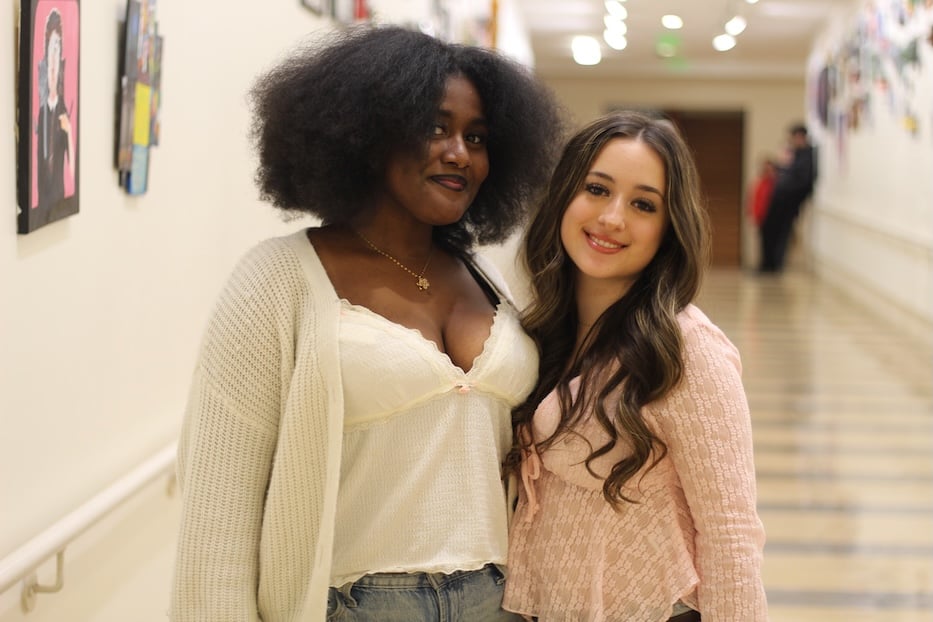
Mikayla Holley and Cayla Stanton.
“I sat there and I tried to think of my favorite myths,” and Icarus came to her again and again. So did her dream school. “Do I want to take this risk?” Unlike Icarus, whose decision to take a chance spells out his premature death, she knew that the worst outcome could be not getting in (as far as this reporter is concerned, she’s already a future Bison).
Stanton, meanwhile, thought about Demeter and her daughter, Persephone, to whom she was introduced last year when Hadestown came to the Shubert Theatre. The play made her fall in love with mythology all over again. As it stayed with her—she’s a fan of the show—it also made her think about grief and loss in her own life, including with the passing of her mother, Michelle Stanton, and grandfather, Anthony Andreoli, last year.
In her work, suspended somewhere between prose, poetry, and critical essay, Stanton retold the story of Persephone and Hades, a star-flecked purple backdrop glittering behind her. Reading with a sense of total calm, she focused not on their grudging and complicated love, but on Demeter’s thick, palpable grief, so heavy that Zeus sent a messenger to the underworld.
She moved through Persephone’s emergence back above ground, surprising the audience as she pivoted to herself. “Her innocence once lived in me, too,” she said, and suddenly the work took on whole new dimensions. “Frolicking through high school, foolishly believing the fate I feared was distant, in the future.”
She remembered the pain of losing her mother, and then her grandfather, in a single season. Stanton didn’t have the luck of the Greek gods: there was no negotiator she could send to the underworld to bring her mother back. And yet, having the myth in her back pocket somehow sustained her, she said. It still does, because she knows that the loss baked into it is as old as time itself. Or in her words, “I face an eternal winter,” but “I’m not angry or bitter, just grateful.”
“I wanted to connect my piece to something in my personal life,” she said in an interview after the performance. When she envisioned Demeter, “I was thinking about my journey. I wanted to talk about why we share these myths, these stories. They teach us. My grief taught me to appreciate what I have in the moment.”
A series of Winterfest performances at Cooperative Arts & Humanities High School continues Tuesday, Dec. 9 at 6:30 p.m., with band and strings.