

Culture & Community | Education & Youth | Educational Center for the Arts | Arts & Culture | Theater
 studioDUDA Photo.
Vashti and Sumayyah stand face-to-face, a new silence heavy between them. Vashti, at once emboldened and guarded, looks around. Something in her eyes is still so soft. Sumayyah is suddenly not so sure of anything: a current of fear runs through her body. Her spine straightens. Around them, a city is falling into chaos, and their friendship feels like collateral.
“This is how it starts. You know that,” Sumayyah says. The year is 1933, and the Reichstag is burning. It is 1994, and Juvenal Habyarimana’s plane has just gone down over Kigali, the air crackling. It is 2000, and the Taliban controls 90 percent of Afghanistan as it hangs on to power by its fingernails. It is 2026—in Minab, in Caracas, in Minneapolis, in the West Bank—and the blood is on too many hands to count.
So unfolds Aviva Robbins and Monroe Rioux’ deeply affecting And It Changed Nothing, the hour-long culmination of an independent study at ACES Educational Center for the Arts (ECA) that ran Monday night, for one performance only, at the school’s Little Theater at 1 Lincoln St. Set in a dystopian universe that feels stunningly close to the Middle East, the work explores the extreme and indiscriminate violence that unfolds when people no longer see each other as human. Which is to say, it’s also set in our world, at all its raw and throbbing places.
The two students, both seniors and future roommates at Sarah Lawrence College, worked with Elise Morrison, assistant professor of performance studies at Yale, to make the project happen. Fellow senior Rowan Simonelli stepped in as co-director and producer. For both Robbins and Rioux—one Jewish, one Catholic and Syrian—it’s a deep dive into world history, and a history of violence that keeps repeating itself, that is years in the making.
“This is some of the hardest stuff in the human experience,” said Morrison before the show.
And it is. In December, Robbins and Rioux started meeting with Morrison to talk about the independent study, interested in finding a way to weave their own lived experiences into a broader meditation on a soul-achingly-hard state of global affairs. Robbins, whose grandmother fled Nazi Europe for what was then recognized as British Mandate Palestine, was grappling with the long, layered, and often painful history of Zionism. Rioux, who is Syrian and also learned she has ancestry in Rafah, didn’t know what to do with the totality of her history.
Morrison, who supervises senior theater capstones at Yale, had the two start doing research, with the goal of building a bibliography that could become a script and full performance. They poured themselves into it, from detailed histories and timelines of the Holocaust and Rwandan Genocide to the rise and fall and rise of the Taliban, the Syrian Civil War, and Israeli military occupation and ongoing genocide in Gaza.
They read about the geopolitical history of the 20th century, as well as literary works like Margaret Atwood’s The Handmaid’s Tale and Sanaz Toossi’s Wish You Were Here, which ran at the Yale Repertory Theatre in 2023 (Sivan Battat, an ECA grad who directed the show, spoke at ECA about the performance in 2023).
“At the beginning of the process, we thought of our friendship and our backgrounds … and decided that delving into the nuances of our upbringings and our cultures could be a gateway towards delivering the story you are seeing tonight,” they write in a joint program note.
They couldn’t have known that less than a month into starting research, poet and mother Renee Nicole Good would be killed by masked secret police who shot her on the ice-crusted streets of a residential neighborhood. Or that Sudan’s Civil War, which has displaced millions of people, would reach a three-year milestone as they were writing their first drafts. Or that three days before the performance, Israeli forces in the West Bank would shoot Sam Fahd Abu Haikal in his parents’ car, killing him and injuring his mother before his eight-month birthday.
That’s the point of these conversations, right?
The play folds in all of that, with language that somehow doesn’t feel too heavy-handed or cumbersome, because it never strays too far from the humans at its core. Set against a minimal backdrop, And It Changed Nothing follows Vashti (Robbins) and Sumayyah (Rioux), best friends who are coming of age in the fictionalized city of Shanah, a word that can mean both “to change” and “to repeat” in Hebrew.
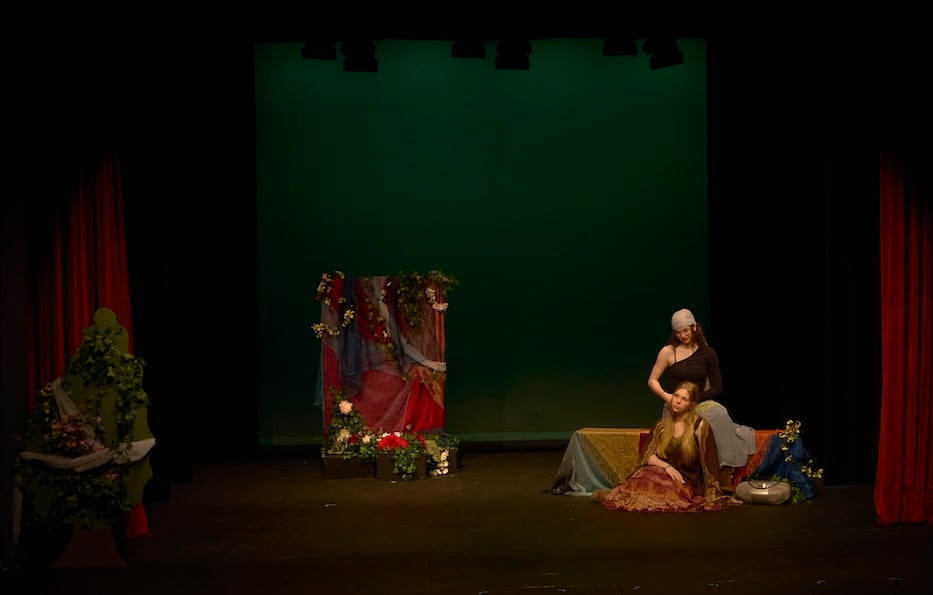
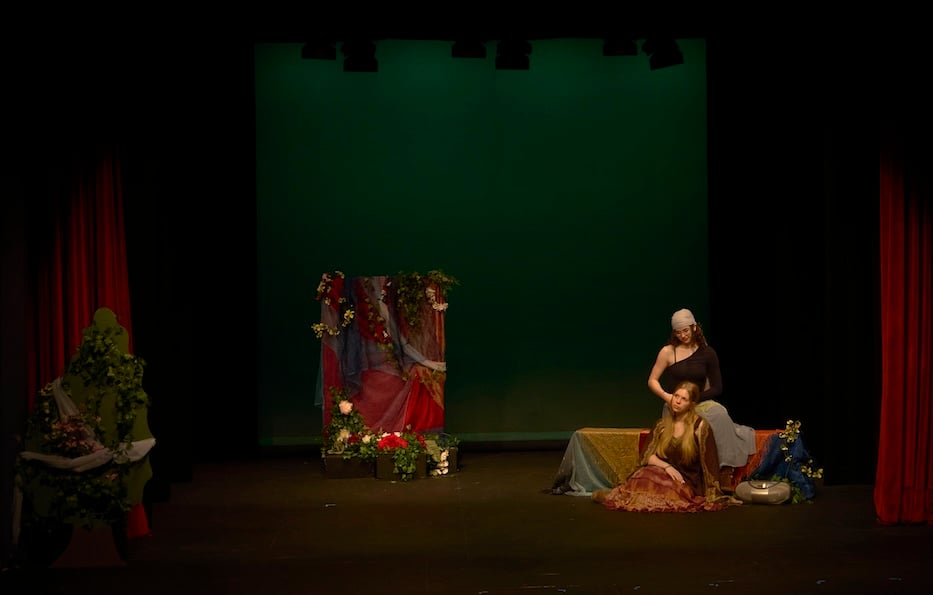
The religions here may be different, but they’re easy enough to catch on to. Vashti, whose family becomes a character in the play, is Hezro, meaning she worships the sun. Sumayyah, who covers her head with a blue scarf, is Inbu, a religion that moves in time and cadence with the moon and the water. Around them, there’s enough of a set to create a tight universe: bright fabric flowers climb up a trellis and spring from a raised bed below; a fabric-covered bench becomes a couch; a radio sits nearby, silent until it’s not.
It’s here, in this quiet and fragrant space, that the two spend hours in each other’s company, secrets passed through half-finished sentences, bright smiles and a few sideways glances. They dance together, palms weaving in and out of each other, and understand that it’s a form of praying. They roll grape leaves and let culinary and religious histories pass between their fingers. They dream forward, with the sense that they will always be in each other’s lives.
But something is boiling over: there is a radical sect of Hezro people known as the Shamsiyah (embodied in a terrifying Ben Curns, who appears only in voiceover), who want to annihilate the Inbu, because they have ostensibly always had too much power. In the audience, we don’t know the year, and we don’t have to: history has already written the playbook for how this is going to go. It’s bitterly timeless.
In a series of radio broadcasts and conversations between friends, the writing lays bare the roadmap to extremism and genocide: Curns growls his way through updates, his voice edged with static, spitting sentences like “Change can be daunting, but it is necessary” and “the Inbu are not who you think they are.” Something in his tone is hard and feral, like a shark circling for blood.
“They are moon roaches,” he says, and it is 1994 all over again, the Tutsi people terrified as Hutu militia refer to them as inyenzi, or cockroaches. Or it is 1932, and the Nazi party has just won over 33 percent of the vote in Germany, despite referring to Jews, Socialists, and gay people as rats. They will build and open Dachau less than a year later. It is 2017, and Myanmar is referring to its Rohingya minority as “Muslim dogs” as families flee their homes, fearing death.
“We are watching,” Curns-as-Shamsiyah says, reading off an ever-growing list of supposed enemies that have names that are both Hebrew and Arabic, a device that shows how porous language, religion, and tradition all are. His voice is an extension of the surveillance state. Vashti and Sumayyah are simply caught in the crosshairs.
What is brilliant, and a testament to the work that these young actors have done to learn their history, is a blurring of conflicts, ideologies and historical villains, until they exist outside of time, or maybe as a painful and constant thrumming within it. In an early scene, for instance, Vashti mentions an Inbu attack from which she is reeling, and we in the audience can see that her fear—which will drive her to do horrible things—is so very real, and equally relatable.
Surely, we too have been in these shoes, acting from a place of fear rather than one of faith. Surely, we too have turned our backs on those who are not so different at all, because we couldn’t hear them over our own thunderous opining.
In another, Vashti holds a tape recorder to her mouth, documenting her experience in “Solar Youth” (think of Bund Deutscher Mädel, not New Haven’s wonderful and recently-shuttered nonprofit). In the audience, a person can see and feel how quickly a fringe movement has transformed into a cultural phenomenon, with deadly consequences for so many. Her eyes gleam as she speaks: she’s learning dances, language, and cultural traditions that she never encountered before.
“My culture, my people, were made of milk and honey,” Sumayyah says just moments after Vashti has danced through an “initiation” ritual, pulling a pistol from her waistband as Simonelli, a long cloth draped over his head and body, kneels on the ground, about to be murdered. It’s the beginning of a lyrical dance, performed in monologues at opposite ends of the stage, that shows just how quickly a person can buckle beneath the weight of a history that keeps repeating itself.
Close your eyes for even a moment, and there are dozens of historical references there: Germany in the fragile and anxious months before and after the Reichstag fire; the Tutsis and Hutus, fighting for power in a conflict sparked by colonial divisions; Israel and Palestine, the history of the Nakba a bloodied boulder between them.
If you, reader, find yourself thinking How did we get here?, this play is part of the answer. What a time to perform it, as business as usual continues against a rising backdrop of fascism, of war mongering, of global calamity.
As actors, both take on these heavy roles (which, of course, they’ve also written) with grace and moxie. While Robbins shines with a sharp, slow-burning edge, her face an open book, Rioux takes on acting as a fully embodied practice, with a number of movement-driven sequences that fill the stage with blooming, full emotion, a sense that the theater is alive and breathing.
The result is a chilling reminder of cyclical, learned, socialized violence—and a desperate call from the stage to stop treating it as an inevitability. We know these girls, on the cusp of adulthood, enough to know to be afraid of what will happen next. They are our daughters, our cousins, our girlfriends and confidants. And, at the same time, they are also still children, their hearts and minds flung so far wide open that they don’t know how to protect themselves.
To maintain their mental and emotional health during the show, both Robbins and Rioux talked about the subject matter a lot, both said Monday evening. As a member of the youth choir HaZamir, Robbins loves learning about her Jewish culture through the arts, she said—but is horrified by the violence being done in her name, particularly in Palestine, Lebanon, and Iran.
“There was a lot of personal investment” in the play, she said. During a concert with HaZamir earlier this year, she made it her assignment to record phrases that justified Israel’s use of military force in Gaza and the occupied West Bank—phrases that she later wove into the show. They included, for instance, “the burden is on you, now more than ever,” which Curns later repeated in a static-kissed radio broadcast.
The most radical moments, though, are those that simply let Vashti and Sumayyah be young women, puzzling over diagrams and lunar eclipse predictions, rolling grapeleaves and scrunching their faces with the first taste, teasing each other over long-blooming crushes and recipes that the other can’t get quite right. These joyous moments, so full of heart they nearly spill over, is the sign that another world is entirely possible, and there are moments when it shimmers through.
This belief in each other—not the hazmat-suited clean-ups, not the delicate ceasefire agreements, not the peace talks and guarded elections and never the power-hungry and incompetent men at the center of it all—is the most revolutionary thing that characters can do.
When Sumayyah says, “the fact that we pray to the same God connects us,” and Vashti pushes back gently, they are showing us that it is possible to be in conflict with each other and still talk it out. When she asks, “Where is the world? Why is no one helping us?” her voice holds centuries of hurt and loss. When the two actors announce in unison, “You’re a hypocrite. You’re the poison in our community,” we see how bad we’ve all become at simply listening to each other.
In her initial proposal for the project, Rioux wrote passionately about the need to bring the work to life to both explore the issue herself and catalyze conversation. She, with Robbins, has succeeded wildly.
“From this project, I hope to learn about how communities seem to devolve into division and chaos within themselves so easily, and what can be done to prevent this and instead cultivate peace and unity,” she wrote. The words echo through the performance. “This project will build upon our ongoing development as artists by challenging us to fully produce a finished play in a short amount of time, and weaving real world issues into a fictional world.”
“It will teach us how to work together on a piece, and what we need to research to build a world while keeping the story and characters grounded.”