

Citizen Contributions | Culture & Community | Opinion | Arts & Culture | Arts & Anti-racism
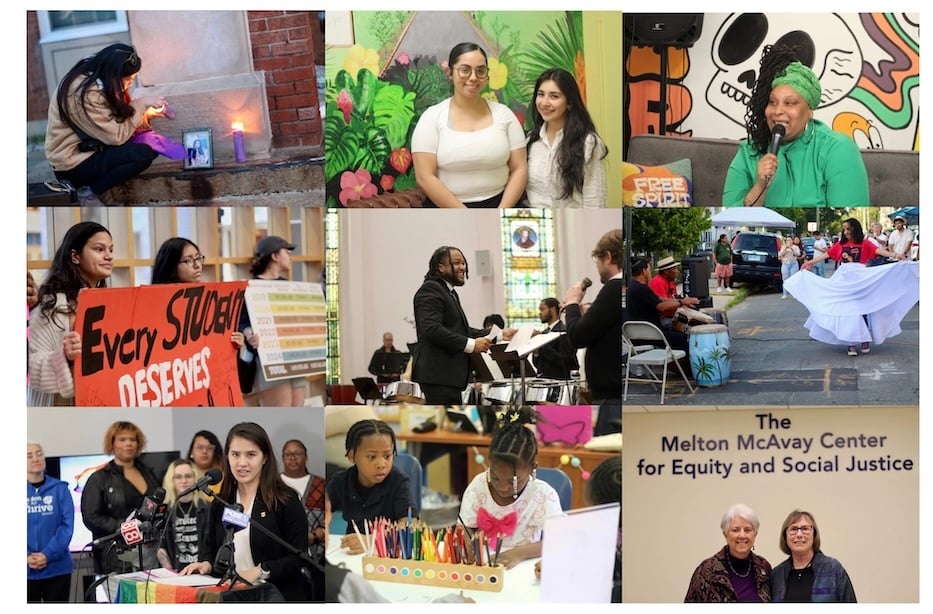
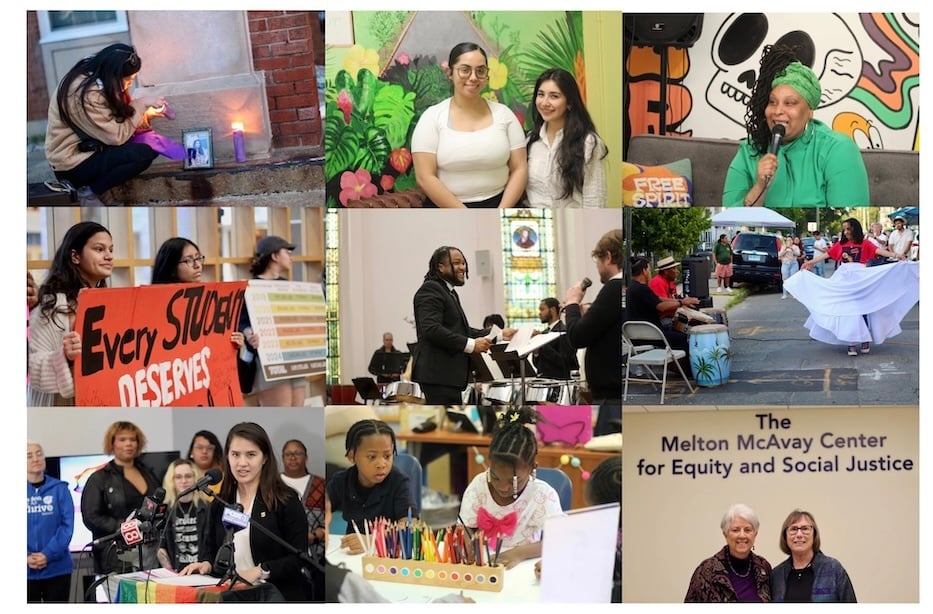
Top row: Vanesa Suarez lights a candle in memory of Roya Mohammadi; NHIC members Kiana Cintron and Ambar Santiago-Rojas; Sun Queen leads an open mic at Strange Ways in Downtown New Haven. Middle row: Students at the Board of Alders advocate for their teachers after the 129 proposed student-facing staff budget cuts; St. Luke's Steel Band conductor Kenneth Joseph; and Kica Matos at a fundraiser in the Hill to support a family affected by ICE. Bottom Row: Ward Nine Alder Caroline Tanbee Smith speaks at the New Haven Pride Center, second grader Olivia David at Hill Central Music Academy; Ruby Melton and Gail McAvay. Lucy Gellman File Photos.
Over the past several years, we have watched philanthropic institutions and nonprofit organizations publicly recommit themselves to equity, racial justice, and deeper community partnerships. Mission statements have evolved. Strategic plans have been refreshed. Language about inclusion, access, and dismantling systemic barriers has become more explicit and more urgent.
And yet, we keep returning to a quieter question: What does it actually look like to operationalize those commitments?
In our observation, the true test of institutional values is not found in aspirational language. It is revealed in governance — in how decisions are made, who is centered in those decisions, and whether institutional behavior aligns with stated goals.
For place-based philanthropy and community-based nonprofit organizations in particular, trust is not a secondary outcome. It is infrastructure. Institutions that serve defined communities depend not only on financial resources but on credibility, relational depth, and moral authority. Their effectiveness rests on being in right relationship with the people and organizations they exist to support.
Trust grows when philanthropic institutions and nonprofit organizations cultivate authentic partnerships over time — when they recognize lived experience as expertise, when they listen before acting, and when their internal practices reflect the same principles they encourage in others. Trust erodes when actions appear disconnected from public commitments or when decision-making feels distant from community voice.
In the years immediately following 2020, many grantmaking institutions and nonprofit organizations undertook meaningful self-examination. They acknowledged systemic inequities. They pledged to change how they funded, how they listened, how they served, and how they showed up in community. Some made real shifts.
But we are also observing something else: a subtle slippage at certain well-known institutions — a quiet drift back toward pre-2020 norms. Whether intentional or not, familiar governance patterns are reasserting themselves. Traditional definitions of expertise regain primacy. Established networks re-solidify. Decision-making grows less transparent. Community voice, if it is acknowledged at all, feels more consultative than consequential.
One place this slippage becomes particularly visible is in executive leadership support and selection.
Executive transitions are defining moments. They are opportunities for boards to demonstrate what they truly value. They reveal how leadership is defined, whose experience is privileged, and how seriously institutions take their commitments to community-centered practice.
When a well-known philanthropic institution conducts an executive search in ways that appear opaque, insular, or disconnected from meaningful community input, it sends a message — even if unintentionally. When nonprofit boards are unable or unwilling to equitably support Black, brown, or women leaders, that too sends a message. It suggests that when stakes are highest, boards may revert to familiar criteria and closed processes. It reinforces the perception that equity commitments apply outwardly — in programs, services, or grantmaking — but inwardly in governance only selectively. It raises questions about whether the structures and norms of governance are truly aligned with the equity commitments institutions publicly affirm.
We do not assume ill intent. However, boards that are unaware of the signals they are sending do not get a “pass,” but require internal, institutional self-examination. Governance culture is powerful; it exerts gravitational pull. In moments of transition, especially, boards often default to what feels safest and most conventional.
In other cases, we suspect something more complicated is at work: the persistence of bias and privilege. Board members are often accomplished, civic-minded individuals who care deeply about their communities. Yet accomplishment and commitment do not automatically confer on board members cultural fluency or proximity to lived experience, regardless of their racial or ethnic background. Without sustained self-examination, inherent bias and positionality can shape assumptions about readiness, credibility, and authority. Privilege can create blind spots about what genuine community alignment requires.
It is possible for a board to speak eloquently about equity while remaining insulated from the daily realities of the communities it serves. It is possible to endorse inclusion in principle while defaulting to traditional markers of legitimacy in practice. That gap — between aspiration and internalized norms — is where trust begins to fray.
Equity is not simply a programmatic priority. It is a governance discipline.
It requires boards to interrogate their own assumptions about power: Who defines excellence? Whose experience counts as expertise? How are major decisions shaped, and by whom? Are community members meaningfully influencing outcomes, or merely offering input? When executive leadership decisions are made, are criteria transparent? Are internal and external stakeholders clear about how alignment with mission is being weighed?
Process, in this context, is not procedural detail. It is substance.
Community-centered governance may include structured listening before major decisions, clear articulation of selection criteria, transparent communication about trade-offs, and honest reflection after the fact. It also requires examining board composition and culture, as well as board and executive recruitment practices, through an equity lens. Who sits at the table? Who feels comfortable speaking? Whose perspectives are weighted most heavily? Visible diversity alone is not the measure of equity. Even when a board has expanded its membership and the optics of who sits around the boardroom table have improved, vigilance — and a sustained willingness to examine where power around the table actually resides — remains essential.
These are not easy questions. They require humility and a willingness to be unsettled.
Communities are sophisticated observers. They notice when values are lived consistently and when they are invoked selectively. They understand that institutions will make complex decisions. What they seek is coherence — a visible alignment between what philanthropic institutions and nonprofit organizations say and how they behave, especially when leadership and power are at issue.
If there has been slippage in some quarters, the response is not defensiveness. It is recommitment. Boards can re-engage in genuine self-examination. They can invite community voices into governance conversations in ways that influence outcomes, not just optics. They can treat transparency as strength rather than risk. They can acknowledge when misalignment has occurred and course-correct publicly.
Place-based philanthropic institutions and nonprofit organizations occupy a unique position within civic ecosystems. They are stewards of public trust. That trust is shaped not only by what is funded or how services are delivered, but by how authority is exercised internally — in who holds power, how it is shared, and whether governance practices reflect the values institutions proclaim.
Community trust is not built through aspiration alone. It is built when values are embedded in governance — especially when power is being exercised — and when institutions demonstrate, in moments that matter most, that equity is not rhetorical commitment but operational reality.
Over the years, the authors have served as board members or as executive leaders across a range of nonprofit organizations and philanthropic foundations in New Haven.