

Culture & Community | Education & Youth | Ely Center of Contemporary Art | Arts & Culture | Visual Arts | Youth Arts Journalism Initiative
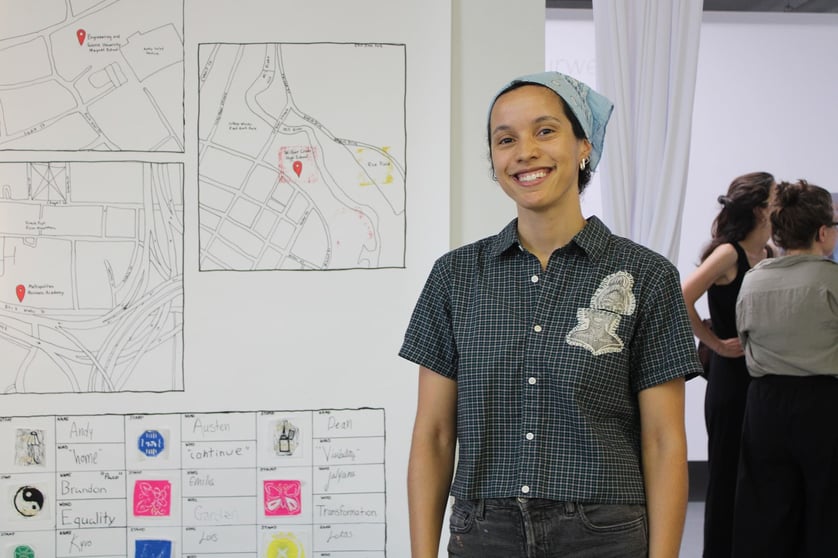
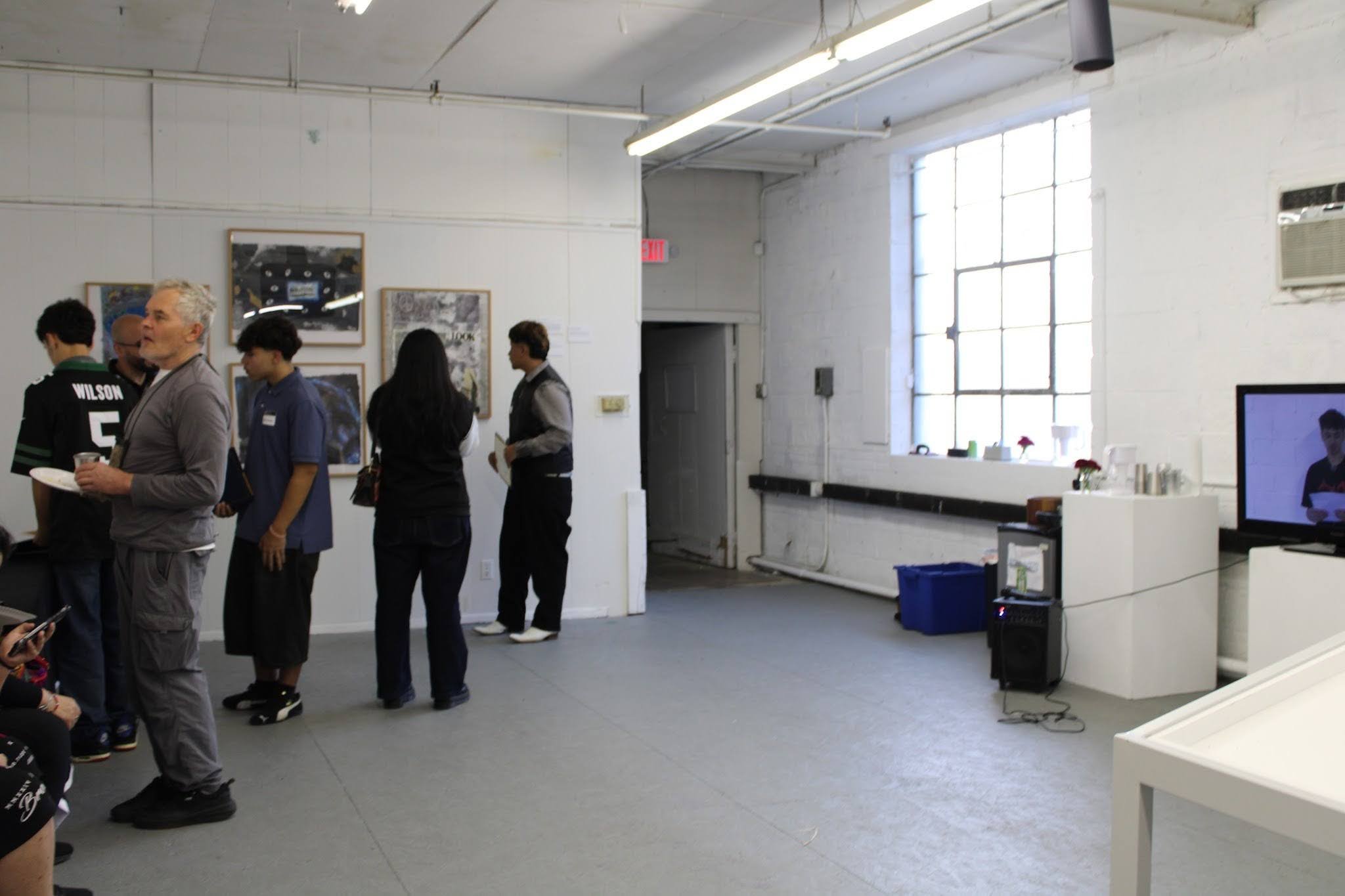
Top: Lead SAP Artist/Mentor Kat Weise, who used the history of The Green Book as a jumping off point for artistic exploration. Bottom: The reception in action. Jarelis Calderon Photos.
As artists and art lovers alike walked into the Ely Center of Contemporary Art (ECoCA) on a recent Friday evening, stories surrounded them in every direction. On one wall, several mixed media works celebrated Black representation, while nearby a piece confronted viewers with a series of watchful eyes. Across the room, a painting inspired by the Big Bang blended deep blues, purples, and blacks to capture the vastness of space. Visitors moved from piece to piece, taking in the details behind each creation. Conversations rose and fell through the gallery.
The reception marked the opening of five new summer exhibitions at ECoCA, with a special focus on the teen artists in the organization’s Summer Apprenticeship Program (SAP) who spent weeks developing their skills with mentor and artist Kat Wiese, as well as assistant Evelyn O’Brien, ECoCA Board Member and illustrator Adriana Bergstrom, Yale Summer Experience Intern Michelle Vong, educator and historian Ian Dudley and New Haven Poet Laureate Yexandra Diaz.
Throughout the program, students had the opportunity to work alongside professional artists, learn new techniques, and create pieces that reflect their own lived experiences and perspectives. With mentors, they also researched The Negro Motorist Green Book, a 20th-century guide written to keep Black travelers safe around the country and especially in the American South,.
There are several copies of the book in Yale’s Beinecke Rare Book & Manuscript Library in downtown New Haven. The book became the foundation for the original work that each student produced.
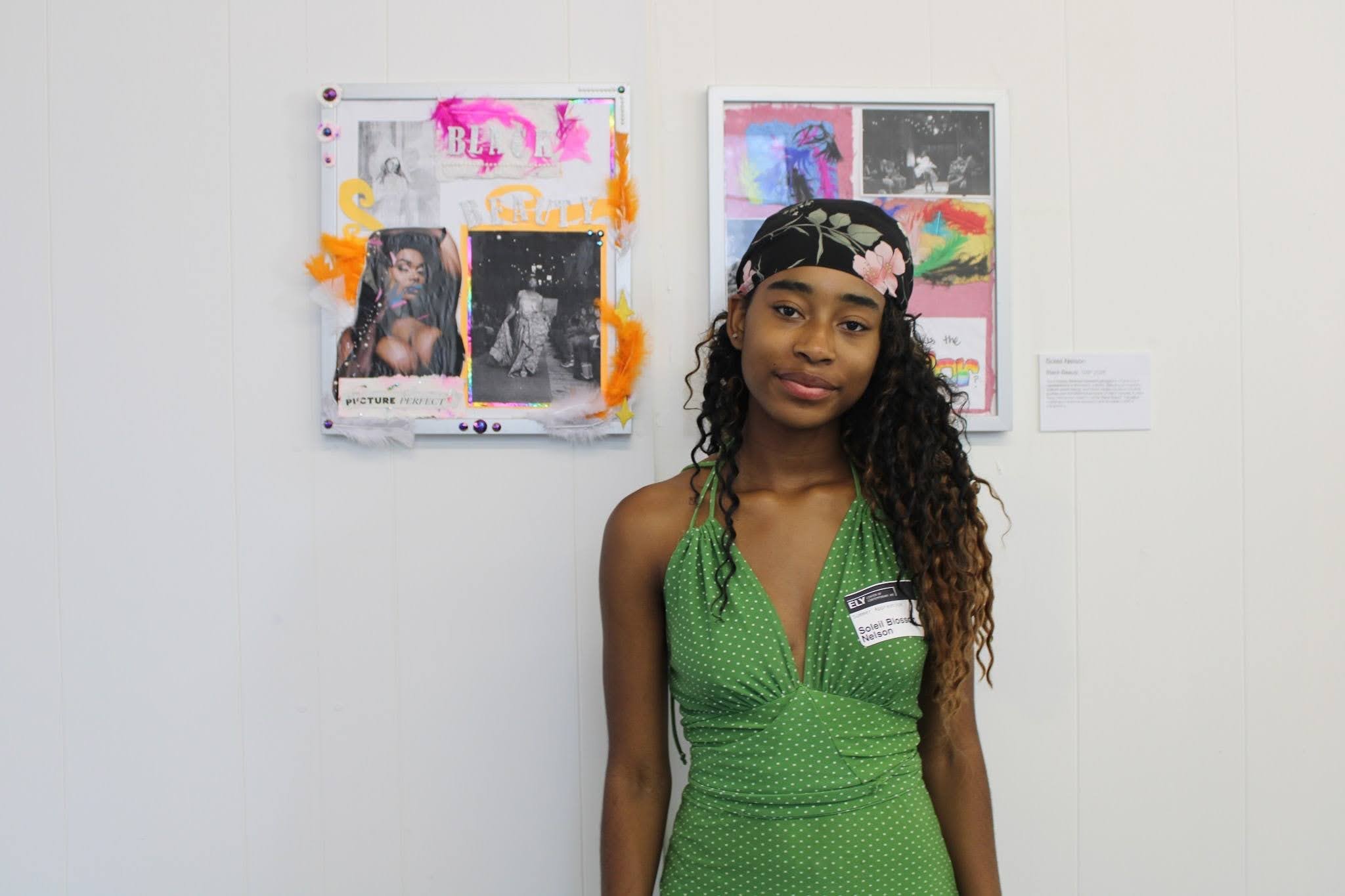
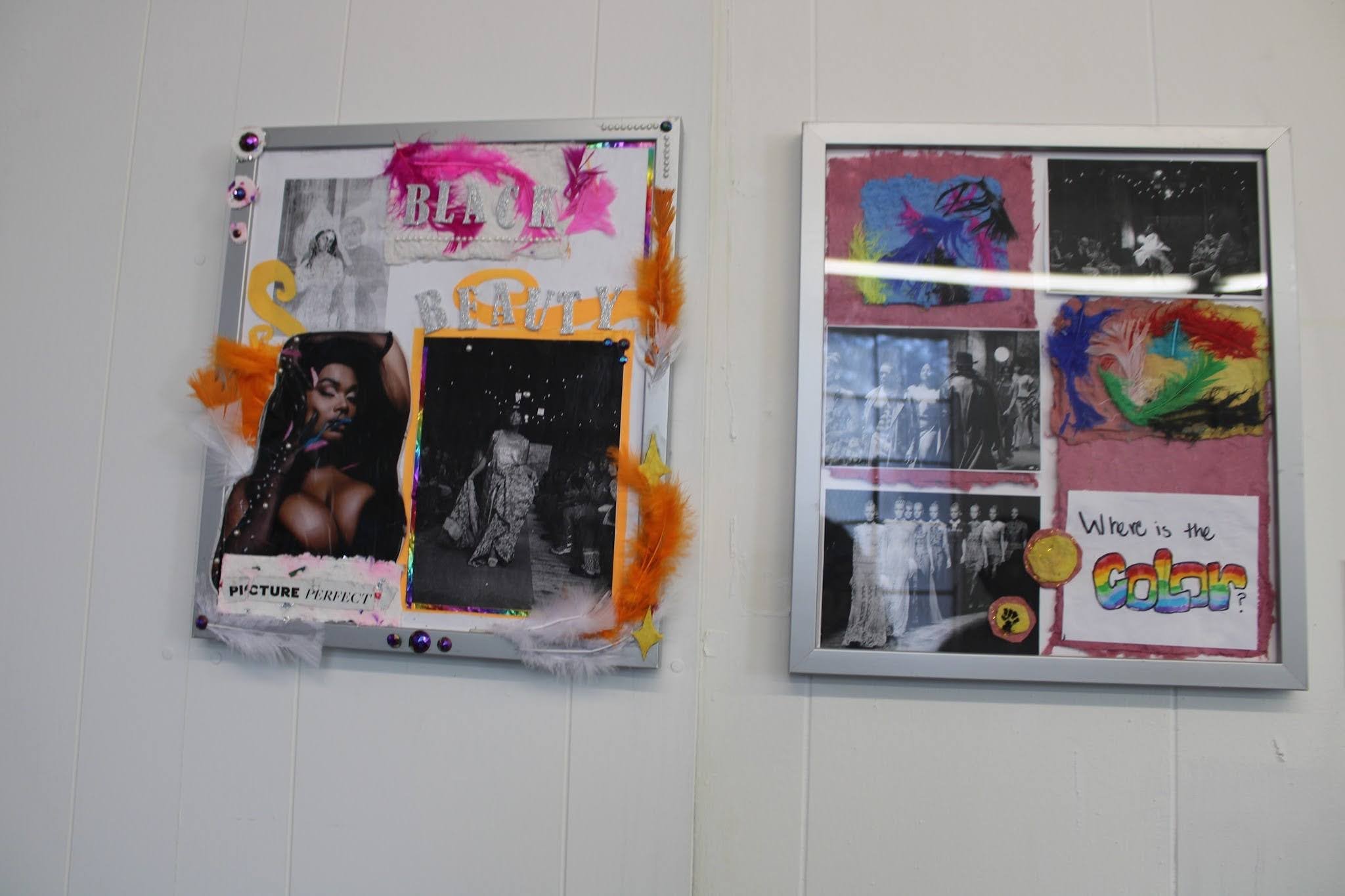
Soleil Nelson with her work.
For many of the young artists, the exhibition was more than just a display of their artwork—it was a chance to have their creativity recognized by the community.
One of the artists featured in the exhibition was Soleil Nelson, a recent graduate of ACES Educational Center for the Arts (ECA) and Hamden High School who showcased two pieces that explore beauty, representation, and the experiences of Black women. For Nelson, whose mother Nadine is a chef and multi-media artist, the artwork was deeply personal.
Created as part of an assignment to reframe a historical moment, her pieces examine the beauty industry and the ways Black women have often been represented– or left out—in spaces like entertainment and fashion.
“I think as a girl, so much of our lives are like beauty and the beauty standard,” Nelson said. “But I think it’s really different depending on different cultures globally.”
Through her work, Nelson wanted to place Black beauty at the center rather than treating it as something included only to meet a diversity standard. Her pieces highlight the importance of seeing Black women celebrated for their beauty, identity, and individuality.
Nelson’s artwork was also influenced by her research into the Green Book, which helped Black travelers find safe places to visit during segregation. Through the program, she learned more about the Green Book’s connection to New Haven and how its history continues to shape the community today.
Nelson was surprised to discover how much history connected to the Green Book existed in New Haven. She learned about places like the Monterey Café on Dixwell Avenue, a jazz club that hosted famous Black performers including Ella Fitzgerald.
“I was on the bus home from this program and I looked out the window and I saw it,” Nelson said. “It’s just like a little piece of history from this program that I can take with me.”
While creating her work, Nelson explained that she learned to trust herself more as an artist. She also credited Wiese for helping her feel more confident and encouraging her to experiment with her work.
“Her confidence made me more confident to mess up, to create, and just be happy with the outcome,” Nelson said.
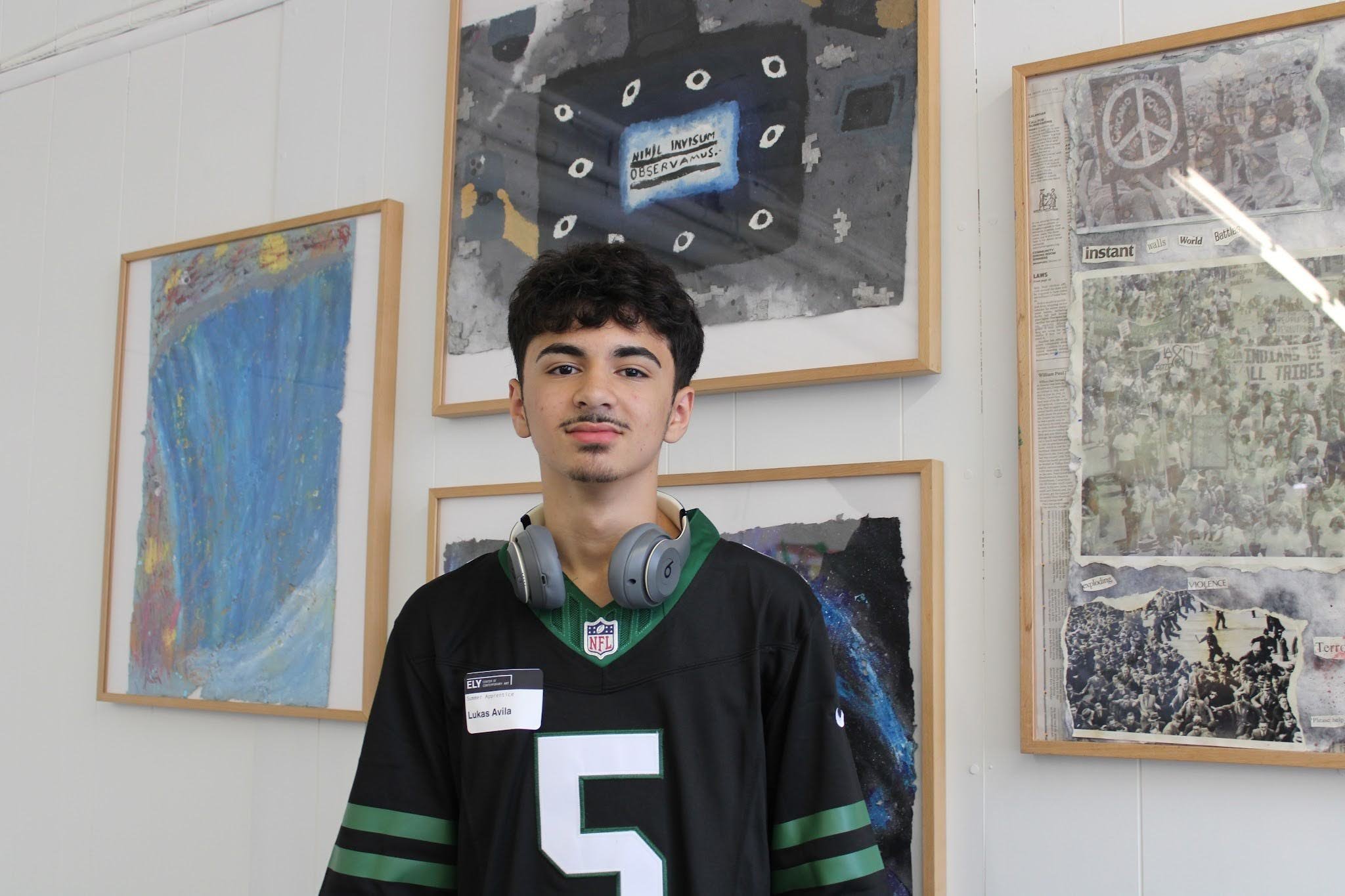
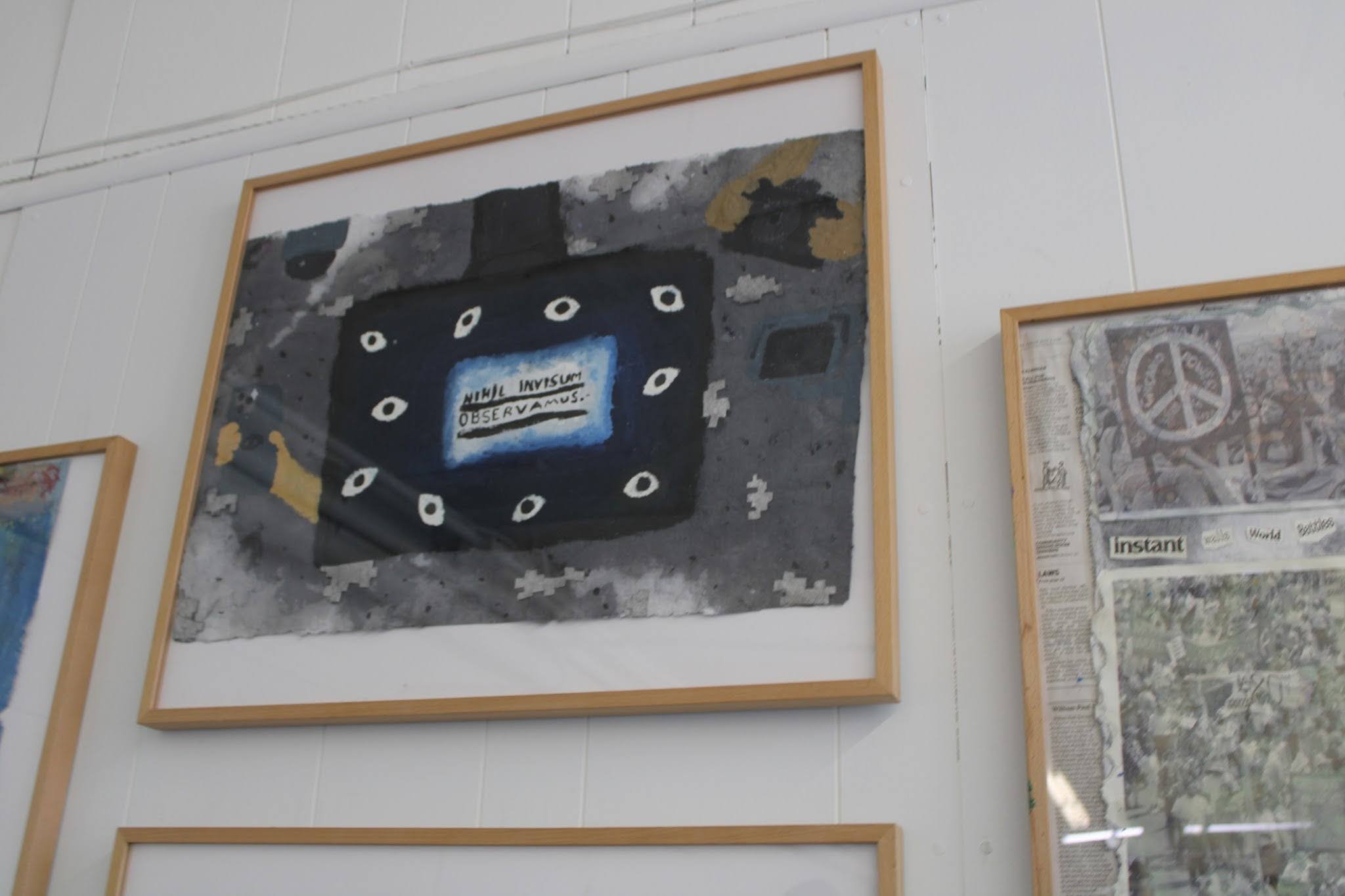
Avila with his work. Jarelis Calderon Photos.
Lukas Avila, a rising junior at Engineering & Science University Magnet School (ESUMS), created a piece titled Scobophobia, which explores the fear of being watched. His artwork examines modern technology and the ways surveillance can impact people’s sense of privacy.
Inspired by conversations about technology and government surveillance, Avila wanted his piece to make viewers think about how much information is collected about them without realizing it. The artwork includes different types of cameras and a screen featuring the words “nothing unseen. we are watching,” highlighting the idea that privacy is becoming harder to maintain in today’s world.
Throughout the program, Avila also gained a deeper understanding of the Green Book and its importance in American history. He added that learning about Connecticut's connection to the Green Book surprised him and helped him see the significance of local history.
“I had a lot of ups and downs of it … but eventually it became what you see here today.”
Working with Wiese and the other mentors helped Avila build confidence and learn new artistic techniques, including papermaking and printmaking. He said that the experience encouraged him to continue creating art with a message behind it.
“The main message that I wanted to take away is that today’s day and age with the technology that’s growing and how the government is using technology against us, privacy can no longer exist.”
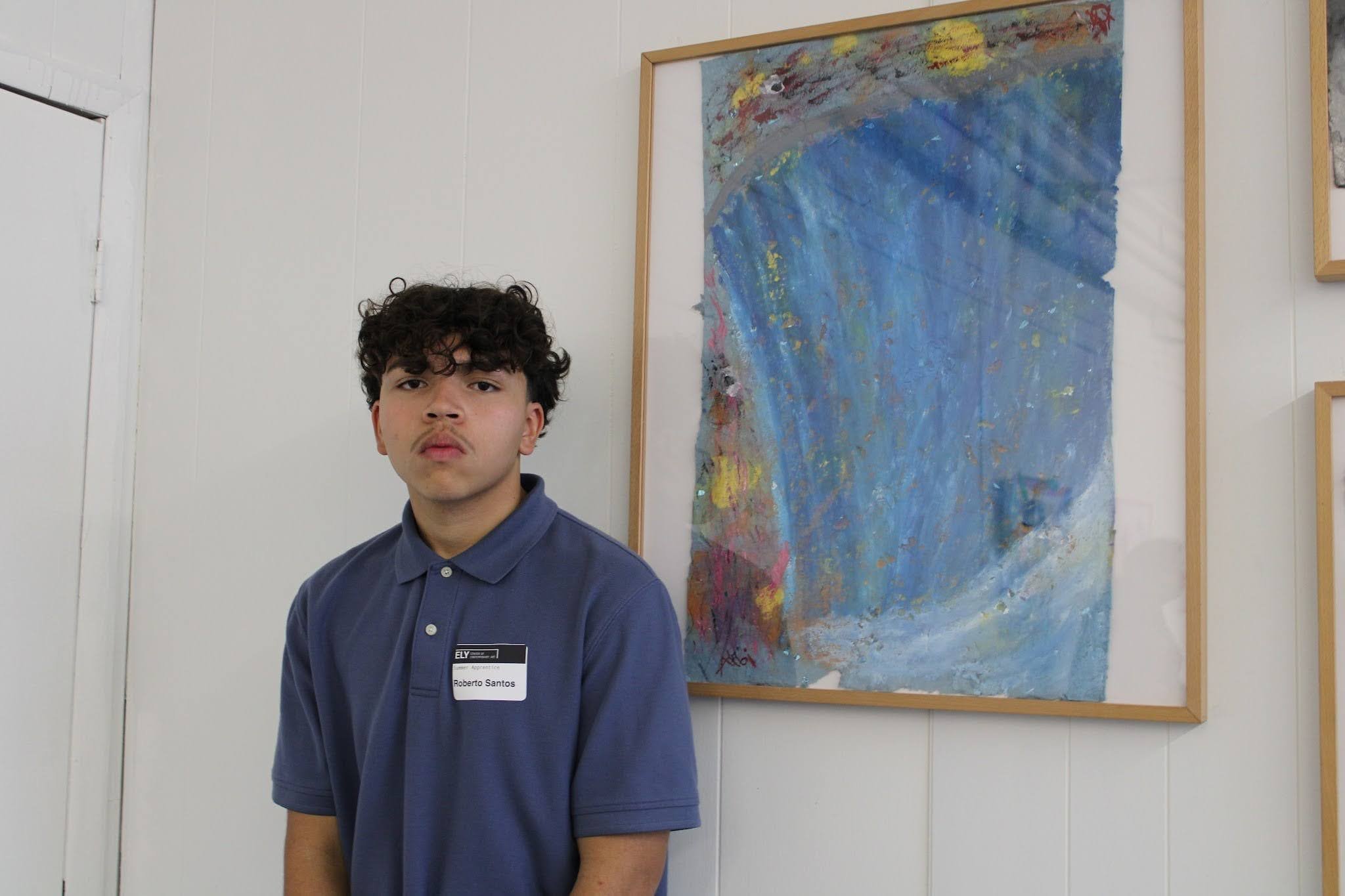
Luis Roberto Santos Correa is a rising junior at Cooperative Arts & Humanities High School. Returning to the program for a second year, Santos created Omakase, a piece inspired by Katsushika Hokusai’s The Great Wave that reflects his passion for photography through layered shades of blue and movement. In Japanese, the word “Omakase” translates roughly to “I’ll leave it up to you”
Although Santos knew little about the Green Book before the program, he said that researching it showed him the importance of preserving stories about safe spaces for Black travelers. He believes combining history with art makes those stories more engaging and accessible.
“This program has definitely got me out of my comfort zone,” he said.
Having participated in the program last summer, Santos added that returning gave him the opportunity to build on what he’d already learned while exploring new techniques, including papermaking. He said that the experience has helped him “grow as an artist” and strengthen his own creative style.
“Instead of just taking a basic picture, I kind of look at it in a more artistic way,” Santos said.
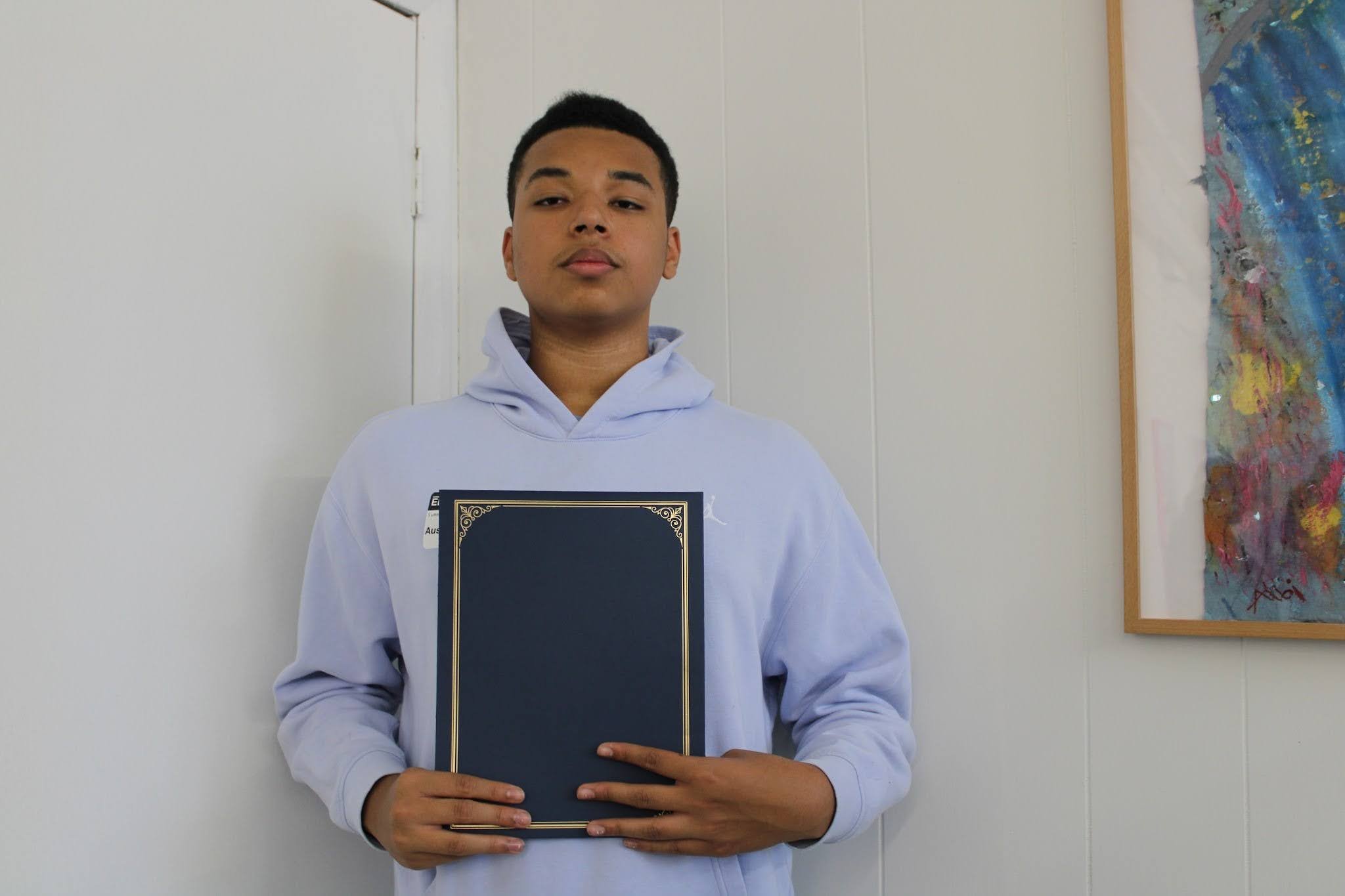
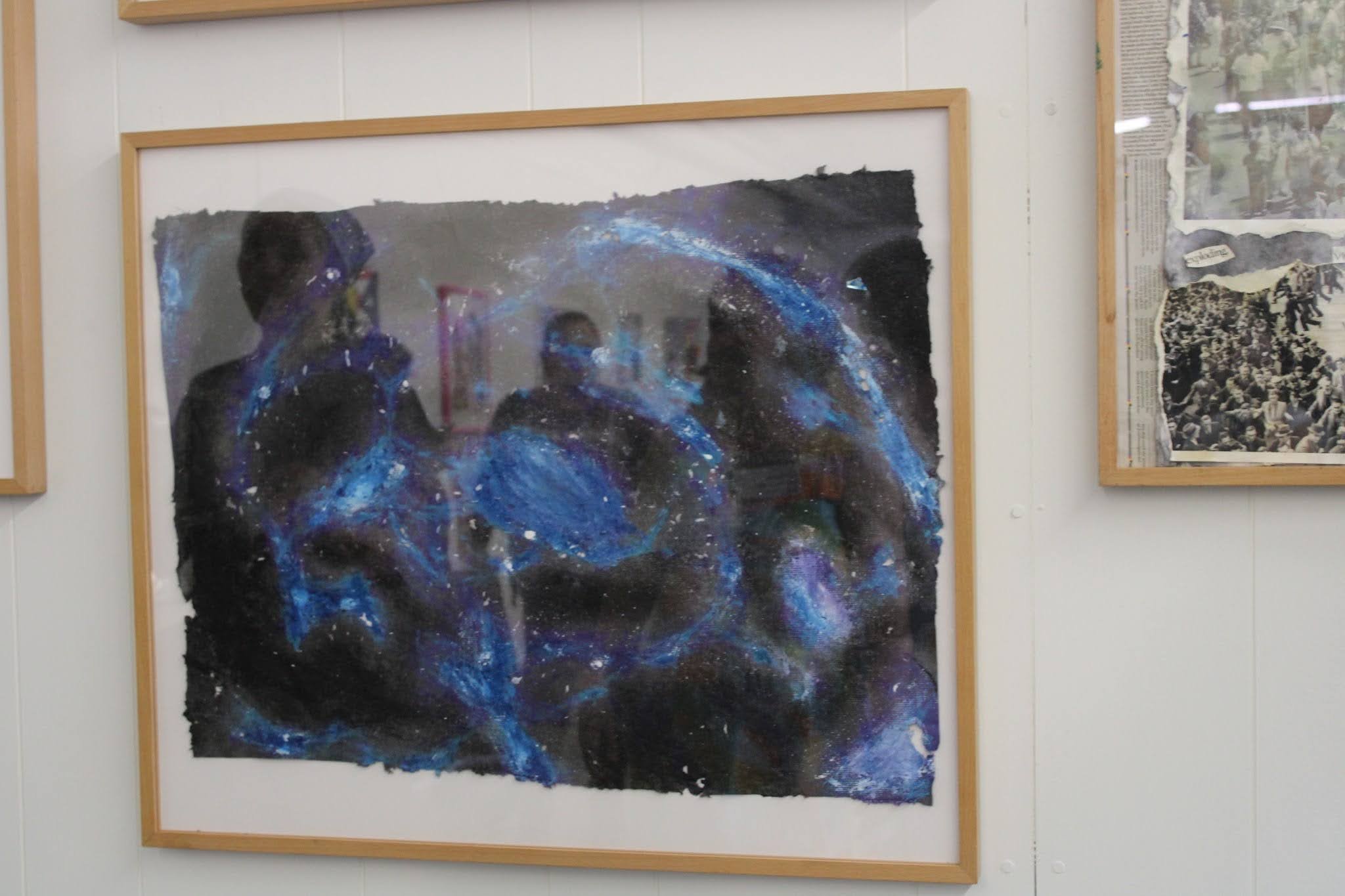
Austen Rice, a rising sophomore at Wilbur Cross High School, created a piece inspired by the vastness of space and the idea of creating something from nothing. His artwork uses a combination of colors and light to represent the scale and mystery of the universe.
Inspired by the Big Bang, Rice used shades of blue, purple, black, and other colors to create depth within his painting. Although he was unfamiliar with the Green Book before joining the program, he explained that researching it’s history became a valuable learning experience.
“The most challenging part was getting the idea and making it really happen,” Rice said.
Through the program, Rice shared that he gained more confidence in his abilities as an artist and learned that improvement comes through trying new things.
“It has greatly affected my confidence by showing me that even if I feel that something isn’t good, I can improve and do better than I really think I can,” Rice said.
Weise, a multidisciplinary artist based in New Haven, created the program with the goal of connecting art, materials, and history. Through papermaking and mixed media, she encouraged students to think more deeply about the stories behind the materials they use and the histories they represent.
Weise chose the Green Book as the program’s focus because of its connection to movement, safety, and community, she said. She wanted students to explore the idea of “safety” beyond protection from harm, but also as a way to think about joy, belonging, and shared spaces.
“The Green Book was a tool to go on a vacation as much as it was a tool to safely travel,” Weise said.
Throughout the program, Weise was impressed by the students' creativity and the way they supported each other. She hopes visitors leave the exhibition recognizing the importance of giving young artists a platform to share their perspectives.
“Young people have something to say, and I think it’s our responsibility, as educators, as artists, to make space for them to say it seriously.” Weise said.
A rising senior at Wilbur Cross High School, Jarelis Calderon is an alumna of the 2025 summer cohort of the Youth Arts Journalism Initiative (YAJI). YAJI is a program in which New Haven, Hamden and West Haven Public Schools high school students pitch, write, edit and publish articles through the Arts Paper.