
Culture & Community | Immigration | Arts & Culture | Youth Arts Journalism Initiative | Arts & Anti-racism
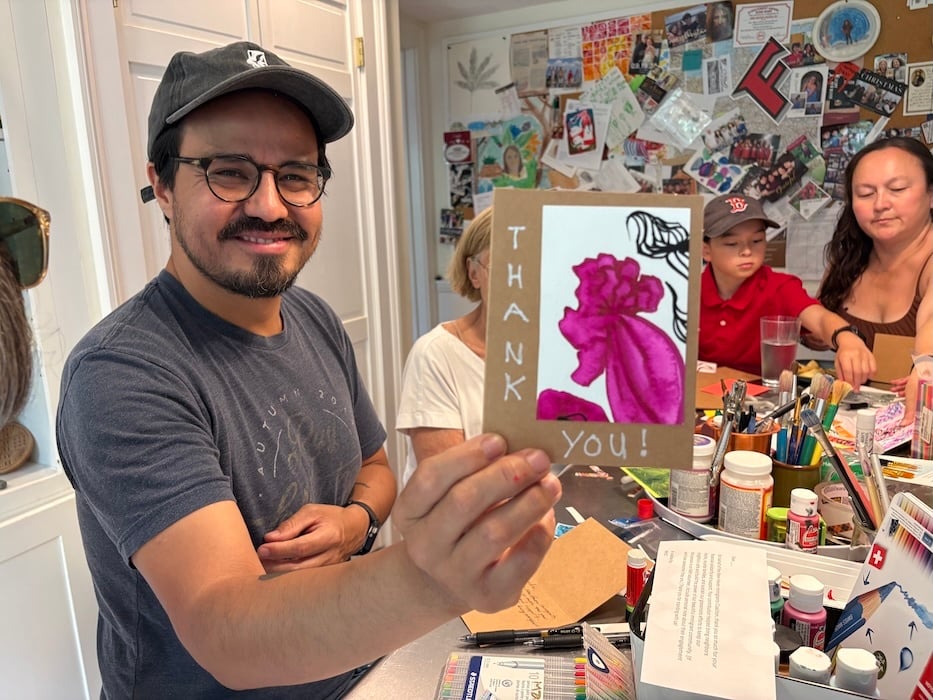
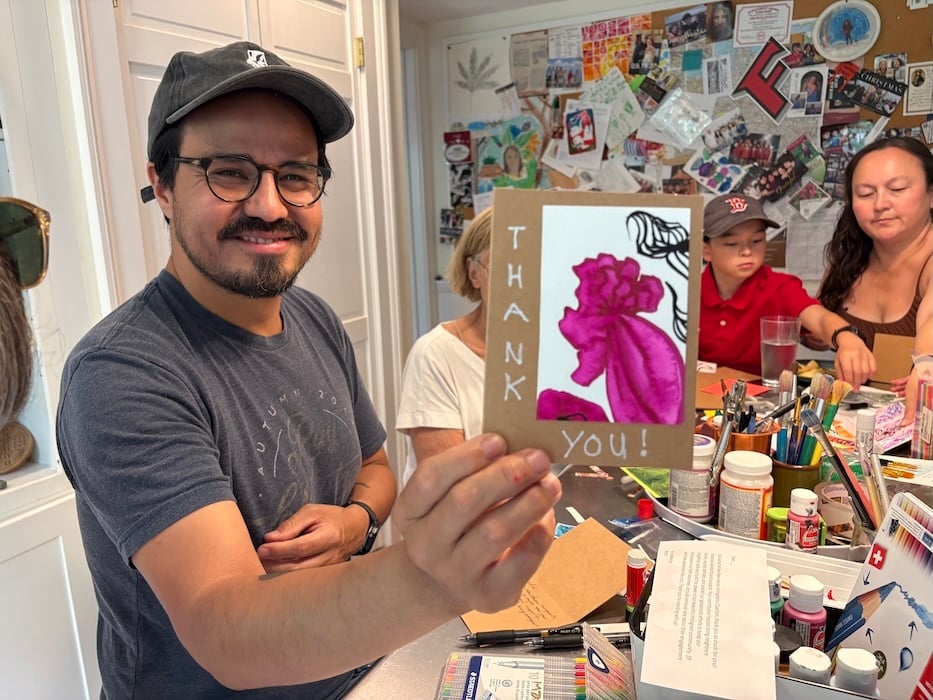
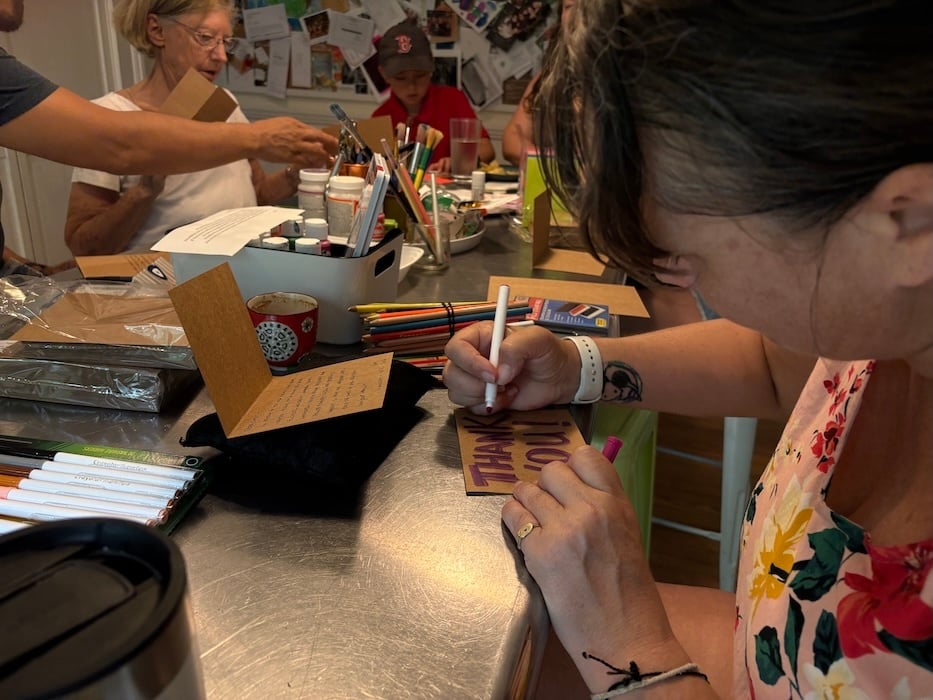
Luis Luna with a thank you card. Karina Gonzalez Photo.
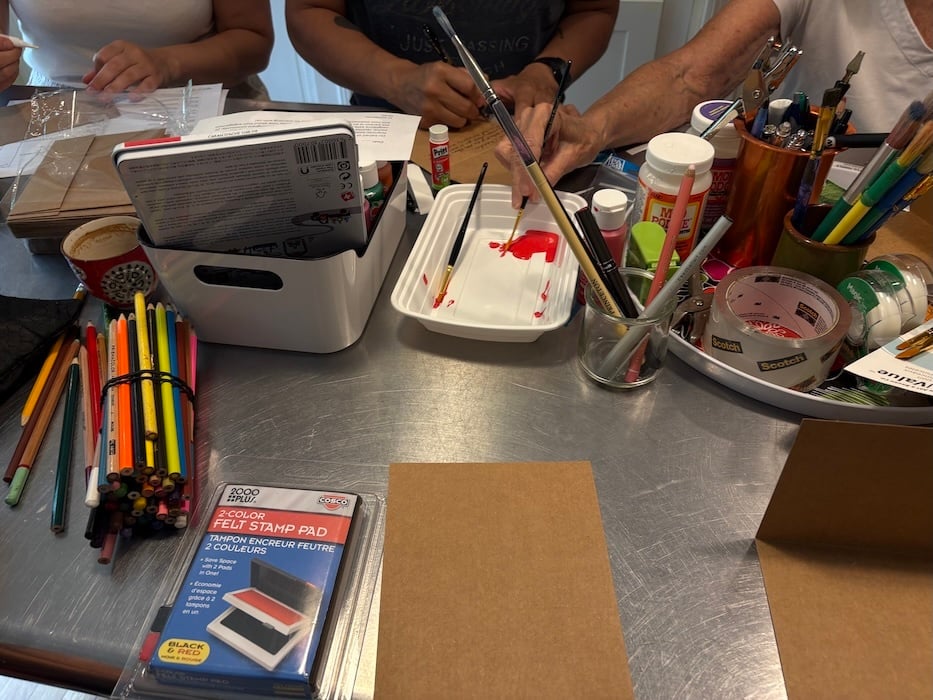
In a house off Everit Street, a day of artmaking was well underway. Voices rose and fell through the first floor. Platters heavy with egg and potato tortillas, cherry-chocolate scones, veggies and chips sat out on the kitchen counter. One room over, a table sat covered with markers, construction paper, blank cards and artwork that volunteers had already completed.
That scene unfolded on a recent Sunday, as members of the New Haven Immigrants Coalition (NHIC) gathered at a home in East Rock to make cards thanking donors and volunteers who have supported their movement. Over several hours, people decorated and wrote handmade cards, ate delicious food, and made conversation with each other.
Paired with the daily and weekly work NHIC does to spread and share knowledge to keep New Haven’s immigrants safe (and, in some cases, bring them home after an arrest or detention), these artmaking sessions are intended to spread joy within and beyond the coalition, to keep the movement going even when the work feels heavy.
Members of the NHIC, who work entirely on a volunteer basis, provide financial and legal resources, emergency food distribution, know your rights and rapid response information, and solidarity work to immigrants living in greater New Haven.
“[We are] always thinking about new and creative ways of seeing the world,” said NHIC member Jenny Heikkila Díaz (JHD). When asked about her perspective on the value of art-making, she emphasized the importance of expressing feeling and creativity, sharing experiences, and contemplating new perspectives on the work.
NHIC, which was founded in late 2024, is a community network that protects and advocates for immigrants across Greater New Haven. It organizes community defense and mutual aid, including rapid response to Immigrations and Customs Enforcement (ICE) officers, food solidarity, and legal and direct financial support to families who have been affected by federal policies that seek to limit, curb and punish immigration.
Sunday, a handful of NHIC members chatted while painting, drawing, and writing messages to their supporters, a needed sense of reprieve floating through the space. Soft music played in the background. Surrounded by shelves of books and colorful artwork, two fluffy cats played. The space felt cozy and welcoming, like home.
As volunteers trickled in and out, several took the time to talk about why immigrant justice work is important to them. Seated at the table as he worked on a card, longtime immigrant rights advocate Luis Luna spoke on his own personal experience, and the experience of hundreds of fellow immigrants with and for whom he has advocated at both the municipal and state level.
In 2025, Luna joined NHIC after years of organizing with Make The Road CT, the Connecticut Working Families Party, Husky 4 Immigrants, and the Semilla Collective among other organizations and grassroots groups. For him, it was and is a no-brainer: he wants to help keep his neighbors safe.
That work, he added, goes back decades. After immigrating to the U.S. from Ecuador with his mother, Luna became involved in immigrant justice around 2007, including advocacy for the then-nascent Elm City I.D. Card. While living in Wallingford, he also became embroiled in an early debate about cops and cameras, unknowingly stepping into the spotlight as a champion of free speech. He’s remained steadfast and even-keeled since, often ready to speak about how immigrant rights, abolition, socialized medicine and housing are all connected.
His first immigrant rights job began in 2012 at Communities for Change in Brooklyn, New York, where he organized car wash workers. The goal, he remembered mid-artmaking, was to gather stories to help people understand the conditions that immigrant workers were often under. Hes still very much interested in how narrative can shift opinion, which he explores in his work as a radio host at the Bridgeport-based station WPKN and a founder of the series Abolition Transmission.
“What we found was shocking: the [immigrant] workers made only $5 an hour,” he remembered of that time at Communities for Change. After joining a coalition that sued the company, he helped ensure that workers received $3 million in lost wages. When he returned to New Haven, that advocacy work remained at the forefront of everything he did, from emergency food aid during the first years of the Covid-19 pandemic to a focus on artmaking as resistance.
Today, he believes art-making is meaningful because it allows people to show mutual appreciation and offer support, he said. He also feels events like Sunday’s create welcoming spaces to connect, build relationships, and strengthen community.
Nearby, volunteer Susan Bramhall agreed. A year ago, her journey with NHIC began when a friend invited her to stand at Wilbur Cross High School’s graduation—due to fears of law enforcement at the ceremony—and the outrage and horror she felt inspired her to become more involved. Last year also marked ICE’s arrest of a Wilbur Cross High School student, around which members of NHIC mobilized and rallied, part of the effort to bring him home.
A year later, Bramhall regularly attends NHIC meetings and said she believes that creating art is a meaningful way to connect with supporters and strengthen relationships within the community.
“It [artmaking] allows you to grow a connection that's positive in a time where a lot of things are negative,” chimed in volunteer Lindsay, who was working nearby (she declined to give her last name). She later said that her involvement in justice work comes from wanting to help and stand by her neighbors.
In part, that’s the hope behind activities like Sunday’s. Since the 2024 election—which became the catalyst for NHIC’s launch—much of the work that the collective has done is emotionally and mentally exhausting. The artmaking gatherings offer a moment to rest, contemplate, and exist in community with other advocates and like-minded people.
“We need opportunities to get together, to be joyful, to be creative, if we’re going to sustain our community and be able to keep fighting,” said Díaz.
This article comes from the ninth and current cohort of the Arts Council's Youth Arts Journalism Initiative (YAJI). From June 29 through August 21, YAJI students pitch, report, write and edit stories with Arts Paper Editor Lucy Gellman, Program Assistants Abiba Biao and Grayce Howe and Mentor Ruby Szekeres. Karina Gonzalez is a rising sophomore planning to transfer into Madison High School. She was previously at Engineering and Science University Magnet School (ESUMS) and Acellus Academy.