

Culture & Community | Edgerton Park | Elm Shakespeare Company | Arts & Culture | Theater
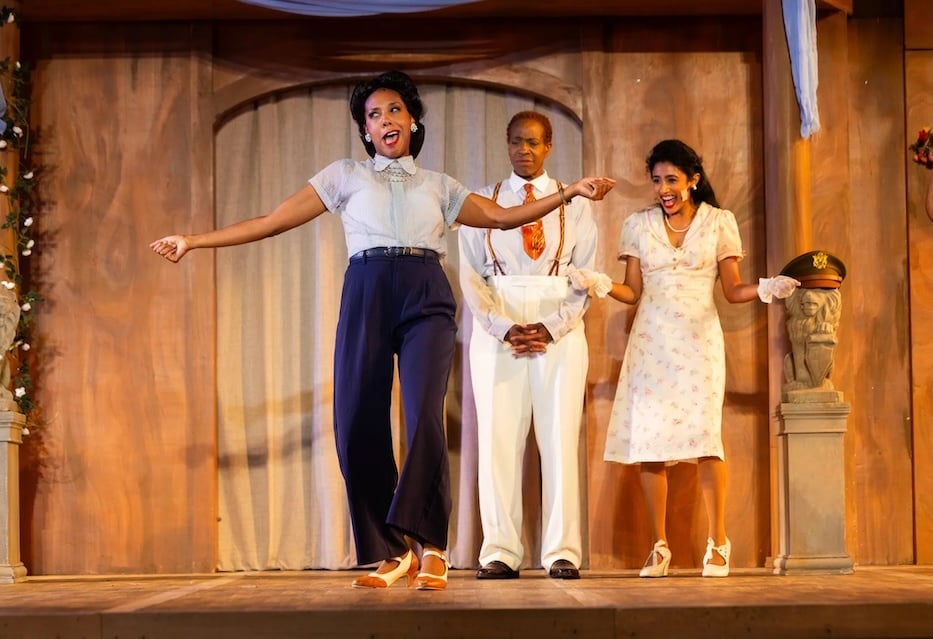
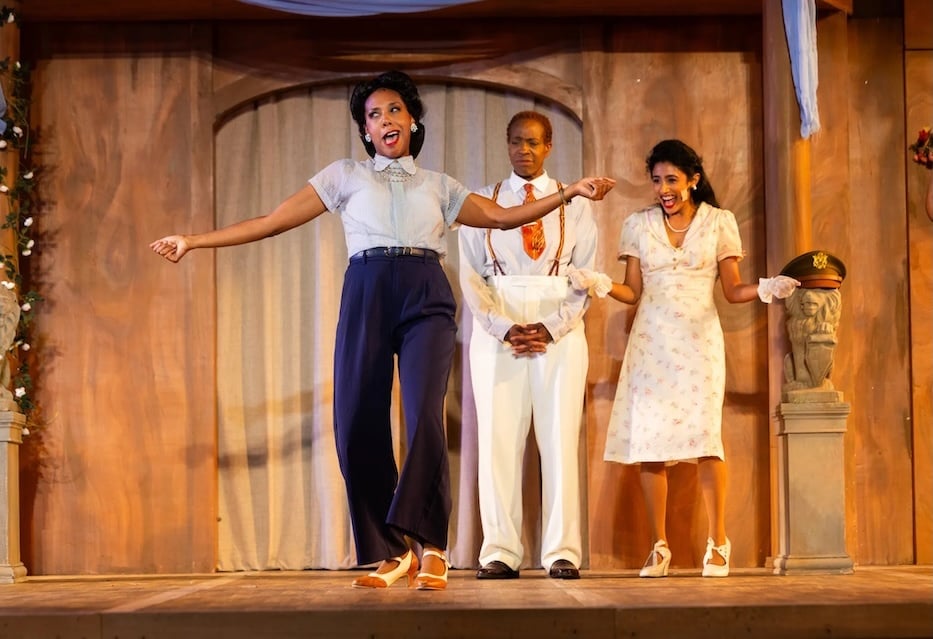
Christina Acosta Robinson (Beatrice), Gracy Brown (Antonio), Veda Baldota (Hero) in Elm Shakespeare's "Much Ado About Nohting." Isabel Chenoweth Photo.
For many Shakespeare aficionados, Much Ado About Nothing was the gateway play into the world of the Bard, the play for which we first “suffered love.” Seemingly light on early modern archaisms, gentler on the less historically-inclined, and trading in tropes we recognize from television, Much Ado is among Shakespeare’s most accommodating, and likewise most welcoming, of plays.
This year, Elm Shakespeare Company welcomes New Haven to experience Much Ado at the Alexander Clark Playhouse in Edgerton Park, with a production that celebrates the many various inflections performance can take and still be legitimately, diversely, “Shakespearean.” Elm’s mainstage productions, of which Much Ado is the 31st annual, are only one part of the organization's year-round programming which centers Shakespeare-based theater education for local youth. The summer mainstage in the park plays an aspirational function as a possible future stage for the youth performers in Players Camps or the Teen Troupe.
As is typical for Elm, this production of Much Ado About Nothing, which opened last Friday evening after the planned Thursday opening was rained-out, features a company that includes Elm Shakespeare’s 2026 Apprentice Company of early-career theater makers. In addition to the Apprentices, professional actors from the New Haven area, out-of-towners, students and recent grads from the David Geffen School of Drama at Yale and others make up the ensemble.
When asked how he approached building a company that spoke the same rehearsal language, Much Ado Director Benjamin Curns (long a fixture in the company, as is his partner, educator and Much Ado cast member Sarah Bowles, who plays Ursula and Francis Feeble) answered that he asked of all the performers, “No matter what your training or background may be, in this process, I ask three things: Show up on time, be prepared, and be nice.”
These are the essentials to any collaboration, but aren’t always enough to elicit stylistically unified storytelling. Past Elm Shakespeare productions have suffered, perhaps, from a company full of individually gifted performers shaping characters that don’t believably fit within the same theatrical world.
Which is why Much Ado, in its internal variety, is an ideal choice for a company like Elm. “One of the great things about Much Ado,” Curns said, “is that it is never the same for too long.”
The play contains four plot threads, each of which is allowed, in this production, to exist in a different stylistic realm. Bickering enemies-to-lovers Beatrice and Benedick (Christina Acosta Robinson and Gregory Jon Phelps) are in a romcom, while young couple Hero and Claudio (Veda Baldota and Balfour Clark) are torn apart and brought together by twists and treachery worthy of a telenovela. Dogberry (Liz Daingerfield) and her troupe of scouts perform slapstick somersaults in the name of justice that even a dog in Friday’s audience, barking when Dogberry entered, found exciting.
And last but for once not least: Don John—here the quietly desperate, pernicious Donna Joan—in a radically sympathetic performance by Grace Wissink worthy of a modern social drama.
This Much Ado About Nothing is set in the 1940’s, with the singing and the swinging to prove it. (More like Much A Doo-Wop, am I right?). Apprentice company members Christina Rielle’s and Bonsaii Ferris’ musical and acting chops succeeded in grounding the ensemble in the emotions of each moment, while apprentice Theo Zucconi’s rich vocals in the pre-show concert promised a “Buona Sera” to the assembling crowd. Commenting on the implications of setting Much Ado in the ’40s, Curns referenced the several instances where female actors play traditionally male characters.
“While that may suggest something about the influx of women into the work force of this era, it is more of a happy accident of casting,” he said. I think Curns and the rest of the Elm casting team should give themselves more credit.
When Donna Joan, in the army green pencil skirt and immaculate tailored jacket of an enlisted woman, hair in a tight bun (costume design by Heidi Leigh Hanson), declares, “I had rather be a canker in a hedge than a rose in his grace,” she is voicing the discontent of women in the workplace exhausted by phrases like “Smile!” and “If you have nothing nice to say, don’t make much ado about it!”
Donna Joan, “trusted with a muzzle and enfranchised with a clog,” is a villain because she weaponizes against another young woman the very double standards of modesty and politeness she despises, turning on the flirt and flatter to cause needless harm.
When Donna Joan lies in order to carry out her scheme against the unmuzzled Claudio, Wissink delivers the lines with such restrained earnestness that I, who’ve seen Much Ado countless times, caught myself thinking, “This can be no trick!” When she says, “I cannot hide what I am,” her “cannot” is a reference not to ability, but to the dangerous volatility of a soul fatigued.
Though often Much Ado’s primary selling point, the bantering Beatrice and Benedict make up the play’s B-plot, secondary to Don John/Donna Joan and her brother Don Pedro (Amrith Jayan, eyes twinkling with the joy of mischief) meddling in the nuptials of Hero and Claudio. Far from upstaging, this production’s Beatrice and Benedick fought over the downstage, vying for the audience’s attention and approval. At one point during the performance I saw, the large oak whose branches hang over the stage dropped an acorn that nearly bonked Acosta Robinson on the head. The tree, at least, had taken sides.
It’s a commonplace in theater that the characters in a comedy don’t know they’re in a comedy. They think they’re having the Most Serious Day of Their Lives. But Phelps’ Benedick and Acosta Robinson’s Beatrice certainly let us know they know they’re in a comedy. Desperate to impress Beatrice, and the audience, Benedick drops into a self-consciously exaggerated iambic meter: “fair BEaTRICE I THANK you FOR your PAINS.”
Acosta Robinson’s broad antics are fun, but they let her down in Beatrice’s moments of real rage and heartbreak. That in this production Beatrice and Benedick’s immature squabbling quickly verges on wearisome is intellectually interesting as part of a play about, as Curns puts it, “growing up and showing up.” As much as Much Ado lights up in a surprise moment of grounded realism, so too it rewards—even occasionally requires—the indicated and the over-broad.
So, if you were to ask me, for which of its “bad parts” I first suffered love for Elm Shakespeare’s Much Ado, I’d warmly answer as Beatrice does: “For them all together.”
Elm Shakespeare Company’s production of Much Ado About Nothing runs Tuesdays through Sundays, at Edgerton Park, 75 Cliff Street in New Haven, through September 6. The show starts at 7:30pm. Admission is free, with a suggested donation of $30.