

College theater | Culture & Community | Education & Youth | Southern Connecticut State University | Arts & Culture | Musical Theater
Isabel Chenoweth Photos.
Last Saturday night, friends, families, and neighbors arrived at Southern Connecticut State University’s mainstage theater ready to be Wilkommen-ed, Bienvenue-d, Welcomed to John Kander and Fred Ebb’s Cabaret. Onstage, waiting swaths of red velour, sturdy brick pillars, and a glowing sign reading “Kit Kat Club” promised a warm reprieve from the cool expanse of grey chairs lined up like soldiers at our backs.
Even as the large expanse of empty stage between the orchestra and the audience promised a large cast, I worried that it would take a cast of hundreds to fill a space as cavernous as the Lyman Center.
I need not have feared. The company of SCSU Cabaret, which included both theater students and members of the undergraduate theater club Crescent Players, crafted a performance that felt intimate even in a space that threatened to overwhelm. And, really, how fitting for a production of Cabaret, a musical that addresses the overwhelming reality, both historical and contemporary, of the rise of fascism by focusing on Nazism’s insidious intimacies.
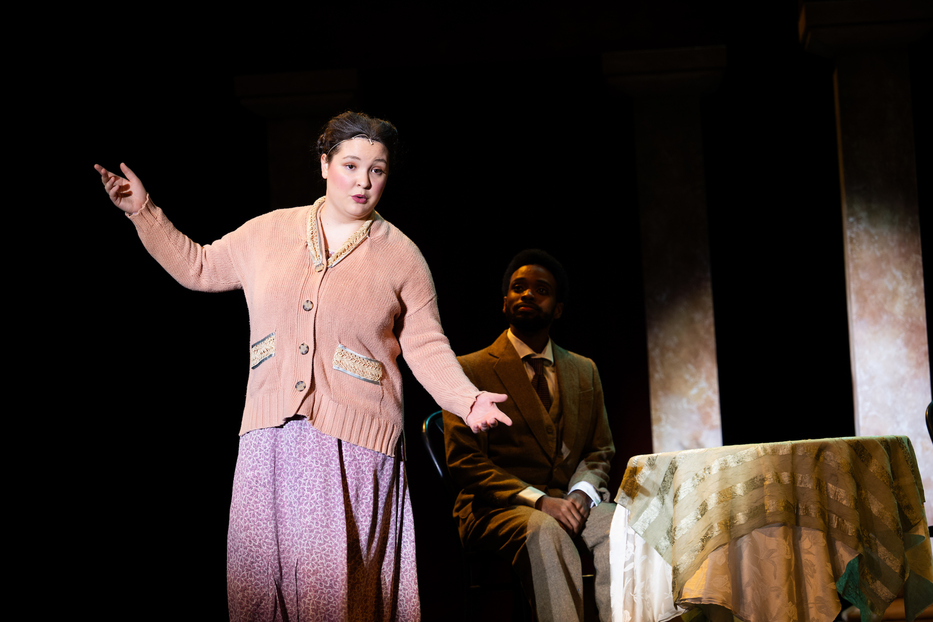
Set in a hedonistic night club in Weimar-era Berlin, Cabaret follows American author Cliff Bradshaw (Trey Griggs) as he becomes embroiled in the lives of the club. There is star performer, Englishwoman Sally Bowles (Aliza Clark); his landlady Frau Schneider’s (a highly capable Hannah Confalone) interfaith engagement to the Jewish Herr Schultz (a very sweet Matt Cabahug); and his new friend Ernst’s (a formidable and frightening Azaad Mamoon) Nazi affiliation.
Late in the musical, landlady Frau Schneider reflects on the betrayal at the heart of the story: the evil-doers out there are in fact none other than “our friends and neighbors.”
Isabel Chenoweth Photos.
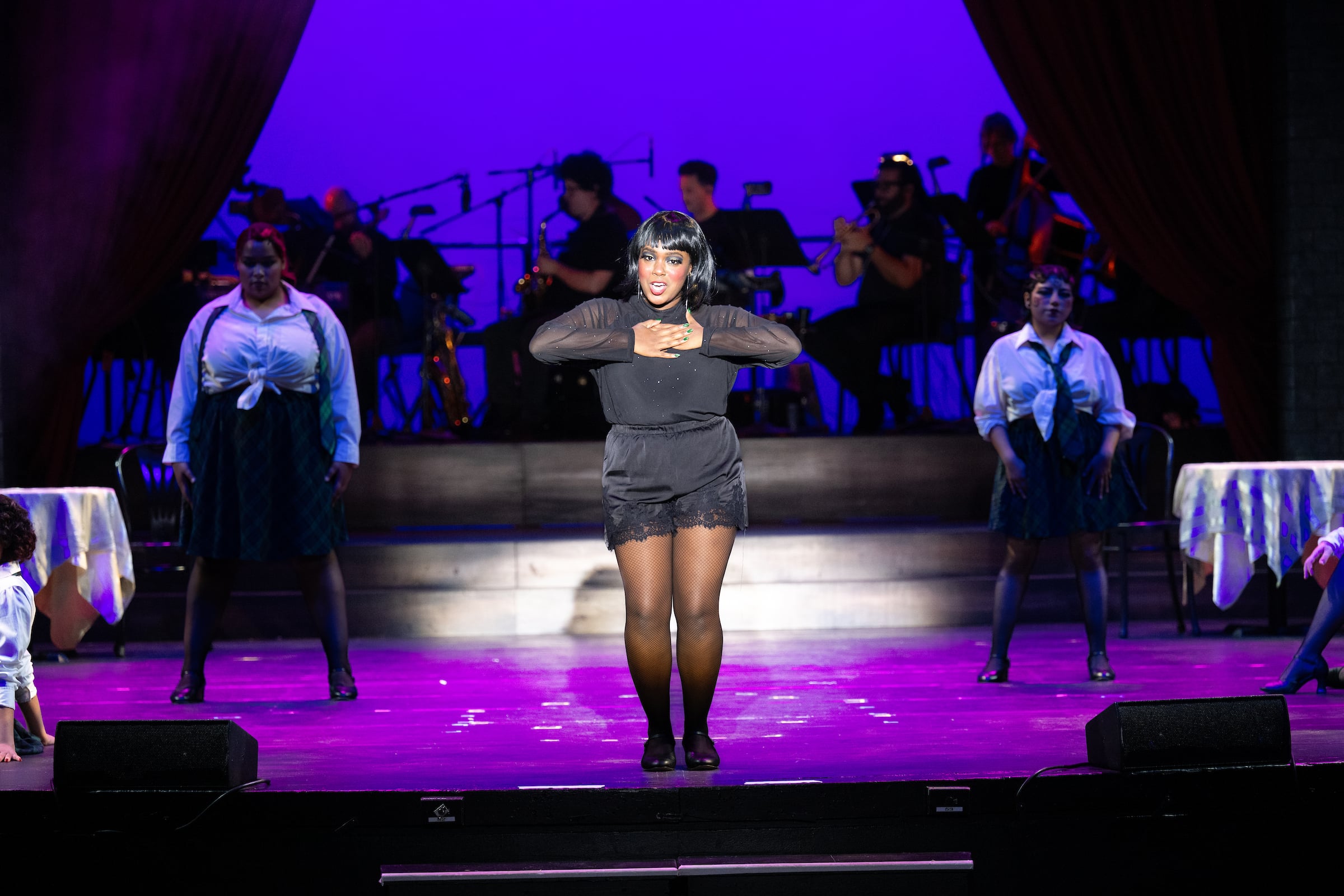
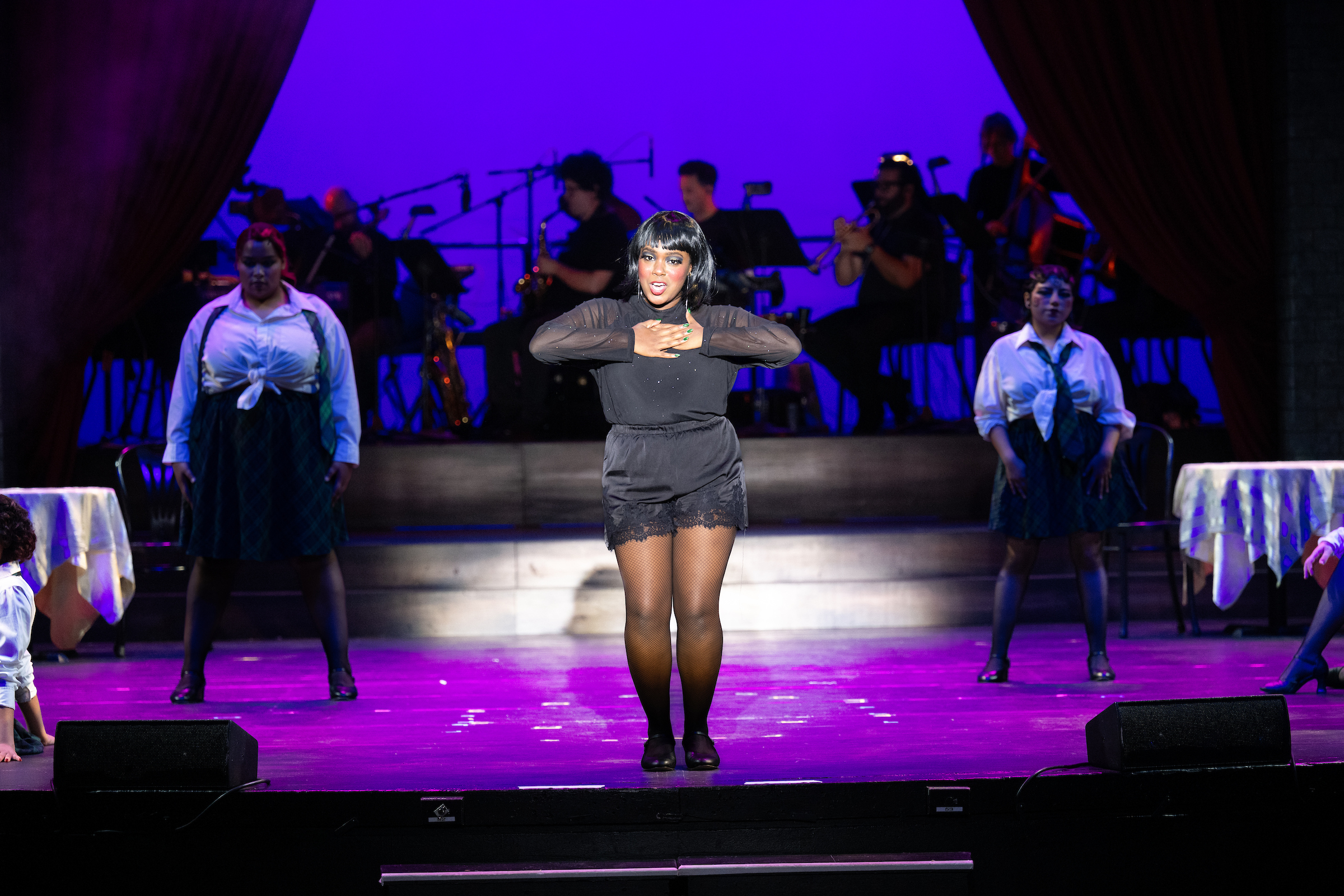
Leading the cast as the club’s—and the show’s—Master of Ceremonies, SCSU senior Jade McGovern makes it her mission from the moment she first slinks onstage to make friends and neighbors of her audience. Rather than blowing her viewers away, McGovern opts for drawing them in. She addresses the audience: “Meine Damen und Herren, mesdames et messieurs, ladies,” she sighs deeply, then adds begrudgingly, “und gentlemen.” Seemingly all-limbs, the Emcee is a strutting marionette with a mind of her own. McGovern brilliantly refuses to meet us where we’re at; she welcomes us in—into the tipsy-turvy world of the Kit Kat Club, where “life is beautiful” and all troubles can be left at the door.
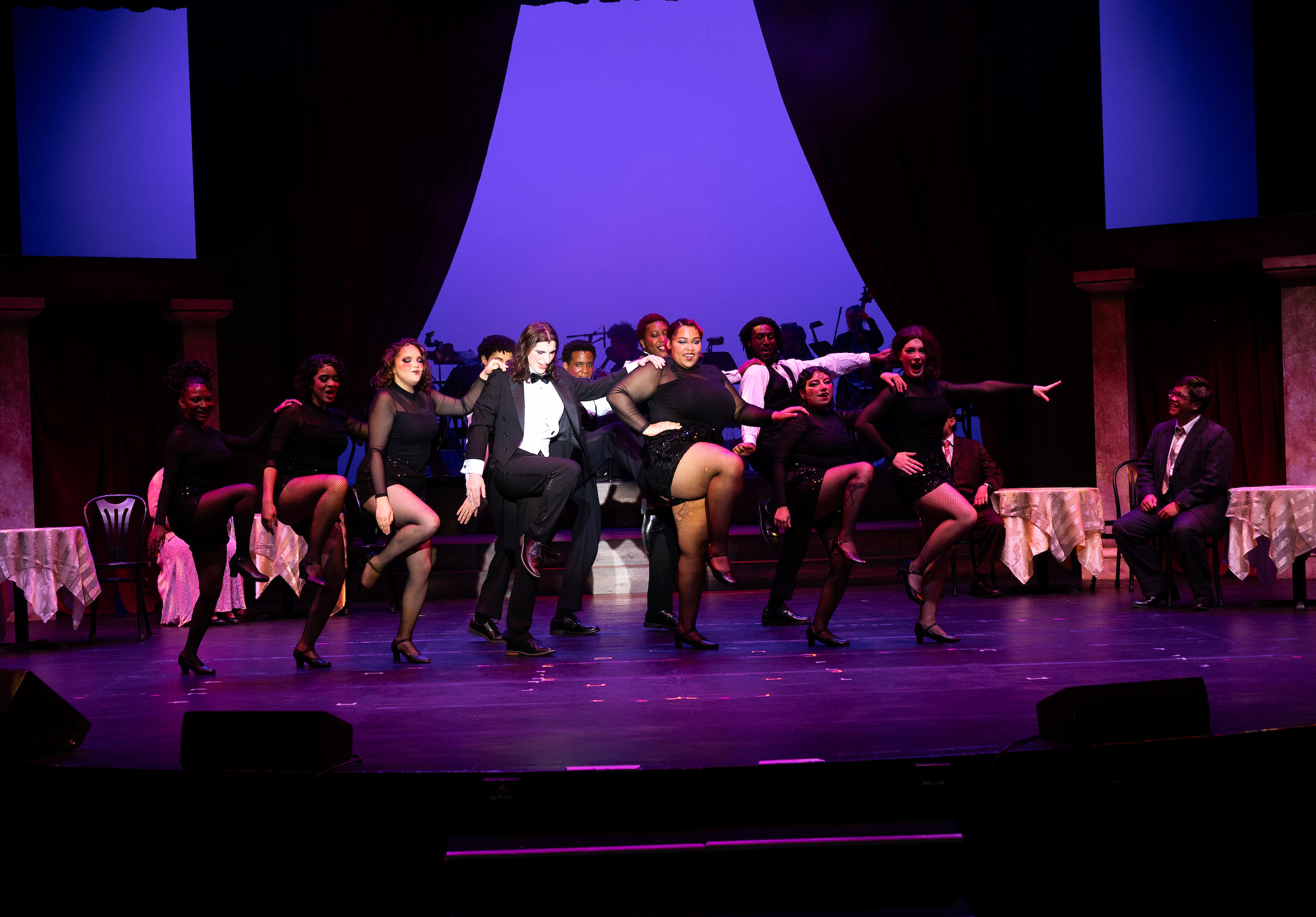
Yet troubles find their way in anyway, or maybe they were always there. Even as Nazism insinuates itself into the Club and the lives of those who live and work there, the Kit Kat dancers (an ensemble of ten triple-threat student performers and Clark) keep dancing. As sultry number follows sultry number, the dancers assume complicated, gymnastic poses, their shaking limbs a powerful testament to the intensive labor that performance requires in the name of making it all look so easy.
Witness to all this effort is Clifford Bradshaw. Cliff, as played with captivating presence by Griggs, is a Langston Hughes or James Baldwin-type—a Black (in this production) American author who has come to Europe to come-of-age, immersing himself in the political and sexual culture of another country to learn more about his own, and himself. Cliff, a novelist, describes the way his first book was damned with faint praise—it “showed promise” critics said.
Griggs’ performance must be described with much more enthusiasm. With little to sing and less to dance (as has become typical in productions of Cabaret, Cliff’s song “Why Should I Wake Up?” was replaced with Sally’s “Maybe This Time”), Griggs became the show’s emotional anchor. Even when Griggs was perched on a chair at the edge of the stage, watching, along with the audience, the Kit Kat girls dance, I found myself looking to Cliff—to his delight, confusion, or discomfort—to help me figure out how to feel.
Isabel Chenoweth Photos.
I wasn’t the only one. Bowles, the club’s star performer who becomes Cliff's lover, looks to Cliff with questions, but never seems to find the answer she’s looking for. She and Cliff are complementary opposites, as were Griggs’ and Clark’s performances on opening weekend. Where Griggs sits down, Clark flits about. Clark, as Sally, belts out showstopping numbers with the near-boredom of someone secure in her incredible ability to captivate a crowd with her voice; Griggs chooses quiet, heartfelt proclamations meant for an audience of one.
Under the direction of Larry Nye, Associate Professor in the Department of Theatre at SCSU, Cabaret felt most potent in small moments that bridged the gap between intimate gesture and public performance. Ernst slipping off his coat at a party, revealing the Nazi insignia on his arm, or the Emcee’s apologetic shrug before goose-stepping off stage, were gestures terrifying in their very casualness. (The giant swastikas projected onto the set at the end of act one, deeply upsetting to witness, felt like they belonged to a different show.)
The theater-makers behind SCSU’s Cabaret tell a story of infinite messiness and complexity that can sometimes only be captured by the simplest statements. “There was a cabaret,” Cliff writes out loud as he leaves Germany, “and there was a master of ceremonies and there was a city called Berlin in a country called Germany and it was the end of the world.”
Willkommen, bienvenue, welcome.
Catch the second weekend of Cabaret at SCSU'S John Lyman Center for Performing Arts Oct. 15-17. Tickets and more information are available here.