

Co-Op High School | Culture & Community | Education & Youth | Poetry | Arts & Culture | Theater | Yale Rep Theatre
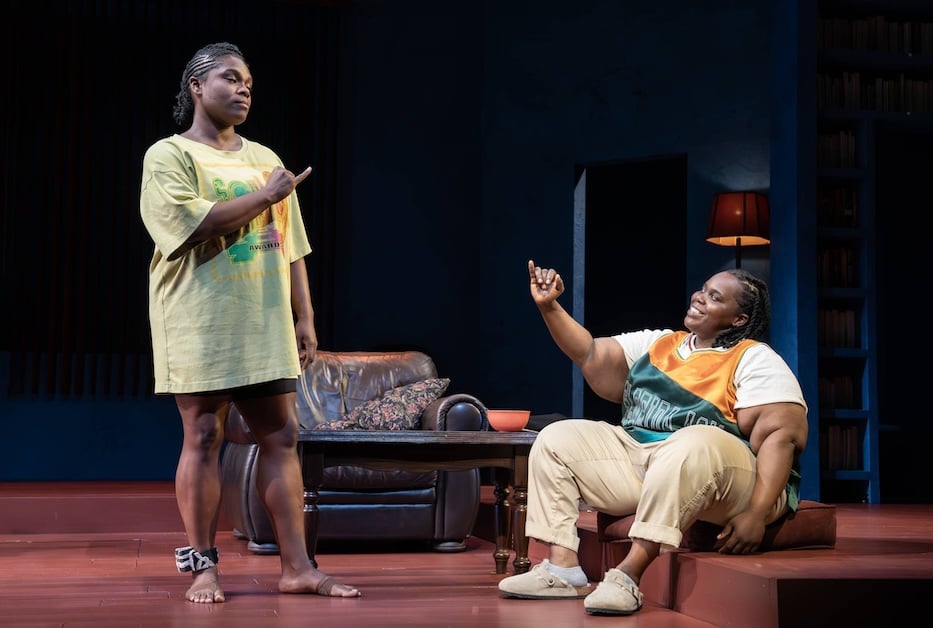
Lauren F. Walker and Tiffany McLarty in a scene from FURLOUGH’S PARADISE by a.k. payne, directed by abigail jean-baptiste. Yale Repertory Theatre, April 24-May 16, 2026. Photo © Joan Marcus.
On stage, two bodies staggered through space, their arms extending out, then recoiling back in. One, standing in a ghoulish light at stage right, pulled at soft, sock-shaped weights fitted around her body, like a hive-shaped dress made of stones. The other heaved herself towards a doorway, a dimpled basket fitted over her head, an eraser-colored, thick outfit swallowing her form. Music, ambient and instrumental, swirled around them, part of this garish waking dream.
Cloaked in the dark of the audience, Elodie Lafortune leaned in to catch every detail. She had never met the actors. But already, she had a sense that she knew how they felt.
Lafortune is a senior at Cooperative Arts & Humanities High School (Co-Op), where she is studying creative writing before heading to Dean College in the fall. Tiffany McLarty and Lauren F. Walker are actors in a.k. payne’s Furlough’s Paradise, running at the Yale Repertory Theatre through Saturday night. The play is a triumph that is as physical as it is poetic, with a sense of possibility that lasts long after the curtain has closed.
Tuesday morning, they came together thanks to the Rep’s Will Power! program, which invites students from the New Haven Public Schools (NHPS) into the world of the theater. For Lafortune, whose brother Amani passed away when both of them were still young children, it became a reflection of how theater, and the arts more broadly, can be part of a grief journey that doesn’t have an ending point, but simply changes size and shape over time.
Tuesday’s performance, which featured an animated talkback with payne, actors McLarty and Walker, and assistant dramaturg Layla Williams, welcomed students from Wilbur Cross High School, Cooperative Arts & Humanities High School, Metropolitan Business Academy, Engineering and Science University Magnet School (ESUMS) and New Haven Adult & Continuing Education.
“I think it’s radical and super important to have the space to dream,” payne said after the show, as Lafortune listened from the front rows. They looked to Robin D.G. Kelley’s 2002 book Freedom Dreams: The Black Radical Imagination, which traces decades of freedom dreaming across the Black diaspora. “All of the different movements that have existed throughout time have always been inspired by dreams.”
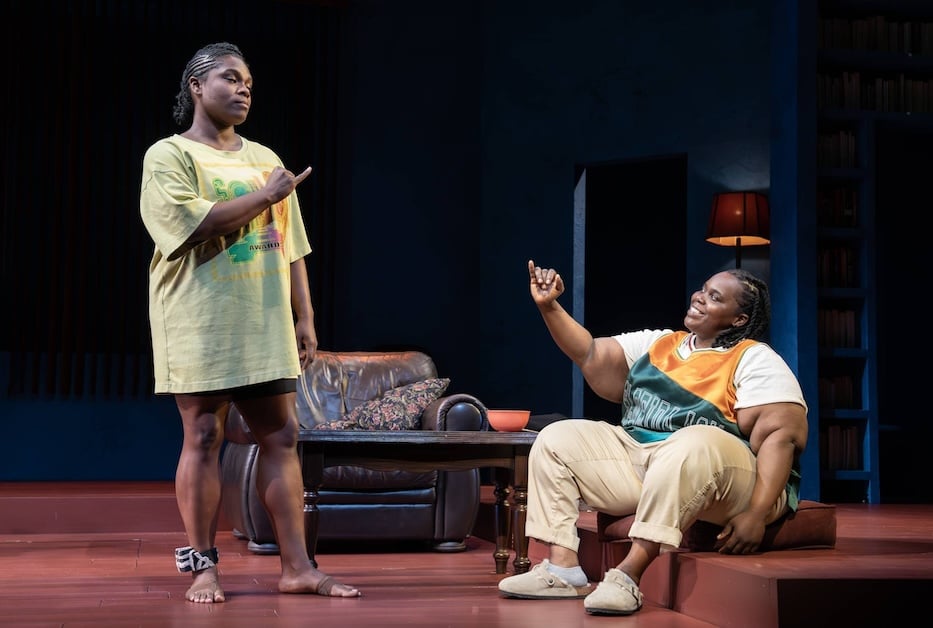
Lauren F. Walker and Tiffany McLarty in a scene from FURLOUGH’S PARADISE by a.k. payne, directed by abigail jean-baptiste. Yale Repertory Theatre, April 24-May 16, 2026. Photo © Joan Marcus.
So much of that, of course, lives within the play itself, which probes the twin abilities to grieve and dream freely within systems that are not inherently invested in freedom for anyone who is not straight, white and male. Set in “A Great Migration City” in 2017, Furlough’s Paradise tells the story of cousins Mina (McLarty) and Sade (a miraculous Walker), who have reunited to bury Sade’s mother, Lashonda Johnson. Even in Mina’s small apartment, there is so much that feels lived in and familiar here, as if a person could have ascended a staircase on Ivy Street and walked in on a family piecing itself back together.
At first, it seems that the two—once as close as sisters, as the onlies in each family—have lived very different lives: Mina is an Ivy League graduate who works for Google, and commutes between L.A. and San Francisco for a relationship. Sade is on a three-day furlough from prison, a maximum-security facility that is 100 miles upstate (that it’s just “upstate” works here: payne is telling us that this could be anywhere in the U.S., including New Haven, where we are 42 miles from the York Correctional Institution). While Mina has felt the loss of family members in the first person—first her father, Edward, and then her aunt, Lashonda—Sade has experienced it largely from afar, the carceral system a violent and punishing wall between her body and the rest of the world.
As payne deftly, lyrically peels back the layers of their grief—which sits dark and heavy over a shared ability to dream—it’s clear that their lives are more tightly intertwined than they or the audience may have initially thought. When Mina asks “Why can’t we just live?” exhaustion thick at the edges of her voice, the question holds whole universes. When Sade admits that “I do not understand what my voice sounds like when it is not encumbered by this nation,” the audience can feel the painful weight of a country not built for someone who looks like her, all the way to their bones.
A shout out here to both payne and director abigail jean-baptiste, who has interpreted the script with lyrical movement (choreography by Ogemdi Ude), deep physicality, and a rawness that spills beyond the stage, somehow both visceral and warm all at once. If it’s a hard tightrope to walk, the duo does it well, using movement to convey a shift from waking to sleeping, from conscious to unconscious, from one side of the veil to the other and back again. The sheer amount of work that has gone into it shows: this is an intensely physical play, from the opening to a final dream sequence close to the end.
“We were constantly generating!” Walker remembered of the rehearsal room in a talkback with students Tuesday. “Like, I’m getting calluses, we’re getting injured, I messed up my arm … We are up here crying, sweating, fighting for our lives.”
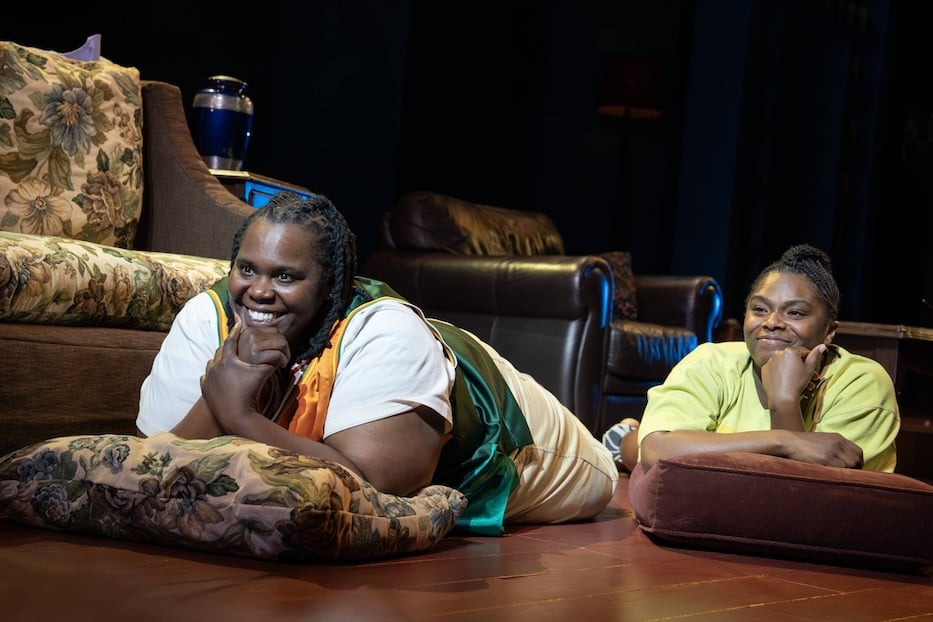
Lauren F. Walker and Tiffany McLarty in a scene from FURLOUGH’S PARADISE by a.k. payne, directed by abigail jean-baptiste. Yale Repertory Theatre, April 24-May 16, 2026. Photo © Joan Marcus.
Working with the creative team, both Walker and McLarty are dynamic, each committing to the character with a fierceness that makes it seem like they have been in these roles their entire lives. As Sade, Walker has a keen ability to find the poetry in both speech and silence, her face and body so expressive that a person can feel it across the full theater. She keeps her defenses high, so that when they crack, the audience wants to pick up the soft pieces that ooze out.
Across from her, McLarty has a presence that is so much bigger than a single human body, surrounded by a cloud of emotional exhaustion that the audience can feel. She’s so real, meanwhile, that you swear you know her: she's that friend down the street, or maybe halfway across the country, the one who is going places, the one who your family and your neighbors still talk about with big, bright smiles. For many of us in the audience (this reporter included), she may be the one who got out, who struggles as a fish out of water both at home and beyond it, who has learned that code switching is another word for survival. When she tries to explain her pain to Sade—who struggles to hear it—we feel for both cousins at the same time.
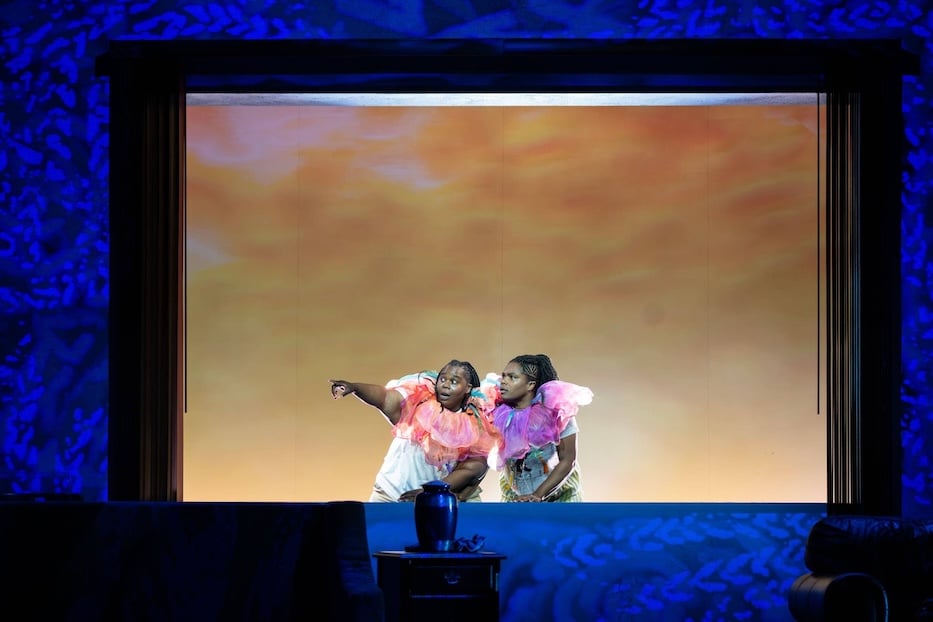
In this world, which is not not New Haven, there is a constant sense of propulsion, and the actors carry it beautifully. Take, for instance, the opening of the show, in which Mina and Sade drag themselves into the space wearing huge, weighted outfits—costume designer Rea J. Brown has referred to them as “grief suits”—over their all-black clothes from the funeral. Projections bathe the set in otherworldly swirls of color (kudos to projection designer Wiktor Freifield, who takes payne’s bent toward surrealism and runs with it, and scenic designer Anthony Robles). Music fills the space, working itself into every crack and crevice of the apartment. The light is spectral, as though the audience and the actors alike are suspended somewhere between this universe and another. And there are shelves and shelves of books, their pages turned out at the audience, a sort of invitation.
As Mina, Walker lurches forward, one hand extended, fingers stretched out, a gleam in her eyes that doesn’t seem quite human. She repeats it, not fully in control of her own body, until she begins to pull at the weights holding her down. In the audience, we think of handshakes, of helloes, of meetings, of all the ways people (women, and especially Black women, and especially queer Black women) must make themselves small on a daily basis. Behind her, McLarty’s Sade is a revelation, twitching at the shoulders and neck with an eerie, mechanical precision as she struggles to make it through the front door. When at last she lifts a basket over her head, there’s a sense of breath, flowing in and out, like the play can at last move forward.
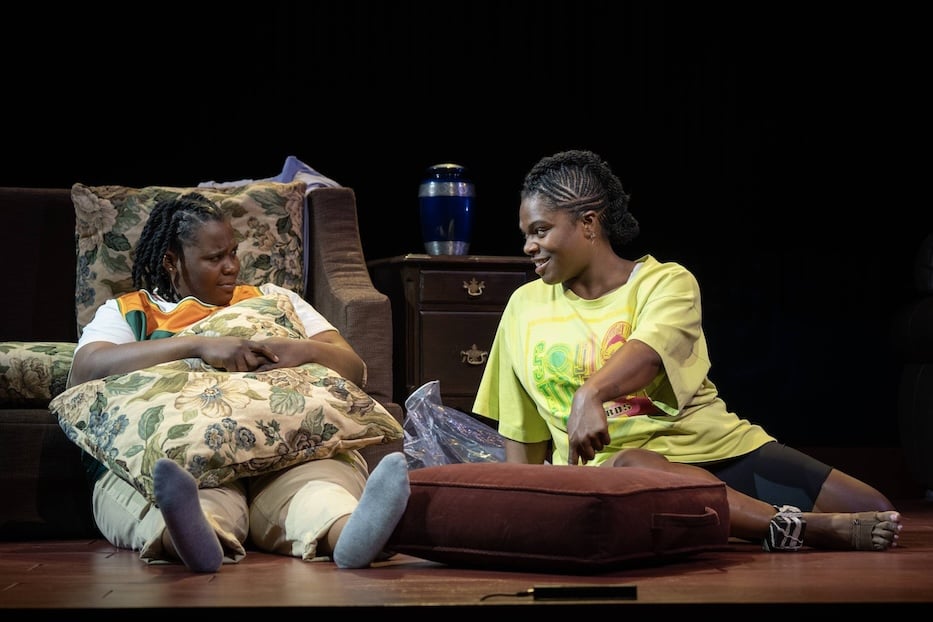
Lauren F. Walker and Tiffany McLarty in a scene from FURLOUGH’S PARADISE by a.k. payne, directed by abigail jean-baptiste. Yale Repertory Theatre, April 24-May 16, 2026. Photo © Joan Marcus.
Even as the scene snaps into reality, a cloud of questions surrounds them: Who do these women belong to? What suits have they donned and shed in this world that does not accommodate their grief any more than it does their Blackness? How have they had to make themselves small, to sublimate the most fundamental parts of their humanity, for the comfort of those in power around them?
In the audience, we see payne ask this again over and over: as the two dip in and out of fitful sleep, turning the set into a surreal, physical map of their subconscious, as Mina imagines her gender-less children and defends her white girlfriend until she doesn’t, as Sade's vision of a liberated world takes shape somewhere between the pull-out couch, the fruit-stocked refrigerator (a liberated world has fresh fruit; prison does not) and the perennially rickety shower handle in Mina’s bathroom.
Extending her hands, she conjures a world of shared things: shared housing, shared land, shared space for children to play. The sharp, gnashing teeth of late-stage capitalism—of a country founded on the theft and trafficking of people and land—are nowhere to be found.
Tuesday, Lafortune watched with bated breath, soaking in every detail. Even before the house went dark, she listened patiently to a voiceover that encouraged breathing among audience members, taking a beat beside her peers in the darkened theater. She watched Mina and Sade make their way into the apartment, their bodies suspended somewhere between this world and another one entirely.
She listened to the language, clocking the force and poetry (and warmth and humor, of which payne provides plenty) in nearly every turn of phrase. On stage, Sade stretched space and time, conjuring an image of Mina’s father, Edward, that was vivid enough for both of them to see. She made a gesture, and there was was Mr. Eddie back on his porch, “blasting Louie like he was tryna reach God.”
Minutes later, Sade recounted her work as a library manager and impromptu algebra teacher at the prison (if there is such a thing as a Bettsian vibe, this play has it). Mina listened, nodding along, taking it all in. But she spoke again, it was like she was unstuck in space and time, only able to remember Sade in a time of her life before prison. Lafortune listened carefully, to see what would happen next.
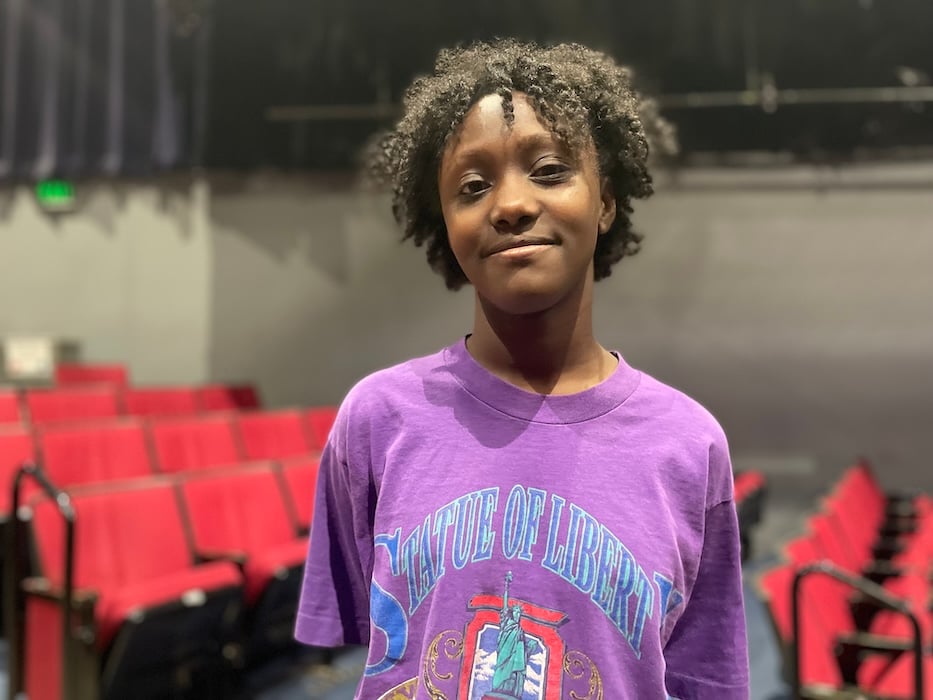
Elodie Lafortune. Lucy Gellman Photos.
“You don’t have to talk about me in the past tense,” Sade snapped back, tacitly encouraging both Mina and members of the audience to think beyond the violence and erasure that is built into the American carceral system.
As the play deepened, Lafortune stayed with it every step of the way. She let the poetry of lines “it’s like my heart is moving faster than my mind” and “what y’all got in your utopia?” and “I felt like my body was extending from the beginning to the end of the sky” wrap around her. She made mental notes as payne dropped cultural references including “The Proud Family,” “Fresh Prince of Bel-Air,” and the Cheetah Girls. She let the cousins’ world expand with their dreams, feeling out their utopia as they imagine it in real time. The poppy, buoyant sound of the 1990s filled the house.
As time crept back in, she watched the two dream forward and then windmill themselves back to childhood, building a blanket fort that glowed from the inside, full of warm and honeyed light. She delighted as they began to remember their parents in voiceover, these now-familiar voices filling the theater. She soaked in the marbled, luminescent blue of stained glass that bloomed over the tent, the gut punch of a correctional officer knocking sharply at the door.
When they held each other for a goodbye, she watched an audience hold its collective breath, as if they could keep the cousins there, together, if they just stopped time for long enough.
Throughout, Lafortune thought about her little brother, Amani, who passed away from osteosarcoma in early 2020, when he was just seven years old. To keep his memory alive, she and her family keep pictures of him around the house. They talk about him, aware that memories are living things. “We remember him, and you know, we celebrate him. We do the things that he would like to do.”
“It was a really good play, and I feel like it really touched the grief,” she added. For her, to see grief and dreaming side by side was equally powerful: Lafortune wants to be an essayist and novelist, with a focus on both fiction and political and intellectual criticism.’
“Especially with anti-intellectualism and the state of like reading and illiteracy in this country, and how the political world is turning, I feel like art is the thing that is gonna save us,” she said afterwards, with that same understanding that grief and dreaming can sit side-by-side. “We have to keep the artists alive, despite anything that the world throws at them.”