

Culture & Community | Poetry | Storytelling | Arts & Culture | Yale Rep Theatre
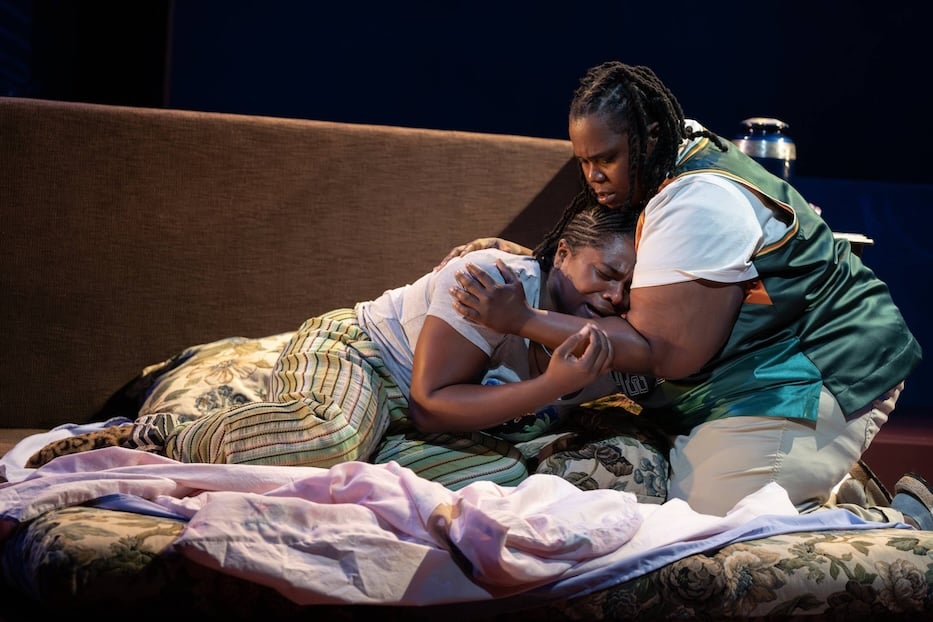
Lauren F. Walker and Tiffany McLarty in a scene from FURLOUGH’S PARADISE by a.k. payne, directed by abigail jean-baptiste. Yale Repertory Theatre, April 24-May 16, 2026. Photo © Joan Marcus.
My chest carried a headstone as I left the Yale Repertory Theatre Saturday night. Sorrow was etched into me.
That moment came during, and again after, Saturday evening’s viewing of Furlough’s Paradise, written by a.k. payne and directed by abagail jean-baptiste at the Yale Rep. Throughout, the work resisted passivity; it demanded complete inhabitation.
The play follows cousins Mina (Tiffany McLarty) and Sade (Lauren F. Walker), who are each other’s closest kin after the death of both of their parents. Mina is the seemingly better-off cousin who graduated from the Ivy League. She is responsible, even providing Sade with a place to stay for her mother’s funeral. She can afford a bicoastal lifestyle and rental properties because she makes animations for the tech conglomerate Google.
Sade, on the other hand, is the “lost cousin” on a three-day furlough from prison to bury her mother, Lashonda—for whom Mina has cared in her final days. We never learn the exact details of her crime, but we are made intimate with her desire for freedom. It’s a freedom she thinks that Mina was unfairly afforded (and has taken for granted) because her father, Edward, placed no limits on her life.
Or as she screams in frustration at one point, Mina’s life was “fucking rigged!”
Saturday, that complex relationship came to life at the Rep. The moment Mina and Sade emerged on stage, cast and crew submerged the audience in a pain as deep and stirring as the blue of the stage’s whirling backdrop. We ceased being an audience and became long-lost family members joining the cousins in mourning.
As the piece opened, Mina and Sade embodied grief’s absurdity. Struggling to shed indiscernible, cumbersome “grief suits,” they stumbled back and forth. Mina’s costume was covered in unidentifiable attachments and swung heavily across her body. Sade’s was topped with a bucket that swallowed her entire head.
Once freed, they wasted no time bearing resentments as they clumsily negotiated their nuanced grief.
“Your daddy was trying to dream you white,” accused Sade, her eyes glinting with satisfaction at the mixture of shock and hurt on Mina’s face.
“You made your choices,” Mina shot back in a later scene.
Defensive, Mina described a fearful reality: a colorless life constrained by white people’s expectations, fraught with unsafe spaces including a long-term romantic relationship. “I don’t think she’s even seen a Black girl cry,” Mina disclosed about her white partner, Chelsea.
While Mina revealed her trepidation over meeting Chelsea’s MAGA parents and fretted over future offspring, Sade simultaneously ribbed her for Chelsea (who, insult to injury, is vegan) and dream of someday having mixed, genderless babies.
“I’d be mad as fuck if my whole room was orange,” she exclaimed after learning details about Mina's dreams for her future babies. The audience and Mina broke out into raucous laughter as the play’s heaviness momentarily lessened.
So many tender moments like this In Furlough’s Paradise revealed the sly beauty of payne’s lyrical writing.
Utilizing the elusive language of loss to give contour to formless sorrow, payne still manages to leave space for unexpected flashes of joy. At Saturday's performance, the impact of grief’s dual nature resonated throughout the evening.
Amidst intense scenes in which the cousins traded tales of woe, Black pop culture references from John Coltrane’s “Naima” to the depiction of Martin Lawrence and his love, Gina (actress Tisha Campbell) on "Martin" bubbled to the surface, providing a grounding comfort to soothe the disquiet. The production achieved the feat of feeling lived.
Director jean-baptiste and various designers provided a visually rich setting that enveloped the audience in Mina and Sade’s emotional volitivity and guided us along the uncomfortable terrain.
As the cousins warily caught each other up on years and years of their lives, the stage breathed with them. Sometimes the lights cut off, plunging the audience into darkness as Sade detailed the inhumanity of her imprisonment or the despair of giving up her daughter Paradise.
Other times, the lights warmly spotlighted the cousins as they arrived at epiphanies that drew them closer.
“I’m really fucking scared of being alone,” confessed Mina in a scene.
“I know a whole lot about being scared of being alone,” Sade replied tenderly.
When vivid nightmares hounded the cousins, those scenes were rendered through surreal color-shifting backdrops and turbulent choreography.
As much as they were plagued by nightmares, the cousins also found refuge in speaking hope out loud. Sade revealed that she and her girlfriend G dreamed of creating a utopia, a “United States of Free Formerly Incarcerated Black Girls” where they would live Blackly, queerly, and freely. Mina doesn’t understand why Sade is so full of ambition yet won’t use her three days of freedom to enjoy the outdoors.
“The sun makes the rest unbearable,” Sade gravely stated. She expressed the need to simply be; let her inhale her sugary Cookie Crisp cereal while reveling in a marathon viewing of “The Fresh Prince of Bel-Air” in peace.
As Furlough’s Paradise crept toward its ending, the mood turned sentimental. Mina and Sade became kids again, throwing a diaphanous white sheet over furniture to create a fort. Huddled near the television, they giggled themselves into a weightless peace.
But the mood under the sheet turned somber once again when Mina and Sade took turns reading their respective parents’ obituaries. A stained-glass window was projected onto the sheet. The cousins stepped out, bearing flowers that they laid, ritual-like, across the stage.
Then, there was an ominous knock at the door and the sheet was sucked into the floor. Reality reared its ugly head; there was no more time for mollifying make-believe.
Delaying the inevitable, Mina and Sade lovingly squeezed one another under stark lights. Their sobs thickened the atmosphere as they traded promises and words of wisdom.
By the end, grief became something that the cousins moved through together – rough and uneven, but also curiously soothing. In that space, sadness did not disappear.
It reverberated, transformed, and left behind something like grace.