

Culture & Community | Hamden | Arts & Culture | Youth Arts Journalism Initiative | Literacy | Hamden Public Library
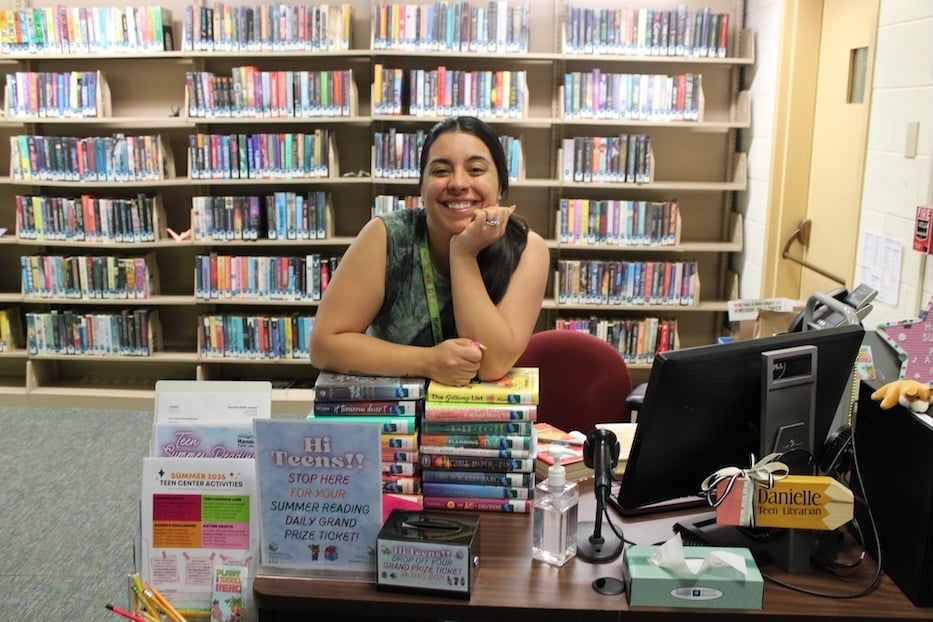
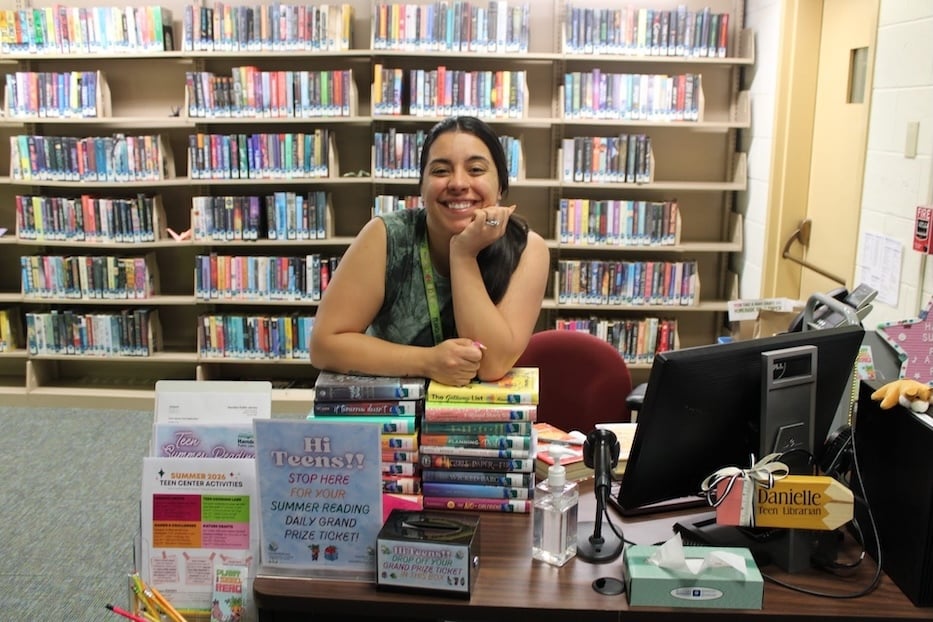
Danielle Sekas, teen librarian at the Hamden Public Library, at her desk. Samir Iydroose Photos.
On a normal day, rising freshman Ornpicha and her sister, Alice, read for about 30 minutes a day. They head to the library whenever they run out of books, or spot a program that looks interesting.
But this summer, the two are spending more time delving deep into literary worlds, thanks to the Hamden Public Library’s (HPL) 2026 Summer Reading Challenge. Titled “Plant A Seed, Read!” the challenge runs through August 17 at all three branch locations of the Hamden Public Library, with prizes for readers of all ages. It began June 22, just as schools let out across the town, with a magic show and kickoff celebration. It will conclude with ice cream and bingo in August.
So far, about 400 people have signed up to the challenge, though this number could be greater as people can sign up online. Last year, about 300 children participated, and 400 or 500 people overall, according to Marcy Goldman, the head of the children’s department at the HPL.
If you want to participate, you can go to any of the three branches—that’s the Brundage Community Branch, the Whitneyville Branch, and the Miller Memorial Library—and pick up a pamphlet to log your reading, then use it to note whether you achieve a goal of your choice. There are weekly and challenge long prizes; learn more about those here.
Samir Iydroose Photos.
Planning for the Summer Reading Challenge usually starts in February, said Goldman. To make it happen for readers of all ages, Goldman works closely with Teen Librarian Danielle Sekas and Digital Navigator and Library Technical Assistant Matt McGregor, who does a lot of work between the departments.
There are three age groups: children aged birth to sixth grade, then teens, who are 7th to 12th grade, and adults. Having an avenue for adults to participate was really important to McGregor.
“We want everyone to have something to do and to have ways to reach more patrons and build stronger relationships between librarians and patrons,” he said. “Also, kids have fun things; adults should have fun things too.”
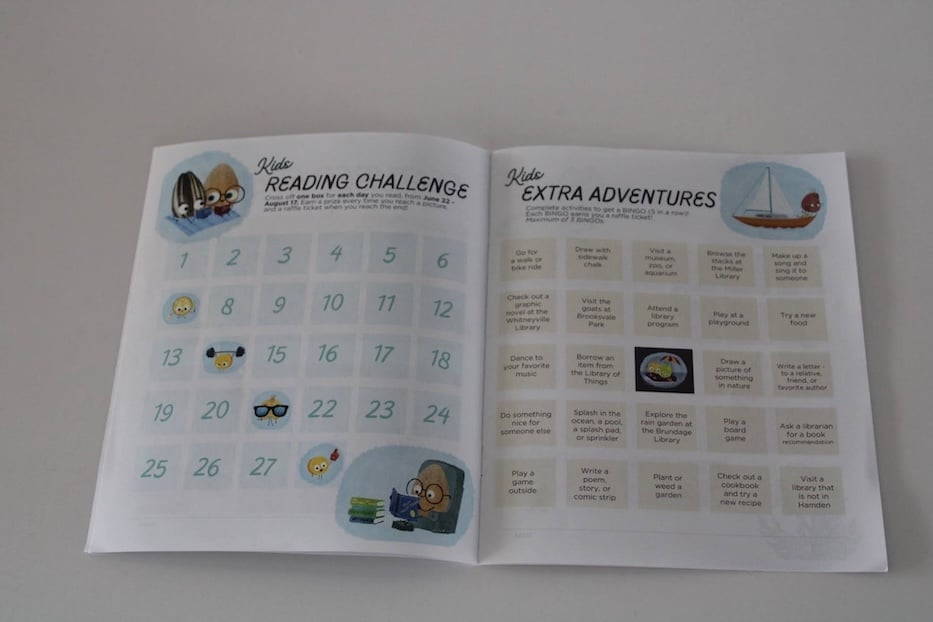
Meticulous consideration was also taken when designing the “gameboard,” or tracker pamphlet, such as the incentives participants earn, and how to measure reading, Goldman said, emphasizing the importance of accessibility.
“We chose to use days instead of hours or minutes because there are some people who can read five chapter books or a novel in a day, and some are struggling readers, so using days equalizes that,” Goldman said. “Standardizing it so it is days also means we can use the same gameboard for the kids and adults [and teens].”
The gameboard is 12 pages long, with six pages devoted to spreads for tracking the 28 days of reading and to a bingo board for each of the three ages. It features many illustrations of flowers, vegetables with faces, and other foliage. It also includes a list of events hosted by the library and a guide for completing the challenge.
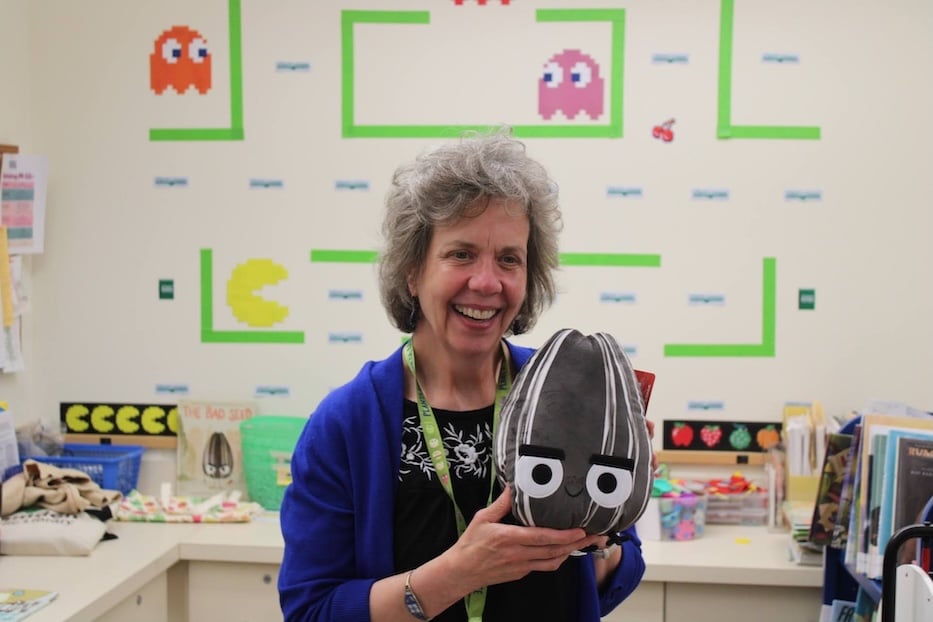
Melissa Canham-Clyne holding the Bad Seed, a character made by Jori John and Pete Oswald, both working for iREAD. Samir Iydroose Photos.
Many of the elements are the same as last year, said McGregor, although the prizes change each year, as do some of the challenge’s finer details. This year, the theme of “Plant A Seed, Read!” came from Illinois Reading Enrichment and Development (iREAD).
This year, the programming ideas are related to the environmental sciences. Much of the iREAD-provided programming has not been implemented for adult and teen programs, but there will be some children’s programming, like an activity where children paint terracotta pots and plant seeds in them or assemble faux succulents. Teen and adult departments used the “art assets and the parts about theming” in the iREAD resources, according to McGregor.
“It is important to choose a goal that is realistic,” said Sekas, when asked about the challenge. “Audiobooks or physical books, or any kind of reading works. Also, if you don’t like a book, stop reading it. If it is for fun, you are under no obligation to finish a book.”
McGregor directed prospective readers to “come to the library, introduce yourself to the librarians, to help you find a book; librarians are friendly, and none of us bite.”
Melissa Canham-Clyne, the director of HPL, advised readers to “approach reading as about stories and not focusing on the clock or the page count.”
“Growing up, I hated reading, but I loved stories,” she added. “So my advice is to think about a book as the story and language you are getting out of it.”
All of the librarians involved in organizing the challenge noted that they think that summer reading is critically important. Sekas pointed to the documented summer slide phenomenon, in which students can lose reading levels over the summer if they don’t continue working on literacy development. Having a challenge like Hamden’s can prevent that regression, she said. It also brings people—including families like Ornpicha and Alice, who came with their mom, Tanya—to the library.
“My favorite part about being a children’s librarian is being able to see kids get excited about reading,” Goldman said. Summer reading can do just that.
“Summer reading is an opportunity to explore worlds you want to explore on your own timeline. You can find what you like in reading and characters,” added Canham-Clyne.
She also acknowledged that summer can be a lonely time. “You don’t have school, and the people you’d talk to there, and people are also going away, and having a good book can make you less lonely,” she said. She added that parents who want their kids to be readers should model that behavior.
Many people participating in the challenge are also really excited about it. Tanya really likes how the bingo board can give them things to do. “It generates a lot of activities,” she said.
Tanya also appreciates how it makes her kids want to challenge themselves. “Normally, they read 30 minutes a day, but now they want to do more.”
McGregor ended by saying that “there is a book for every reader and a reader for every book.”
This article comes from the ninth and current cohort of the Arts Council's Youth Arts Journalism Initiative (YAJI). From June 29 through August 21, YAJI students pitch, report, write and edit stories with Arts Paper Editor Lucy Gellman, Program Assistants Abiba Biao and Grayce Howe and Mentor Ruby Szekeres. Samir Iydroose is a rising junior at Hamden High School.