

Culture & Community | Arts & Culture | Theater | East Haven | Cabaret On Main
Photos courtesy of Cabaret on Main Theatre.
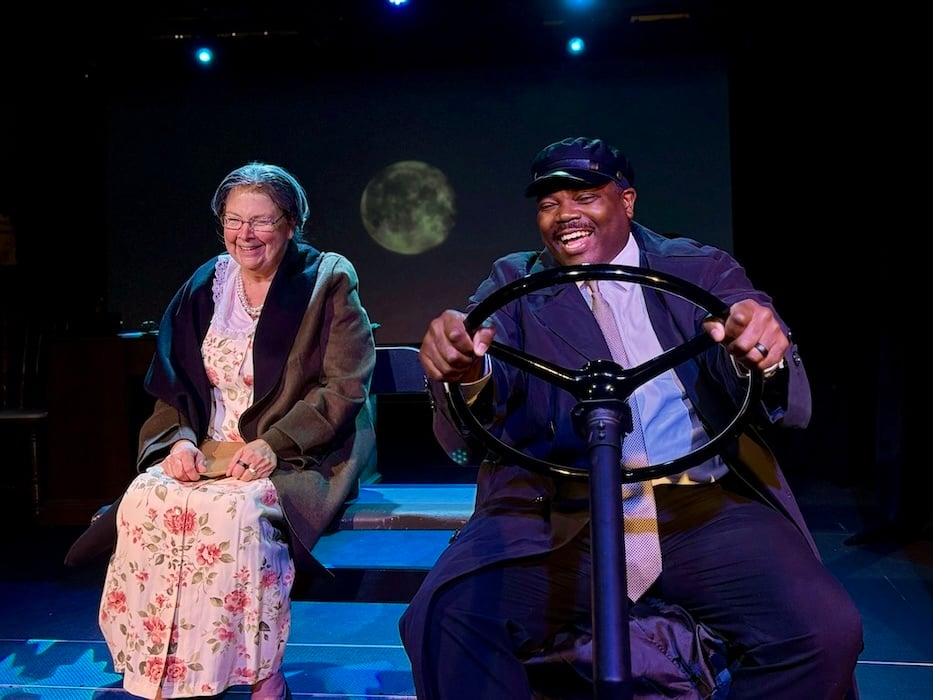
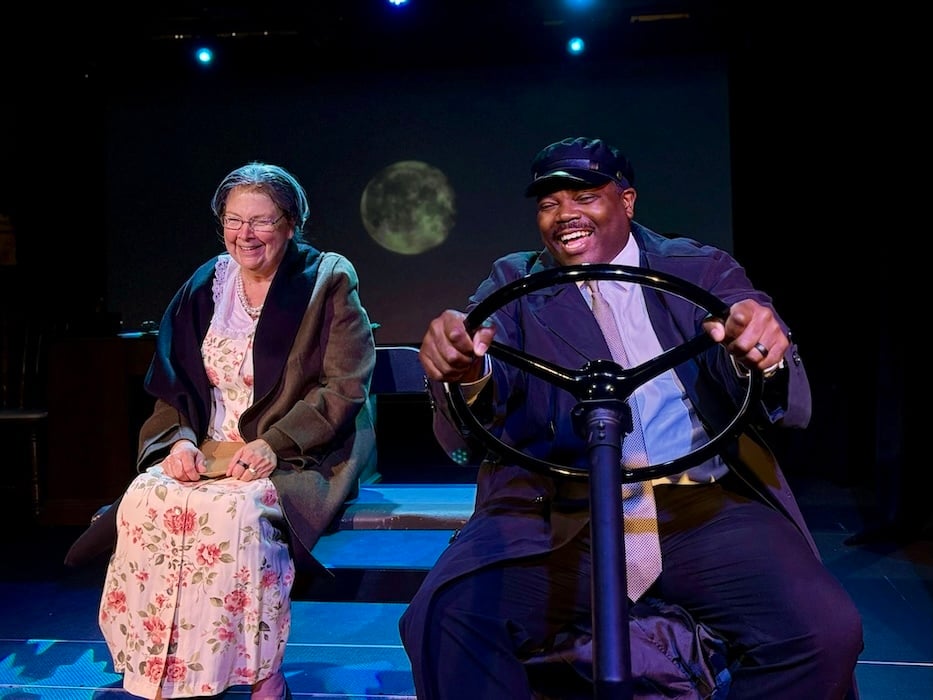
Daisy Werthan and Hoke Colburn trade anecdotes with each other, dipping in and out of Southern history as the conversation unspools between them. Daisy turns back the clock to 1888, and the first time she saw Mobile, Alabama as a young child. Hoke, listening intently, conjures his daughter, whose marriage to a Pullman Porter means she has traveled all over the country. Around them, 1954 is in full bloom.
“Ain’t it silly, the things you remember?” Daisy asks, laughing softly, and for a moment the words just sit there, round and glittering and so certain. Then the two blink, and the moment is gone.
Remembering, and forgetting, and the imperfect weight of history all sit at the core of Alfred Uhry’s 1988 Driving Miss Daisy, running at the Cabaret On Main Theatre Thursdays through Sundays through October 4. A sometimes-cheeky, often emotional look at Southern racism, the performance is surprisingly affecting, asking questions about who gets to assimilate, who does not, and who gets left behind.
The work, directed by actor, educator and filmmaker Nick Rapauno, is a production of the Broadway On Main Theatre Company, which lives beneath the Cabaret On Main umbrella. For both Rapauno and Cabaret co-founders Billy DiCrosta and Neil Fuentes, it’s an opportunity to talk about the way racism, antisemitism, elder care, aging, and loneliness all show up in the country’s current political environment, just as they did decades ago.
“Look at the world that we’re living in,” DiCrosta said before a tech run last week, as actors slipped into costume and checked their mic packs backstage. “I think antisemitism is at an all-time high right now. So is racism. It’s our job to bring this to the audience,” where it can catalyze conversation that lasts long after the lights have gone down and the final bows are over.
Photos courtesy of Cabaret on Main Theatre.
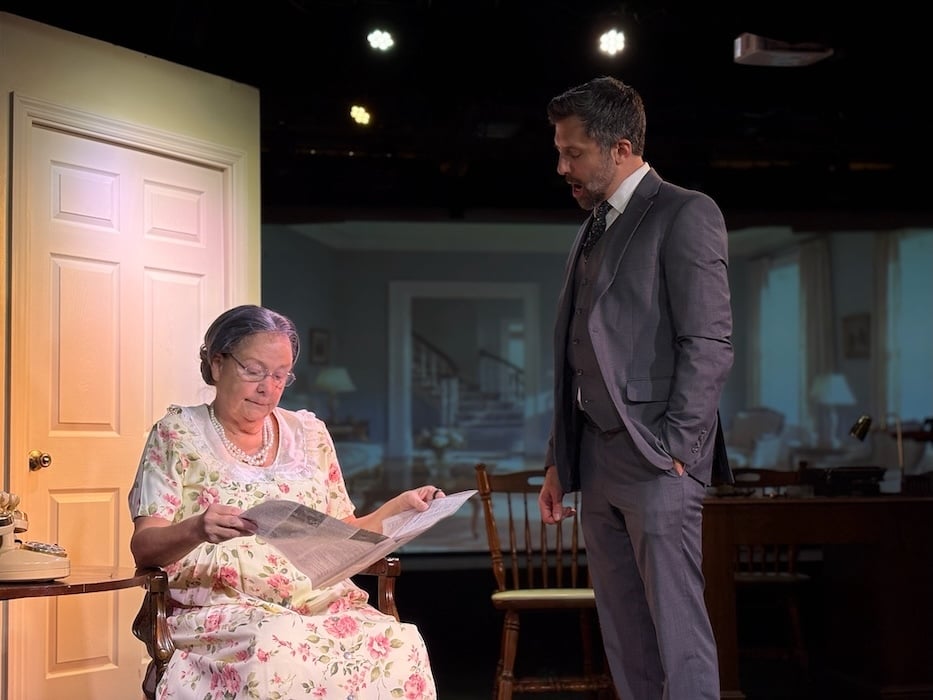
Told over a tight two acts, Driving Miss Daisy criss-crosses 25 years as it jumps from 1948 to 1973 in a rapidly changing Atlanta, where the pace of civil rights work seems as languid as the thick, oppressive summer heat. As the show opens, the titular Daisy Werthan (Debi Freund) is grappling with her entry into older age, which as of late has caused an unwanted lawn job and totaled car. Her son, Boolie (Jamie Carson), is trying to convince her to hire a driver, like many of her elderly friends.
Daisy, in whom Uhry said he saw his grandmother, Lena Guzman Fox, is also Jewish—an anecdote introduced near the beginning that becomes a narrative pillar of the work.
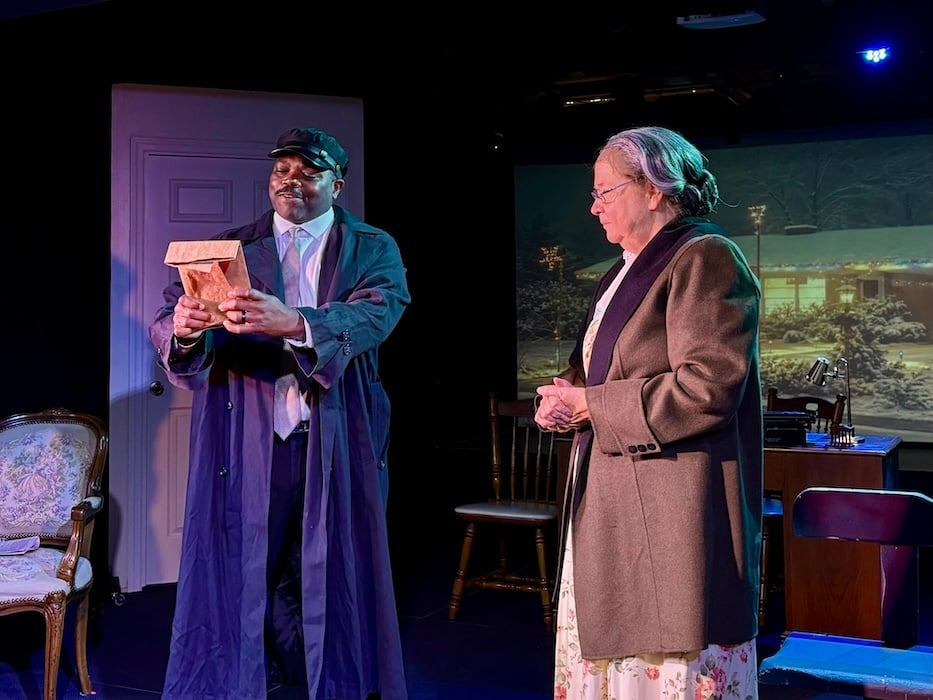
She is also not one to acquiesce: she pushes back against the idea of a driver, fiercely tied to both her independence and her pocketbook (she can still remember, after all, growing up without much money—a refrain in which many audience members may see their own elders). So when Boolie hires the endlessly patient Hoke Coburn (Marvin “MJ” Jones) as her chauffeur, she’s not thrilled. It’s not clear if he is either: Jones’ depiction is quiet and even-keeled, even when making clear that racism still exists around and between them.
What follows is a story of both care work and relationship building that is cross-cut with the realities of racism, antisemitism and capitalism, forces that are still very much at play nearly four decades later. Hoke, played by Jones in a key that is as empathetic as it is reflective, is the only Black character in the show, save a housekeeper named Idella who we never see onstage. The Werthans, who have climbed the social ladder into the upper middle class are Jewish, but at a time when they get to be white and Southern before their religious identity.
What feels significant about the play, the first in Uhry’s Atlanta Trilogy, is that it is both a time capsule and very much a living thing, timely precisely because history has a way of slipping backwards and repeating itself. When Uhry first wrote the show, he was reflecting on his own lived experience as a fifth-generation European Jew in the American South, a period that included the wider acceptance of Ashkenazim, or European Jews, as effectively white.
Photos courtesy of Cabaret on Main Theatre.
That history is thick and complex (and arguably, has been scrubbed from the movie more than it has the play): manyJews’ assimilation into the white mainstream did not happen without a departure from some of the deep solidarity work between Black and Jewish people that took place in the nineteenth and first half of the twentieth century. That rupture, decades later, is still painful—particularly as the current administration uses whiteness as a weapon, and simultaneously works to push Jewish people back to the fringes.
Uhry’s Atlanta was one where his family, at least by the time he was born, was well established in the middle class. In Daisy, a former educator who has worked her way out of meager circumstances, an audience member can see the bent toward assimilation happening nonetheless (or maybe it has happened before the curtain opens): she references pork chops and crab boil and revels in a tinsel-decked, brightly lit Christmastime Atlanta—all while making time for weekly synagogue services.
The audience, meanwhile, watches her son—one more generation removed—distance himself from his Jewishness even further, both professionally and personally. Carson, without ever being heavy-handed, makes that shift into a kind of itchy conservatism with nuance, showing an audience how that generational change happened when no one was looking.
“I was raised, pretty much, to think of myself as Southern first, American second, and Jewish third, which was very confusing,” Uhry told RoughDraft Atlanta last year, and it absolutely echoes here. “I was brought up with Christmas trees and Easter egg hunts – no Seders, nothing like that – but with a Jewish heritage, and a Jewish face. I was clearly Jewish, but I kind of wasn’t. “
If Hoke is a less robustly developed character in the script, then Cabaret on Main can thank Jones for bringing complexity, subtle humor, thoughtfulness and wit to the role. Indeed, he, with Freund and Carson, has turned to the script as a document that he is genuinely interested in exploring, sometimes through tears that have come mid-rehearsal, or at the end of a particularly charged run.
“It’s such a powerful and emotional story to be a part of, and that’s amazing,” said Jones, who grew up watching Driving Miss Daisy with his mom when he was a kid growing up in Hamden.
A few years ago, he learned about Cabaret on Main through his daughters, who at 14 and 10 years old both love to act. While they were in rehearsal, he would work remotely in the theater’s lobby. At some point, he realized that he wanted to act; Driving Miss Daisy is his first significant role.
“I knew when he used to sit here doing his job that he belonged onstage,” DiCrosta joked, a little twinkle in his eye, during an interview at intermission.
Freund, who for years served as the director of Equal Employment Opportunity (EEO) and Diversity for the Connecticut Department of Children and Families (DCF), agreed. For her, the role speaks to a period that—although she was much younger than Daisy is in the show—she lived through, and was forever impacted by.
In just 25 years, she noted, the script folds in historical events that range from postwar America’s recovery to the 1958 bombing of Atlanta’s Hebrew Benevolent Congregation to the Civil Rights movement to continued and de facto segregation and horrific anti-Black violence in the American South to the Korea and Vietnam Wars. She remembers all of it, including how tumultuous it felt at the time. Now, she said, people don’t seem to realize the significance of how much happened—and the fact that they don't want to go back there.
“What an incredible role,” she said. She added that while she wasn’t raised Jewish, she has a feeling that her German-American family was, but that their history was lost as Jews fled Europe, lost their lives, and sublimated their identities just to exist. That history may be heavy, she acknowledged, but it’s necessary to revisit.
In addition to a charged racial and religious dynamic in which they see parallels to today, several cast and crew members have also taken on caregiving roles in their own families, such that the script exists as both a window and a mirror. Jones, who looks after his mom in real life, remembered a scene that he and Freund workshopped for weeks before it felt like they’d gotten it right.
When they finally hit their stride, Freund so perfectly embodied the steep, slippery slope into old age that for a moment, Jones felt like he was back with family, seeing a pattern he’d seen so many times before. He was gobsmacked. He still is sometimes, although a person wouldn’t guess it based on how composed he remains on stage.
“I think the big connection for me is the emotion that she [Daisy] is throwing onto Boolie,” Carson said. That kind of mother-son dynamic is relatable, he clarified, so much so that many audience members may see it in their own families. “It’s a really meaningful story to me,” in which the quirks and nuances of their relationship may speak to people across generations.
What Uhry does best is illustrate those changes through his time hops, so the show’s different dynamics are all interwoven. Take, for instance, so many of the scenes that take place inside a car, where Daisy’s mistrust and stubbornness—often misdirected at Hoke—slowly thaw into something that resembles friendship, and Hoke shows that he is the most perceptive (and perhaps the most prescient) character in the show. A nod to Fuentes, who has used the theater's projection capabilities to make it seem like they really are in a moving vehicle.
When she, incensed that her synagogue has been bombed, cries out “who would do something like that?” the grief in her voice is palpable—and so too is Hoke’s sense of empathy for her. “I know just how you feel,” he responds, and even before he continues, there’s a gentle edge to his voice that conveys how much he really means it.
When, nearly a decade later, she declares that “Hoke, things changin!,” it’s meant to feel like a moment of hope in a long and tenuous civil rights struggle. But he keeps it real, noting that “they don’t change all that much,” and it’s a sobering message for the audience to do better.
If Driving Miss Daisy is imperfect—and it is, in the way that Uhry’s own experience also created cultural blinders, and set the stage for a little bit of a too-rosy racial reconciliation fantasy—it is still arguably a net positive for the community that comes out to see it. At a final run-through, DiCrosta watched from a lamp-lit production table, Rapuano taking notes nearby. On stage, Daisy was growing old—they all were, actually—and it seemed as though everyone was on their own emotional journey with it.
“They’re ready,” DiCrosta said.