

Culture & Community | Hamden | Long Wharf Theatre | Southern Connecticut State University | Arts & Culture | New Haven | Quinnipiac University
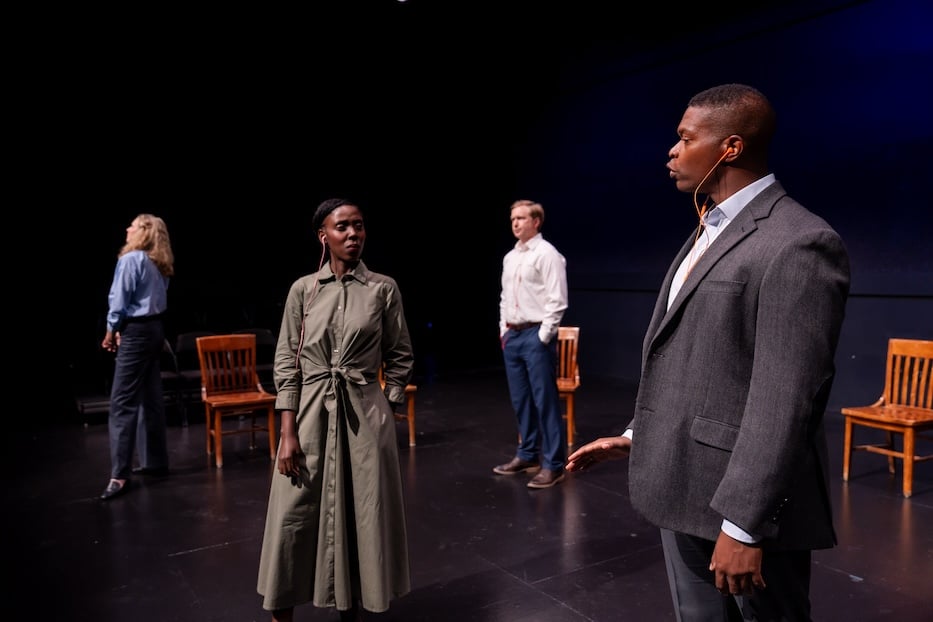
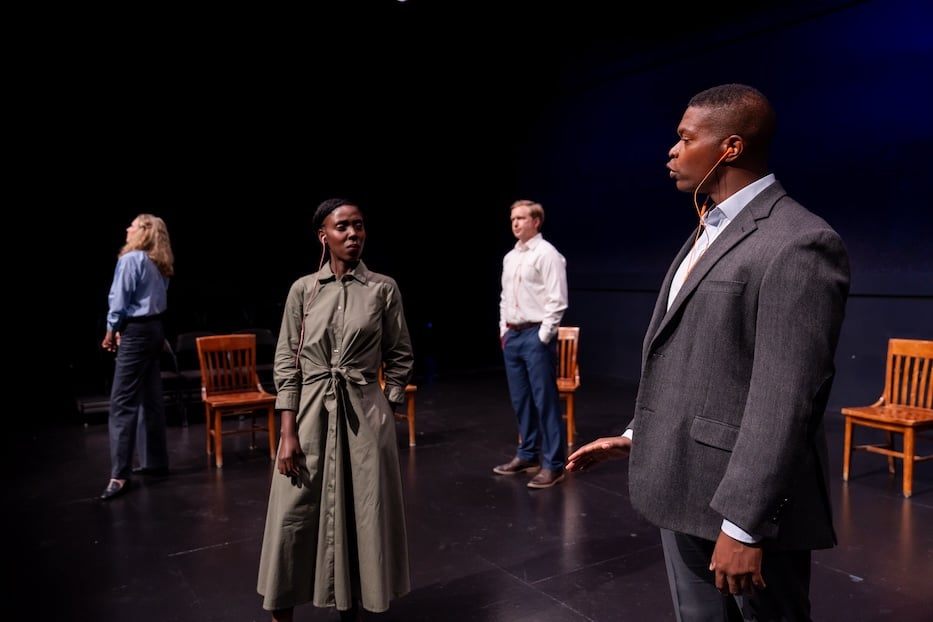
Amara James Aja, MaYaa Boetang, Christina Kirk, Roderick Hill | The Ford Hill Project; Long Wharf Theatre in partnership with Waterwell and Quinnipiac University. Joël Cintron Photos.
Professor Anita Hill speaks into a microphone, her eyes sharply focused on the members of the Senate Judiciary Committee. Her lips are pursed. She doesn’t flinch. She shifts only when she breathes. Outside of the chamber, Federal Judge Clarence Thomas is already calling her a liar. Back inside, a young Joe Biden, then just a senator from Delaware, presses her to reach into the recesses of her memory.
“As I recall, it either happened at lunch or it happened in his office, when he said to me, very casually, you ought to go out with me sometime,” she says, with a clipped coolness that makes the senator trip over his words just a little.
“You ‘ought to’ or you ‘are to’?” Biden asks, as if this is the delicate slippage he was looking for. It’s as if he is telling her, at least a fracture is not a full break. Hill doesn’t miss a beat.
“You ought to,” she says. The words are so sharp they could slice the air around them. And for a split second, we in the audience can feel it too: the audacity of a woman asking to be believed.
MaYaa Boateng, who plays Anita Hill with an unflinching, precise and nuanced understanding of her bravery, is a cast member in the The Ford/Hill Project, a collaboration between Long Wharf Theatre, Waterwell Productions, and Quinnipiac University that runs Sept. 25 through 27 at Garner Recital Hall at Southern Connecticut State University (SCSU).
Written by Elizabeth Marvel and directed by Lee Sunday Evans, the show opened Sept. 19 and 20 at Quinnipiac University’s Theatre Arts Center, located at 515 Sherman Ave. in Hamden. It continues on the 25th at SCSU; tickets and more information are available here.
An experiment in documentary theater that is having quite a moment—this month there are also performances at the Roy and Edna Disney Cal Arts Theatre (REDCAT) in Los Angeles and the Brooklyn Academy of Music in New York—the work knits together the testimonies of Professor Anita Hill and Dr. Christine Blasey Ford, delivered to the Senate Judiciary Committee nearly 30 years apart.
The production features Boateng as Anita Hill, Christina Kirk as Christine Blasey Ford, Amara James Aja as Clarence Thomas, and Roderick Hill as Brett Kavanaugh. It is steeped in history, including transcripts that Marvel masterfully weaves in and out of each other, flipping the narrator just when a viewer thinks they’ve gotten the hang of who is who.
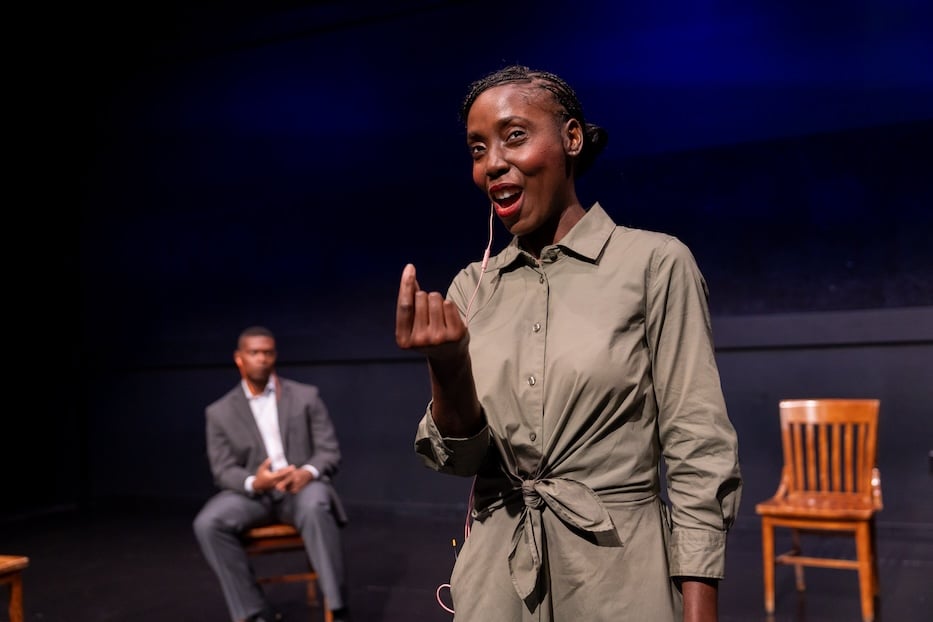
MaYaa Boetang in The Ford Hill Project. Joël Cintron Photos.
In the first hearing, which took place in October 1991, Hill accused Judge Clarence Thomas—then sitting on the federal bench, and nominated to the Supreme Court of the United States—of sustained sexual harassment during his time as her supervisor at the U.S. Department of Education and the Equal Employment Opportunity Commission (EEOC).
This harassment included Thomas’ vivid discussions of sex and pornography in the workplace, as well as descriptions of his own sexual prowess. During her testimony, during which she remained remarkably composed, members of the all-male (and all white) Senate Judiciary Committee grilled Hill on what they painted as no more than a nuisance in the office that she had the choice to avoid.
Multiple times, members—none more persistent, perhaps, than future U.S. President Joe Biden—asked her why she didn’t simply switch jobs, which decades later stings with the same prickly-hot blame as questions like “what were you wearing?” and “did you have anything to drink?”
What they did not do, so eager to absolve Thomas of this stain on his record, was publicly summon fellow accuser Sukari Hardnett, a former EEOC employee who submitted a sworn affidavit but was never called as a witness. Likewise, the American public never got to hear from Angela Wright and Rose Jourdain, to whom committee members spoke over the phone but did not call forward to testify.
Twenty-five years later, should it have been a surprise when another woman, Moira Smith, came forward with new allegations?
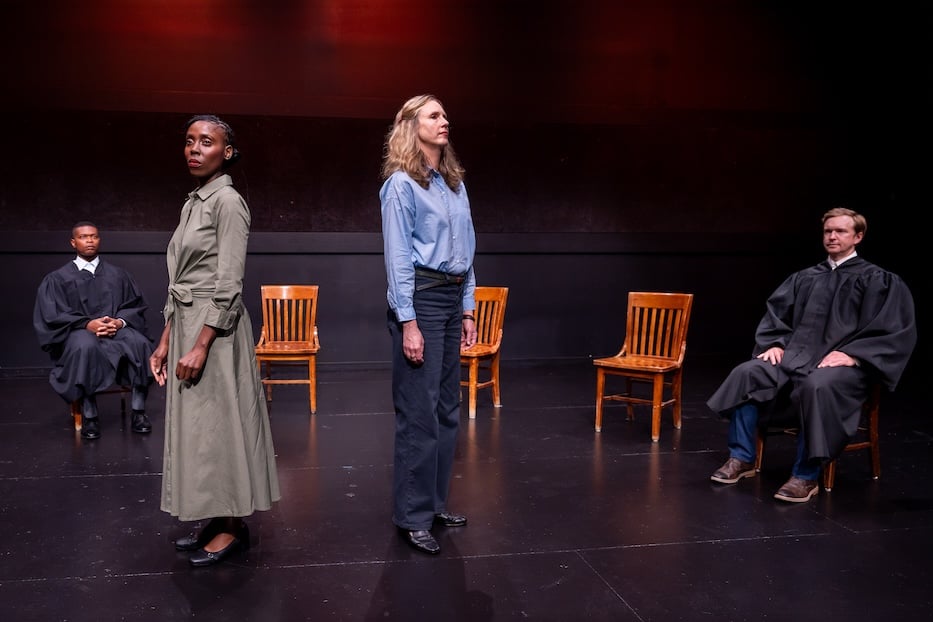
Amara James Aja, MaYaa Boetang, Christina Kirk, Roderick Hill | The Ford Hill Project; Long Wharf Theatre in partnership with Waterwell and Quinnipiac University. Joël Cintron Photos.
The second hearing in the play is of course that of Ford, who in September 2018 appeared before the Senate Judiciary Committee with accusations that Kavanaugh, then seated on the federal bench and nominated to the U.S. Supreme Court, had sexually assaulted her at a party while she was still in high school.
That memory, she said during the hearing, has remained with her for decades, encroaching on both her personal and professional lives. Or as a 2018 CSPAN voiceover announces at the beginning of the play, with a recall that is devastating because of its precision, “Indelible in the hippocampus is the laughter, the uproarious laughter.”
Like Hill, Ford, a professor and researcher who has dedicated her career to the study of psychology, never lost composure. The closest she got, in fact, was asking for a caffeinated pick-me-up after hours of testimony that might have left a grown man on his knees, begging for forgiveness (just not Kavanaugh, who wept, babbled, praised the merits of beer enough to earn the sobriquet "Justice Kegstand" among two legal journalists, leaned on a Yale pedigree, and touted his connections with conservative women who supported him all while near-foaming at the mouth).
Like Hill’s hearing in the 1990s, Ford was not the only woman to speak out against Kavanaugh: in 2018, Yale graduate Deborah Ramirez also accused him of exposing himself inappropriately during the time the two overlapped in college.
Even before the play begins, we in the audience know where all of this is going (if we needed an argument around term limits, consider that Sens. Chuck Grassley, Orrin Hatch and Patrick Leahy sat through both testimonies, although perhaps owing to race and class Leahy was much gentler on Ford than he was with Hill). Marvel does too: that’s why she’s built this world, in which the violence of patriarchy is a record scratch that the audience can’t get out of for at least 80 minutes.
Like Kavanaugh, Thomas flatly, angrily denied every allegation, painting himself as the victim in what he famously called a “a high-tech lynching for uppity Blacks who in any way deign to think for themselves.” He unspooled at the seams, so visibly furious at times that his words seemed to knife the air (Kavanaugh, too, gave a clammy, pathetic, spittle-filled performance that was like something out of a confessional, except without the confession). That it makes an audience good and mad years later is the point: it should.
This, of course, is also the sheer brilliance of the play. Sifting through the transcripts, Marvel and Evans have identified a topic so vast—that is, the inherent and deep violence of patriarchy, and the risk it will continue to pose to all humans as long as it goes unchecked—and found a container for it that is as accessible as it is affecting.
By cutting up the transcripts, and knitting them back together at different points in time, they are able to present a document that traces two specific, insidious and parallel acts of misconduct, but tells a story of masculinity, power and complicity that stretches from the 1990s (or really the 1980s, when Hill first started working for Thomas at the U.S. Department of Education) to 2018 to today.
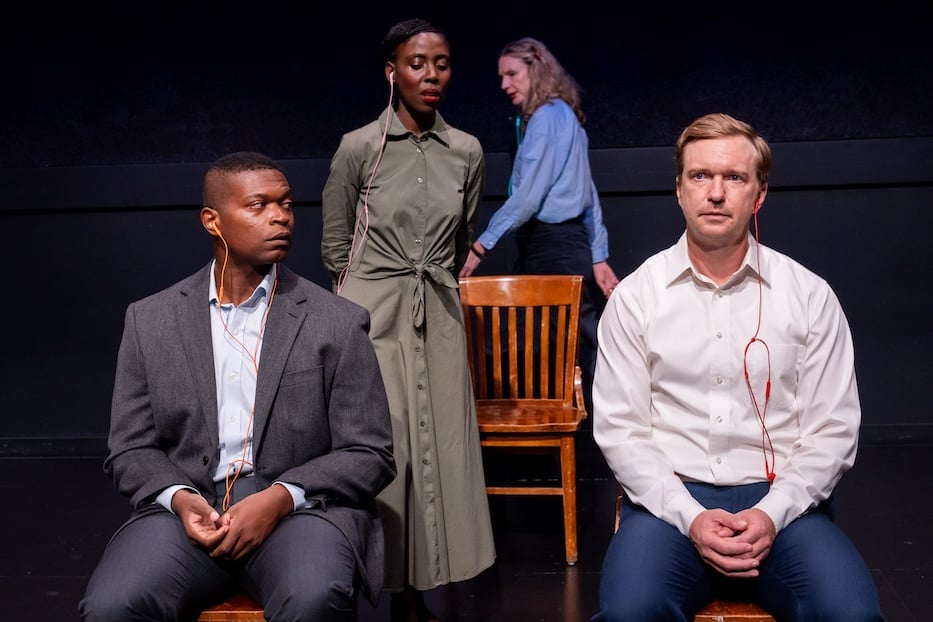
Amara James Aja, MaYaa Boetang, Christina Kirk, Roderick Hill | The Ford Hill Project; Long Wharf Theatre in partnership with Waterwell and Quinnipiac University. Joël Cintron Photos.
Nowhere in the script does Marvel ever have to add an epilogue, or point out that the audience is watching this work five months after the release of the Epstein Files, as a sexual predator holds the highest elected office in the country (if sexual violence is a partisan issue in the play, it’s not in real life: Democratic darlings Eric Swalwell and Graham Platner are also implicated in this long history). The play has done all of that for her, and for the viewers who are lucky enough to see the show.
The actors, meanwhile, do the rest. Boateng, who was most recently in All My Sons at the Berkley Rep, has a sense of timing and nuance that is impeccable, and uses it to tap into the same even-keeled, crisp and restrained delivery that Hill provided in 1991, as she listened to questions that ranged from inappropriate to embarrassing to verging on slut-shaming wrapped in legalese and political formalities.
Like Hill—and arguably even more so, because this is the theater, after all—she communicates whole worlds of meaning in her face, particularly her wide, focused eyes and ability to scowl without ever actually doing so. Alongside her, and sometimes even finishing her sentences, Kirk is the perfect other half: she is clinical but not aloof, composed but not cold, smart but not showy about it. She is, in other words and very much like Hill before her, performing a kind of expected femininity, while coming forward with a truth that patriarchy has asked her to suppress.
By doing so, the two are able to harness and sustain the same immense, jaw-dropping power that Hill and Ford tapped into in real life, often at great physical, emotional and mental cost to themselves. At one point, Boateng-as-Hill remembers a moment in February 1983, at which she was hospitalized for nearly a week “on an emergency basis for acute stomach pain which I attributed to stress on the job.”
Later in the show, Kirk-as-Ford remembers how the assault has followed her through school, marriage, and motherhood—even renovations to her own house, where she fears for her safety and the safety of her family. Again, this news is delivered with such an even sense of recall—no hysterics, no raised voices, no snapping or sobbing—that it is physically painful to listen to, in part because it is so intensely relatable.
At moments, Marvel flips the narration—there is one short section where Aja and Roderick Hill transform into Anita Hill and Ford respectively—opening a portal to a world of what might have been, if sex and gender were perhaps not so prescribed in the first place. By then, these men have loudly, vehemently protested, broken down, blamed, scowled, glowered and lied, making clear that they will do anything but accept culpability. So when Marvel turns the tables, it’s almost funny to see how measured they become.
What Kirk and Boateng show, meanwhile, is an act of courage, stamina and truth-telling that viewers would do well to fold into their own lives. At the end of each show, where bows might otherwise be, the two cross paths at the front of the stage, and look each other directly in the eyes as they are walking. Behind them, Aja and Hill are fitting their bodies into the billowing black robes that mark their promotion to the Supreme Court.
Without stopping, the two women lock eyes for maybe seconds, although it feels much longer. It’s as if they are saying, I see you. Or maybe, Thank you. Or maybe, This again? You have got to be kidding me.
Aja and Hill, meanwhile, nail the depiction of these men with an exactitude, churlishness and piping hot, overflowing anger that leaves the audience (or at least, this reporter) wondering if they have to shower to get the roles off of them after each show (imagine playing Medea, but make it 100 times more odious, and then remember that these are real, living people who get to make decisions about Americans’ human rights every day).
At the end of the show, as they two come forward all robe-clad and puff-chested, it is all a person can do to remember that these are just actors, and not throw verbal tomatoes at the stage (if anything, I left the show hoping that the two have access to the emotional and mental care they need to process these roles).
As the first show in Long Wharf’s current season, aptly titled “State of the Union,” The Ford/Hill Project ultimately feels like an invitation and a reckoning that is still open-ended. At the center of the stage, a comparatively minimal set—seven chairs, all arranged in a shallow half circle—creates a space that is clearly about language and people and ideas, even before any of those things are onstage.
By the time actors leave it 80 minutes later, there’s enough momentum to keep an audience going through Arthur Miller’s The Price, a joint run of which begins at the Legacy Theatre in Branford at the end of next month.
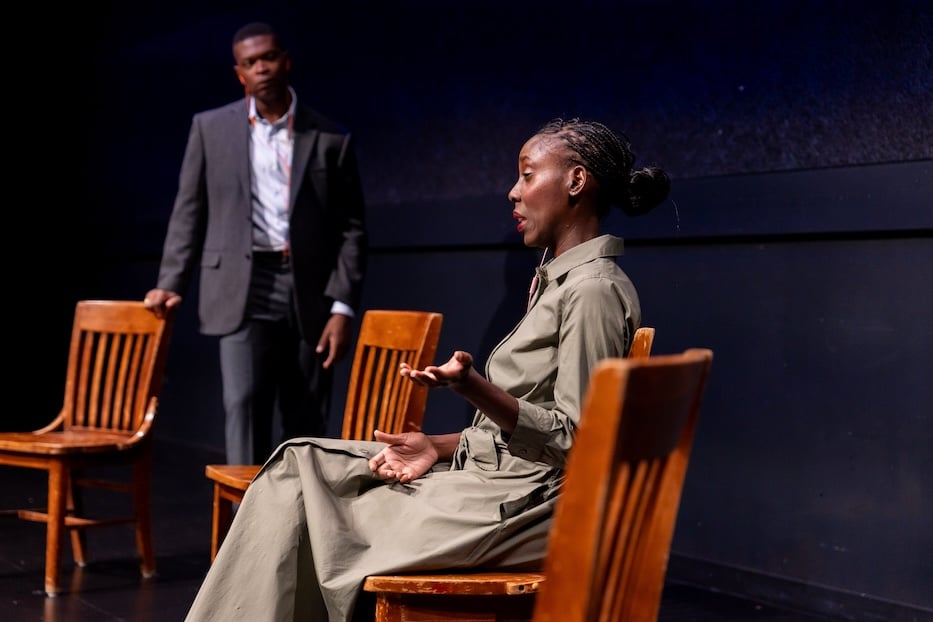
MaYaa Boetang in The Ford Hill Project. Joël Cintron Photos.
The unspoken character in the show, meanwhile, may be Long Wharf Theatre itself. In almost nine years, the work is the closest thing that the community has gotten to an apology for the degree to which, nearly a decade ago, select theater staff aided and abetted sexual misconduct within the organization. Many of them went on to flourish professionally, in large and well-funded institutions where they still are today.
In the early weeks of 2018, multiple women accused the organization’s then-artistic director of sexual misconduct in an article in the New York Times. At the time, Long Wharf was a much larger institution than it is now: it had a staff that was close to 100 people, more robust year-round programming, and operated out of two stages at 222 Sargent Dr. in the city's Long Wharf neighborhood.
The accusers did not, blessedly, suffer the same fates as Hill and Ford respectively. The community, in large part, believed them over an artistic director who was later called “too big to fail” in an external review of what had happened. Staff members, both on the record and behind the scenes, started talking about what an abusive work environment the theater could be, from verbal harassment to inequitable compensation. The Board of Trustees acted swiftly in terminating the artistic director. It also launched an outside investigation into the theater.
But—at least for this reporter, who remembers it vividly—parts of that history still echo through these transcripts, which Marvel and Evans have so deftly brought to life. Within 72 hours of that first article, the theater seemed to wipe its hands of the mess, pick itself up and keep going. Staff and board printed “LWT Is Me” buttons (yes, reader, buttons) and opened a show. They led talkbacks as if a molotov cocktail had not just exploded in the lobby.
It was business as usual, at a time when nothing was usual. When asked in these pages if she planned to terminate or suspend other staff members, particularly those who had also been in artistic leadership, Board Chair Laura Pappano noted that the issue was not a "a bro culture ... a frat culture" at the organization, but a single person. And if that person was no longer at the theater, wasn't everything taken care of?
The thing is, it's never a single person. It’s never one person in planning meetings and read-throughs and rehearsals and tech runs and board rooms and opening nights. It’s many people, who choose to look the other way because it means keeping a job. Because someone decided that feathers are better unruffled.
People go home to their wives, and sometimes their daughters too. They get new jobs that allow them to soar professionally. There is no collective fall from grace. Or at least, there wasn't here. It’s why Marvel and Evans are so smart: they recreate, like a murder board, the blooming web of complicity it took to keep these men in power.
In June of 2018, Long Wharf’s board released a report that called for significant internal and external changes at the theater. It took another year, and the appointment of a new artistic director, for considerable staff changeover to start taking place. Almost a decade later, the theater has never held a town hall or community discussion to address the specific harm—that web, fibers of which are still all over New Haven's artistic landscape—that came out of that moment.
In the show's first performance at Quinnipiac last Saturday, that history simmered beneath the surface—but found an arguably different Long Wharf, one that is still finding its footing and reinventing what it can be, in its wake. As Jessica Durdock Moreno, director of artistic planning at the theater, pointed attendees to a “Decompression Room” staffed with mental health professionals from Clifford Beers Community Care Center, Rev. Martine Gloria Bruno led the room in deep breathing.
Beside her, Quinnipiac Director of Theatre Production Angelisa Gillyard noted “the power of theater to bridge history” through storytelling and witness. Rev. Gloria Bruno took a deep breath in, and then exhaled, opening her eyes wide. In the audience, some members seemed as though they were still on the verge of tears.
“Healing,” she said, “Can only happen in community.”