
Culture & Community | Institute Library | Arts & Culture | Youth Arts Journalism Initiative | Kim Weston | Wábi Arts
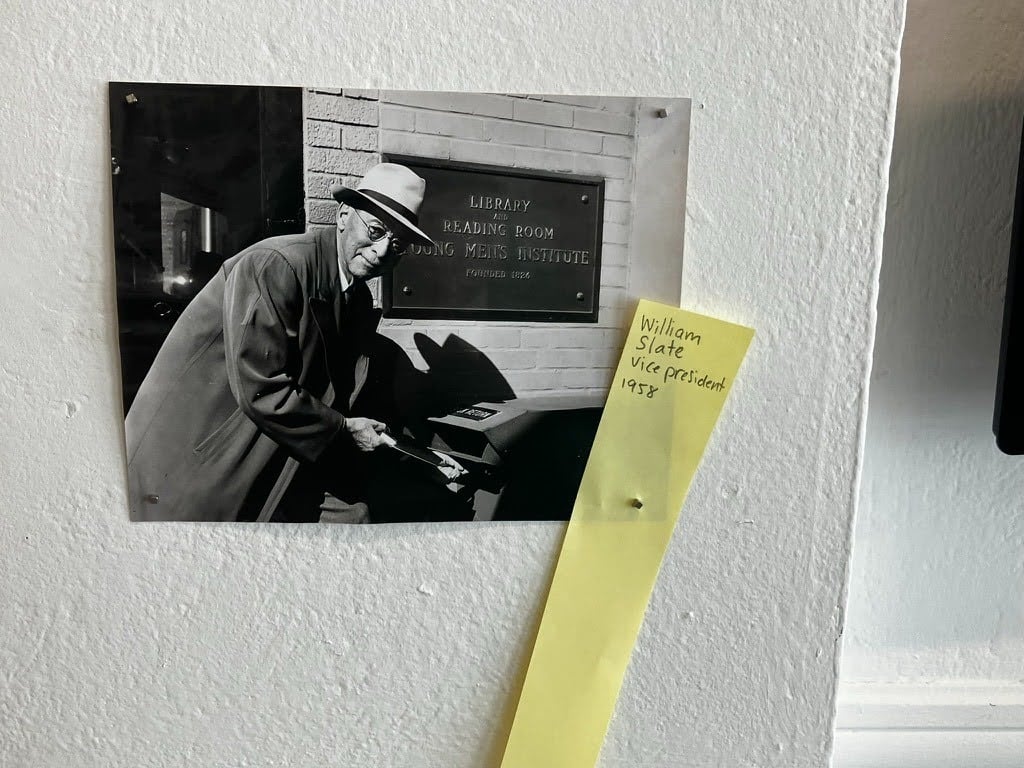
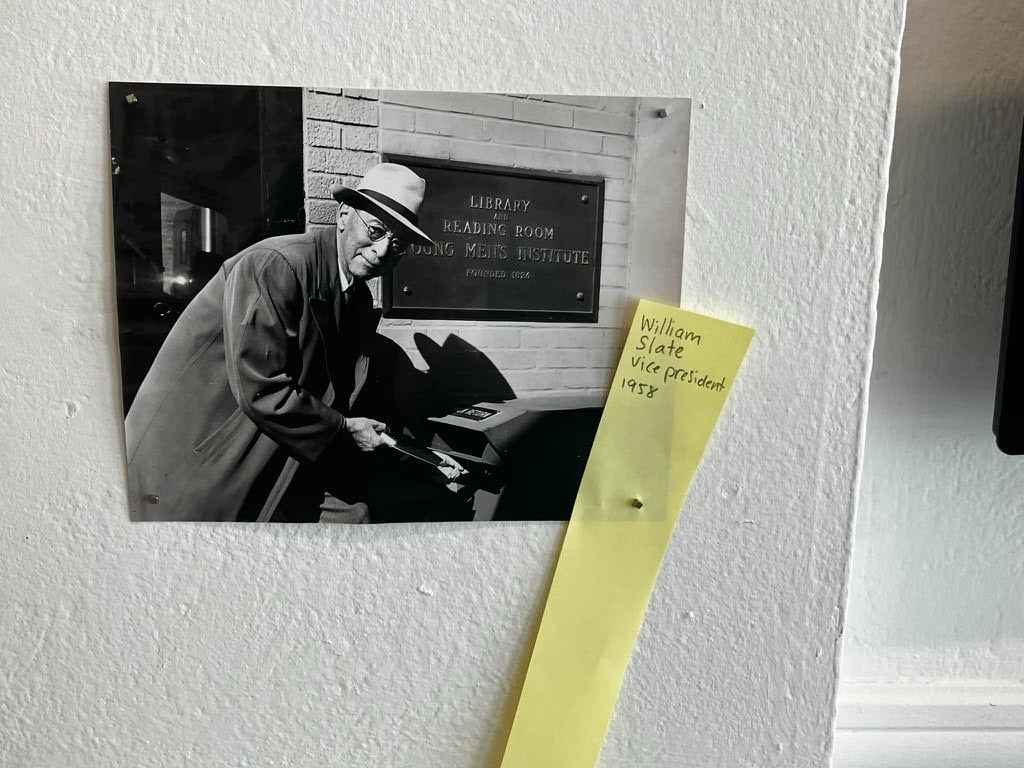
In a display case by the southeast wall of The Institute Library’s Gallery Upstairs is a fading ticket granting admission to a July 12, 1855 reading of a poem by Franklin Fish, sponsored by the New Haven Young Men's Institute. Above it, a torn flyer announces the Institute’s 1860 lecture series, “to be delivered in College Street Church.” Across the room, another display case holds a flyer advertising the Institute’s library and reading room, containing “10,000 volumes.”
These are, according to the library’s website, “never-before-seen” rarities from the library’s archive, brought together by the Library’s archivist Peri Pignetti and its operations manager Eva Geertz for the library’s Summer 2026 We Make a Library, which began on June 13 and ran through September 19.
The exhibition, curated by Martha Willette Lewis, celebrates the 200th anniversary of the 1826 founding of the New Haven Young Men's Institute. In addition to archival items, it features Through Their Lens: A Bicentennial View, a photographic take on New Haven’s present from artist and educator Kim Weston and young adults in the Wábi Focus Fellowship.
In addition to a record of the Library’s history, the exhibition also functions as a record of American history itself.
The books and magazines woven into We Make a Library—a tradition for shows in the Gallery Upstairs—detail the progression of Americans’ social and cultural preoccupations, from a zine about bodily autonomy to The True Story of the American Flag to Bob Woodward’s controversial Wired: The Short Life and Fast Times of John Belushi, to a Rolling Stone profile of Greta Thunberg.
In presenting the progression of American history alongside the progression of the library’s history, Lewis asserts the library’s ability to, as an archive, carry history within it, preserving the trends and highlights of each era of publishing since its founding in 1826.
The exhibition’s archival authority, though, is called into question by many of the prints provided by the members of the Wábi Fellowship. Take “Leisurely Reading,” by Asia Murphy, for example.
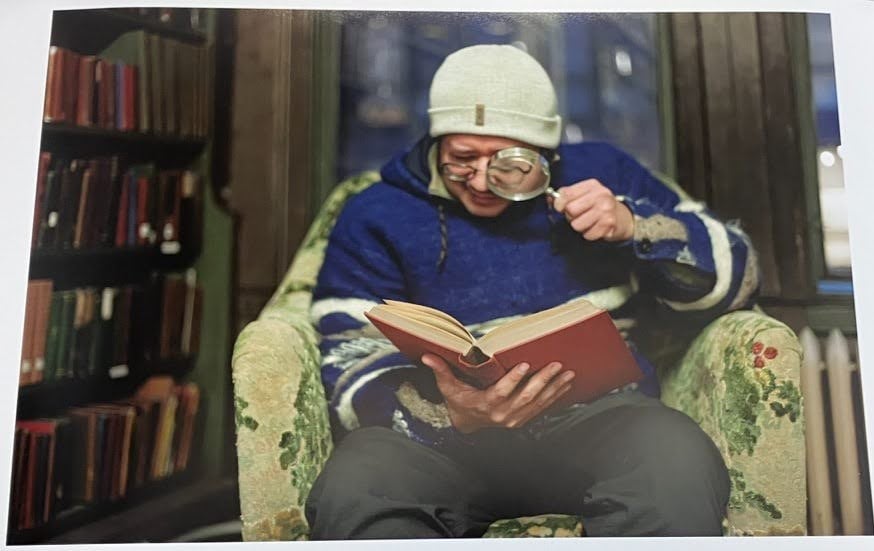
“Leisurely Reading,” by Asia Murphy.
This photograph, depicting a man in a Christmas sweater and beanie poring over a book with a magnifying glass, sees the Library as a space of play. The man holds his magnifying glass over his glasses, well away from the book, and wrinkles his face into a cartoonishly puzzled expression.
One might notice also the use of color in the photo. Greens, blues, reds, and whites are all emphasized equally, recalling the colorful joviality of a circus clown or a game of Candy Land.
This playfulness contrasts with the library’s image of itself, as seen through a 2011 collection of commissioned photographs by Meredith Miller.
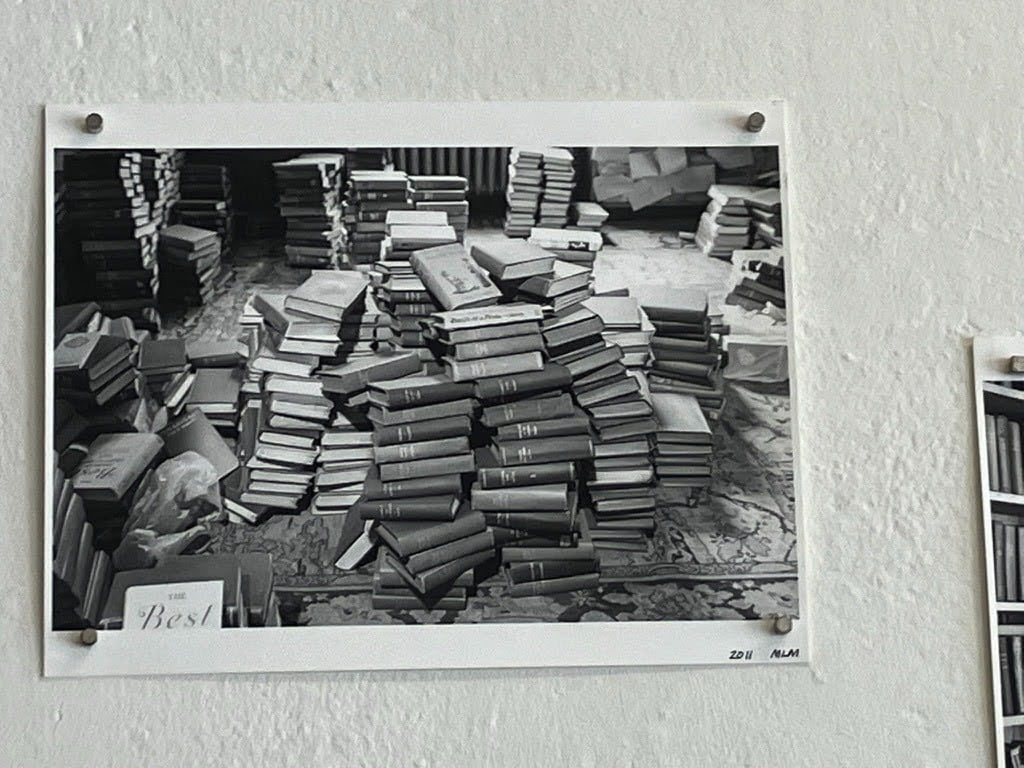
One of Miller's images.
On the surface, Miller’s photographs seem to consider the Library a solemn and deeply academic place. The greyscale pictures replace eye-catching color with the nuances of light and shadow. They ignore the human entirely, in favor of rooms overflowing with volumes and the intimidating mass of the knowledge within them.
When placed above Murphy’s photos (as they are in We Make a Library), though, Miller’s pictures themselves appear more playful. You must notice the stack of books on the floor are ready to tumble like dominoes, and that the papers in the background are billowing in the wind like pinwheels.
By imagining the Library as a playful space, Murphy brings out its real playfulness, and in doing so implores the audience to look deeper into the Library’s image of itself. Similarly, its stagedness prompts the audience to consider the stagedness of Miller’s photographs— or the whole exhibition— and see the library as it really is.
In their questioning of the archival authority of We Make a Library, the young photographers of Through Their Lens present their own disparate visions of New Haven and its relationship to the library.
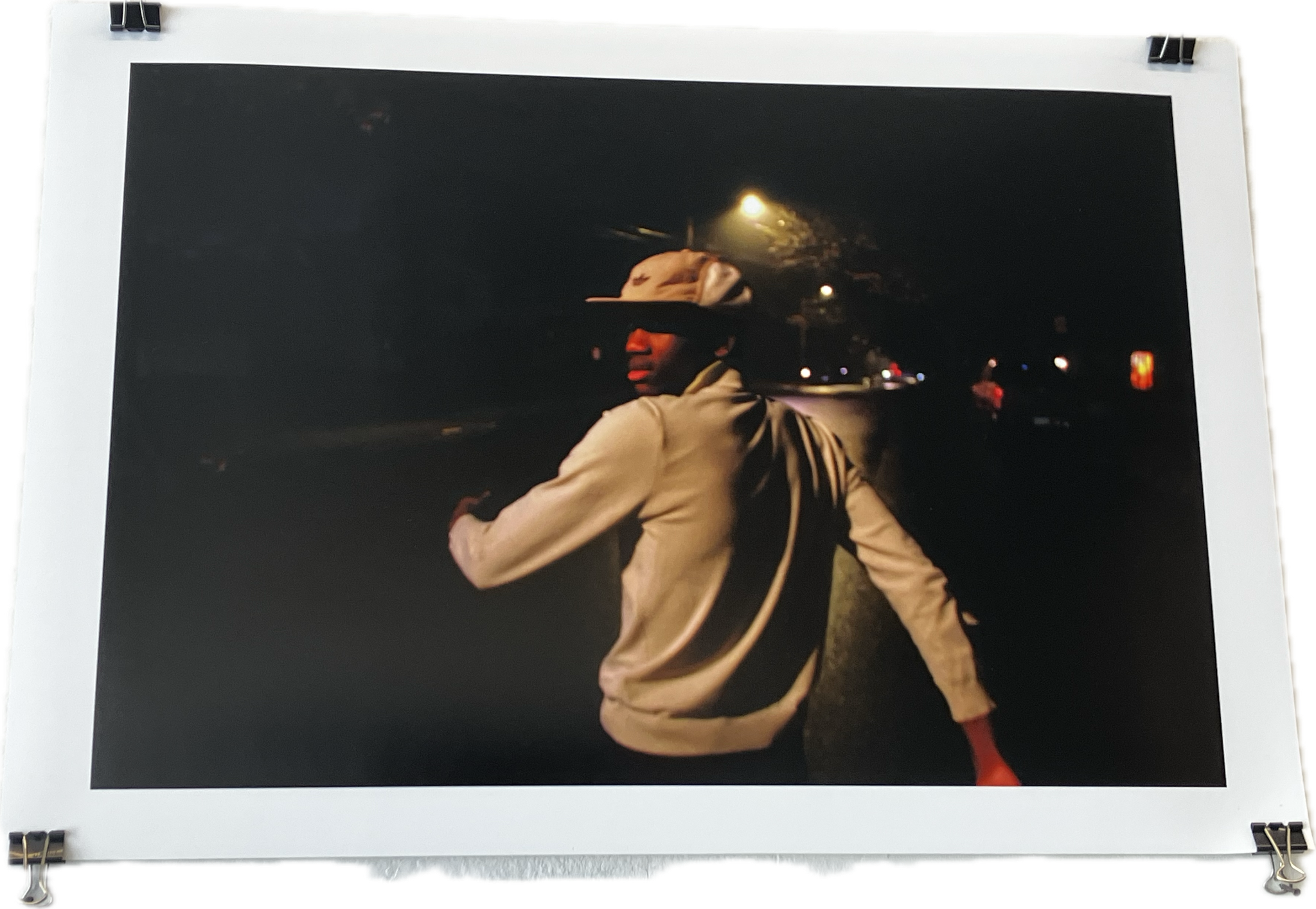
"Caught,' by Brock Bowen.
On one hand, Brock Bowen’s visions of dark, empty streets are distinctly unhomely and unsettling. In “Caught,” for example, he captures a subject in motion, vulnerable and running through a dark, semi-urban setting while aiming a look of worry at the camera.
Bowen’s use of horror-film iconography compels the viewer to initially expect murderous creatures to crawl from the shadows and the air under the subject’s arms. The worry on the subject’s face, though, places the killer in the viewer themself. By displacing his audience into the position of the feared and murderous, Bowen draws out the alienation and displacement of identity that comes from living in a small city.
Meanwhile, Allesson Vanessa Cosetl Muñoz presents a homelier image of New Haven. Pieces like “Familiar Sparks” and “Hold Heartedly” center the light and warmth of community and celebration amidst darkness, coolness, and loneliness of their backgrounds, emphasizing the connection and sense of place that can come from living among others.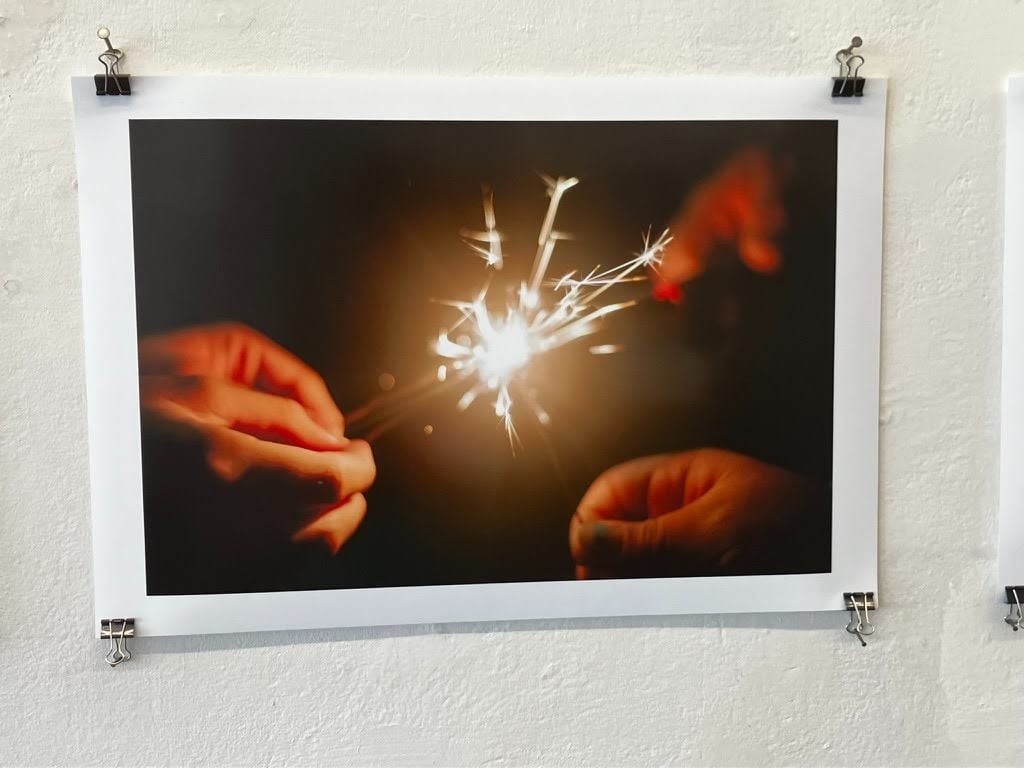
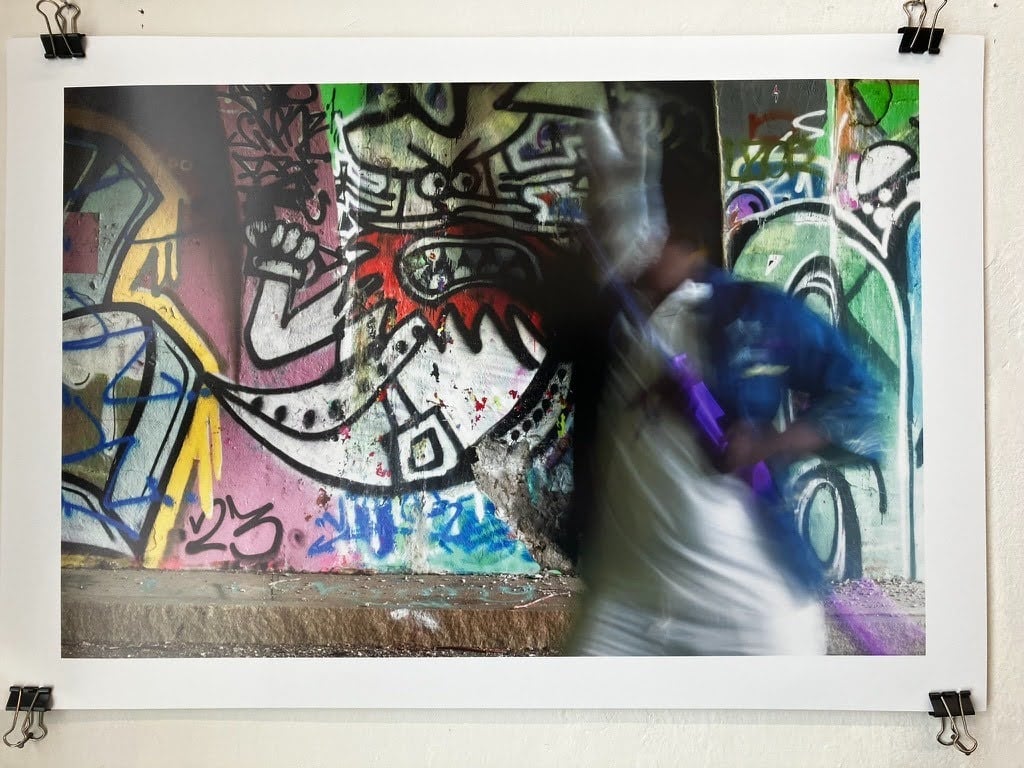
Either way, from the distinctive red ‘No Standing’ sign in Bowen’s “Too much lost” to the bridge graffiti in Tywan Harris’ “Graffiti & Ghost,” Through Their Lens is very clearly set in New Haven. We Make a Library, on the other hand, has much less to do with the city. Excepting a poster for a pig roast (held by Jack Hitt at the library’s benefit in 2013), in fact, the city hardly appears at all, with the exhibition depicting the library more as a cultural barometer for the United States as a whole than as a local institution shaping and shaped by New Haven.
Through the presence of the Wábi fellows’ universal-yet-geographically-specific work, the relationship between the Library and the city becomes apparent. Throughout its entire history, the Library has been one of New Haven’s defining cultural institutions. Since the early 2010s, it's been one of the only locations in the city to consistently host visual art exhibitions, poetry readings, jazz nights, and the like. As well as a fascinating record of American history, The Institute Library holds within it a great deal of New Haven’s cultural identity, and that’s just as important.
Tal Berkowitz is a graduate of the 2025 cohort of the Youth Arts Journalism Initiative (YAJI). He is a senior at Wilbur Cross High School and the ACES Educational Center for the Arts.