

Education & Youth | Arts & Culture | Theater | Youth Arts Journalism Initiative | Hamden High School
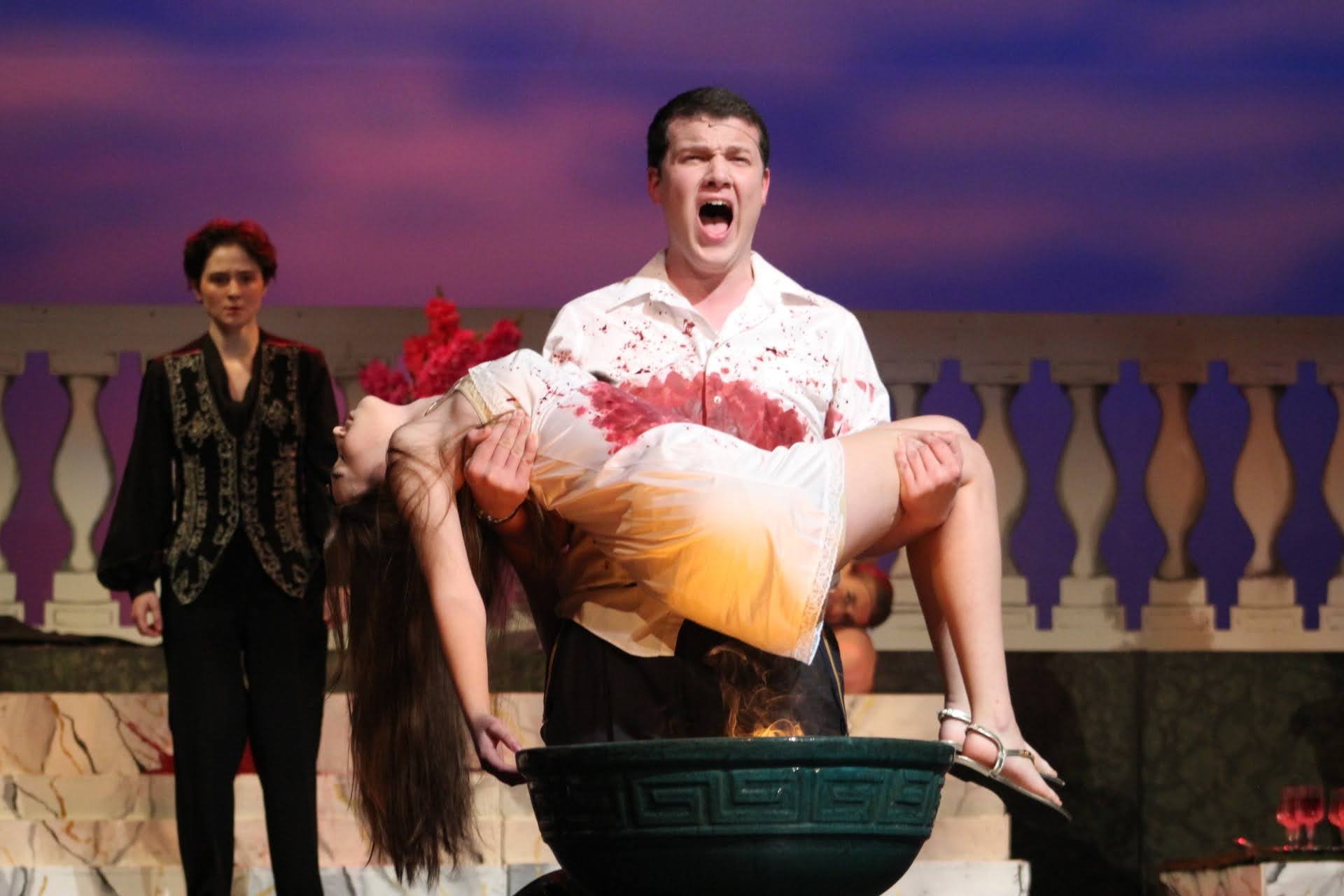
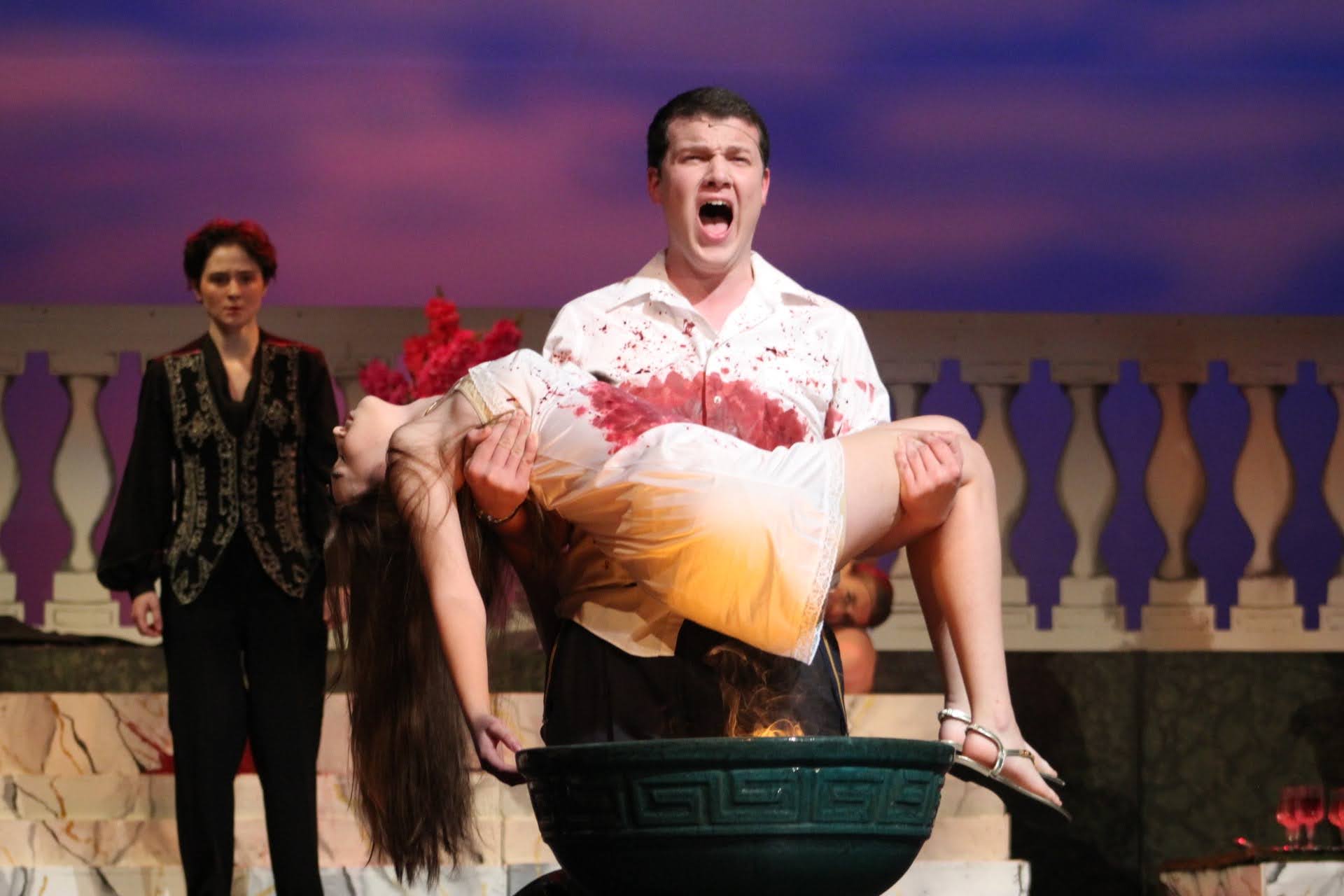
Owen Arenberg as Agamemnon, and Lauren Freer as Iphigenia. Samir Iydroose Photos.
King Agamemnon let out a guttural, piercing scream, a thundering, booming, anguished wall of noise. Maybe his bellow lasted a touch too long — but it was supposed to be uncomfortable, as war is uncomfortable. He clutched the limp corpse of his daughter in his hands, kneeling on the stage.
Then he got up. A moment later, the cast took their bows to fervent applause. The actors then coolly walked off of the stage, leaving broken wine bottles, shoes, wedding dresses, flowers, hats, and a conspicuous red stain in their wake. Members of the audience dazedly exited the auditorium, and went back to their lives.
This sort of tonal contrast – watching an hour long tragedy about the perpetuity of war, then being greeted by laundry and the dog and needing to unload the dishwasher – was a key part of the Hamden High School Mainstage Ensemble’s production of Iphigenia 2.0, written by playwright and historian Charles Mee and directed by Marydell Merrill.
In its short, three-day run, it became something of a rabid, more aggressive version of Kurt Vonnegut’s Slaughterhouse-Five — with young actors who rose to the occasion.
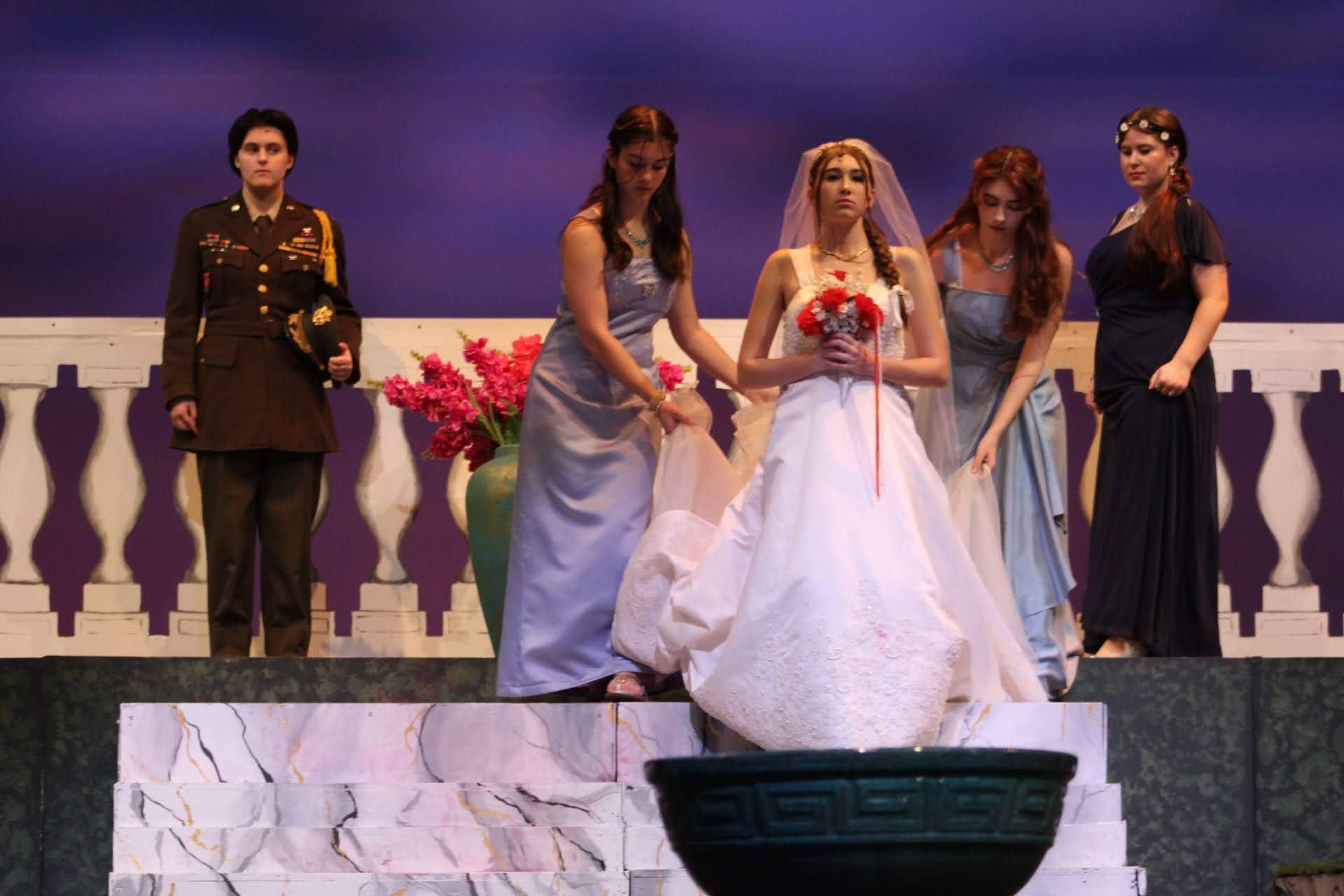
Mee’s reinterpretation of Euripides’ classic play, Iphigenia at Aulis, follows King Agamemnon, the commander of Greek forces in the Trojan war. In Euripides’ play, Agamemnon has angered the Greek Deity Artemis, and is unable to leave Aulis because Artemis has stopped the wind. She tells him she will only restore it if he sacrifices his daughter, Iphigenia.
He lures Iphigenia to Aulis, under the guise of planning her wedding to the warrior Achilles. Clytemnestra, Iphigenia’s mother and Agamemnon’s wife, and Menelaus, Agamemnon’s brother, intercept the news of a faux wedding. Hijinks ensue as she tries to prevent Iphigenia from being killed. When the knife to kill her is raised, Iphigenia gets whisked off to a peninsula, and a deer appears in her place.
Or as Assistant Director Anabella Cabadas paraphrased it at a run-through last week, “Clytemnestra says to Iphigenia, ‘Your dad lowkey finna kill you,’” and her mother helps prevent that fate from transpiring.
Mee’s play goes differently, and hits a little close to home in a world upturned by violence. Forgoing the traditional Greek Chorus and divine influence, soldiers demand that Agamemnon (Owen Arenberg) sacrifice his daughter (Lauren Freer), in order to prove his commitment as a leader. They also list their demands, which are — affectingly — deeply quotidian things like Oreo cookies, tinned fish, newspapers, amphetamines, and pornography.
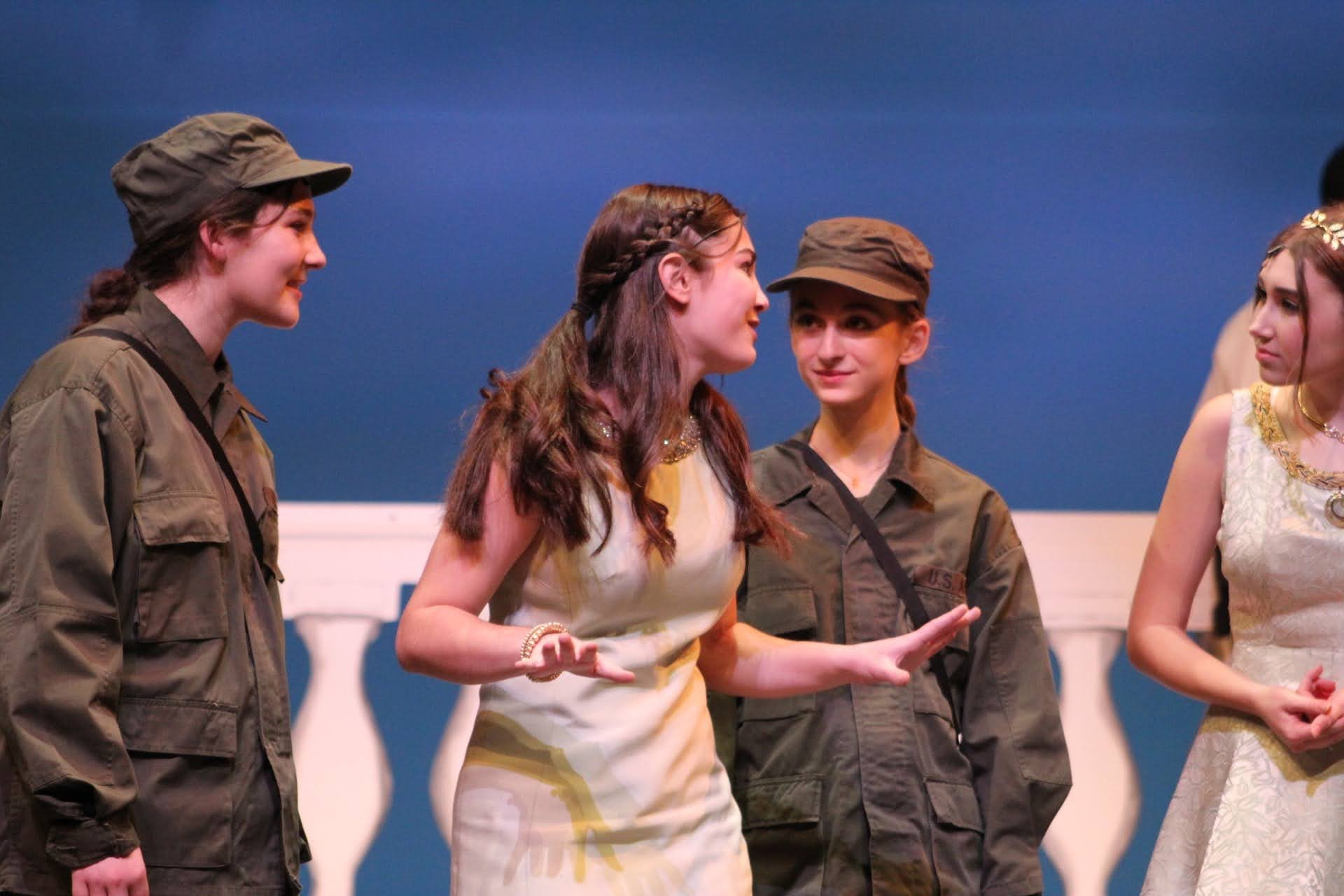
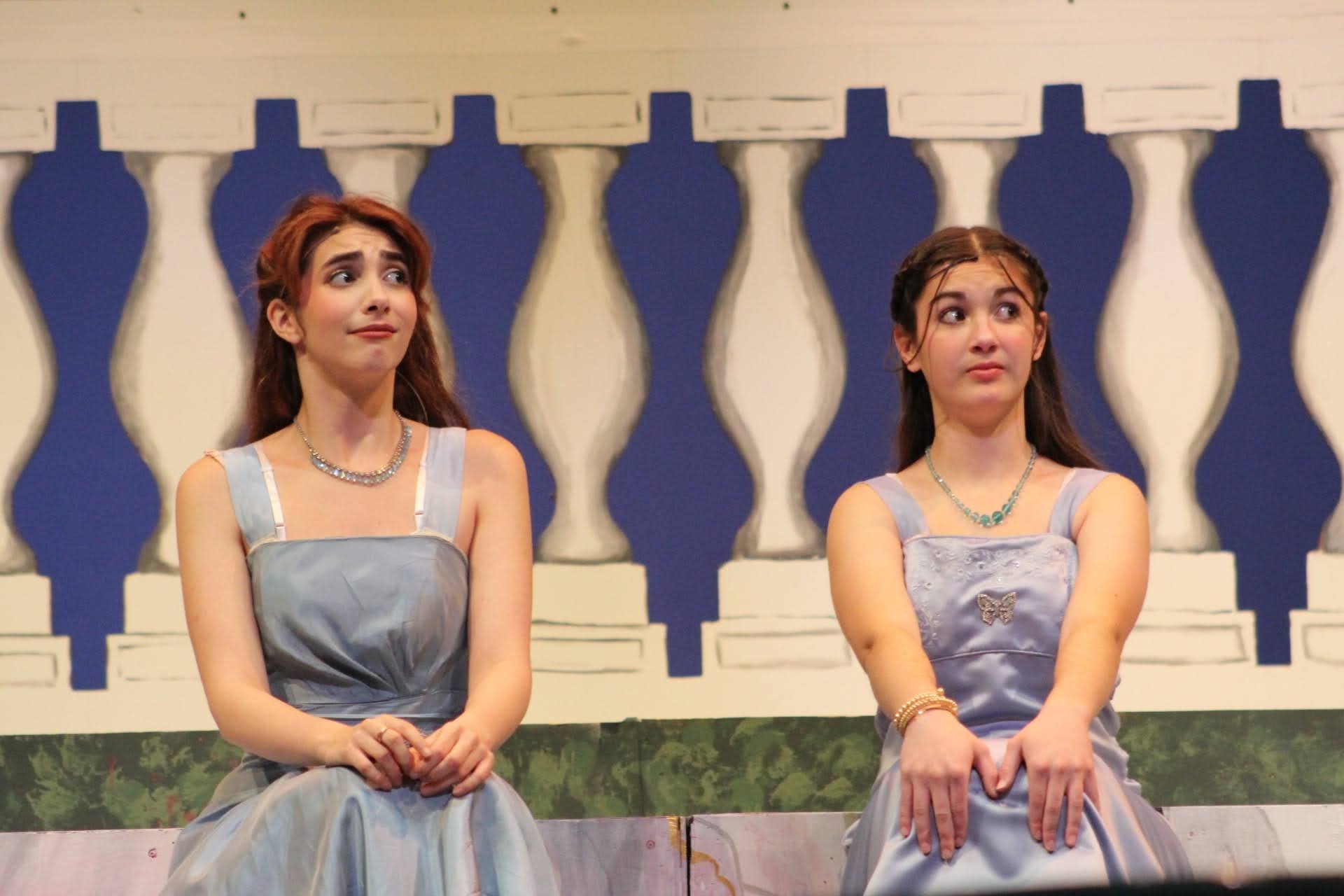
Top: Caroline Seguin among students-turned-soldiers. Bottom: Caroline Seguin and Natalia Como.
Some things seem like echoes of Euripides, until all of a sudden they don’t. The play, for instance, opens with an unnamed old Greek man (Liam D’Amico) scrubbing at a stain of wine, or perhaps blood, from the stairs. He successfully cleans the stairs, but at the end of the play, there is another stain.
Here, the bridesmaids (Caroline Seguin and Natalia Como) for the wedding are bubbly, giggly teenagers, obsessed with bachelorette parties in Beverly Hills and similar superficialities. It’s a jarring contrast to the ongoing armed conflicts.
As the show unfolds, the set is minimalistic. There is a back platform with a railing at the back, a projected sky behind it, and plants shaped like a spiral on either side of the steps . There are two tall columns on either side of the set, as if to telegraph the meeting of past and present. There is a fireplace in the middle that casts a faint orange glow across the stage, and there is a smoke machine nestled into it.
Bringing The Show To Life
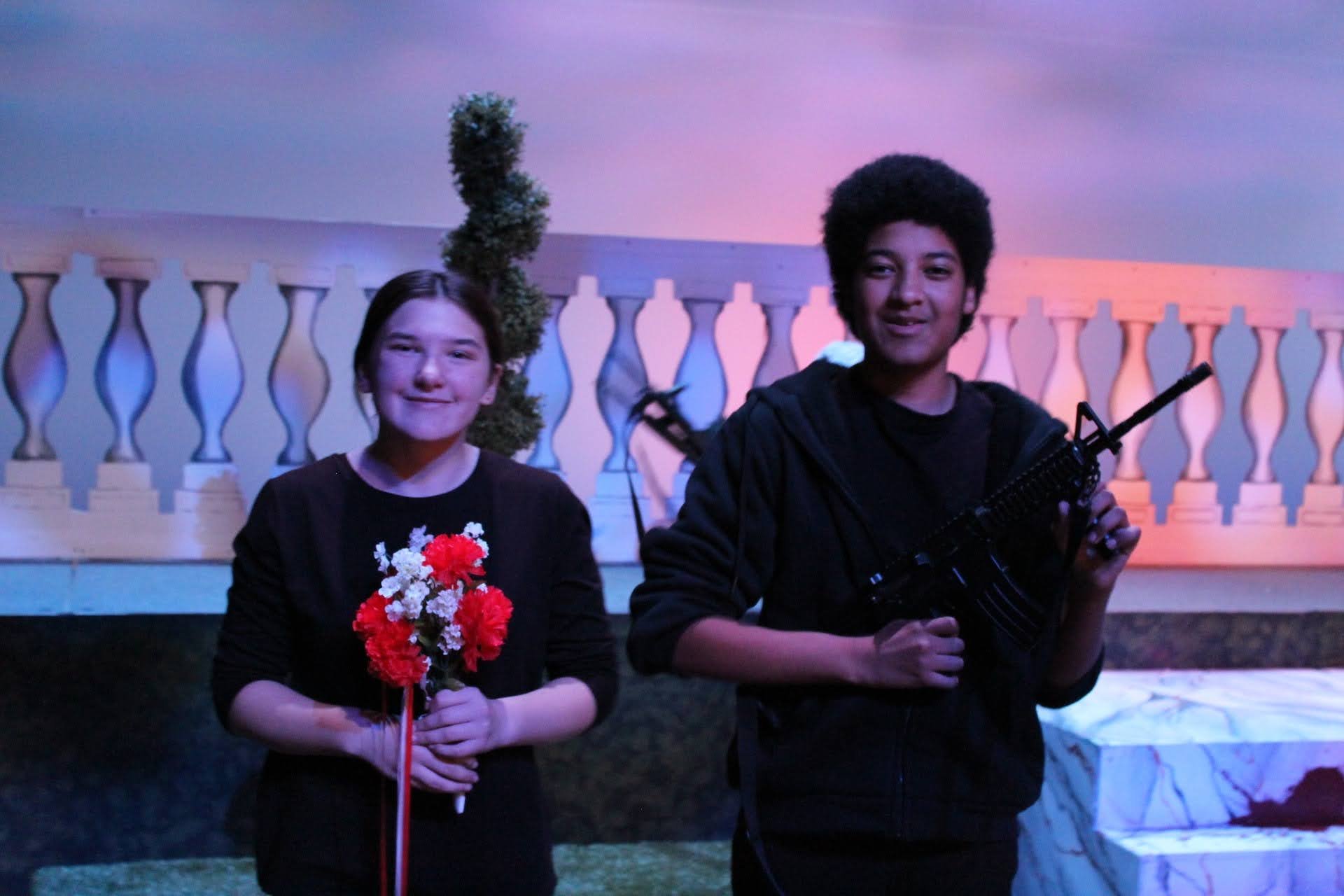
Izzy Smolnik and Andre Conner, both on the props crew, holding a wedding bouquet and a rifle, respectively.
At a recent run through last week, students stretched out before performing, their hands momentarily behind their backs, forearms flush against their spine. Their hands grasped for each other. Lucius George, who plays Achilles, explained that actors have to do that sort of motion in putting on and removing their mics — which is why they practice it.
Around the actors, members of the crew were hard at work. Elizabeth “Izzy” Smolnik, a member of the props crew, prepared to pour a blood-colored mixture of washable red paint, water, and some green, black, and purple powder into a breakaway wine glass, which is carefully reconstructed with a goldilocks amount of museum wax each night.
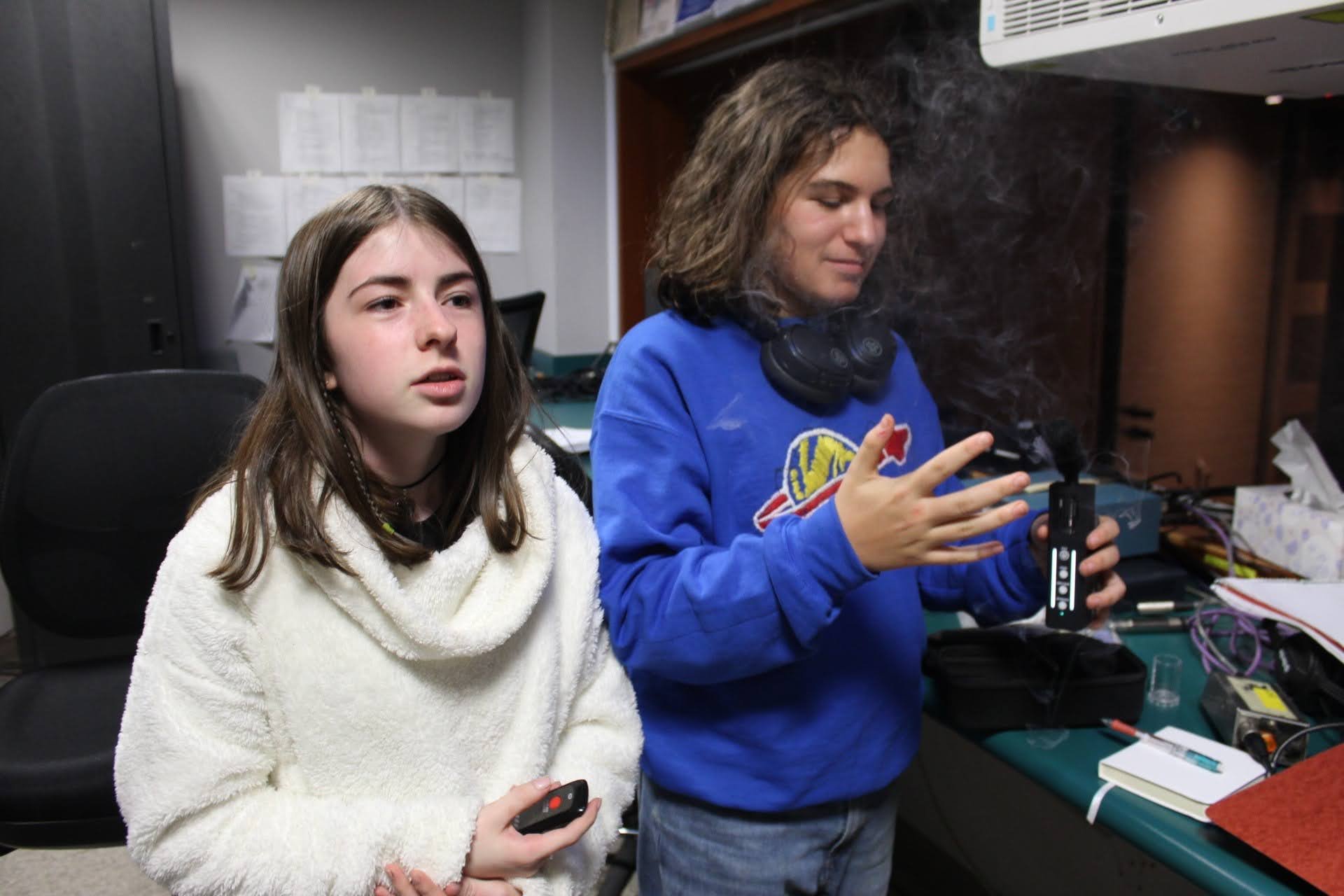
Rory Dowe and Zephyr Gallagher, both in charge of lighting.
Meanwhile freshman Rory Dowe, who presses the “special button that makes smoke come out,” said that she really enjoyed being in charge of special effects as she prepared for a run. Dowe has a background in lighting, but had only recently learned to refill the smoke cartridge with the tenderness of “cradling a dying orphan baby,” among other maneuvers.
“I like being up in the booth, and seeing everything, and all my friends are in theater, so crew is a way to participate without being super impressive on stage,” Dowe said. “Plus, coincidentally, almost all of my clothes are black, so that works well.”
In the show, the smoke apparatus is triggered remotely from the booth, and it smokes whenever the focus is at the center of the stage. While the smoke was very, very faint during a run, it was a nice touch when soldiers gathered around the firepit, and told war stories — including about their loved ones they hadn’t seen.
Dowe’s favorite smoke scene took place when the soldiers laid down their weapons into the fireplace, before a “really weird” dance sequence to LL Cool J’s “Mama Said Knock You Out.”
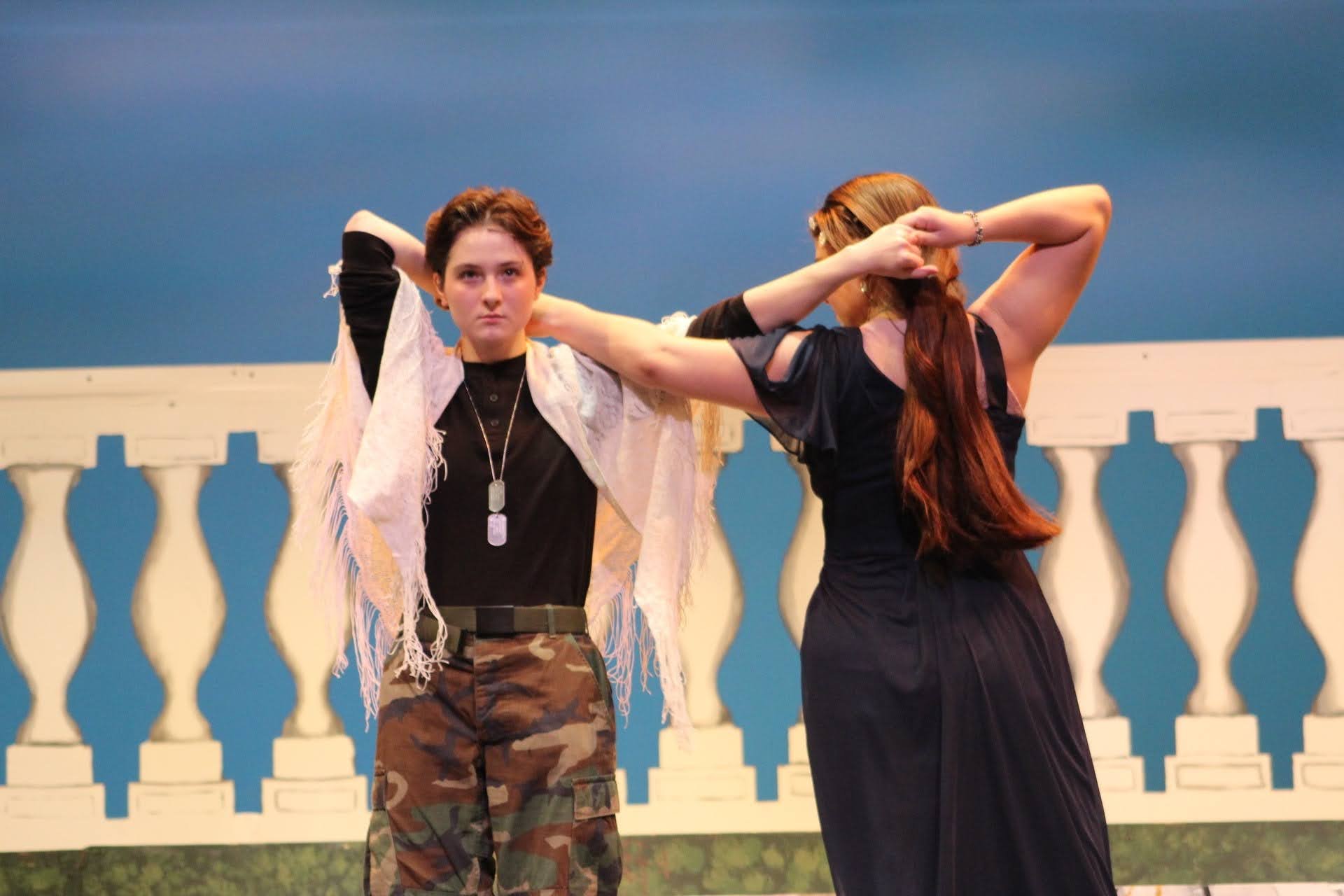
Lucius George and Lyla Banks.
There have been growing pains along the way, crew members admitted — and all of them have been worth it to get to the performance. Exactly a week before opening night, the crew had to move the railing over. The railing had holes in it, and the triangular braces were showing through the holes. Because it was backlit, the shadows were not falling the right way.
“It caused a lot of stress, because I –” Production and Head Stage Manager Oliver Hamilton began.
“We –” interrupted Cabadas.
“Yes, we had to rebuild the set a week before opening night,” finished Hamilton.
In the final run, all of those careful touches paid off. Arenberg was a standout performer throughout the play. He assumed a tall and authoritative posture (he also remained remarkably upright while carrying another human being), and he seemed genuinely distraught over the conundrum his character faces.
“It's a very nuanced role, King Agamemnon, between anger, sadness, and loss,” said Arenberg. “It is one of the most innately human things to do, show how something feels, but it is exceedingly difficult. Me, Owen, I don’t kill my daughter, but I have to show that to the audience.”
Arenberg said that he also naturally has poor posture and fixing it was difficult, but was only able to overcome it with Director Merrill’s threat of finding a corset in the basement.
George, for his part, was fully prepared to do a wonderful job of throwing the glass at the stairs during the tail end of the play. The way that the liquid splattered, and the speed at which he did it, was, during the run through, disconcerting in a great way.
George also did a wonderful job of being seduced by Clytemnestra (Lyla Banks), engaging in a torrid dance that exuded both Achilles’ naivete and Clytemnestra’s desperation. This scene was one of many that cemented Iphigenia 2.0 as a play that critiques war and the consequences of it (not to mention corsets and water-soluble paint).
Samir Iydroose is a graduate of the 2026 Youth Arts Journalism Initiative and a junior at Hamden High School.