

Culture & Community | Education & Youth | Music | Arts & Culture | Mauro Sheridan Interdistrict Magnet School
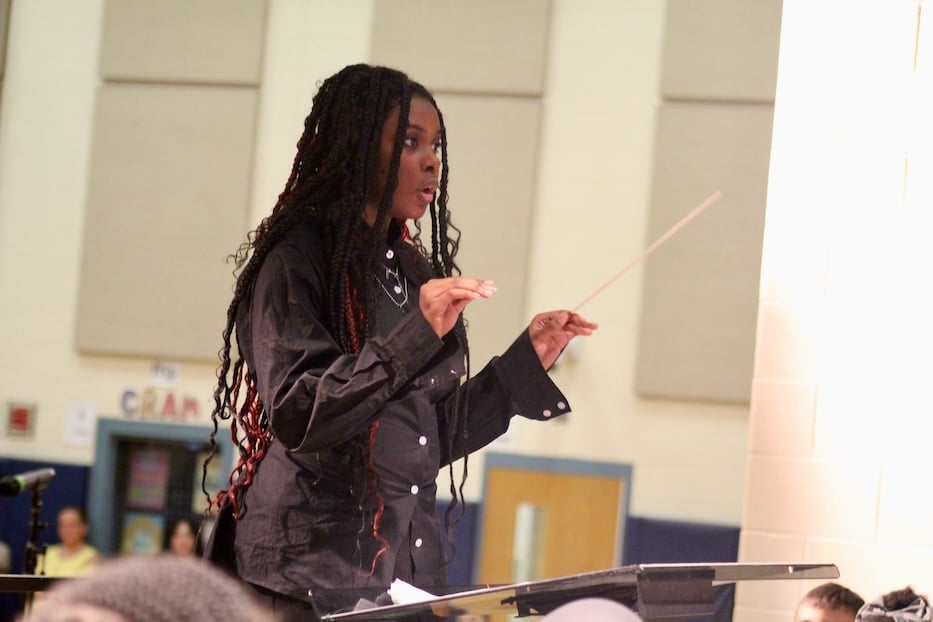
Gabrielle Hilton at the podium. Lucy Gellman Photos.
Eighth grader Gabrielle Hilton raised her hands and looked over the musicians assembled in front of her, the faintest hint of a smile tugging at the edges of her mouth. Counting the group in, she steadied her right hand and let the left do the talking, palm and fingers swooping through the air. At her command, horns and percussion came right to life, their voices bright and brassy. The band was ready to dance.
Tuesday night, Hilton conducted Michael Sweeny’s “Band Room Boogie,” a rollicking, bluesy ode to musicianship that lets every section of the band shine, during Mauro Sheridan Interdistrict Magnet School’s mellifluous spring concert. Rescheduled after extreme heat prompted early dismissal last week, the evening became a testament to the impact arts education can have on students—and the grassroots collaboration that can happen with a little know-how and some musical elbow grease.
“I feel very grateful for it,” said Hilton, an eighth grader at the school who is headed to Cooperative Arts & Humanities High School in the fall. “It makes me feel like I have more opportunities. The older I get, the more advanced I get … Ms. Iezzi, she pushes me to be my very best.”
For her, and for teacher Marissa Iezzi, who directs the band at Mauro Sheridan, the story of how she got to the conductor’s podium starts both four years ago, and as recently as last month. When Hilton was in fifth grade, Iezzi welcomed her into the band room for the first time, to pick out the instrument she would play for the next four years. Hilton, who had grown up on Troy "Trombone Shorty" Andrews’ autobiographical picture book, gravitated toward the trombone.
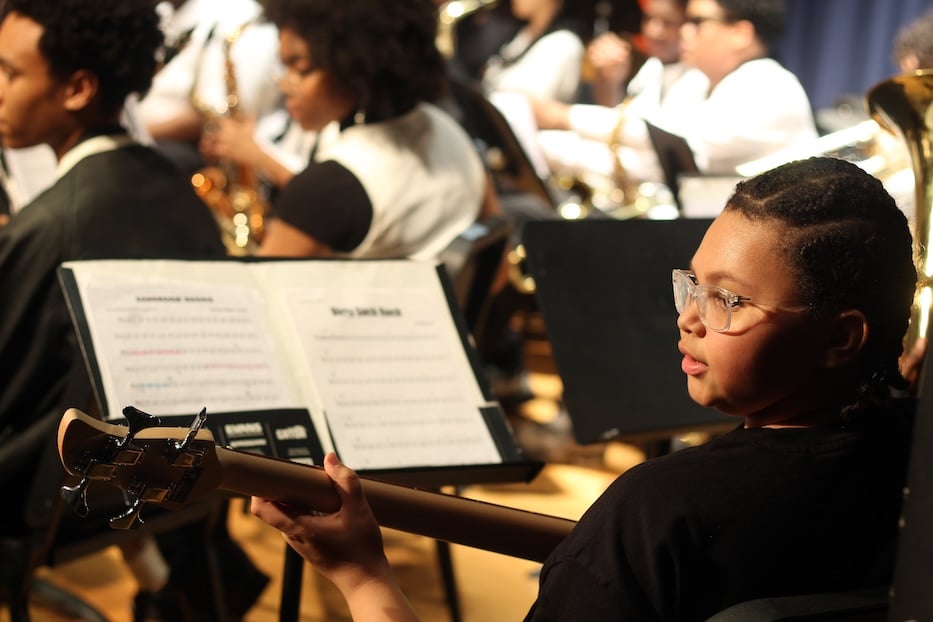
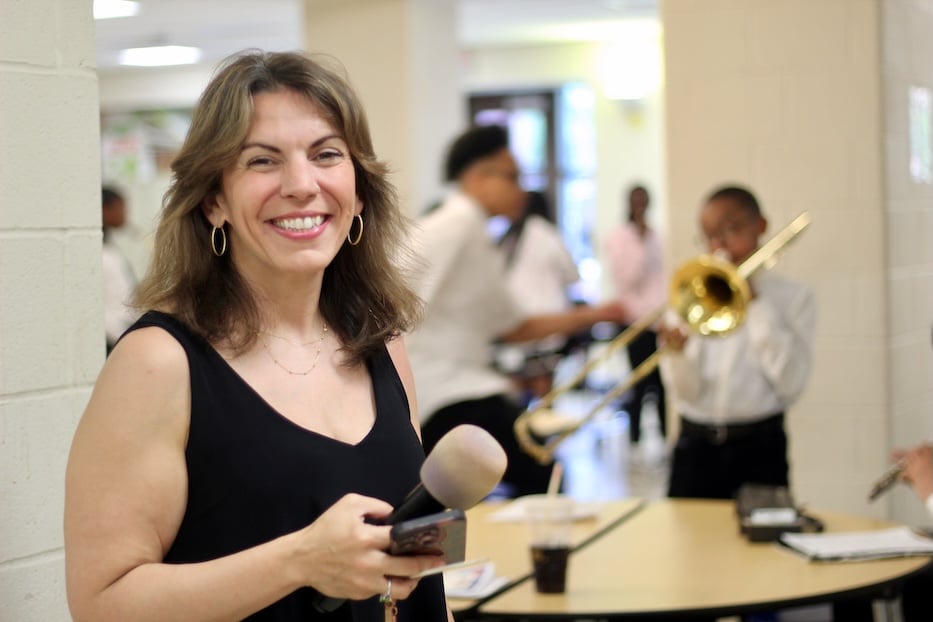
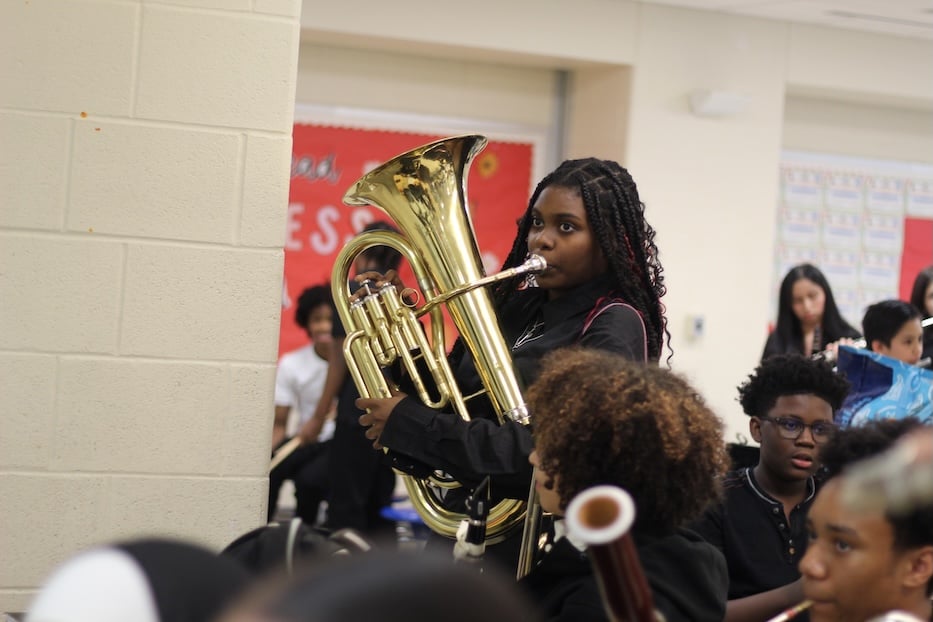
Top: Students get ready for the "Dirty Sock Rock" backstage. Bottom: Iezzi during band warmups in the cafeteria.
That year, both of them were beginners of sorts: Hilton had never played a brass instrument (she has since picked up baritone and euphonium, and is interested in the flute), and Iezzi was new to Mauro Sheridan, after years teaching at Truman School, James Hillhouse High School, and Woodland Regional High School. But almost immediately, they hit it off. There was something about Iezzi—who can play just about every instrument, and is as kind and funny as she is firm—that made Hilton want to be a better musician. There still is.
“I love working with Ms. Iezzi,” Hilton said. Iezzi pushes her in a way that feels productive, she continued: she’s a role model and a cheerleader, and sometimes a giver of tough love that Hilton needs to hear. When Hilton wanted to pick up the baritone, Iezzi was there to help her learn. When she joined the Morse Summer Academy and All-City Band, Iezzi cheered her on. When Hilton had the chance to join Co-Op’s band during its spring concert, Iezzi and teacher Matt Chasen worked together to make it happen.
“She is very motivated and very passionate,” Iezzi said in a phone call Wednesday. “She has grown so much as a person in the last four years … she practices all the time. She is always up for a new musical challenge.”
And then last month, when Hilton critiqued one of her other teachers on their own conducting technique, Iezzi pushed back—and offered her student a brand new challenge.
"I kind of read her the riot act,’” Iezzi remembered. “I was like, ‘Listen, Gabby. It's hard to do this. You think that we get up and just wave our arms around and keep a steady beat?’"
She explained to Hilton that conducting is an art form of its own, that requires knowing every part of the music inside and out. To conduct, Iezzi doesn’t just have to learn the music before her students: she has to think through its patterns and map out each of its sections, knowing exactly which instrument does what, and when. And then, “I was like, ‘Why don't you conduct a piece, then?'” Iezzi remembered.
It may have been, at the time, more of a rhetorical question. But Hilton, not one to be easily deterred, took it as an invitation. So Iezzi picked out a piece that would feel accessible—that’s where the “Band Room Boogie” comes in—and started teaching her to conduct. Iezzi had her learn her part, and then look over the score, and then learn every section’s part. She pushed Hilton to recreate the chord progression on the classroom’s piano, thrilled when she did.
Then she reached out to Caitlin Daly-Gonzales, an old friend from band camp who happens to be the director of education at the New Haven Symphony Orchestra (NHSO). A few days later, Maestro Perry So was standing in Iezzi’s second-floor classroom just off Fountain Street.
So, who began his tenure with the NHSO in 2024, was in town at the end of April for one of the symphony’s concerts. Normally, he tries to do a school visit every time he’s in New Haven, he said in a phone call Wednesday. But this was the first time a school tipped him off to a young conductor in its midst. And from the beginning, “her talent and her interest and her passion” were all clear to him.
“I started working with her on conducting without her arms … basically, the idea that less is more,” he said. “There’s so much you can communicate [with more subtle gestures]. I really wanted to introduce the idea that she didn't need to be very demonstrative.”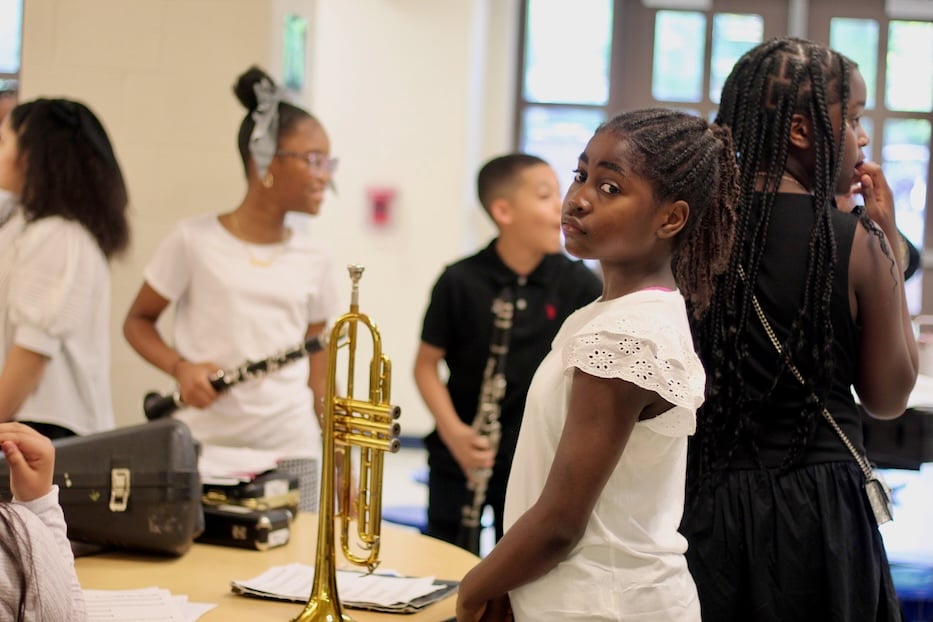
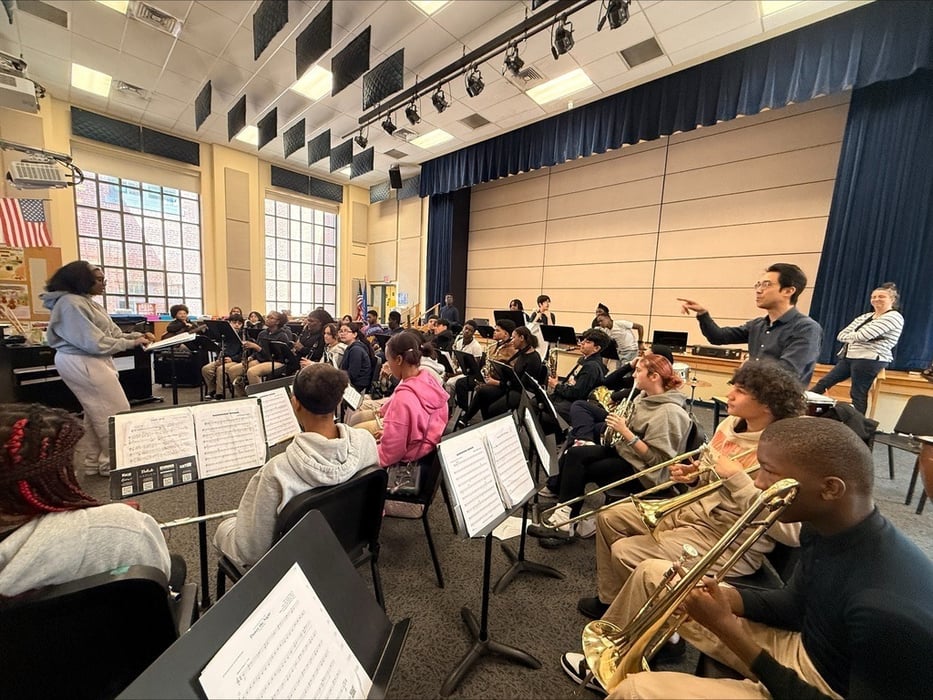
Top: Warmups. Bottom: So working with Hilton last month. New Haven Symphony Orchestra Photo.
From the jump, he encouraged her to focus on “the small gestures,” like using her eyes and her breath to cue in specific sections of the band. He went over conducting patterns, delighted when she picked them up quickly. He watched how calm she remained at the helm, thoughtful about the small, meaningful movements she was making as soon as he suggested it.
That’s a learning for him too, So acknowledged: he has been known to bust a (graceful) move at the podium, so taken with the music and the musicians that it becomes hard not to conduct with his whole body. Every time he steps into a classroom or onto the podium, he opens himself to learning something new.
“It [conducting] is something of a choreographic art, but Gabby has something that I can only dream of having,” he said, adding that while the premise of conducting itself is rooted in a nineteenth century European “desire to have an authoritative figure,” it’s always thrilling to see someone at the helm who is not an old white man. “She has this really steady, calming presence. We all have the gifts that we have, but I admire that about her. I think it’s going to take her far. We want calm, thoughtful, steady people leading us.”
“The conducting itself is not really the challenge,” he added. “The challenge is the kind of philosophy that you model by standing in front of people.”
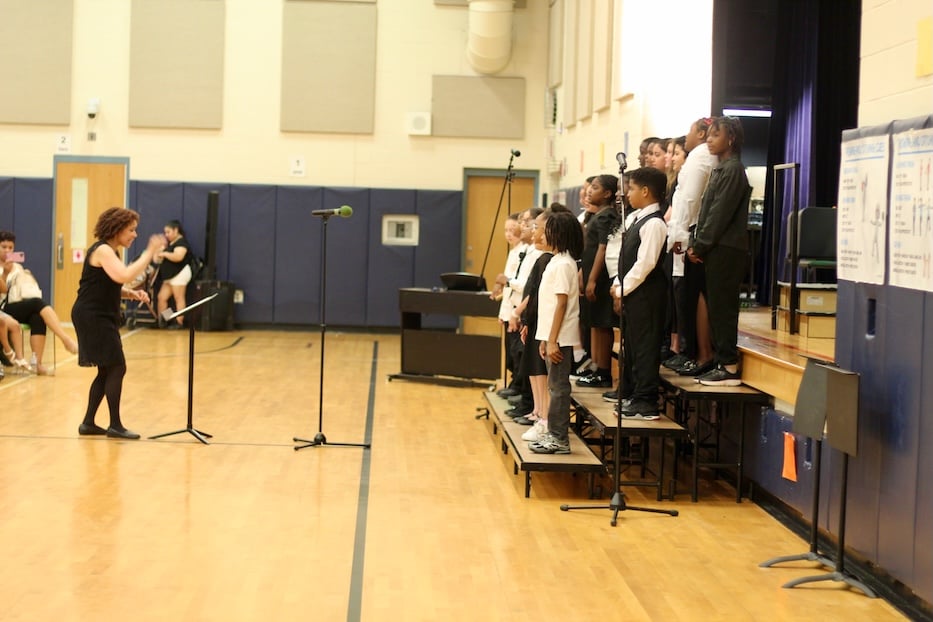
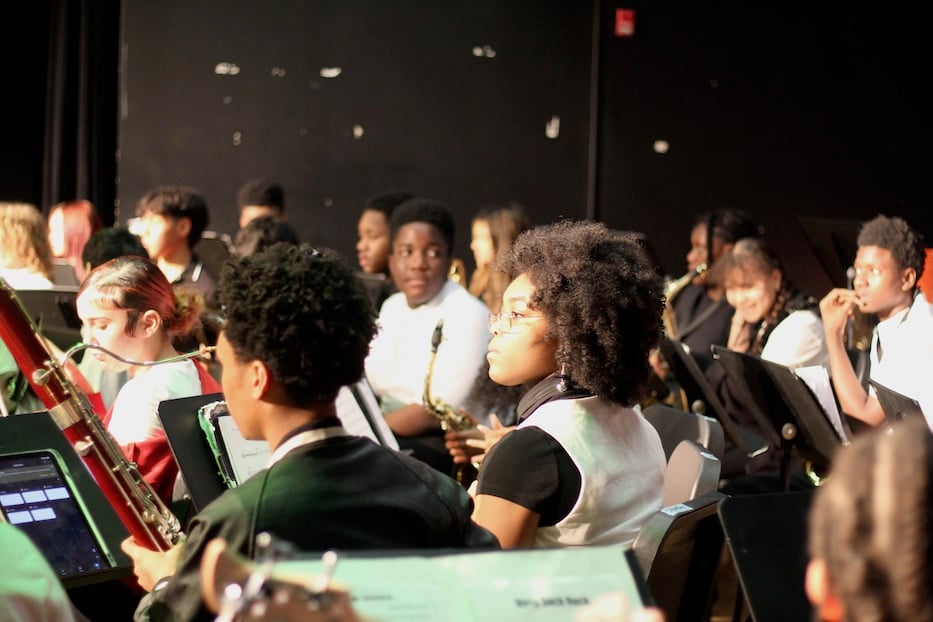
Top: The "Cadet Chorus," directed by Elisangela Ortiz. Bottom: Students get ready to boogie, musically, backstage.
Tuesday, it was easy to see that all at work. Between heart-squeezingly-good choral performances of “I Like To Teach The World To Sing” and “You Can’t Stop The Beat,” members of the fifth grade band made their way nervously into a second floor hallway, some buzzing with excitement as others checked in with Anthony Akambe, Yaretzi Melendez and Jonayra Rivera, all high school freshmen and Mauro-Sheridan alumni who had returned to help Iezzi out with the concert.
Inside the school’s gymnasium, hundreds of parents had turned the space into a concert hall, their bright cotton shirts and knitted sweaters filling it with shades of celebratory pink and yellow. So no wonder that as Iezzi, fresh off the “Dirty Sock Rock,” turned it over to Hilton, preemptive applause filled the room. In the audience, a few dozen parents lifted their phones, and pressed the record button.
At the podium, Hilton appeared completely calm, smiling for just a moment before she took a beat, and got serious. She counted her classmates in, raising her hands to her chest. In her left, she balanced a baton gingerly between her fingers, and took a deep breath. From the podium, she looked up at her classmates, eyes focused on a group of clarinets at stage left, then flutes closer to the center, then over to the saxophones just beyond her right shoulders. Her braids, streaked with sections of red that seemed to glow, fell over her shoulders and down her back.
The drums marched forward, crisp as they entered with a jubilant Rat-tat-tat! Back at the podium, Hilton pursed her lips and nodded, almost imperceptibly, at the woodwinds as they took over, flutes pushing to the front like cream separating out from the milk beneath it. She breathed in again, a study in composure. The band swooped back in for just a moment, and then it was the clarinets, their voices hollow and almost duck-like, that called back. Beneath them, drummers brought their sticks together, keeping time. A few beats later, the brass re-entered, bouncing as Hilton kept her baton waving gently.
Musicians were sailing forward, with Hilton calmly at the helm. As drums and trumpets gave two crisp bursts of sound over the saxophones, Hilton drew in her lower lip, cheeks sucked in for a moment, eyes fixed on a section of woodwinds a few feet in front of her. She turned just a little to the where the saxophones and bassoons were seated, then slowly swiveled back to the clarinets. In front of her, young musicians rounded the final bend, the sound bouncing. Even as the last few strains of music hung in the air, the audience exploded into applause.
It was one of many subtle and sublime moments to happen throughout the night, from choral selections of Frankie Ruiz, Bob Marley and George Harrison (never has “Here Comes The Sun” sounded so sweet, with voices ringing out, crisp and clear and full of hope) to the concert band’s take on Paul Anka’s “My Way” and a giggle-laced rendition of “It’s Raining Tacos” to which the audience joined in. As students waded into the riff on Pachabel’s Canon, parents joyfully shouted the words “Shell! Meat! Lettuce! Cheese!” back at their children, all of them clapping on beat.
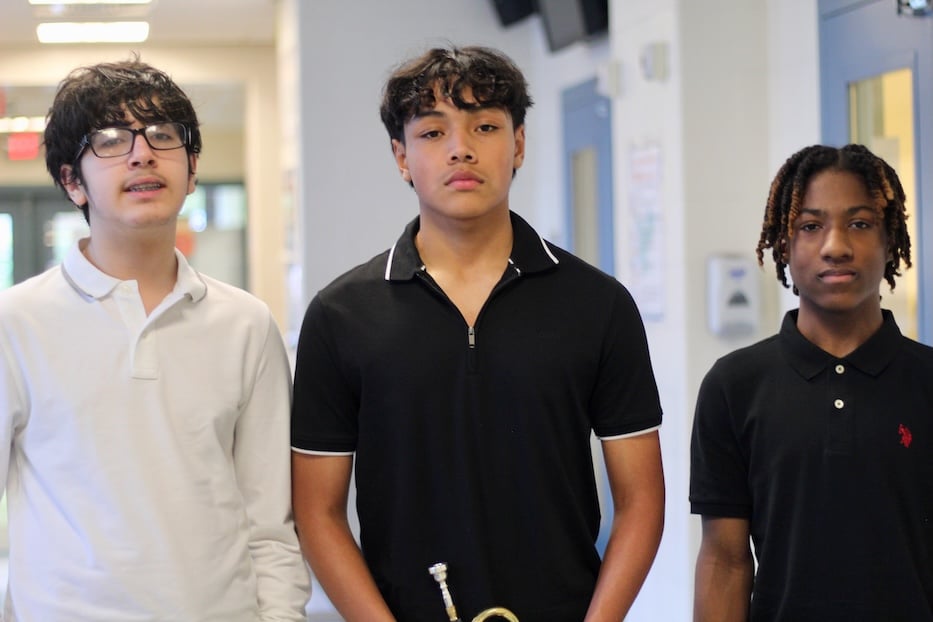
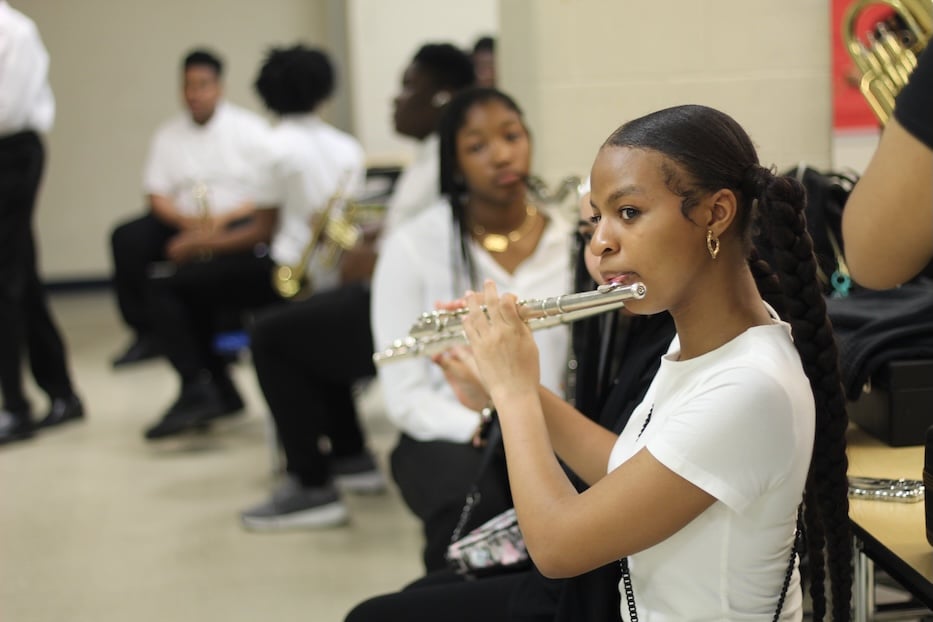
Top: Eighth grade students Abdul Aziz, Ethan Olmos, and Zion Reynolds-Norfleet.
Before the night ended, some of the eighth graders also called the evening bittersweet: it was the last time they would play with their peers, before heading to different high schools across the region. For many of them, it was also a goodbye to Iezzi, who started the same year that they began band classes at the school.
“It’s like a full-circle moment,” said Ethan Olmos, an eighth grade trumpet player who soloed on “My Way,” and had played alongside the New Haven Chamber Orchestra just a week before. In the fall, he plans to start high school in Branford, where he will continue his studies in the trumpet. “She started with us."