

Southern Connecticut State University | Arts & Culture | Theater | Yale School of Drama | José Rivera
What two school productions of the playwright’s work reveal about Latinidad on stage.
 Ah, the Latino play. To a certain group of people—which includes yours truly—it's a source of endless discussion: What exactly is it? Where are our classics? Who makes up our pantheon? We will fight about who’s who and what’s what all day and never agree.
We can’t even agree what to call ourselves; I’m sure some readers have already raised an eyebrow at my usage of “Latino” rather than “Latine”—which, though less than the aberration “Latinx” (which is thankfully all but dead now), still strikes me as an academic invention that bears no connection to most of the people it’s supposed to describe (though, if you’re gonna use it, for the love of abuela: do not put an accent on the “e!” “Latiné” is several layers of grammatically incorrect and makes me cringe every time I see it).
The issue may begin with the fact that “we” are not a very cohesive group; as I have written about before, Latinidad is an invented identity, created by people seeking political power and maintained by corporations seeking an economic edge. It bears some relation to race, ethnicity, country of origin, and immigration status, but does not strictly conform to any of them.
It may be why, as a friend of mine joked, we have invented a genre as well: “Every Latino play requires a grandma, a ghost, and a recipe.” Regardless of who is writing it, what it is about, or for who it is for, the Latino play has taken a shape that mixes Greek, English, and American ingredients with a pinch of magical realism and two tablespoons of Spanish (though each of those few lines will be quickly repeated in English by the same character: “Oye, ven acá, come here!”).
So when I saw that two different universities were performing José Rivera plays last week—in some sort of planetary alignment that would feel quite at home in one of his stories—I decided to make my Friday into a two-show day: a matinee of his 2000 References to Salvador Dalí Make Me Hot at Southern Connecticut State University, and an evening of his perhaps most famous play, the 1993 Marisol, at the Yale School of Drama.
His unexpected resurgence in an otherwise run-of-the-mill New Haven weekend warranted investigation; this was not a coordinated effort to celebrate him, or an observance of a specific anniversary of his plays. Does the coincidence say something about the state of the Latino play? And if so, what?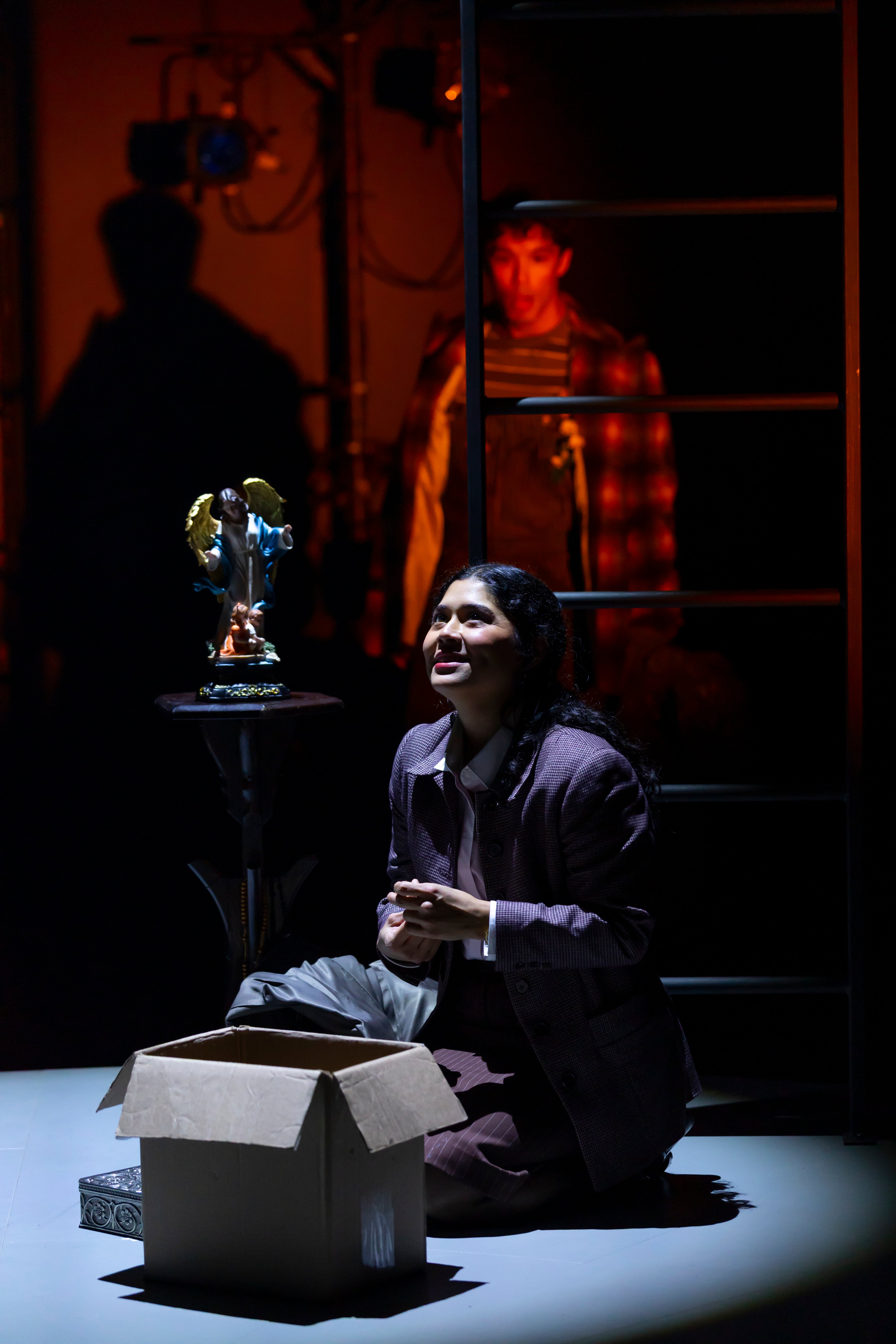
If there is a Latino theater pantheon, most would argue Rivera belongs in it. He was born and raised in Puerto Rico until the age of four, when his family moved to Long Island; growing up in this country nudges him away from a Latin American label towards Latino-American one—a bucket that is arguably overrepresented in our mix.
This disproportion explains some of my skepticism towards the genre of Latino Theater™: most of its plays are the byproduct of writers who only have partial access to their family’s culture, but are pushed by the industry (who’s always so eager for “diverse voices”) to take full ownership of it. The result feels to me like what I imagine our representation of dinosaurs would feel like to actual dinosaurs—“You imagined ALL THIS out of a couple of bones? We’re not lizards! We have feathers!!”
But I cannot hold this particular issue against Rivera, who, at least in the two plays I saw, did not showcase any particular interest in asserting his identity to non-Latino audiences: more than anything else, the culture and worldview of these plays are Rivera’s own.
What I could glean of Riveran culture from these two works was, primarily, a sense that things are not okay. In References, time has stopped; Gabriela, the wife of a soldier stationed in the Mojave desert, cannot tell the days, or the nights, apart (and neither can we). In Marisol, the eponymous protagonist has been murdered—or at least that’s what the papers say, though she believes it was someone else with the same name.
Both plays are concerned with the end of the world. In Marisol, the angels are rebelling against God; human society, freed from its guardians, is plunging into chaos. In References, the apocalypse is personal: Gabriela’s marriage to her husband Benito has been coming to an end for years, and she is both eager and terrified to put it out of its misery.
The two tales also see the end times as a necessary evil so that something better can take its place. It’s not for nothing that both protagonists are women: Gabriela and Marisol don’t hate men, but they wish men had done better—and they will choose themselves when pushed. The men in these stories—ranging from a coyote who “smells like shit” to a schizophrenic who carries Marisol’s baby inside him—are somewhat interchangeable, all struck with Adam’s blindness: they can’t see past their fists…or their dicks.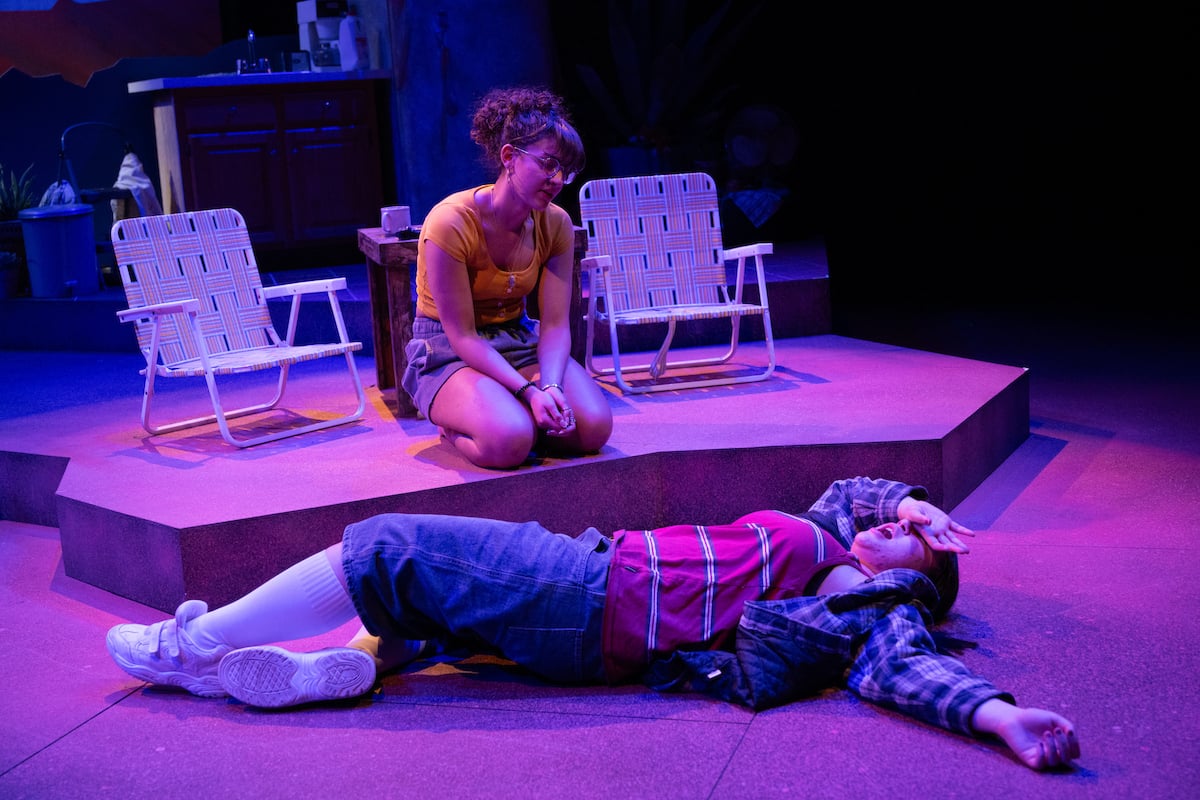
“Men ruining things:” this is the true genre of the plays, and it is perhaps why both feel so ripe for a revival in 2026, when the combined forces of state repression, surveillance capitalism, and natural catastrophes make us feel, to quote Gabriela, at “the end of the world”—and it’s all men’s fault.
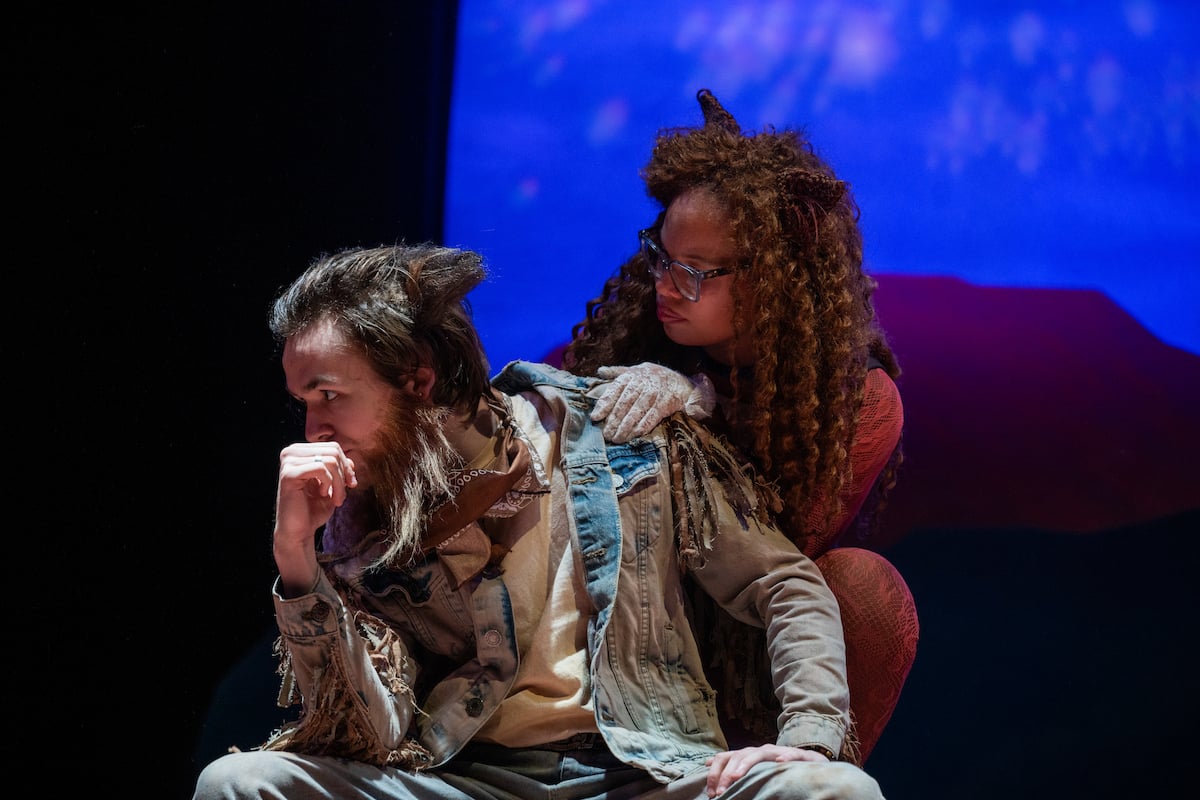
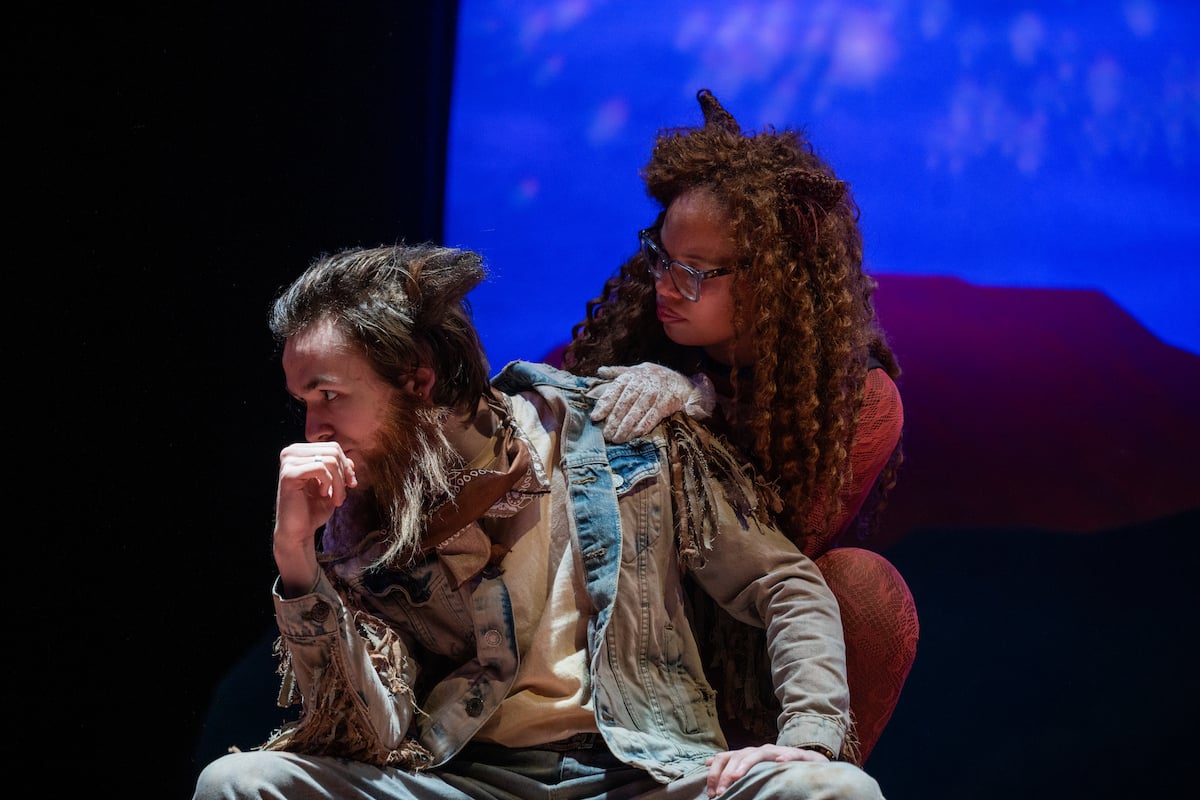
Each team takes a different approach to realizing the vision. Southern’s References, directed by Ruben Ortiz, co-founder and artistic director of New Haven’s A Broken Umbrella Theatre, is a languid, contemplative affair. The set (by Douglas J. Macur) is quite literally the desert; a fridge and a sink share the space with lawn chairs and a cactus. Inside, outside, it’s all the same: there’s sand in the bed, but only Benito (Gian Melendez) notices—Gabriela (Alejandra Cruz) sleeps in the backyard.
It was interesting to see students playing people a decade older (with the exception of Marangelie Colón, who plays a 14-year-old to hilarious effect). The students brought an energy to their roles that enhanced the feeling of time having stopped; a Benito who would be this battle-weary and a Gabriela who would be this disappointed in twenty-something bodies made them feel even more angsty than the text implies.
The first and fourth acts are surreal, involving talking animals and conscious satellites, whereas the second and third are realistic—and, through no fault of the production, more of a slog. Rivera seems to be in his element when not confined by the need to make sense; the circularity of Gabriela and Benito’s arguments, might as it have driven home the point that this relationship cannot go on, was no match for the courtship of Gabriela’s house cat (Jazmyn Willis) with the wild coyote (Ryan Garrett) roaming her property.
It is perhaps in the character of Martin, the aforementioned 14-year-old who lives next door, that Rivera finds the balance: the hilarity of his insistence that Gabriela has taken his virginity merely by talking to him matches the seriousness with which he announces that hair will sprout all over his body soon, and he’s ready to marry her. Unlike Benito or the Coyote, Martin has all of the pride and none of the swagger. References is not a comedy, per se, but it is more likely to laugh at the absurdity than to be scared of it.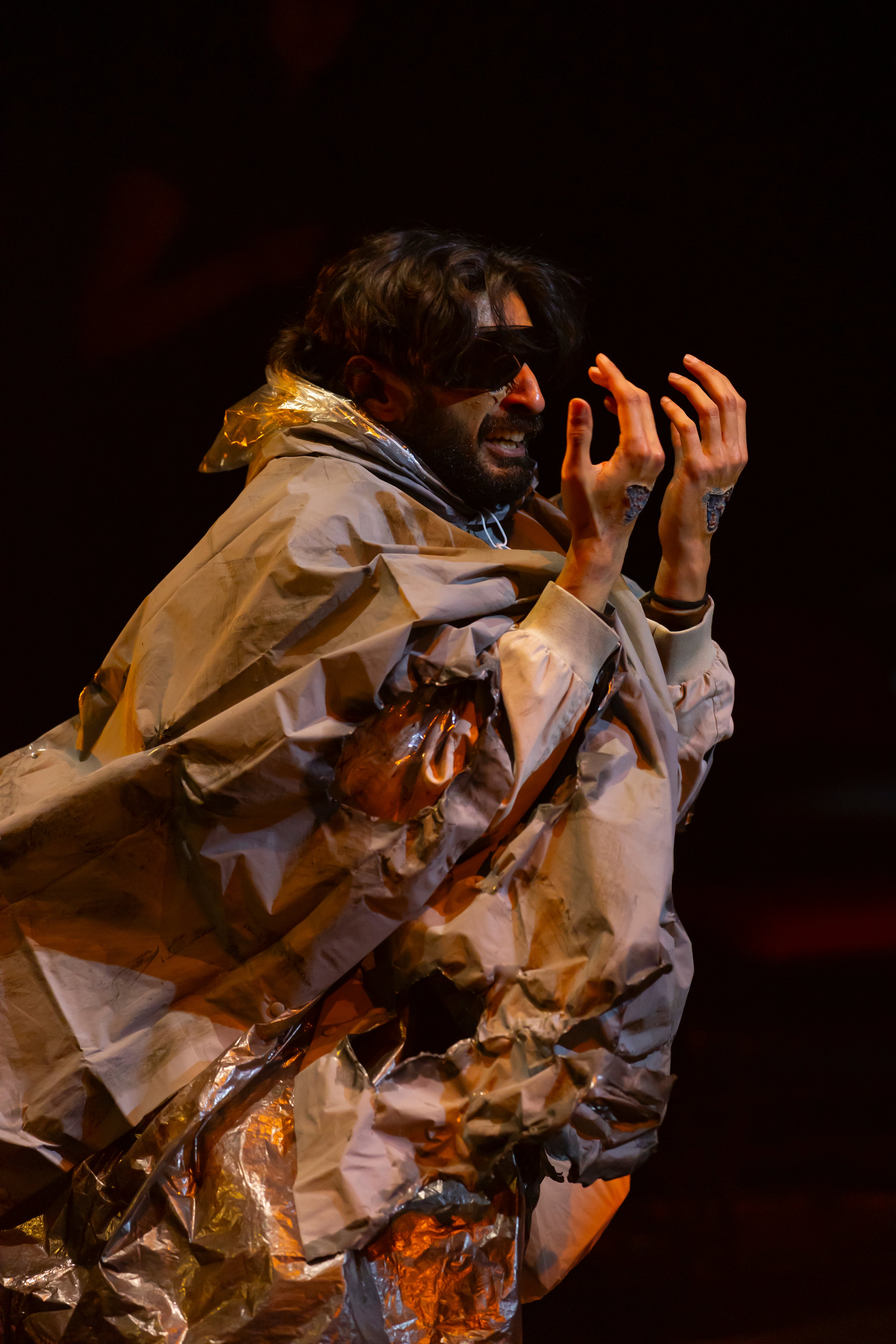
Yale’s Marisol, on the other hand, is a tense nightmare, helmed by MFA directing candidate Héctor Flores Komatsu. The production manages to evoke, in the present day, Rivera’s pre-millennium anxieties, which share the biblical underpinnings of Tony Kushner's Angels in America and the apocalyptic lawlessness of José Saramago’s Blindness.
Unlike References, Marisol often relies on cast doubling, which enhances the disorienting effect: the woman who screams for her boyfriend to open the door (Ashly Chalico), and threatens to shoot up the whole building if he doesn’t, is also a fur-clad socialite with tickets to Les Mis who wonders whether Mastercard will restore her credit if she turns Marisol (Rebecca Rivera) in. The subway rider who threatens Marisol with a golf club (Ameya Narkar) is also a supposed cast member of Taxi Driver who demands his acting fee while licking on some quickly-melting ice cream. Much like in a nightmare, different people look the same, and they are all just as scary—even if it’s not clear whether any of them are real.
Neither play has what could be called a happy ending; they have ambiguous, unsettling stops that feel less like a resolution and more like an acknowledgement that this is as far as we need to see to guess how the rest goes. Neither has an obvious Rivera stand-in either, which could be considered a rarity in today’s landscape.
But, upon further inspection, both plays turn out to share a conspicuous character: the moon. In References, it’s a somewhat jealous presence (played by Azaad Mamoon) who tries to seduce Gabriela, perhaps out of an inferiority complex regarding the sun (and for having been called “inconstant” by Shakespeare). In Marisol, it’s the very ground characters step on (in a set by Francesca Pan with projections by Bobby Marcus), a creative interpretation of Rivera’s mentions in the text of the moon having fled to Mars during the angelic rebellion.
I wonder: was Rivera writing himself into the moon? Much like his lunar counterparts, he observes his characters from a distance, having empathy for them but knowing too well the danger of getting involved in the lives of people who don’t seem to want to change.
It’s also a good metaphor for his engagement with Latinidad: both plays have Puerto Rican characters navigating a very American world, being in it but not of it. The institutions they encounter (the army, the press, the financial system) only know how to use them, never how to speak to them—let alone listen. The people they come in contact with can never totally see them as human, only as others to be (as the crass game goes) fucked, married, or killed.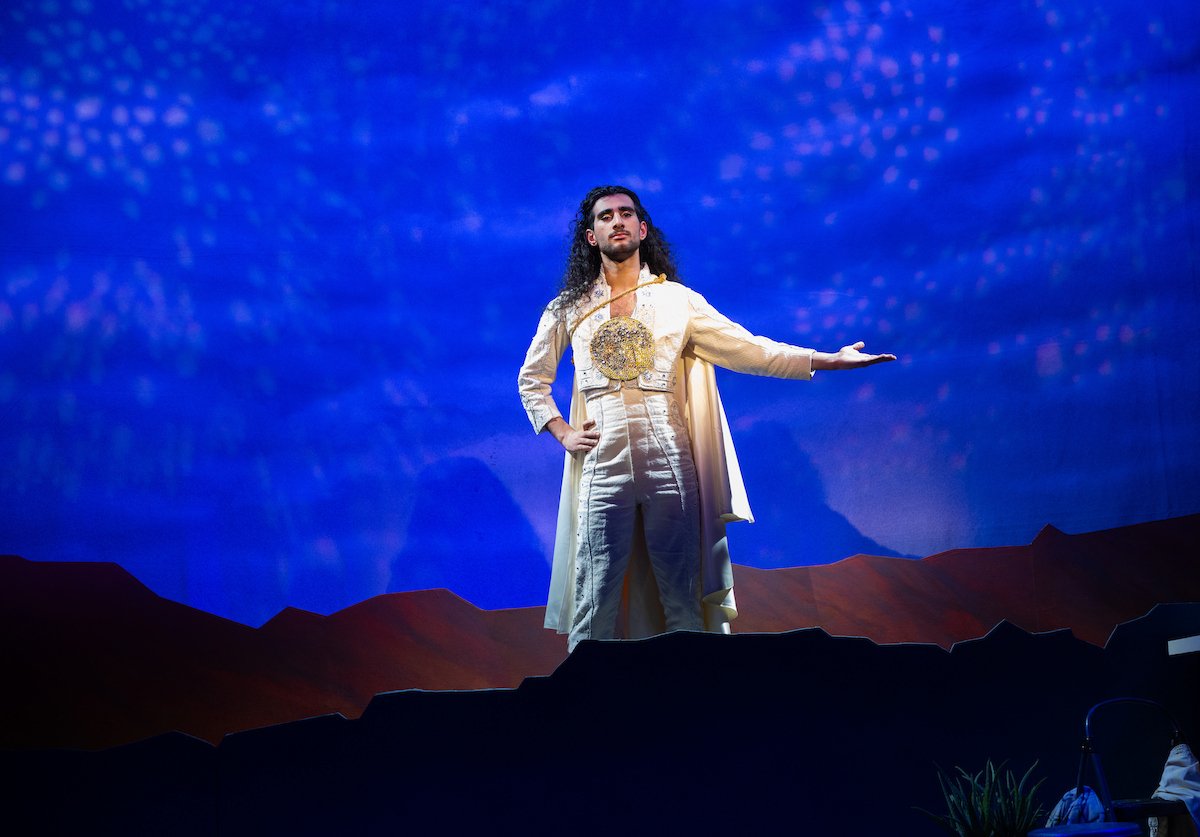
The most “Latino” thing about these plays might be their use of magical realism, a genre often sorely misunderstood among our lot. But Rivera, who studied under Gabriel García Márquez, shows dominion over it. Neither play includes a grandma, a ghost, or a recipe; instead, the boundaries of reality are broken freely, without any surprise on the characters’ parts. Much like the function of songs in musicals, magic is the way that Rivera finds to express the inexpressible.
At a time where our identity remains as undefined as ever—when people celebrate Bad Bunny’s Super Bowl performance as a win for immigrants despite him being Puerto Rican, Anitta breaks global records by shedding her Brazilian sound for trap and reggaeton, and actors like Rachel Zegler, Jenna Ortega, and Ana de Armas find success playing traditionally white characters—these revivals of Rivera’s work offer a different perspective: when your identity is invented, you might as well go on and invent a whole world around you.