


Dance | International Festival of Arts & Ideas | Arts & Culture | Youth Arts Journalism Initiative | Shubert Theatre
Jason Hudson Photo.
The custodian hustled across the front of the theater, carrying a long push broom with him. The curtain lifted a few inches as he made his approach, and he got to work, striking the confetti from the stage.
“Excuse me!” he said, then ushered audience members out of their front-row seats, continuing his cleaning. “Excuse me,” he repeated as a new character approached the stage from the audience, clothed in flip-flops and a ball cap. The repetitions continued until members of Pilobolus were assembled for "Walklyndon," an energetic piece that was, in fact, the second dance performance of the night. The man sweeping had not been not a custodian, but dancer and Pilobolus company member Connor Chaparro.
That moment of transition encapsulated the propulsive, affecting, deeply physical storytelling that the dance company Pilobolus brought to the Shubert Theater Thursday night, during a one-evening performance at the International Festival of Arts & Ideas. Presenting its Other Worlds Collection, Pilobolus pulled audience members into new environments and explored partner work and collaboration throughout a 90-minute program.
“We’re really happy to be a part of the festival this year,” Artistic Director Matt Kent said, introducing the show. “I want to thank all of you for actually coming out to see live theater together. IRL. Seeing work that can’t be downloaded, it can’t be outsourced, and it can’t be faked.”
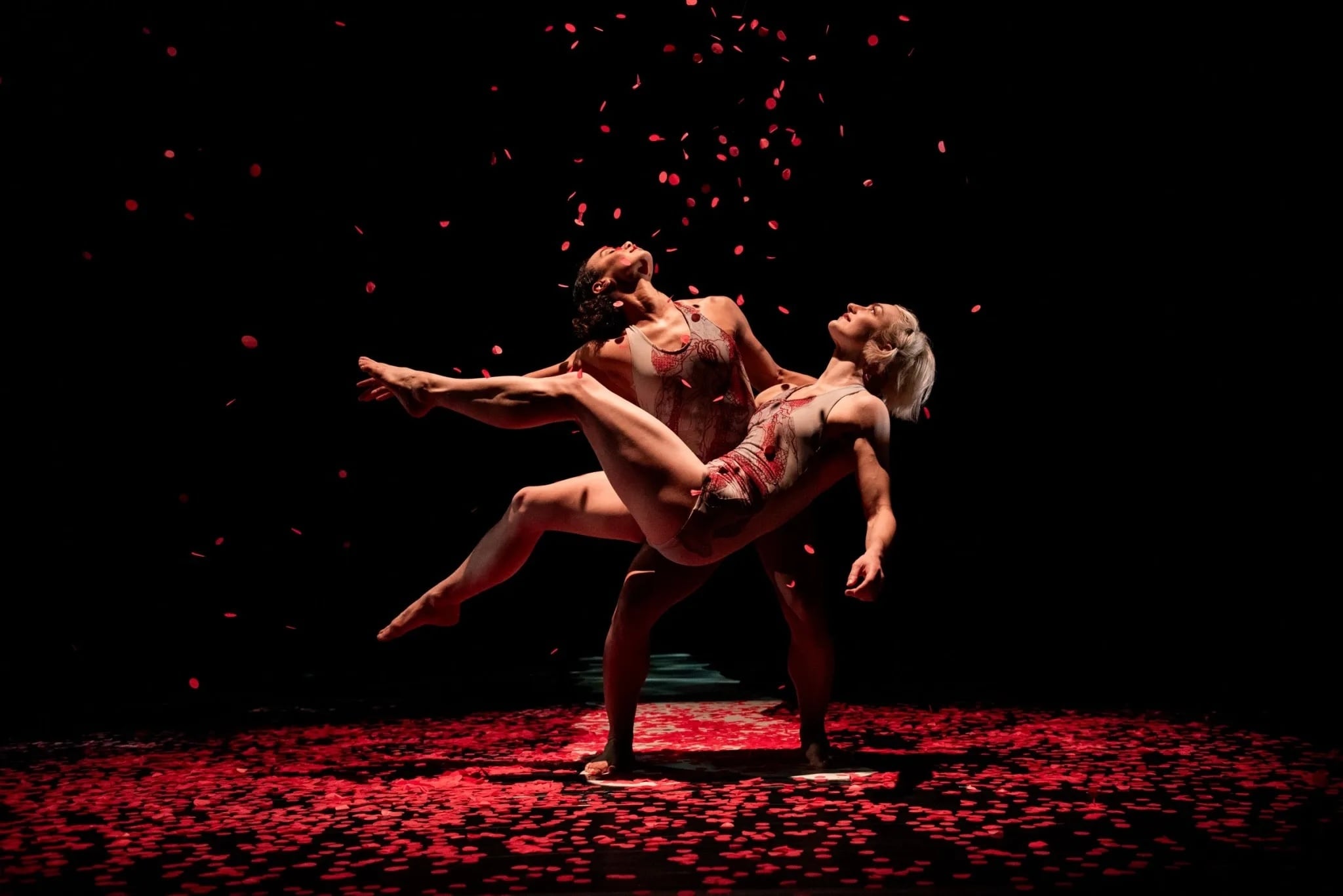
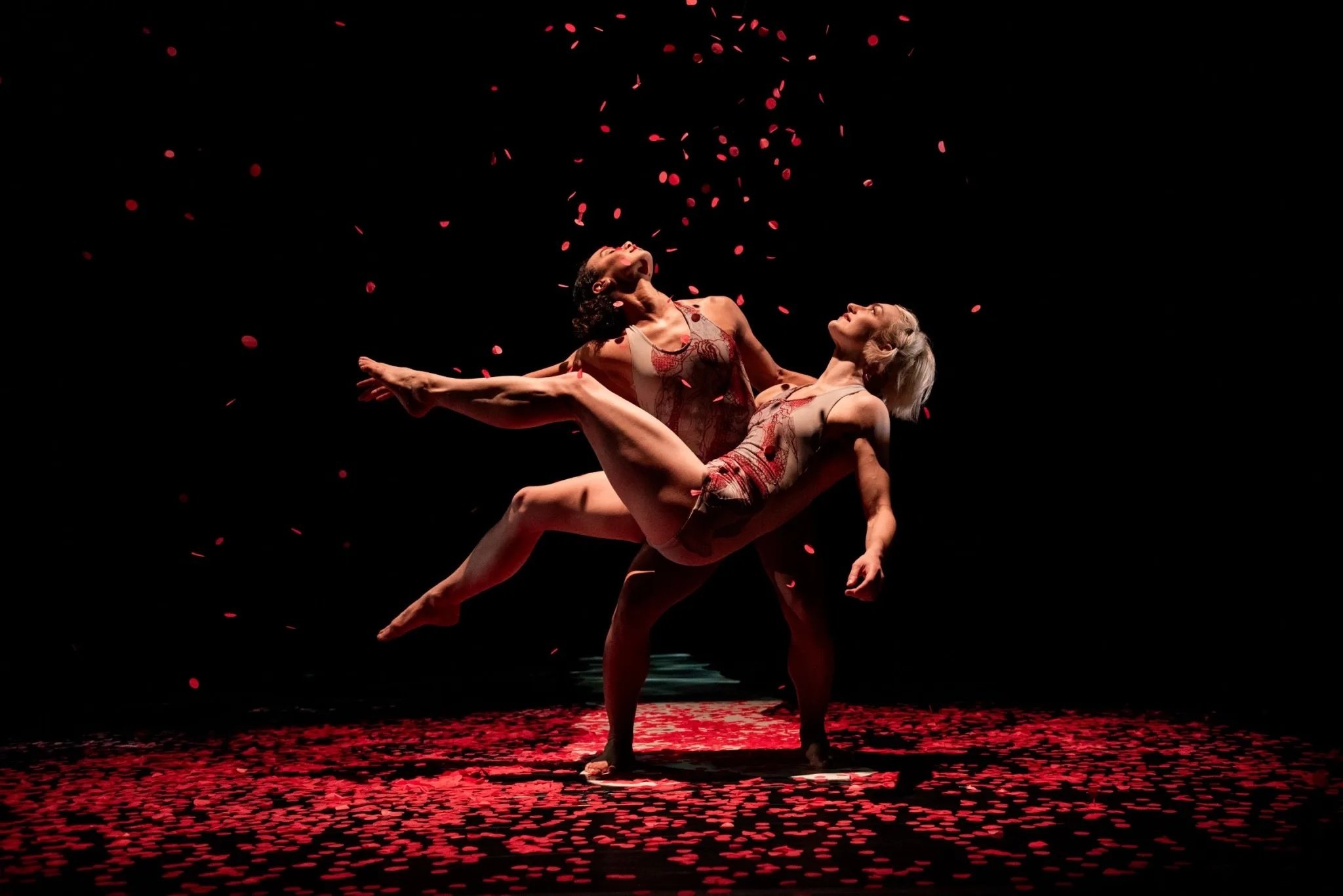
The program began with "Bloodlines," a duet featuring Hannah Klinkman and Anouk Otsea. The lighting was warm and dim as one dancer carried another in a swinging embrace in the upstage right corner. Diagonal to them, smoke began to fill the air, and red confetti petals fell from the rafters.
The atmosphere was spare, perhaps, but something bloomed in the downstage world as the dancers moved toward falling confetti and then retreated to their corner. The storyline and musicality were tumultuous, and the relationship clear and connected. The dancers were blood relatives, or sisters.
Everything in this piece felt intentional, the dancers were costumed in short, halter-neck unitards with a red design that could be interpreted as florals or internal organs. Mirroring them, the red confetti traversed the line between flower petals and blood cells.
Of all of the pieces in the Other Worlds program, "Bloodlines" was the most choreographically complex and detailed. The movement was exploratory and full of partnering. Even when dancers were not physically connected, their movement mirrored one another in opposition and responded to the beats in the music. It was fluid at times and precise in others.
The transition into the second piece of the program, "Walklyndon," lightened the mood: the audience warmed to the company as members made their way onto the stage. The piece featured all six dancers in the program, costumed completely in yellow, with varying colors of boxing shorts. Instead of music, it relied on breath and comedic sounds from the dancers to accompany their movement.
Dancers tapped into their dramatic and physical skills, as the piece relied on play fighting that was actually intricate partner work that required practice and skill to execute safely. Dancers walked in horizontal paths through the wings of the stage, stopping and interacting when they came across one another. The piece featured plank lifts where one dancer was carried upside down and parallel to their partner, and impressive floor planks held with feet off the ground.
The second half of the program picked up where "Bloodlines" left off, with Hannah Klinkman performing a solo entitled "Pseudopodia." The stage was washed in red, and Klinkman performed within the same diagonal pathway that was prominent in the choreography of "Bloodlines." The choreography featured continued rolls across the stage, progressing in intensity, punctuated with movement like the coccyx balance hold, candlesticks, and flatback forward holds. The dancer held stillness before melting to the ground and propelling into more fits of rolling.
A person could feel that same propulsion again in "Particle Zoo," a quartet that began with Connor Chaparro, Ryan Hayes, and Isaac Huerta onstage, all clothed in white pants. One dancer ran onstage to join them, wearing white pants and a T-shirt before looking around and throwing his shirt offstage to fit in with the rest of the group. The dance ensued, performers continuously shuffling around and shifting places.
Jazzy drums and saxophone floated over the stage, and a person in the audience could nearly feel the push-pull between dancers, the desire to both conform, and to shift into different positions, finding one’s own cadence. The piece transitioned to an interlude of partnering that felt rivalrous, before evolving into a dreamlike atmosphere, as stars filled the scrim and Alexis Cruz-Castro appeared to be walking on air. With each step he took, his feet were caught in the arms of another dancer. He didn’t have to fight for his place: his fellow dancers supported him.
The piece fluctuated between union and rivalry, but the dancers were never divided. They moved together, whether in opposition or harmony. The expressions of the dancers lightened, and the T-Shirt from the beginning of the number was thrown back onstage. A dancer put it on, and everyone exited.
This, however, was not the end. Three dancers ran back to center stage, arms stretched out. With a boom!, a body clothed in white pants and a white shirt dropped into the arms of the dancers, and the stage went black. The audience gasped in surprise and amusement as the lights came back on for bows, and the dancers presented a prop body.
After a show full of surprises, Pilobolus had one more waiting for audience members outside. White umbrellas set out a path for audience members, leading to the Temple Street Plaza behind the Shubert Theater.
As audience members eagerly waited, Kent announced, “Last night we came out here, and we started goofing around with these umbrellas. We put together a little something, and we want to show you how we played with them. Then, we want you to get an umbrella in your hand and join us for some fun.”
More audience members filtered out to come see the surprise. “Team on the steps, are you ready?” Kent asked.
Executive/Co-Artistic Director Renée Jaworski, along with Pilobolus and Arts & Ideas staff, ran from the stairs to the center of the courtyard green, striking a dance number to Michael Jackson’s “P.Y.T.” Everyone lived in the energy of the show and the moment, and audience members took the chance to learn a number of their own to end the night.
Jayla Anderson is a graduate of the Arts Council's Youth Arts Journalism Initiative. A proud graduate of Cooperative Arts & Humanities High School, where she studied dance, she is now a rising junior at Vassar College.