


Culture & Community | Arts & Culture | Visual Arts | West Haven | University of New Haven
Katharen Wiese Photo.
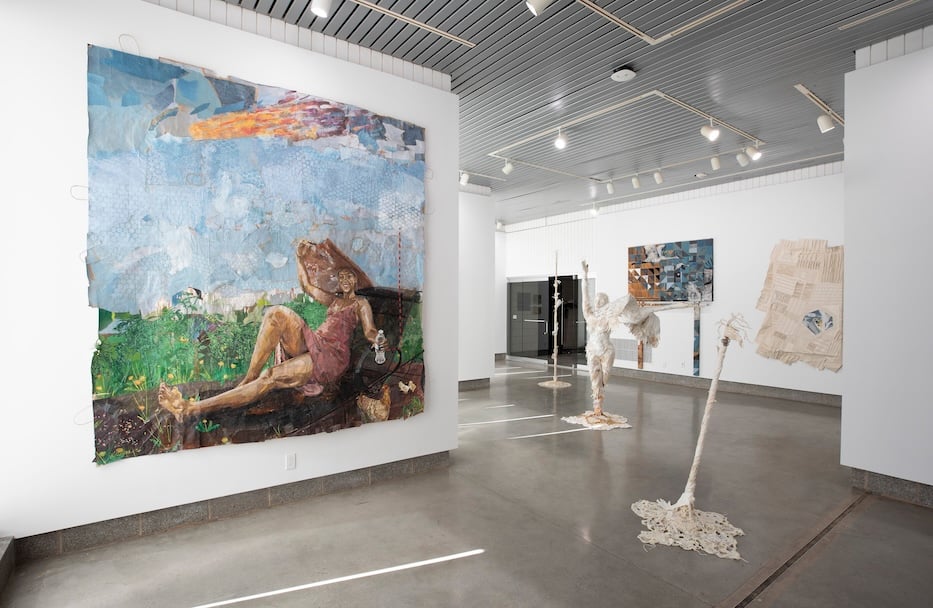
A beaming woman lounges on a black metal recliner, her posture and expression conveying complete ease. One hand extends the brim of her large straw hat, while the other holds a plastic water bottle, her long nails encircling its label. Beneath the chair, a chicken with a huddle of small chicks wanders in the dirt. Bright yellow dandelions pierce the green spikes of grass. All are oblivious to the fiery orange trail of a comet overhead.
Katharen Wiese’s large painting how to smile at the end of our world places a Black figure within an agrarian landscape, the moment preceding an apocalyptic event. The scene introduces a complex web of co-mingling themes—eco-anxiety, the relationship between a figure and the landscape, and the coordinated movements of people, animals, and goods—that run through Hard Leisure, on view at Seton Gallery at the University of New Haven through April 13.
Wiese’s solo exhibition encompasses the varied body of work that she produced as a community-engaged teaching fellow at the University of New Haven and as an artist in residence at the Eli Whitney Museum and Workshop, both from 2024 to 2026. Prints, paintings, small-scale material explorations with handmade paper, and sculptures—most completed within the last year—are shown alongside some of the first fully non-representational works exhibited by the artist. An impulse to layer, both conceptually and materially, unites the show, its title a nuanced contradiction about the hard-won nature of respite, which is particularly resonant for an emerging artist.
A similar tension undergirds being an artist whose output wrestles with the waste materials of products. Between 2022 and 2024, while she was in graduate school at the Yale School of Art, Wiese purchased no new art supplies. She sourced wood from abandoned pallets, bought used paint tubes on eBay, and scrounged for other reclaimed materials like secondhand glitter. “The work of African American artists is often described as being resourceful,” she said during an interview at the gallery, but for Wiese, the word “responsible” gives more agency to the makers. Instead of responding to the materials available, perhaps Black artists were (and are) thinking more consciously about what it means to add new matter into the glut of a deeply ingrained, longstanding consumerist culture.
Joseph Smolinski Photo.
“A painter knows that to do no harm is impossible,” Wiese said, quoting from “The 95 Theses on Painting,” by Molly Zuckerman-Hartung, a contemporary artist and senior critic at the Yale School of Art. Being a painter is a choice, and one that comes with consequences, including environmental injury. Wiese often wonders about what it means (for herself and her subjects) to be a part of this exploitative system, and she has been fixated on mitigating her personal impact on the natural world where she can. The structures that have caused environmental harm are linked to other systems of abuse, and her recent practice has been surveying this spiral.
A recurring material throughout the show is corrugated cardboard, an emblem of product movement. Think about all the discarded Amazon packages in your recycling bin, and the trucks, trains, and airplanes that were utilized to deliver them to your door. Now think about Wiese saving these things from the trash.
In several works—Parcel 1, Knots, 40 acres, to name a few—the ripples of cardboard’s interior are a defining texture within the composition, an abstract element that is cut up and rearranged like scraps of fabric in a quilt. Wiese’s great-grandmother was a quilter and a farmer, and much of the artist’s practice pays homage to these traditions, whose overlap is both creative and bodily sustenance.
“Papermaking and quilting find each other in the history of rag paper,” Wiese explained. In Interstice 1 and 2, as with many other works, she incorporates handmade paper into her process. In places, Wiese has pressed the fibers into the corrugation of cardboard to mimic its texture. The top layers are peeled away in patterns that resemble cheetah spots, contrasted by the repetition of the half-square triangle—a basic quilting block. These smaller works sometimes read as technical studies, compared to the ambition of other, more involved pieces within the exhibition, where she innovatively merges material and image-making.
In how to smile at the end of our world, the thin handles from brown shopping bags emerge along the edge and within the composition. The pattern of bubble-pack wrap is woven into the surface, creating uniform circles where the paint rests on the raised polypropylene shapes. Delaminated cardboard is the painting structure, yet the paint is acrylic, a significant source of petroleum-based plastic pollution. Wiese knows that there’s no zero-impact way to paint, but that’s part of the message. To what extent is the individual at fault for the myriad ways that broader systems continue to imperil our environment?
Joseph Smolinski Photo.
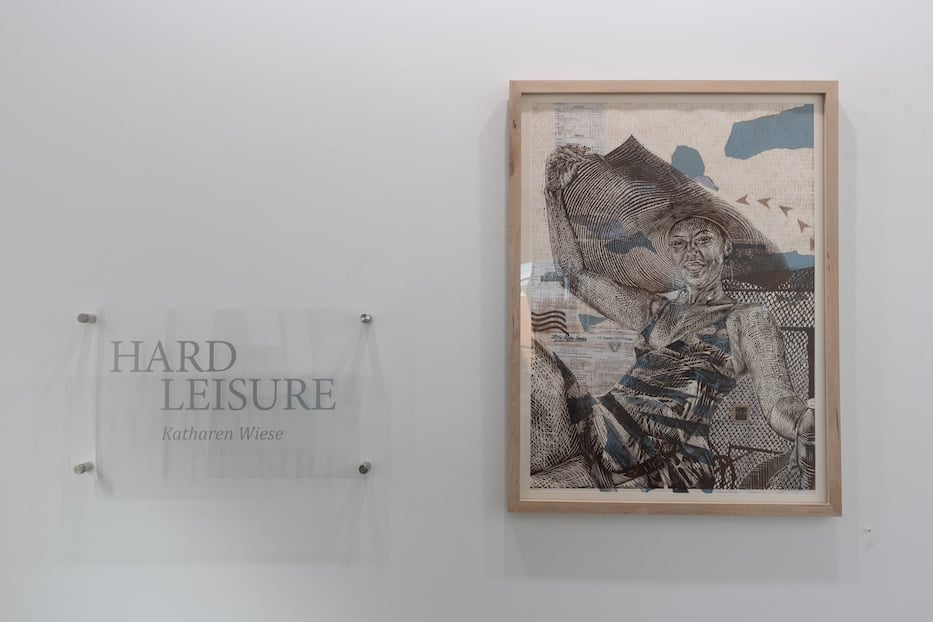
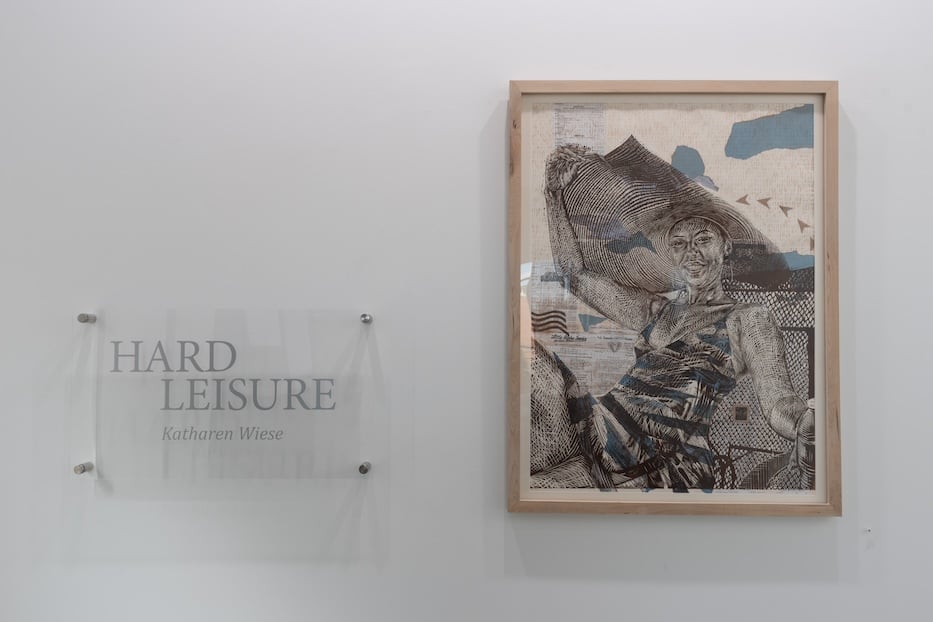
Around the corner from this painting, the same likeness (and print) appears in the exhibition’s eponymous work from the series i made the cornrows: Portraits of Black Nebraskans. The project resulted from several long-form interviews, during which Wiese asked participants to share five ideas central to their understanding of self. These conversations often revealed the distances between perceived and constructed identities, allowing Wiese to understand others through their eyes rather than what she had projected. She used these fact-finding sessions to fashion individual portraits that speak to the person’s unique identity.
For Imagine Uhlenbrock, the smiling subject of the exhibition’s connected painting and print, a vital facet of her identity is her creativity. She is a small business owner and nail artist. Uhlenbrock’s work is included in the collection of the Museum of Nebraska Art, and some of her fingernails take on a golden, glittery finish within Wiese’s spectacular print edition, only one of which is on view inside the gallery. Her success as an artist and her outspoken comments about race made Uhlenbrock an important figure during Wiese’s coming of age in Lincoln, Nebraska, a small, predominantly white community, and Wiese’s admiration shines through in the portraits of this woman.
Another strong influence can be felt in this edition, within both the composition and technique. Wiese considers these relief prints of Uhlenbrock to be in dialogue with Elizabeth Catlett’s Sharecropper. This linocut print portrays a Black woman wearing a similarly floppy hat, but unlike Uhlenbrock, whose eyes lock fearlessly with the viewer, the gaze is averted from the viewer. Uhlenbrock also appears youthful compared to the wizened face in Catlett’s image. Ultimately, Wiese’s portrayal feels triumphant and joyful—this is a woman with palpable delight in front of a camera—while Catlett’s Sharecropper points to the arduous nature of tenant farming.
Katharen Wiese Photo.
A reproduction of Catlett’s composition appears as a teeny postage stamp within the series, a way for Wiese to align herself with the socially-engaged artist while subtly nodding again to the idea of transport. Stamps also allude to the history of printmaking: prints were intended to be disseminated.
In the negative space of this print series, a viewer can also find pages from The Negro Motorist Green Book, an important source for Wiese. Published between 1936 and 1967 by Victor H. Green, this guidebook detailed information on restaurants, hotels, and other organizations that were welcoming and safe for African Americans during the Jim Crow era. “Vacation without humiliation” was the motto, stated on the cover. Pages of the facsimiles of “The Green Book” are collaged throughout the works on view—see Safer Places for a slim index of states, and notice how many are missing.
Taken as a whole, the edition showcases Wiese’s strengths as a printer and image-maker. The limitations of the medium provide a constraint that cuts crossways to the artist’s tendency to layer and patch, at times, at a dizzying clip. Here, we see Wiese’s care and investment in her subject, the result of an authentic and sustained interest in rendering the likeness and overall aura of a person with tenderness.
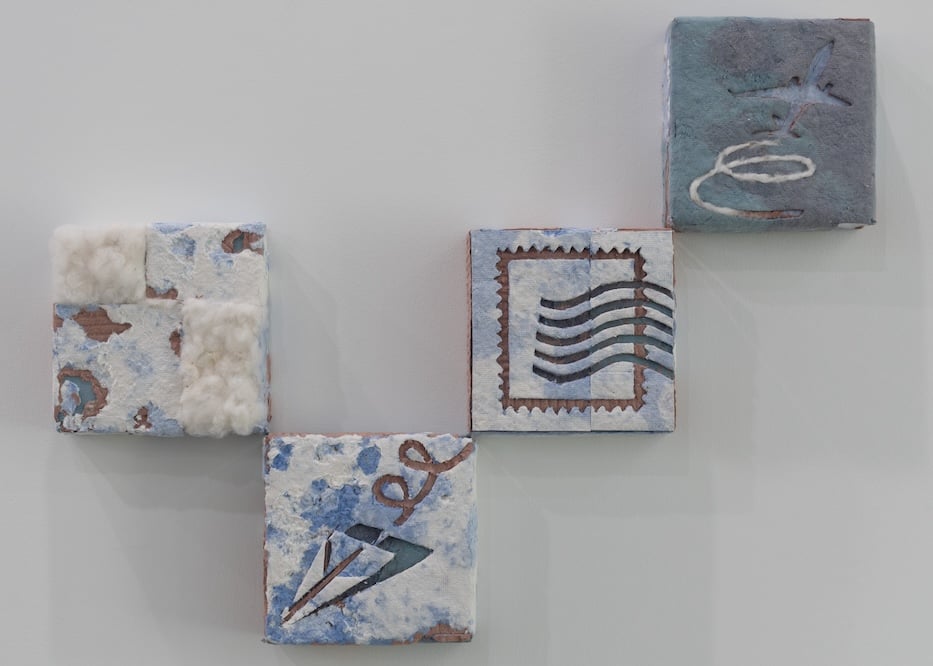
Elsewhere, the concept of migration circles through the show, with the symbol of the postage stamp echoed around the space. In Parcels, a stylized and simplified rendering of a stamp forms the composition for one of the four small panels, all made from cut and torn cotton paper and raw cotton. One conveys white puffy clouds, one recreates the graphic for sending electronic mail, while the final panel depicts an airplane, its nose aloft for takeoff.
Aircraft imagery is also found in Double Vision (fly over spaces), Time Collapse, and Coach, among others, reinforcing the notion of travel. For many and for artists, sometimes in particular, traveling is a fact of life. Our families are spread across the country or the world, and our professions necessitate a certain amount of time inside a tiny, metal cabin of one kind or another, more often than not fueled by petroleum-based products.
Yet another form of resettling—through The Great Migration—is embedded in many other works. The oil painting Going North is based on a family photograph from 1969 that shows Wiese’s grandparents in front of their car before relocating from Alabama to Nebraska. With its straightforward translation of the photo, the painting feels more traditional than others included in the show, save for the pearls sewn onto the surface of the canvas—a gesture that recalls Wiese’s mother, a beader.
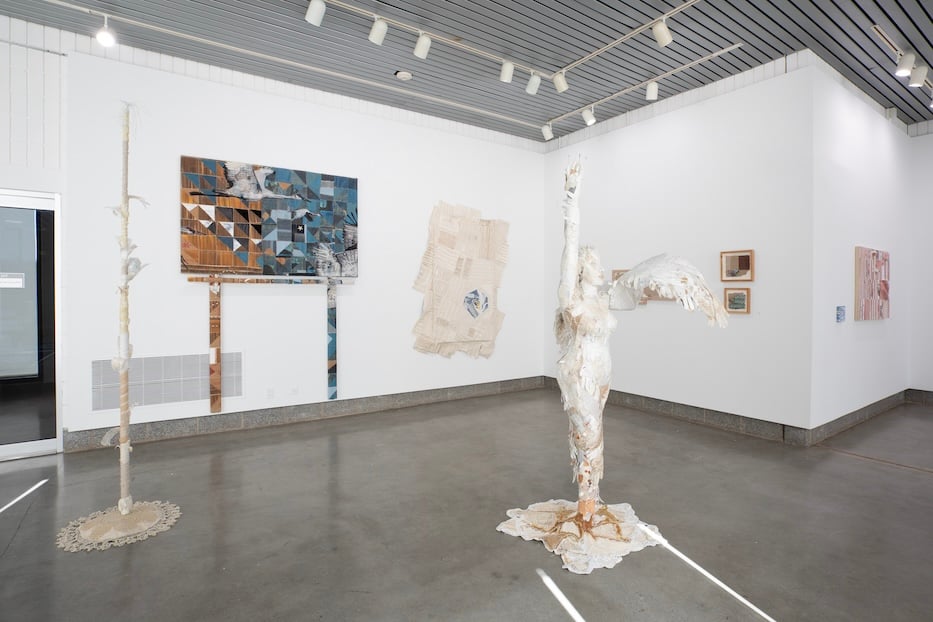
Beading is also prevalent in the sculptural installation comprising three works placed in the center of the gallery—To move and stand still, Stalk, and Stalk and vine. Using collected plastics, reclaimed fabrics, and paper, Wiese draws a comparison between the paths of sandhill cranes and the flight of African Americans to the North during the twentieth century. Every year, about 500,000 sandhill cranes settle along the Platte River, a major waterway in Nebraska, in a phenomenon some biologists refer to as a great migration—the same language used to describe the mass relocations of Black Americans from the south to the northern and western parts of the United States in the middle of the previous century.
Titled A Great Migration, the installation was on view at the Yale Peabody Museum beginning in August of last year. The three sculptures were accompanied by a video of close-ups of “The Green Book,” shown with swatches of lace and crochet with stop-motion sequences of hands collected from museum visitors. Craft traditions meet the migratory paths of people and birds at the nexus of environmental destruction and racial oppression.
Within Hard Leisure, Wiese begins to stitch together a multitude of artistic processes, techniques, and lines of inquiry. There are moments of technical brilliance and exciting beginnings through her material play with paper. The exhibition documents the embarkment of an artist’s practice as it moves in many directions. And the title suggests there is room yet for rest, to make space for appraisal and praise alike.
Hard Leisure continues through April 13, 2026, at Seton Gallery, 300 Boston Post Rd. in
West Haven.