

Culture & Community | Arts & Culture | Theater | East Haven | Cabaret On Main
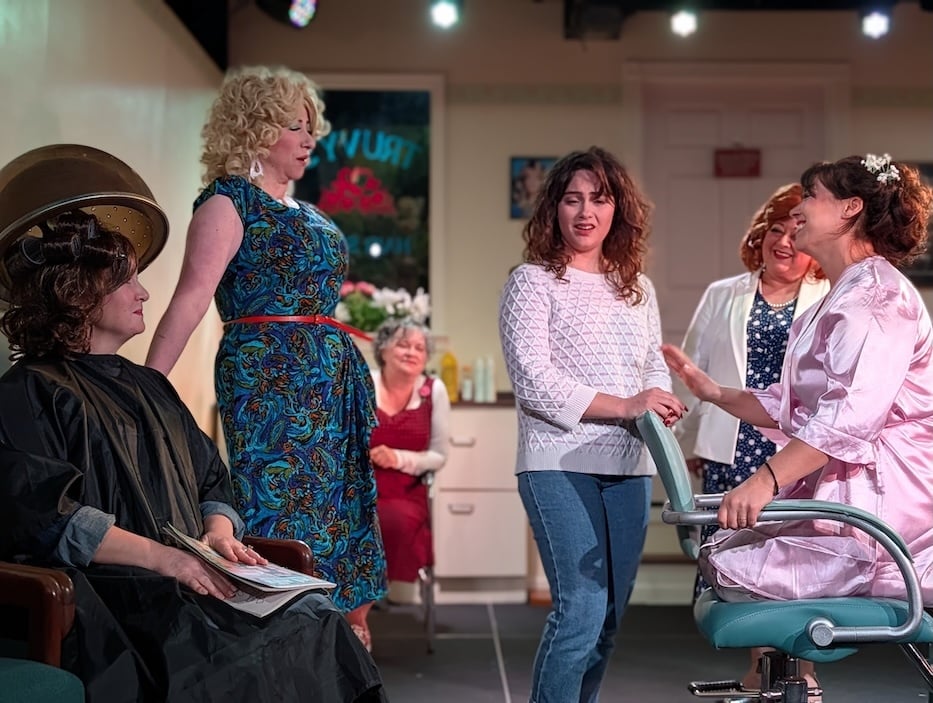
Lisa Costello as M'Lynn, Cindy Harris as Truvy, Juliana Vaiuso as Annelle and Kaite Corda as Shelby. Michelle Rocheford Johnston and Dian Erikian are in the background. Photos courtesy Billy DiCrosta.
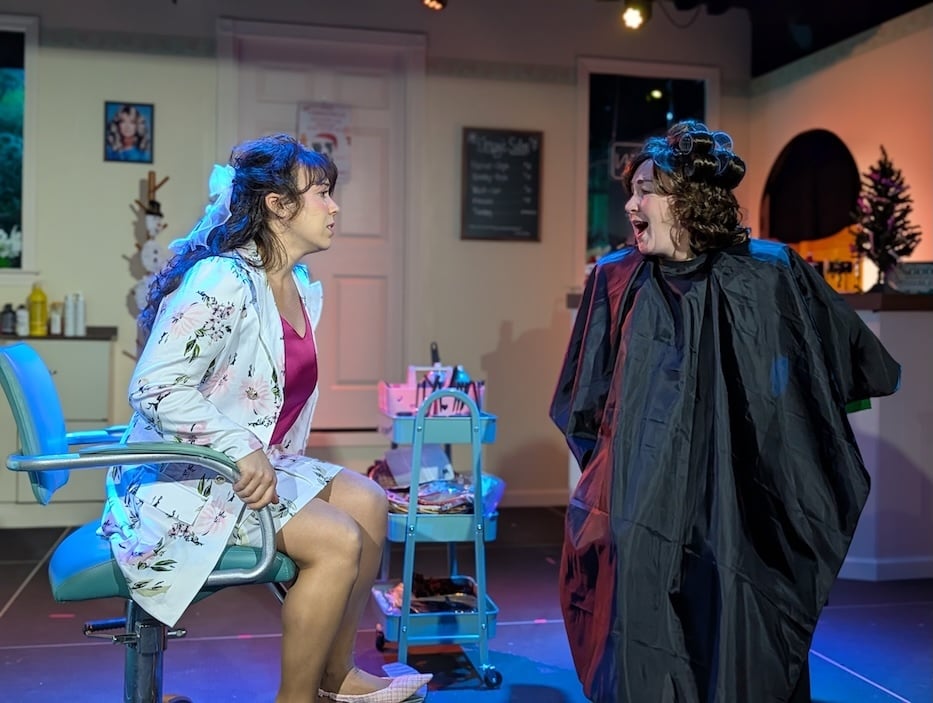
Shelby and her mother study each other from across the hair salon, being fussed over more than usual. At the table, Truvy holds her hands nervously, then unclasps them and busies herself in the tight space. Annelle takes a beat to figure out what to do. Clairee turns a piece of news over in her mouth, as if she might scowl. Around them, there’s an entire universe of unknowns—Shelby’s diabetes, an upcoming kidney transplant from her mother, the way it will affect her young son, especially when she’s all alone at home.
And yet, for a moment, it feels like everything will be all right, if these women have anything to do with it. The offers—for food, for hospital visits, for company—start pouring in. “We are in such good hands,” Shelby says, and looks out at the women around her with big, soft eyes.
Those hands—and the big, generous hearts and minds to which they are attached—are part of a bittersweet (but heavy on the sweet, in all the right ways) Steel Magnolias, running at Cabaret on Main in East Haven through March 22. Based on the too-short life of Susan Harling Robinson, who died of complications from Type I diabetes in 1985, the play tells the story of Shelby Eatenton-Latcheri, whose decision to have a child despite her diabetes puts her life at risk, and ultimately causes kidney failure, and her premature death.
In East Haven, where it is presented by the Broadway on Main Theatre Company, it becomes so much more: an opening to speak candidly about chronic illness and medical risk, a portal to a time and place that feel drenched in nostalgia, and an affecting meditation on how women take care of each other, even and especially when the going gets tough. Performances, which run Friday through Sunday, are dedicated in part to the memory of Genny Clements, an arts educator and friend who passed from Type I diabetes in April 2024, at just 29 years old.
The show is co-directed by Neil Fuentes and Nick Rapuano.
“It’s a way to express ourselves," said Fuentes, a chef and vocalist who runs the theater space and the New Haven Academy of Performing Arts (NHAOPA) alongside his husband, Billy DiCrosta. It’s personal, too: two weeks ago, Fuentes lost his older brother, Orlando Fuentes, to diabetes, and realized that the show allowed him to grieve in a different way.
“It’s a way for us as artists … I’m sure there are millions of people like me, who do not express easily what we’re feeling inside. I feel it, and I release it by directing the show.”
Part of that is the mission of Broadway on Main Theatre Company, which has been growing since Cabaret on Main opened its doors in the home of a former garage in 2022. That year, DiCrosta and Fuentes —who had already been running NHAOPA for nine years, largely out of their New Haven home—imagined a theater outreach program rooted in mental health awareness, where characters worked through trauma, grief and conflict resolution all in the span of a show.
Performances didn’t have to feel overwhelmingly heavy (Steel Magnolias is, in fact, full of sharp comebacks and laughter), but they did have to introduce a conflict and move through it. Last year, for instance, shows included Mary Poppins and an adaptation of Stephen King's novel Misery. “This show definitely fits within that,” DiCrosta said, adding that it’s also a meaningful nod to Women’s History Month.
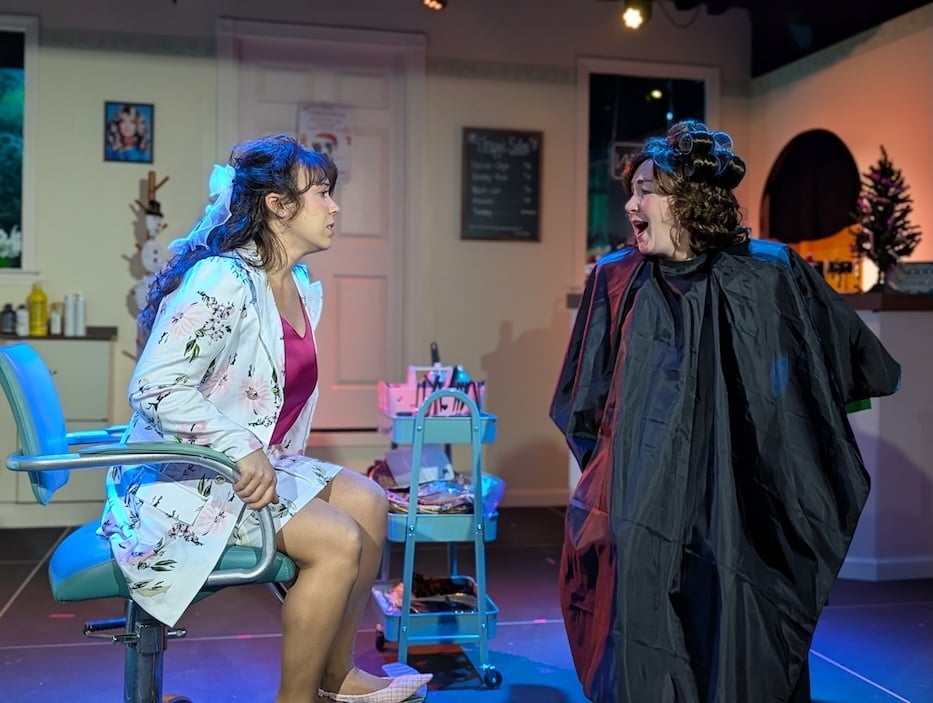
And certainly, that’s true here, as a tight-knit and dedicated cast of six women take the stage, and build an entire world upon it. Set in the fictionalized town of Chinquapin, Louisiana in the 1980s, Steel Magnolias tells the story of Shelby (Kaite Corda), a young, bright-eyed NICU nurse who walks into Truvy’s Salon on her wedding day, and opens a narrative can of worms that is impossible to look away from. As audience members discover, Shelby has Type I diabetes—a chronic disease that can lead to complications like heart and kidney failure, but often also attracts misinformation and stigma—and is working to manage it as she steps into this new chapter of her life.
Already, the audience has met Truvy (a delightful Cindy Harris) and her intriguing new assistant, Annelle (Juliana Vaiuso), who together run the space on hairspray, gossip, and a tentative love that comes into full bloom as the play unfolds. Around them, the town’s characters come to life in vivid color: Clairee (Dian Erikian), who is finding herself after the loss of her husband, a cranky but lovable Ouiser (Michelle Rocheford Johnston), and Shelby’s mother, M’Lynn (Lisa Costello), who is often the voice of reason in a space filled with fantasy.
From the moment characters walk in, there is such sweet momentum here, the heaviness of Shelby’s diagnosis cut with a humor that she is often helping drive forward. In one scene early on, for instance, Annelle puts on a pot of coffee, unaware of the hot dogs boiling at the bottom of the pan she’s taken the water from. Only after she’s handed the coffee off to Truvy and Clairee does she learn about her mistake. “Yuck,” Clairee announces, with the conviction that one might deliver a guilty verdict.
But this is a play about huge, forgiving hearts, and it becomes a laugh line that lands. Harris, in her Cabaret on Main debut, plays it soft and gentle at the same time, encouraging her young charge to just restart the coffee as she plans out what she’s going to do with Shelby’s hair. Between the trio, conversation moves at a quick clip, giving the salon a real sense of place.
“Don’t worry!” Clairee says to Annelle, and she means it. There's a sense that messing up here is just part of the process. “I love a good hot dog. Just not with cream and sugar.”
At a performance Saturday, the line stuck its landing, giggles floating up from the dinner seating and audience as Erikian caught a pair of eyes somewhere in the house, and gave a sly little grin. Then, the show kept soaring forward. Shelby, a magazine cutout of Grace Kelley and a bunch of baby’s breath in a ziploc bag, waltzed in and owned the place, with a deadpan that elicited laughs before she even spoke. Curlers framed her face. For a moment, everything else disappeared, from the meat-and-smoke scented coffee to Shelby’s own need to make sure her insulin held steady during the day.
In Fuentes and Rapauno’s able hands, this cast knows how to world build, and it’s a joy to watch. Harris-as-Truvy frets and fusses over her clients (and over Annelle, who is just getting on her feet) like a mother hen, nearly tut-tutting at the latest news her friends bring with them into the shop. Shelby is a weaver of stories, with a kind of girlish sweetness that is hard not to fall in love with. Johnston plays Ouiser with the sensibility of a loveable, curmudgeonly aunt from Long Island, with a kind of hard edge that melts away during the show.
Offstage, Fuentes has expanded that dynamic, with decades-old, technicolor-drenched commercials from the 1980s that wrap the theater in their light as characters change from one scene to the next. Some, like a Wheaties spot with glistening strawberries that soar into a bowl of thick, too-white milk, are so funny and charming that they become a kind of dramatic bridge, giving actors time to change as they solidify an audience’s sense of time and place.
The result is a play that is not only about Shelby—or any one of the characters—but about how women, if they (we) are lucky, have the honor of taking care of one another through some of life’s biggest transitions. Harris, who has a knack for crisp, comedic timing, is definitely that friend who fussed over someone in those first hazy months of postpartum, bringing the extra maxi pads and granola bars (the good ones, with sea salt and chocolate) and neighborhood gossip that was always served piping hot.
As Annelle, Vaiuso is that messy friend who found Jesus in her 20s, but is completely genuine when she says she’ll pray for you. An NHAOPA alum who played Mrs. Brill in last year’s performance of Mary Poppins, she nails the balance between doe-eyed and scrappy, with a kind of moxie that is easy to miss until it’s front and center. In Clairee, Erikian finds a character that’s easy to root for as she pulls herself out of a pit of grief, and begins to rediscover the world of the living. Even Johnston, whose exterior comes across as leathery at the top of the show, becomes completely loveable, with a bright sunflower-adorned hat (props to Johnston, who also did costume design) that feels like an apt metaphor for the moment.
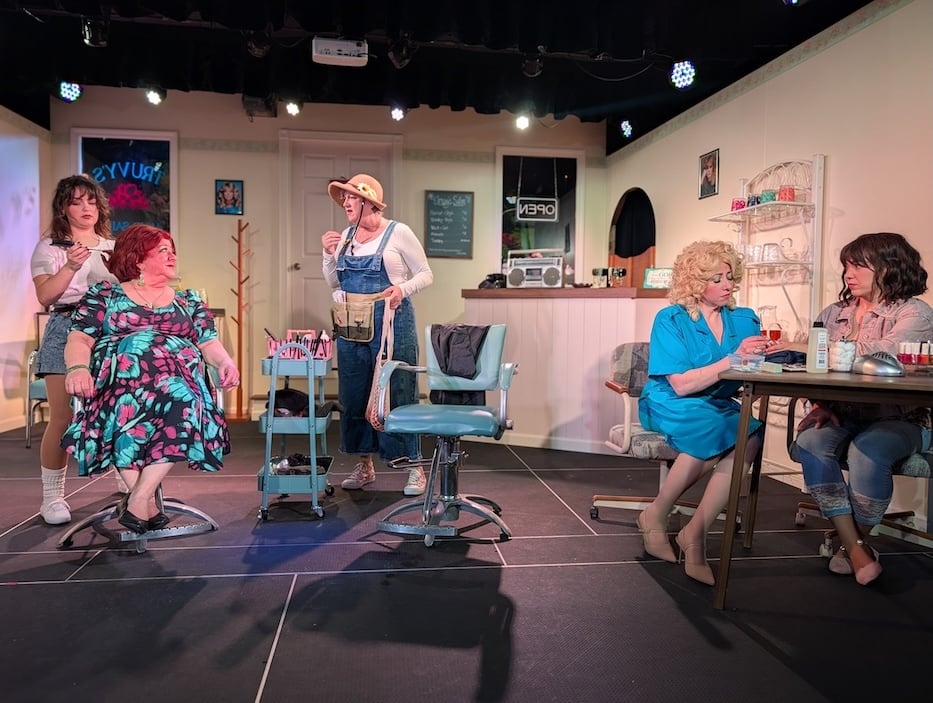
If the play belongs to Corda’s spirited, winsome and sometimes deadpan Shelby, she’s never doing it alone. When Costello transforms into M’Lynn, it’s easy to see a mom, or maybe a beloved aunt or cousin or godmother, trying her best to let go of that tight leash and still make sure her babies are okay (it may help that Costello is a mom in real life, and joined NHAOPA as a way to be closer to her kids, both young performers themselves).
She is warm, but also full of opinions (98 percent of which are right), including those meant to save her daughter’s life and grant her the independence she so desperately wants. In one of the work’s most powerful moments, shortly after Shelby’s death, she becomes unstuck, finally letting herself move through the grief she has been carrying. As she stands, shaking, there’s a sound that comes from somewhere deep inside her, instantly recognizable for the exhaustion and pain at its edges.
“I'm fine.. I'm fine.. I'm fine.. I'm fine!” she announces, and the whole salon moves in to support her, because it is so clear she is not. “I could jog all the way to Texas and back.. but my daughter can't!! She never could!! Oh.. God.....I'm so mad I don't know what to do!! I wanna know why! I wanna know why Shelby's life is over!”
“I just wanna hit somebody, till they feel as bad as I do!” she adds, and the rage is so relatable. Even here, the cast finds the joy: Clairee, within seconds, volunteers Ouiser to be a punching bag, making clear the dynamic between these women, even through tears. “I just wanna hit something! I wanna hit it hard!”
In the process, the company has cracked open a discussion that feels much bigger than diabetes and chronic illness: it is equally about how pregnancy is not a health neutral event, despite a federal government that seems to treat it like one, about mothers and daughters speaking to and sometimes past each other, about women holding women in a way that no one else can. In the end, it reminds those in the audience that systems, many of them broken, are not going to save people. People who love their neighbors are going to save people. Matriarchs, especially, are going to save people.
“It's an experience of a lifetime, that's for sure,” Costello said. “Not only are we bringing awareness to the problems of diabetes, but also the bonds of women, and for Women's History Month, how important it is to have those relationships. Throughout the show, we go through a lot of ups and downs ... It's a humbling and honoring experience to bring M'Lynn to life and to share the stage with such talented actresses.”
It’s also helping carve out a space where magic and memory can live side by side. Through the rehearsal and performance process, Fuentes has been able to think about his brother, and also use the work as a form of advocacy. People leave the theater thinking more about diabetes than they did when they walk in. It’s a group effort, both he and DiCrosta were quick to add: DiCrosta designed the set and produced the show, with a small but mighty creative team behind him.
“My brother was a very interesting man,” Fuentes recalled. Orlando Fuentes was a member of the military, who loved airplanes, married multiple times, and looked out for his family. “Not too easy to deal with, but with a very, very big heart.” A decade ago, his health began to suffer from complications from diabetes. “It’s a disease that, he himself said, you don’t even realize that it’s consuming your body from the inside, and you don’t even know.”
So too with Clements, a founding member of NHAOPA who passed at 29 years old from complications from Type I diabetes. During intermission Saturday, Fuentes remembered her as a vivid presence, whose powerful voice was outmatched only by her big and generous personality.
“She was known for her big conducting style,” Fuentes remembered warmly, laughing at the memory of getting accidentally (and gently) slapped as Clements extended her full wingspan to conduct. In the theater, it was easy to see part of the community she was building through arts education. Back in the theater, the lights flashed to signal the end of intermission.
“Do you have tissues?” Fuentes asked.
Cabaret on Main is located at 597 Main St. in East Haven. Tickets and more information are available here; performances run Friday through Sunday. For more about the work of NHAOPA and Cabaret on Main, listen to the interview above.