

Dr. Martin Luther King Jr. | Education & Youth | First and Summerfield United Methodist Church | Music | St. Luke's Steel Band | Music Haven | Arts & Anti-racism
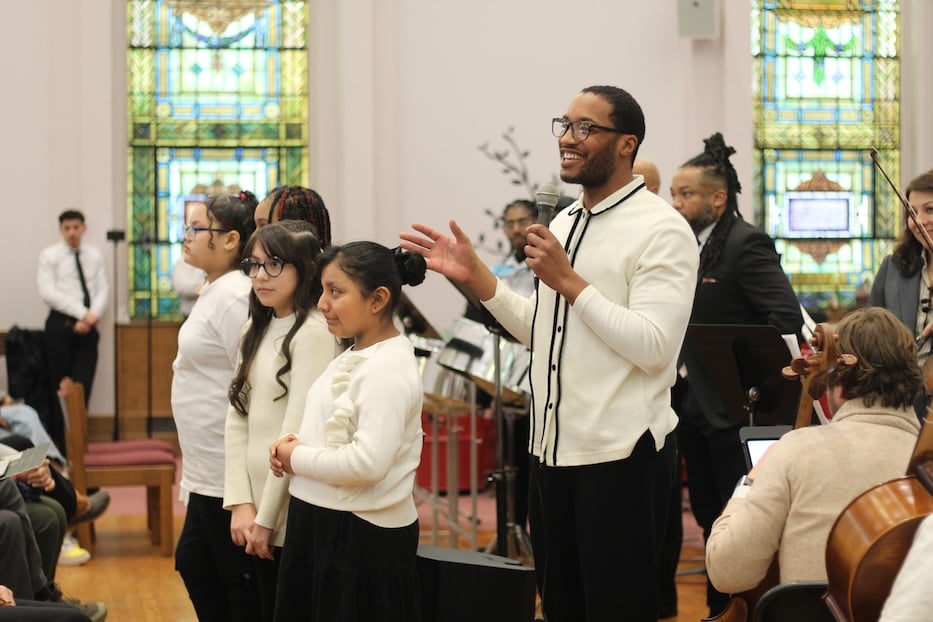
Miles Wilson-Toliver and choir students. Lucy Gellman Photos.
At first, it was the tempered, sweeping call of violin, laying down a carpet of sound silky enough for students to land on. Then half a dozen young voices joined in, so soft and high they were almost bird-like. Accepting People Now / Loving Everyday / Freedom for our lives, justice for all, they sang. The melody, new and old at once, rose and fell. Let us live in peace / Kindness follows me / We belong together in this world.
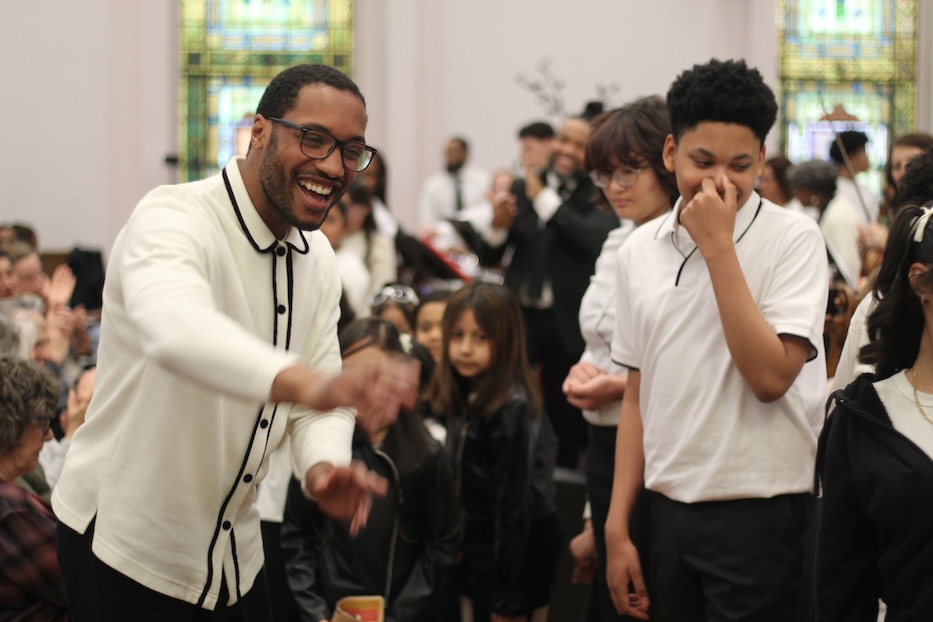
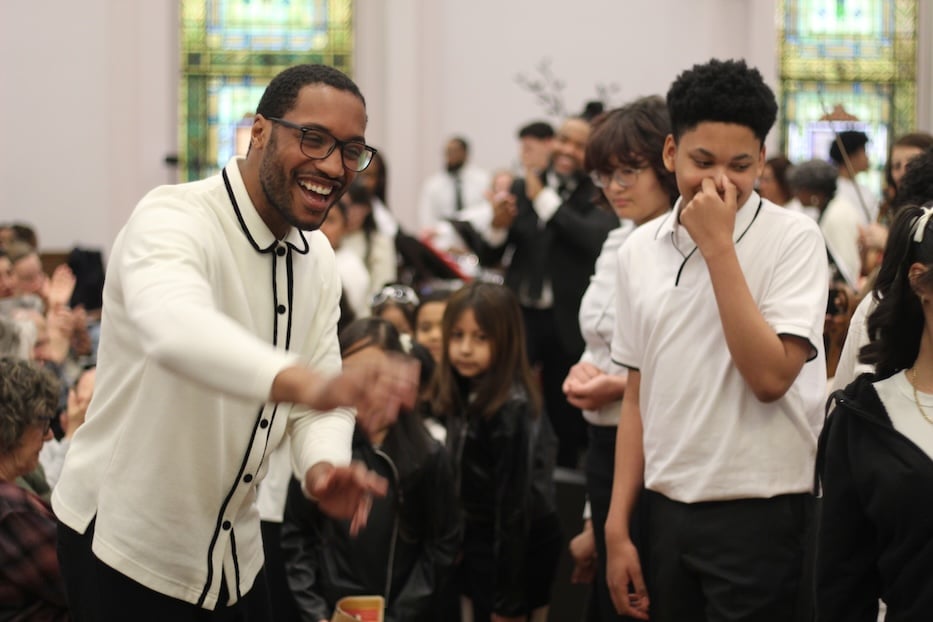
Framed between the stained glass windows, choral director Miles Wilson-Toliver locked eyes with the performers, his face soft and wide open. He lifted his hands, fingers outstretched on the chorus, and it felt like praying.
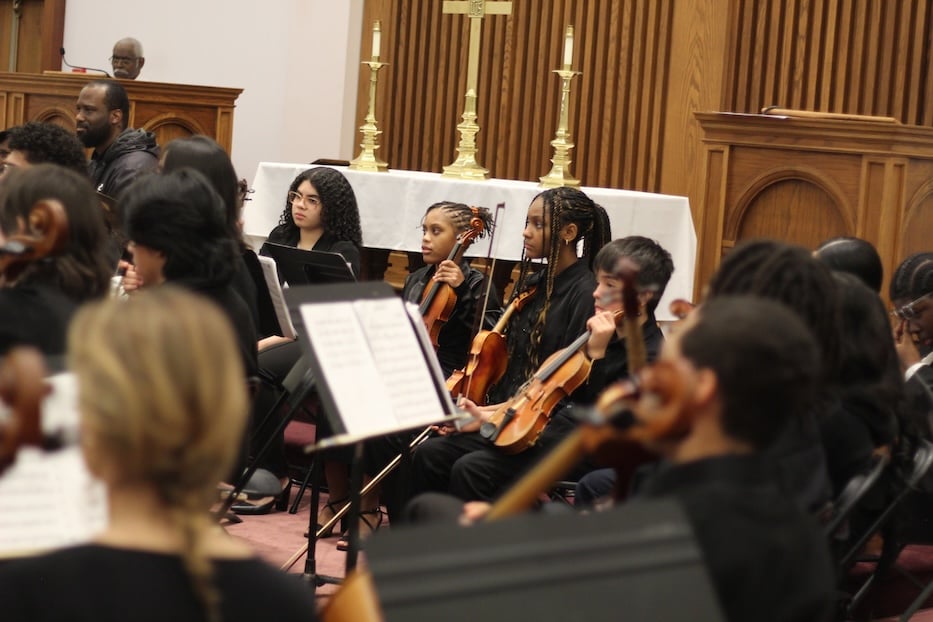
That message, carried on bright, young voices, filled First & Summerfield United Methodist Church Monday afternoon, as members of Music Haven and St. Luke’s Steel Band joined forces for their 16th annual Martin Luther King, Jr. Day concert. Held inside a hub for union organizing, social justice movements and safe sanctuary, the concert became a powerful call to imagine a kinder world—and listen more deeply to young people—at a time when both can feel elusive.
For the first time in almost two decades, it also welcomed a totally new sound: Music Haven choir students, who Wilson-Toliver has directed each week since last October, and who brought an original song to the afternoon’s hour-long performance. Over 200 people attended, filling the church with thunderous applause throughout the show.
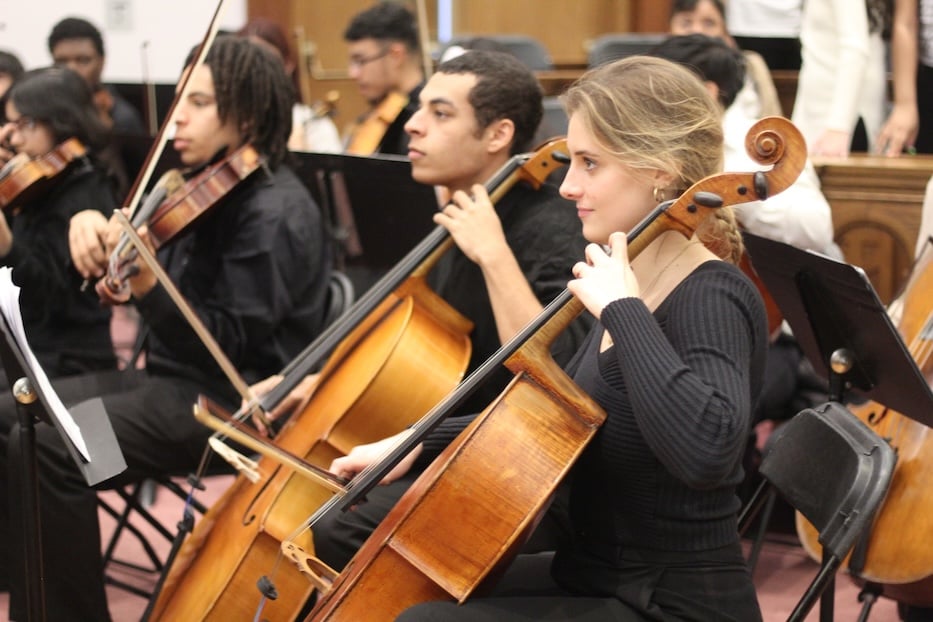
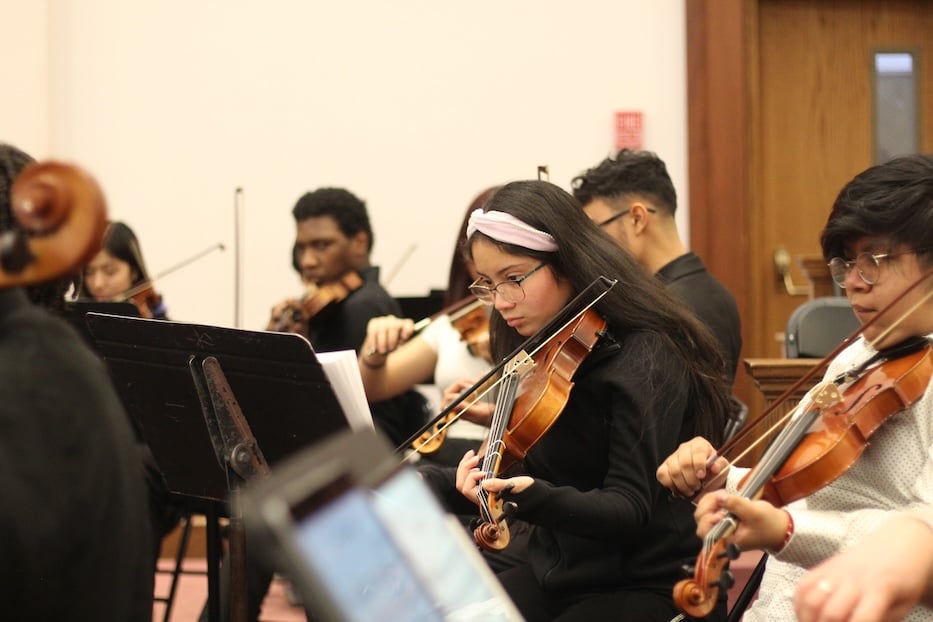
Music Haven alumni including Isabel Melchinger and Max Jackson returned for the concert, which they grew up playing.
“My thing is to bring care into the classroom,” said Wilson-Toliver, a graduate student at the Yale Divinity School who teaches elementary, middle, and high school choir students at Music Haven’s Erector Square offices twice a week. “I think there is something special about singing with others. I feel connected in a way I wouldn’t otherwise be able to.”
Part of that connection, certainly, is baked into the mission and bones of the concert itself, which began in 2010 at St. Luke’s Church on Whalley Avenue. At the time, Music Haven and the steel band were neighbors, both relatively young organizations for whom the collaboration was an experiment. Early movers and shakers in both groups—Tina and Netta Hadari, violist Colin Benn, steel pan player Debby Teason and the late Ed Mapp—midwifed it into being.
“We outgrew the church very quickly and kept on moving,” recalled musician Kenneth Joseph, who has directed the steel band since 2010. “I always have an amazing time reconnecting with Music Haven. The mentorship there, it’s just a beautiful thing to see.”
Since those early years, the concert has become a musical fixture in downtown New Haven, where it has navigated multiple moves, poetic collaborations, leadership transitions, award ceremonies, and a rotating repertoire that has included everything from Tony Allen to Harold Melvin & The Blue Notes to Marvin Gaye to John Lennon. Along the way, both Music Haven and St. Luke’s have continued to grow, prompting moves to Fair Haven and Shelton Avenue respectively.

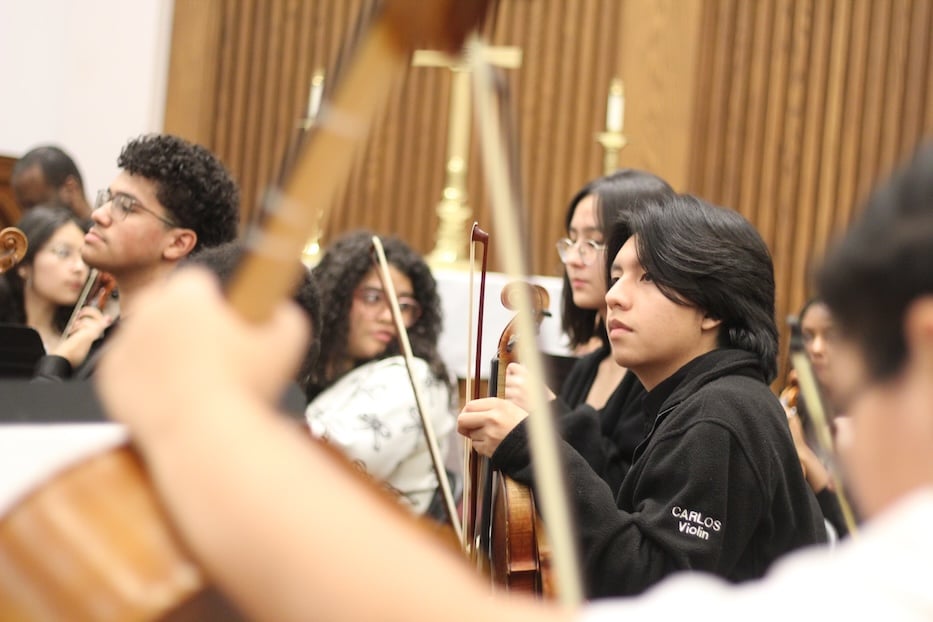
Top: Joseph, introducing John Lennon's "Imagine." Bottom: Music Haven students.
Monday, a listener could feel that musical footprint expanding yet again in real time, as musicians moved from Harold Melvin & The Blue Notes’ “Wake Up Everybody” to Nina Simone’s “Feeling Good.” As soloist Adina Salahuddin took the mic, the room fell into hushed, reverent silence, as if listeners knew exactly what was coming. Low-bellied strings unfurled themselves across the space, a steady hum that you had to listen for not to miss.
Birds flying high, you know how I feel, Salahuddin sang, and string musicians got in position, listening to her all the while. Sun in the sky, you know how I feel. Joseph watched, mesmerized before remembering himself, and getting ready to conduct. Breeze driftin' on by, you know how I feel. Here, Salahuddin began to make it entirely her own, her voice swooping to the very bottom of its range as she let out a rich hum.
It's a new dawn, it's a new day, it's a new l-iii-ii-fe for me. A phone rang, and the audience paid it no mind. Yeah, it’s a new dawn, it’s a new day, it’s a new life for me. Joseph lifted his hands as string musicians lifted their bows. And I'm feeling good. She hadn’t even finished the final notes as strings and steel came in, with the kind of force that a person could feel in their ribcage.

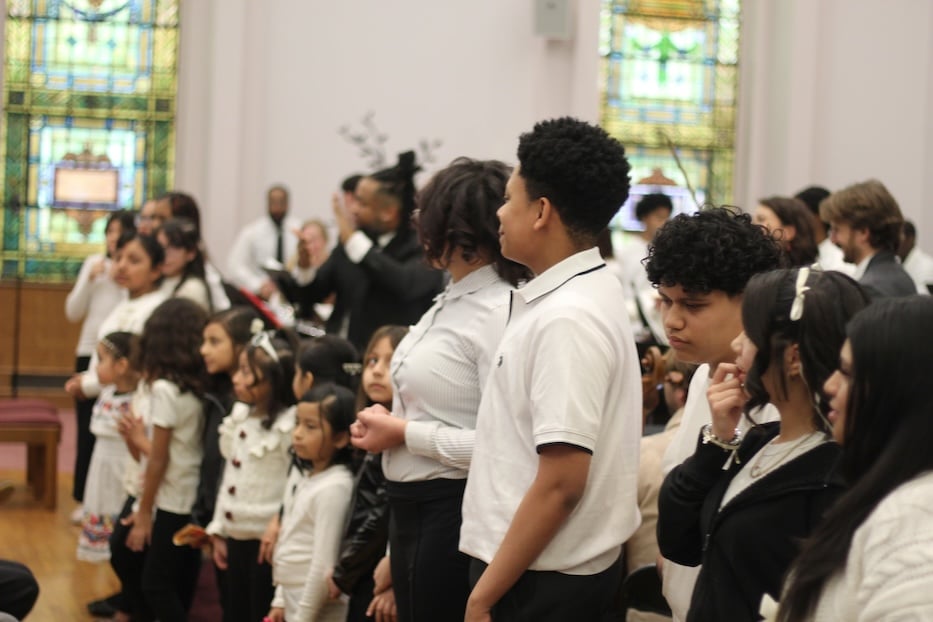
Top: Adina Salahuddin and her sister, Camisa, after the concert. Bottom: All choir students joined musicians for "Lift Every Voice and Sing," to which the audience was invited to sing along.
“Yes!” a few members of the audience cried back to the musicians, dancing in their seats as they bobbed back and forth, shook shoulders, and clapped on the downbeat. Salahuddin, beaming, ceded the floor to ringing drums and strings that boomed one moment, then soared the next. Every so often, percussion from drummer Kareem Victory broke through a wall of ringing sound, and lent the arrangement a hammering heartbeat.
“You know, I feel like a lot of change has happened not only in the world, but at Music Haven,” Salahuddin said in an interview after the concert, pointing to new teachers like Wilson-Toliver and Orchestra Director Jillian Emerson at the organization. “The music is really exciting. It feels like everyone connecting.”
“This time, I tried to have more fun with it [“Feeling Good”],” she added, with praise for a winding, rhapsodic solo that her teacher, violinist Yaira Matyakubova, played in the middle of the number. “I think today is a call for peace, for unity, for everyone to come together. No matter what you believe, there is something to reflect on.
That was true as steel pan players took up Michael Jackson’s sweeping “Earth Song,” giving it a voice that held onto the urgency of the original piece, but imagined that another world, a more melodious and bright world, was also entirely possible if there was space to will it into being. Later, the same message returned in Lennon’s “Imagine,” a new addition to the program that seemed to resonate with the audience.
But it was the middle school choir that unexpectedly (and delightfully) took the afternoon’s spotlight, with an original song set to the melody of SZA’s “Kill Bill” that became a pint-sized anti-bullying manifesto for 2026. Gathered at the front of the church with members of the Haven String Quartet behind them, students looked out at the audience, wide-eyed and fidgety as hundreds of faces looked back. As strings played them in, they shifted their focus to Wilson-Toliver, arms lifted, and let themselves lean into the words. Their little bodies stilled, arms falling to their sides.
Accepting People Now / Loving Everyday / Freedom for our lives, justice for all, they sang, Wilson-Toliver conducting gently as they relaxed, and the volume rose incrementally. Let us live in peace / Kindness follows me / We belong together in this world. Ooo-oo-h!
It became, in under two minutes, a stirring call to do better—in our homes, in our classrooms, in our city institutions and in our houses of worship—because the future literally depends on it. Already, the youngest choir students had raised their voices to the rafters with “Woke Up This Morning,” popularized by the Freedom Singers (Bernice Johnson Reagon, Rutha Harris, Cordell Hull Reagon and Charles Neblitt) in the early 1960s.
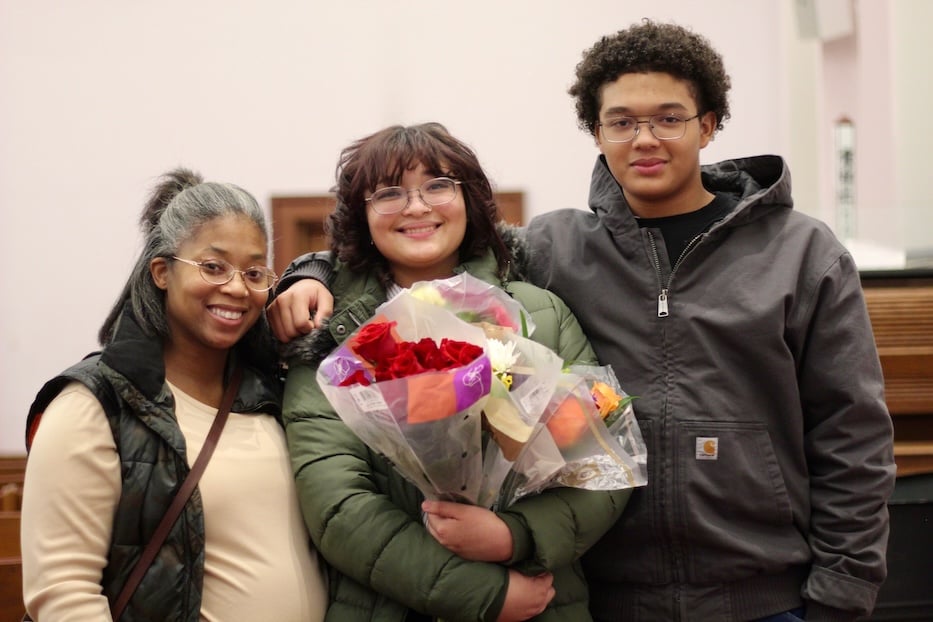
 Top: Choir student Khalia Williams (center) with her mom, Brandi Alston-Rice, and twin brother, Khalio Williams.
The high schoolers, a small group with a growing sound, waited in the wings to perform Kanye West’s “Rain.” But for a moment, it was just the middle schoolers and the church and the audience, sharing a single moment. “This song is about uplifting each other while fostering an anti-bullying space for children to express themselves safely with a true sense of belonging,” Wilson-Toliver wrote of the song in an email after the concert.
While the song wasn’t originally part of the curriculum, “I always want them to write music,” said Wilson-Toliver after the show. Music, for him, is a second language: he grew up singing in church in Hartford, and then studied classical voice at Carnegie Mellon University (his performance in Dwayne Fulton and Tameka Cage Conley’s A Gathering of Sons won awards at the Pittsburgh Festival Opera in 2017) before becoming a teaching fellow at Harvard.
At Music Haven, “we talked about core values, we talked about Martin Luther King,” and the project bloomed from there. When he conducts, “I think I’m giving pastoral care,” he said with a smile. “I have to honor different conversations, I have to make space for people and I really have to lean in on core values.”
Khalia Williams, a freshman at Eli Whitney Technical High School, said she’s been excited to perform with the high school choir, where she’s rediscovered a passion that she first tapped into as a little girl. While she sings frequently at Shiloh Missionary Baptist Church, Music Haven has given her a chance to sing in the wider New Haven community for the first time.
After shaking off some pre-performance jitters Monday, she let the music carry her through the afternoon. “Singing is just a nice outlet,” she said.
“It’s about showing up and being there for other people,” she added of Martin Luther King, Jr. Day, grateful for the chance to perform in King’s honor.
Joseph, who last year did not shy away from the political turmoil outside the church’s doors, brought that same sharp-eyed clarity to this year’s concert. Before introducing Lennon’s “Imagine,” he explained to the audience that the group had selected and adapted the piece because the message felt as trenchant on Monday as it did in when Lennon first recorded the song in 1971.
“It’s asking listeners to envision a world of peace without the divisions that cause conflict,” he said, before turning back to the podium, and ushering in a rising, gentle wave of sound that crested by the hook. That hope, for world where coming together did not feel so tenuous, lasted all the way through a moving rendition of “Lift Every Voice and Sing” to which the audience joined in.
Reached Monday night by phone, Joseph said that he can see doing the same concert for many years to come. He recalled driving one of the band’s younger members home on Monday afternoon, and talking about the sense of peace that had come over both of them during that sacred, shared hour in the church. Already, he’s thinking forward to the next one, and a summer camp that strings and steel students have in between.
“This is a very special concert,” he said. “It’s hard, you know, in the time that we’re in right now. But there are people showing up and teaching us how to be on the right side of justice. In the time that we have here on this earth, we really do have to make a difference.”