

Culture & Community | Institute Library | Arts & Culture | Visual Arts | Youth Arts Journalism Initiative
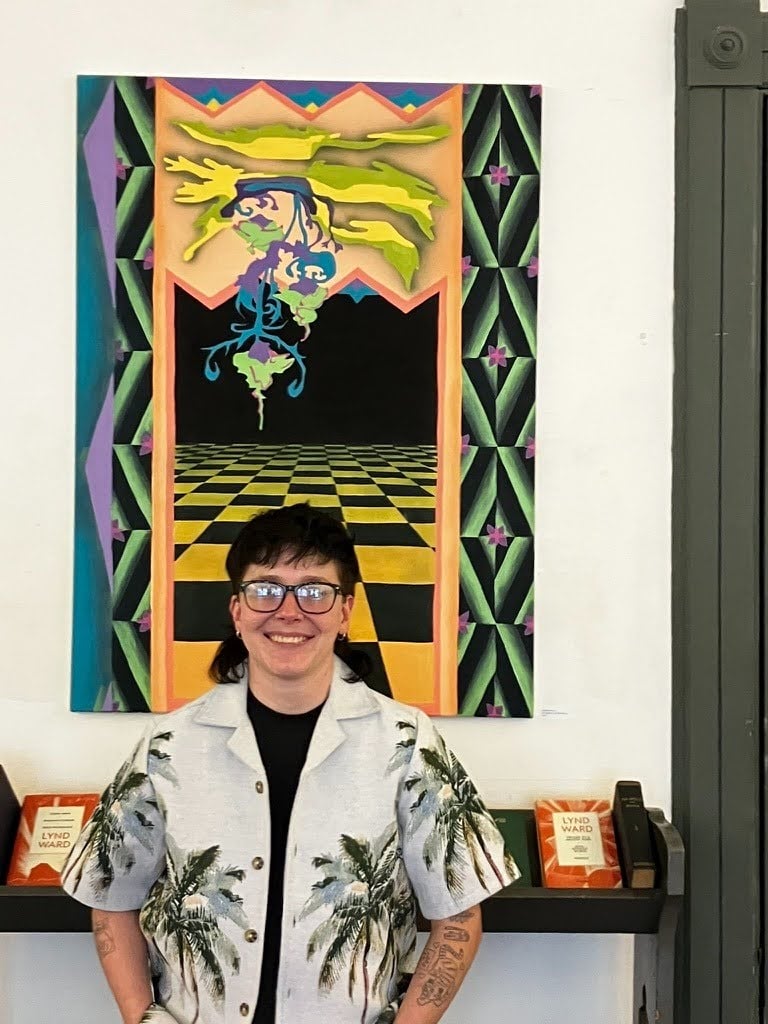
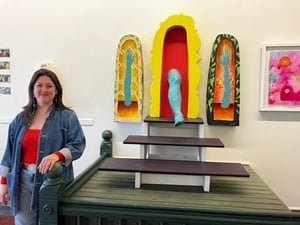
 After a fortnight’s-long closure for construction, the Institute Library opened its doors to the public again last week for a series of events, including a jazz night, a poetry reading, and Saturday’s “Collage & Closing” farewell to Panreality, an exhibition curated by Maxim Schmidt (pictured at left, with Chelsea Rowe’s “The bathtub on 18th avenue") which had been running in the library’s Gallery Upstairs since April 8.
Due to asbestos in the gallery, the IL remained closed to the public for most of the show’s run (it is still closed to the public during the day, with events that continue as scheduled). The new and current show, We Make A Library, opened earlier this month and features artwork from Wábi Gallery’s FOCUS Fellows. The best place for event updates is the organization’s Facebook page.
“Panreality was a word I made up to try to describe … what makes a moment lived in, beyond the tactile, immediate, objective things in space,” Schmidt said. “[It’s] is a little hokey as a word, [but] I love inventing words that fit… what I’m trying to convey, even if [they’re] a little hokey.”
The closing event took place on a recent Saturday afternoon. Around 15 people, including several featured artists, their friends, and their families stopped by to admire the collection, take pictures, and chat about their work with visitors and other artists.
Among them was Saunder Gratta (pictured below), whose drawing “Where did the time go?” was situated next to Barbara Shepherd’s surrealist, psychedelic collaged-together cityscapes and Dan Gries’s computer-generated monochrome spaghetti world.
The drawing features a clock with no hands, whose gold numbers and plain white face are encircled by an orbit of interlocking gears, drawn in brass and amber colored pencil. The middle of the drawing, a smiling falcon sitting on a detached robotic hand, is almost entirely graphite, save some streaks of brown on the metallic wrist. The falcon wears a blinder over its head, and so appears like an owl, or perhaps a Celtic druid. A piece of fabric tied to its leg streams off the page and gets lost behind the navy-blue foam squaring the outsides of the clock and hacking through the numbering.
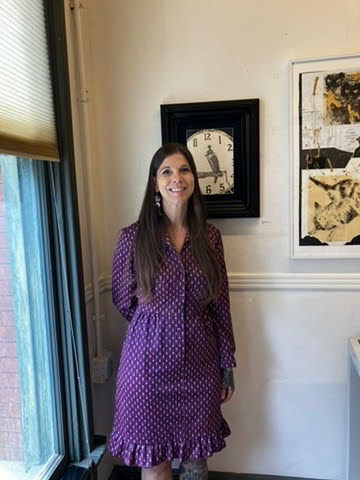 Standing on a broken clock face with a wrench in its beak and gears strewn around, Gratta’s falcon appears as if it has disassembled time. “Where did the time go?” is exceedingly contemporary in this way; since the eighties, critics like Fredric Jameson have noted the relative inability of present cultures to delineate one time period from the next. Sociologists like Pierre Bourdieu have identified economic and social insecurity as instilling precarity in human subjects. That is, instilling a condition of perpetual uncertainty regarding the future.
Together, these conditions give twenty-first century life a feeling of temporal placelessness, as if all experience is a rehearsal of old stimuli, absent of any progress dividing one day from the next. In this way, the falcon’s eerie grin as it takes apart time—and tarnishes the robotic arm, which is as much of a hopeful vision of the future as the piece gives us—captures physically the strange feeling of being forced into a time loop by a runaway social abstraction.
This sense of timelessness persisted in much of the work presented in Panreality. It came through most plainly among the wit, petulance, and angst of Sammi Bechard’s drawing “I can’t get up and change the cd right now. Whatever, I guess I’ll just listen to this song forever.”
The piece’s title captures the anxiety about an everlasting past many young people feel. Recent music is so indistinct from its predecessors that even curated playlists feel like listening to the same song forever. “I can’t get up and change the cd right now,” though, demands viewers don’t wallow. Its title dismisses the possibility of living in a stagnant world with the characteristic snark of a teenager who’s just been asked to clean the toilet.
Despite the juvenile title and the playful ironies in decoration (posters for Heinz, Marlboro and Duchess. A “no smoking or vaping” sign and a pack of cigs), the bedroom in the painting almost seems out of the late nineties. A lava lamp sits on the bookshelf. The boombox plays The Cure. The bedroom’s occupant holds a paper catalog up on her knee. Her cell phone is out of sight.
On the other hand, nobody said “MILF” in the nineties, and vaping wasn’t really a thing. “I can’t get up and change the cd right now” seems to inhabit both the present and the past.
This absence of temporality also resides in the creations of Keith Rancourt, whose architectural models dominated the gallery’s two central tables.
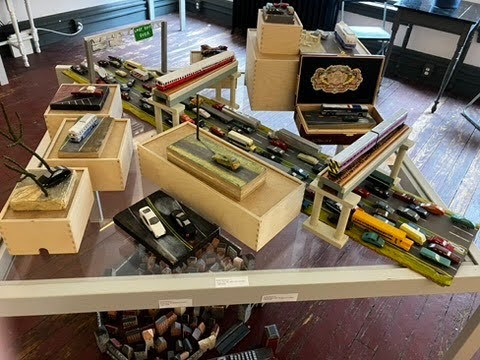 “cars in the city, cars in the country” contains a wooden model of a highway, jammed with dozens of hand-painted wooden cars. A green sign marks the off-ramp: “LAST EXIT EVER.” A sign on the other side of the hallway informs drivers of their destination: “Nowwhere.” Around the highway, atop wooden blocks and boxes, Rancourt’s other cars sit alone on their own roads. Rancourt said he was inspired by “Boston in the late seventies-early eighties, when [he] was in art school there.”
Here, Rancourt amplifies the feeling of temporal placelessness with one of literal placelessness. Both feelings are acknowledged bluntly in the text of the road signs, but they manifest themselves too in Rancourt’s decision to spotlight the highway. We tend to think of highways as unremarkable. As places which exist purely to mediate travel, they must be.
However unremarkable, highways are most definitely weird. The monotony of pavement and aluminum crushes time and space into a singular axis, where distance is measured in minutes, traveled from one functionally identical stretch of road to the next. By forcing the audience to behold the highway, Rancourt blows through the veneer of unremarkability and exposes an unsettling erosion of reality spiderwebbing the globe. In exaggerating the weirdness, he transmutes that erosion of reality into the raw materials for playful creation, subjugating it once again to human desire.
Temporal placelessness also appears in “Central America in my heart,” which took up the other central table. It’s a vision of a fictional Central American town, which Rancourt places in “no country in particular.”
The town is absent of more than its relationship to external geography. Space is scrambled within its walls too. The relative locations of shops and houses change as Rancourt moves the piece between locations. “[It’s] all modular,” said Rancourt, “I can arrange it however I want.”
This placelessness is present in more than just Rancourt’s work. Chelsea Rowe captures it remarkably well in both of her displayed pieces, “Soft-Boiled Eggs” and “The bathtub on 18th avenue.”
The latter is an oil painting, featuring prominently a checkerboarded floor stretching infinitely through a black void. Teeth of pastel orange— which seem more so to come from an abstract dimension than anywhere purporting to exist physically— cut into the infinite darkness. Faintly glowing black and green diamonds buffer the sides of the canvas.
“I see the void not so much as nothingness, but as everythingness,” Rowe said. “I do a lot of mask work, where [the performer] can’t see out and [the audience] can’t see in. In my head, this is where those performances happen.”
 Rowe calls liminal landscapes like these “non-places.” Much like Rancourt’s highway, they are perfectly anonymous, and exist in subservience to other locations. They are where things come from.
“Soft-Boiled Eggs,” a series of sculptures also by Rowe, similarly contemplates non-places. “Peach” and “Grape” are arch-shaped blocks of paper-maché each painted over with a picture of a blue hand rising up from the ground. The hand in “Peach” emerges before a zapotec-patterned dark yellow wall, which, along with the paper-maché texture, evokes the cozy and humid stucco of a southwestern home. The hand in “Grape,” though, surfaces in a less homely landscape, where the walls are hellfire red and candles burn hot on a chandelier tumbling through the background.
Between the two hands, a blue plastic leg protrudes from a similar archway shape in “Kick Line,” dropping its foot onto a staircase.
Here, Rowe shows us the meeting of the non-place and the place. The sculptures exist concurrently in the two-dimensional world and the three dimensional one, as objects for viewing and as objects in space. The head behind the hands and foot lives in four worlds simultaneously— ours, the void, and the two its hands are stuck in. A perfect encapsulation of Panreality.
Tal Berkowitz is a graduate of the 2025 cohort of the Youth Arts Journalism Initiative (YAJI). He is a junior at Wilbur Cross High School.