

Creative Writing | Culture & Community | Educational Center for the Arts | Poetry & Spoken Word | Arts & Culture | Elicker Administration | Wilbur Cross High School | Kulturally Lit
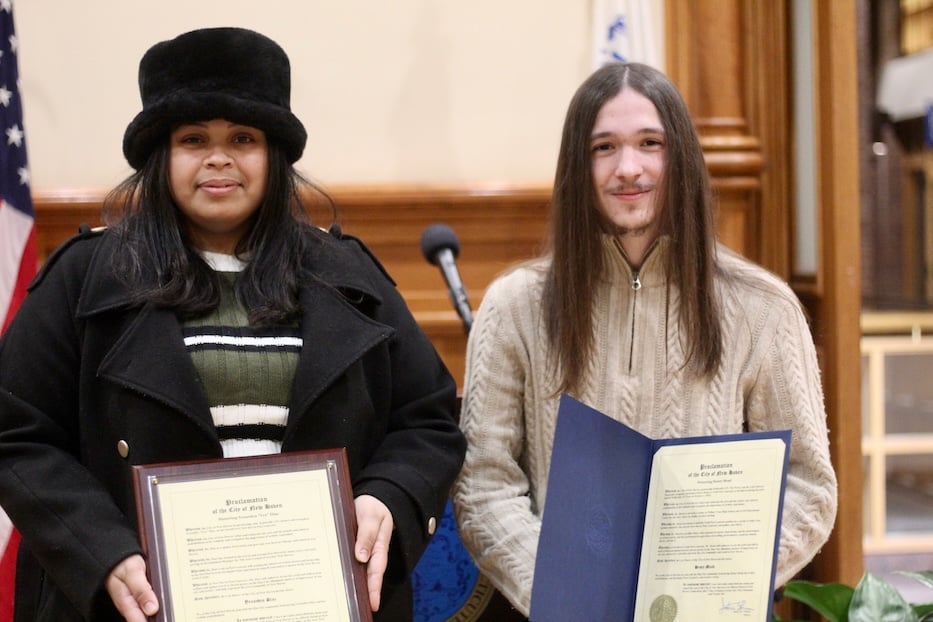
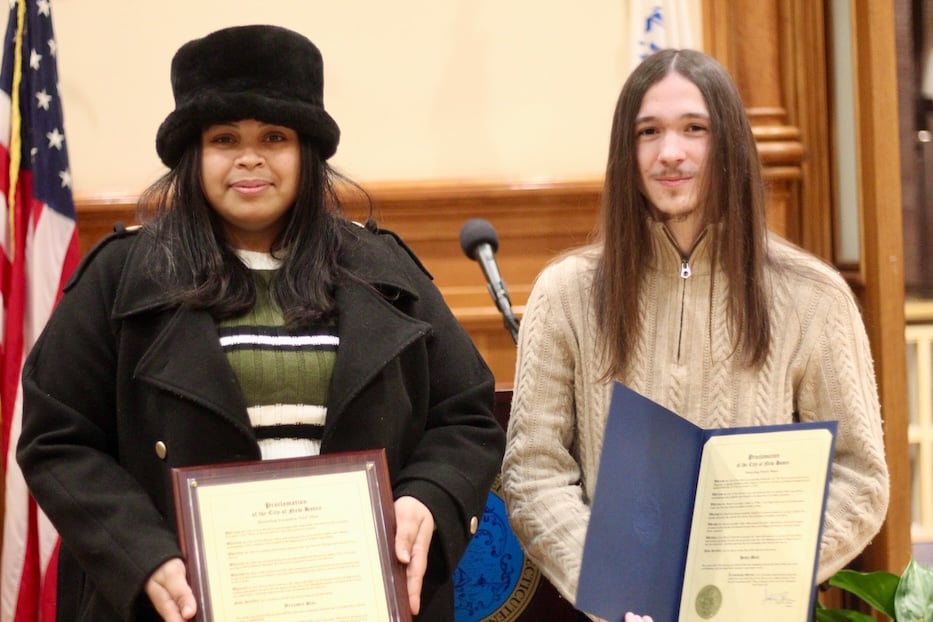
Yexandra (Yex) Diaz and Henry Mead. Lucy Gellman Photos.
Henry Mead didn’t know which poem to begin with.
In front of him, words spilled out over the paper, tangles of language parsed into neat lines. He looked over the audience, searching for something. One poem, he explained, was kind of gritty. The other, sweet. On the page beneath him, a storm was brewing, so vivid you could see the whipping wind and green, low-hanging sky.
“Gritty first, then sweet,” a voice piped up from a few feet away, where a row of chairs sat half-occupied. It was poet Frederick-Douglass Knowles II, who later blessed the audience with some of his own work. “So you leave us with sweetness.”
That gentle exchange—and so many like it that are yet to come—set the tone for the recognition of two new poet laureates Tuesday evening, as New Haven’s City Hall transformed into a tight-knit literary salon and cultural hub for a single, magical hour on a bitterly cold night. As a small crowd gathered in the building’s second-floor atrium, friends, family, and poets from across the state celebrated New Haven Poet Laureate Yexandra Diaz, who technically began the role last month, and New Haven Youth Poet Laureate Henry Mead.
Diaz, a literary dynamo, full-spectrum doula, mother, and development manager at the Arts Council of Greater New Haven who is the artistic director at The Word (and part of Connecticut’s nationally recognized slam team, Verbal Slap), will hold the position through 2028. Mead, a senior at Wilbur Cross High School and the ACES Educational Center for the Arts (ECA), will serve as youth poet laureate through next year.
Diaz succeeds poet Sharmont “Influence” Little in the role; Mead follows 2024 New Haven Youth Poet Laureate Anna Capelle. Both titles were announced last year, during Kulturally LIT Fest in October. In the interest of full transparency, the Arts Paper is a program of, but is editorially independent from, the Arts Council, where Diaz works part time.
“The arts are an opportunity for us to talk about truth, right? To highlight the truth,” said Mayor Justin Elicker, crediting Kulturally LIT Founder IfeMichelle Gardin for creating the position in 2023, after years of visioning with fellow poets in the state. “Particularly poetry highlights the truth. It’s also an opportunity for us to connect with one another, to be vulnerable with one another, and to find joy with one another. And that’s what this is about.”
And throughout the night, it was, perhaps more than Elicker could have ever imagined. As Diaz and Mead took the podium—first for the official city business of mayoral proclamations, and then again to grace the building with their words, and the words of others—both looked to the importance of using the position as a shared springboard, from which they can educate fellow poets, amplify and center youth voices, and teach New Haven about art as a doorway to social justice work.
Diaz, in so many ways, is already doing that work. Born in Chicago and raised for most of her life in New Haven, she has for years turned to poetry as a way to speak truth to power, and put to words that which might otherwise go unsaid. On stages that range from the Peabody Museum to the New Haven Green to Woolsey Hall to the Southern Fried Poetry Slam in Knoxville, Tenn. (and most recently, the mayor's inauguration), she has used her craft as a mirror and a doorway, through which her listeners can both look more closely at the world around them, and choose to step forward, and grow their world view.
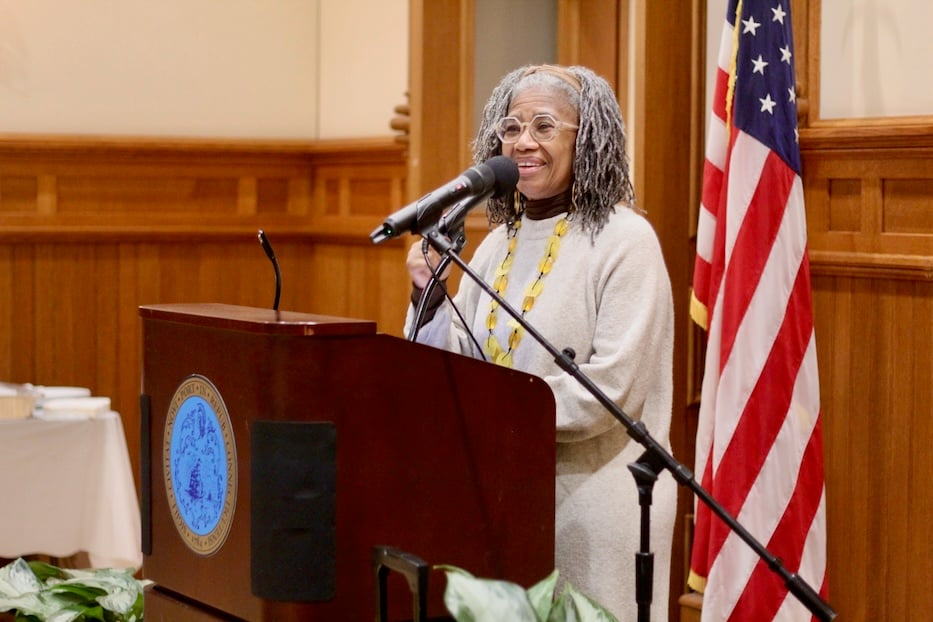
IfeMichelle Gardin, who birthed the idea of a New Haven Poet Laureate in 2023.
For years, she has worked to bring people with her, from her work with The Word to her recent appointment to the city’s Youth Commission. It makes sense that she’s also a mother and a doula; her creative work is literally the business of midwifing language into being. Before the night was over, Josh “AnUrbanNerd” Brown, who served as New London’s poet laureate from 2021 to 2024, noted the joy she clearly takes in seeing other young people perform.
“My vision aims to elevate not just Connecticut as an art hub, but New Haven specifically as a staple for poetry,” Diaz said Tuesday, paying homage to cultural griots Nina Simone and Toni Cade Bambara, who spoke passionately of their creative work as a sacred and powerful duty. “I heard early in my career that it is almost impossible to be both palatable and progressive. And that is why I use poetry as a vehicle for my messages.”
That flowed through her performance of not only her own poetry, but an excerpt of Ferdowsi’s “The Shahnameh,” an epic poem that pays homage to the cultural richness and heritage of Iran and the Iranian people. Inspired by a recitation exercise that students are doing at The Word, Diaz carried the poem to City Hall in an effort to both share the work and remind attendees why the preservation of cultural heritage is also about the survival of a people.
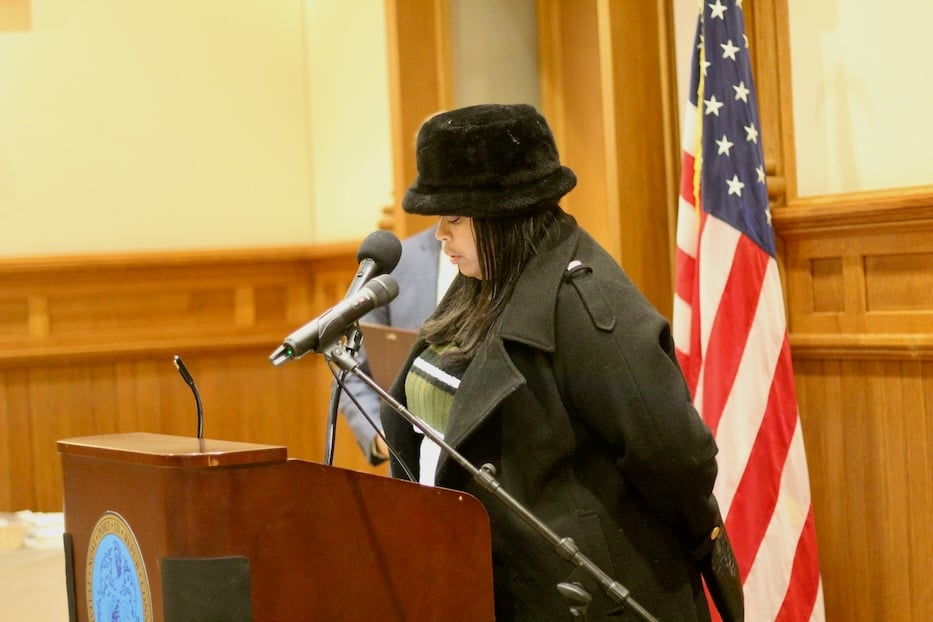
We begin in darkness, she read, and the room seemed to lean in, listening intently. A siren screams / The king gathers / The invaders come from the desert in a cloud of dust / The king gathers his army at a mountain castle. A single battle decides our fate—
In the atrium, a listener could hear the pauses, ever so brief, between each line, and the urgency at the edge of Diaz’ voice. The battle burns, / the din of drums, the clash of axes, the spark of swords. She looked up ever so briefly. The dirt turns clay with blood. The sun goes down on a fallen flag. The day is lost.
If a listener closed their eyes—and many did—they could see it all: the loud, heartbeat-like hoofbeats sending up clouds of dust, the goblets of jewels, luminous in the low light, the landscape, once lush and winding, brought to its knees by an abuse of power. The weathered sheet of paper on which the poet would inevitably write, after years and years of storytelling.
Or in the poet’s original words, carried forward on the sturdy beams of Diaz’ voice, It had to be a poet. Because poetry is music. It sinks into the memory.
So too in Diaz’ ode to New Haven, a nod to the Elm City that sprang alive with vivid description and candor in every verse. Flowing from her own origin story to the city she calls home, Diaz skillfully knitted together the people and places that build a community, from the Puerto Rican bomba y plena that has always been a part of her inheritance to the city’s patchwork of neighborhoods, each a jigsaw piece jostling against the next.
As she read, a listener could again close their eyes and see moments large and small, from funerals that become family reunions and impromptu porch hangs (the line Where porches are a portal to the Ninth Dimension stayed in the air long after the event) to the pulsing promise of a city in contrasts, from Goffe Street all the way out to City Point.
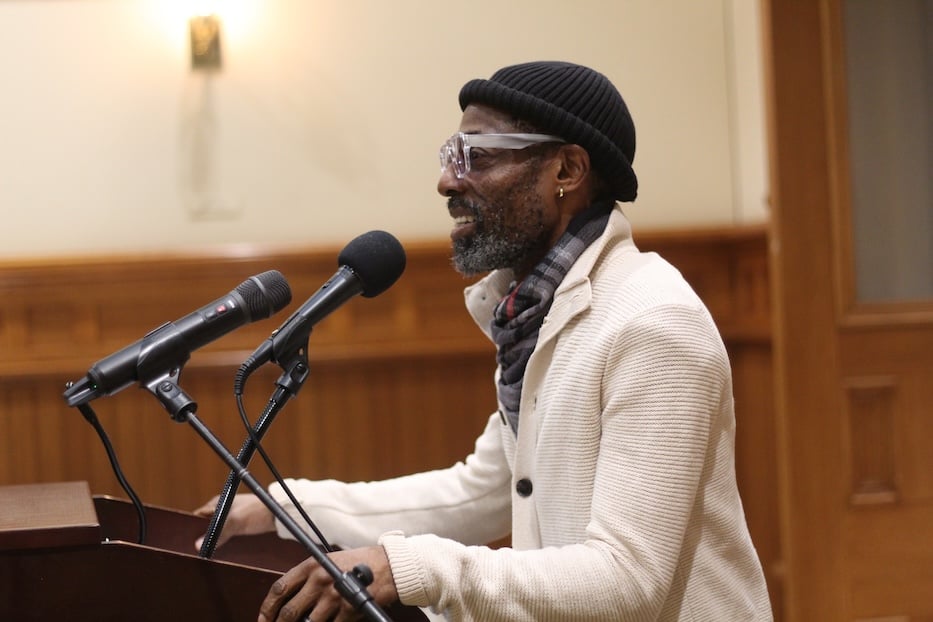
Frederick-Douglass Knowles II.
We harvest joy / And bloom anyway, she read. We turn lemons into a reason to gather / Make ideas into art / Turning an old Armory into amor / Centering people and pride / Our ecosystem is guarded by masters of jedi who wield love / And wear welcomes —
That sense of something deep and visceral flowed through work by Mead, a high school senior who has grown up close to the city’s Wooster Square neighborhood, and came out Tuesday with his parents, Martina Droth and Nick Mead, and ECA instructor Saul Fussiner, chair of the creative writing program at the school.
Reading two poems he worked on last year, Mead conjured image after vivid image, from bright, candy-colored leaves in the wind and wet of a growing storm to a small room near a lake that would become his home for the summer. He later said that he hopes to use the position to teach his peers across the district more about poetry.
That goal is baked into his own approach, he added. After writing a number of “silly poems” as a freshman at ECA, Mead started to deepen his craft, focusing on topics that hooked and held his interest. It “has brought me a level of self-fulfillment” that he didn’t know he could have, he said. He wants that for other students.
“I’ve come to realize that this space, where I’m standing right now, is a platform and not a pedestal,” he said. “Being up here does not mean I’m above any of you, and I’m glad that that’s the case. Being up here, rather, gives me the chance and the honor to share some part of my world with you.”
Around them, current and former poets laureate from New Haven, New London, Hartford, and Enfield made clear that the two are not going at it alone: there is a whole community of support that stretches across the state, from events like Kulturally LIT Fest and the Hartford Book Festival to cultural events that call on poets to ceremonies like Tuesday’s.
Or as poet Nzima Hutchings, Enfield poet laureate and the northern regional representative of the Connecticut Council of Poets Laureate, put it plainly, “You’re not alone.”
“We’re very thankful for the opportunity, because it gives us and our artistry an opportunity to reach more ears and imaginations and minds,” said Knowles, who in 2018 was named Hartford’s inaugural poet laureate. “But I’d also like to stress that it’s not the title that’s important. It’s not the appointment that’s important. We can think about some folks who hold titles in our world that don’t deserve them or utilize them to the best of their ability.”
“It’s about the love for the artistry, the commitment, the strength, the sacrifices, the yeses, the more nos than yeses, the voice of our ancestry that wakes us up in the middle of the night to write these words down now ‘cause if we don’t we can’t go back to sleep … that takes soul. And so to see not only one, but two people from this area willing to do so… that’s what it’s really about.”