Branford | Long Wharf Theatre | Plays
Long Wharf Theatre's production is a respectable, if underwhelming, take on Arthur Miller’s play about duty, regret, and the hauntings of memory
Arthur Miller’s The Price, produced by Long Wharf Theatre at Branford’s Legacy Theatre and running until Nov. 22, begins with laughter. Not from an actor or the audience, but rather from an old laughing record which Victor Franz (played by Alexis Camins) finds among the mounds of forgotten things in the abandoned apartment of his father. He inspects the record, then places it on the dusty phonograph, and suddenly the ghostly sounds of cackling fills the Theatre. Victor can’t help himself, he joins in.
The Price, which premiered on Broadway in 1968, is a lesser known Arthur Miller play than Death of a Salesman (1949) and The Crucible (1953). But the work bristles with the same sharp dialogue, complex characters with interweaving histories, and unflinching intensity that makes Miller’s work timeless. The show tells the story of Victor, a New York police man, who is returning to his childhood home to sell the long-neglected furniture of his father, who has been dead 16 years, before the building is set to be demolished. Victor, we quickly understand, may have left this home but not the past it represents: he had to drop out of school to care for his father after the Great Depression shattered his finances and spirit, foregoing his dreams of being a scientist, and is resentful of his choice. This anger often manifests towards his long-absent brother Walter, a successful doctor who cast off the responsibility of caretaking and lived the life Victor dreamed of. Like so many of Miller’s plays, the choices have already been made by the time the curtain rises. What comes now is the real drama: the long-awaited reckoning.
These stakes are introduced in the first moments of the play as Victor’s wife, Esther (Jennifer Lim), enters to the sound of his lonely laughter. The couple begins to reflect on a shared life they both feel has not reached its potential, but they disagree on what to do now—accept it or fight back. While the dialogue crackled with ferocity, there was a slight nervousness and lack of chemistry between Camins and Lim in this opening scene. They stumbled over a few lines, and Camins in particular seemed uneasy in the environment. At one point, mid-conversation, he picked up some scraps of fabric, leafed through them absent mindedly, and then put them back on the table. Moments later, he half unwound a cord from a lamp, then rewinded it. It felt like an actor doing what he thinks one should do to be dynamic on the stage.
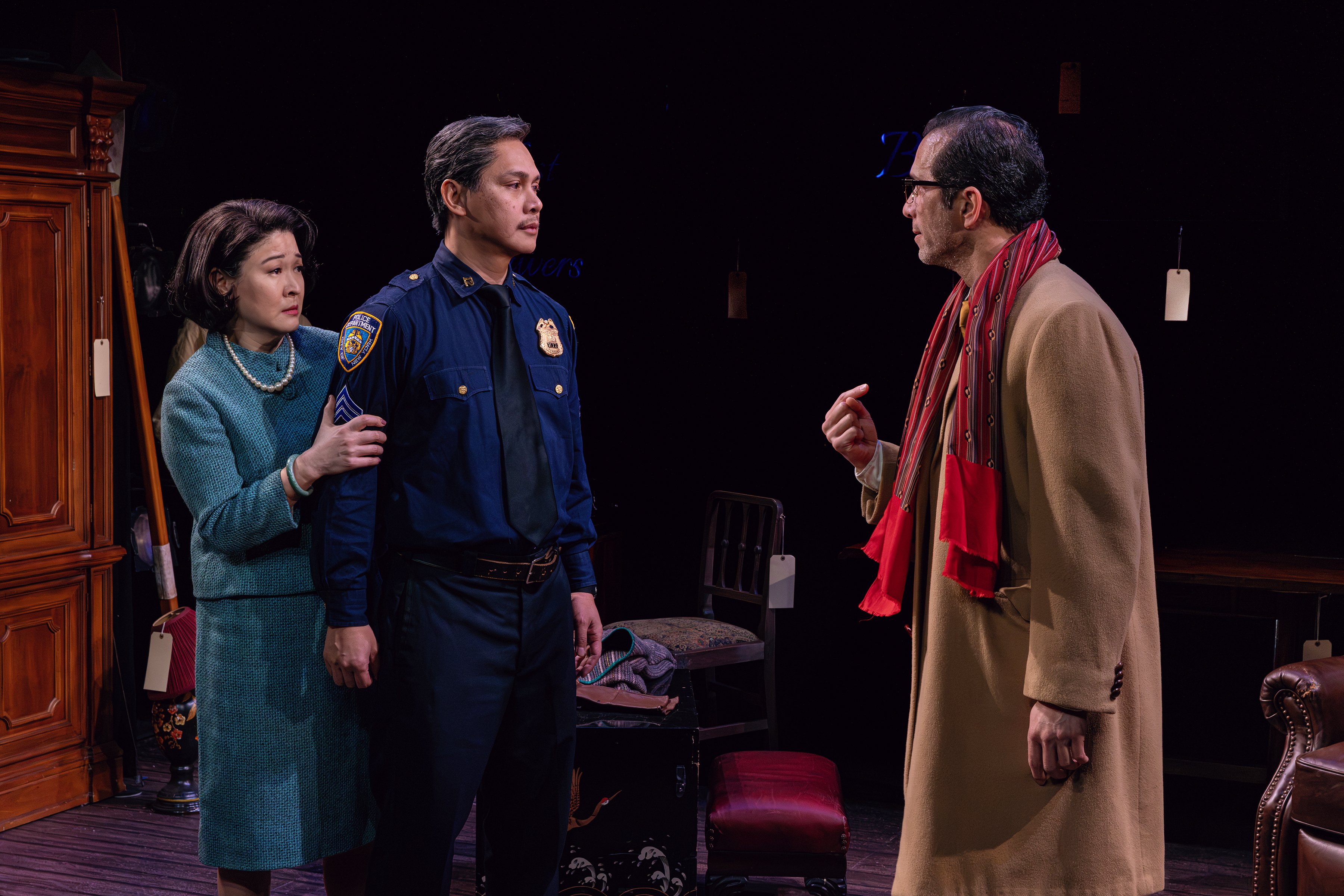
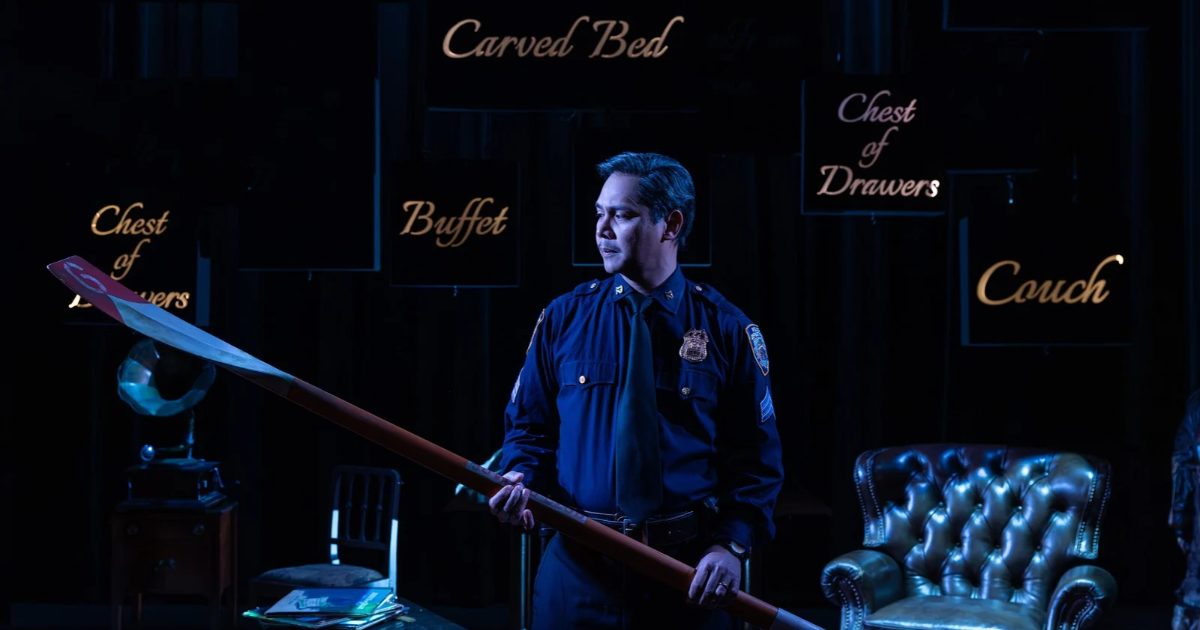
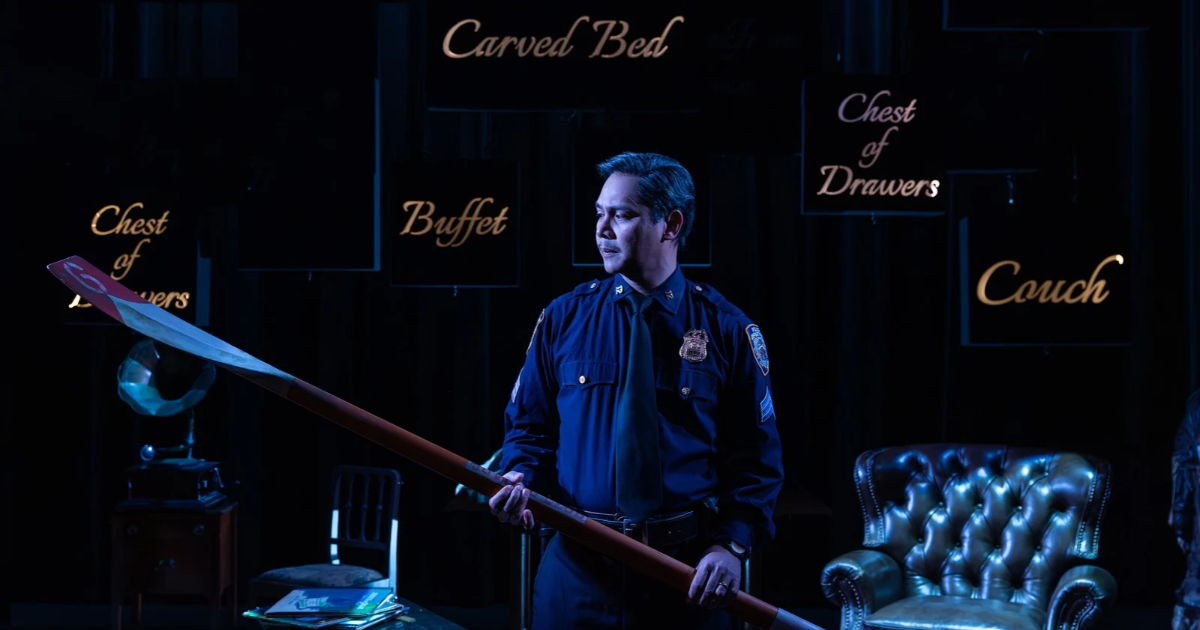
This revealed a larger issue in the production: actors were hemmed in by the set (designed by Riw Rakkulchon), with its mounds of furniture all around them, and cubes—which were lit up with various names of furniture: “Couch”, “Buffet”, etc—floating above them. This created an effectively claustrophobic environment, but also sapped the potential for movement on stage: the actors couldn’t do much except cheat out and walk stage left and right.
But the arrival of Gregory Solomon, an elderly Jewish immigrant antiques dealer played with electricity by a remarkable Mark Nelson, was a relief not just to the audience, but seemingly for Camins and Lim as well, who both loosened up in his presence. Nelson, who played Solomon with a thick Russian accent and an expressive physicality, seemed to burst from the cramped stage and brought peels of laughter from the audience as he laid out the philosophy of the antiques business (“with used furniture, you cannot be emotional”) and at one point scarfed a hard boiled egg out of nowhere (“there wouldn’t be a little salt, I suppose?”). After much discussion, Solomon sets a price for the furniture, but moments before the deal is done, Chekhov’s gun goes off and the long-estranged Walter (Carman Lacivita) suddenly arrives at the apartment.
Lacivita does a respectable job as Walter, the successful surgeon trying to offer financial support to his brother in a much too simple attempt to make amends for years of hurt. Their complicated history means that nothing can be resolved so easily. Through a wrestling match of language, the siblings go back and forth on who the bad guy really is, whether Victor’s sacrifice was worth it, whether Walter’s success was deserved or even fully realized, and whether, deep down, anyone is truly responsible for their own choices. The limitations of the direction by Ralph B. Peña, who kept the blocking and acting mostly wooden and predictably formal throughout the second act (despite Nelson’s best attempts to shock life into it), didn’t bother me much—the show seemed content to exist primarily as a vehicle for Miller’s ever-rich, theatrical language.
The director's program note, on the other hand, remarked (in the well-trodden self-congratulatory tone of much of modern American theater) that this show was interested in what it meant for the Franz family to be played by an Asian American cast: “Duty to parents, family obligations, money and personal success can carry a particular weight in Asian American families.” Other than a Chinese statue and a bureau with cranes on it on the floor, this wasn’t confronted in any meaningful way, and the dialogue frequently mentions Victor being a Polish man (the woman behind me kept reassuring her confused seat neighbor he was saying “police man”). Because the script is still under copyright you can’t alter the text without estate permission, but there are more genuine ways the show could have engaged with this choice.
Casting Solomon as the aged Jewish immigrant he is in the script, rather than an Asian American man, was an odd choice; the role is clearly a stand-in and foil for the brother’s long absent father. Nelson’s portrayal of Solomon was a clear highlight of the production, but this casting choice showed an unwillingness, even a discomfort, in the premise the production had supposedly set up for itself as its guiding tenant. As such, Peña’s rendition of the play can offer little insight into Asian-American life; rather its interests lie in the nature of any human life haunted by a demanding father, a disappointing sibling, and the merciless march of time.
Before the lights go down and Solomon begins taking away the furniture he now owns, he plays the long-dead laughter on the left-behind record. Just like Victor, he can't help himself: he laughs until it becomes a howl. You can sell all the things for a good price, but the past is one heavy debt.