

Culture & Community | Hamden | Arts & Culture | Theater | Whitney Center
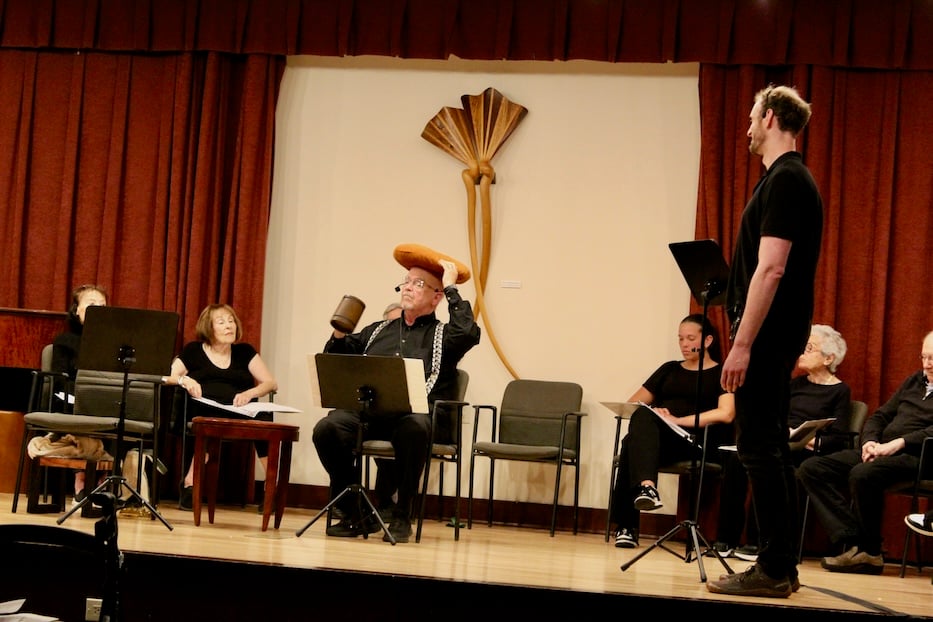
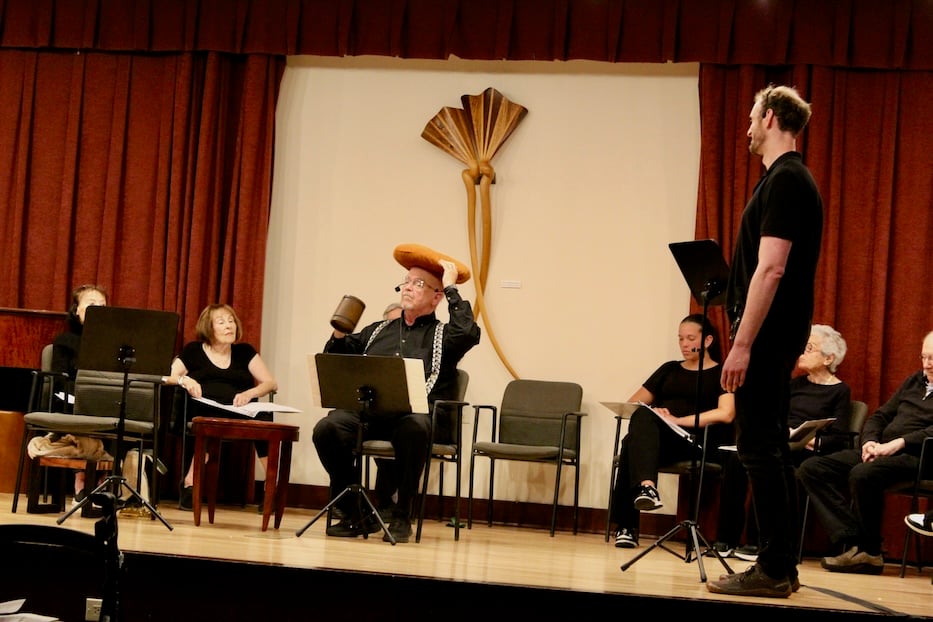
Watson as King Henry IV. Sophia Carey Photos.
“How many thousand of my poorest subjects are at this hour asleep!” intoned John Watson as King Henry IV. In the audience, Henry's subjects made an effort to rouse themselves. A white-haired woman gently snored.
Such a scene is proof-of-concept for Shakespeare: Young and Old and New, a showcase from the Whitney Center Theatre Company that looks to Shakespeare’s words to reflect the complex lived experiences of seniors and their families. A collective composed of residents of the Whitney Center, a senior living and memory care facility in Hamden, the company is helmed by actor and educator Mike Rose.
For the first time this summer, Rose has crafted a performance in collaboration with young actors, some of them members of Elm Shakespeare’s Teen Troupe and their own high school and college theater programs.
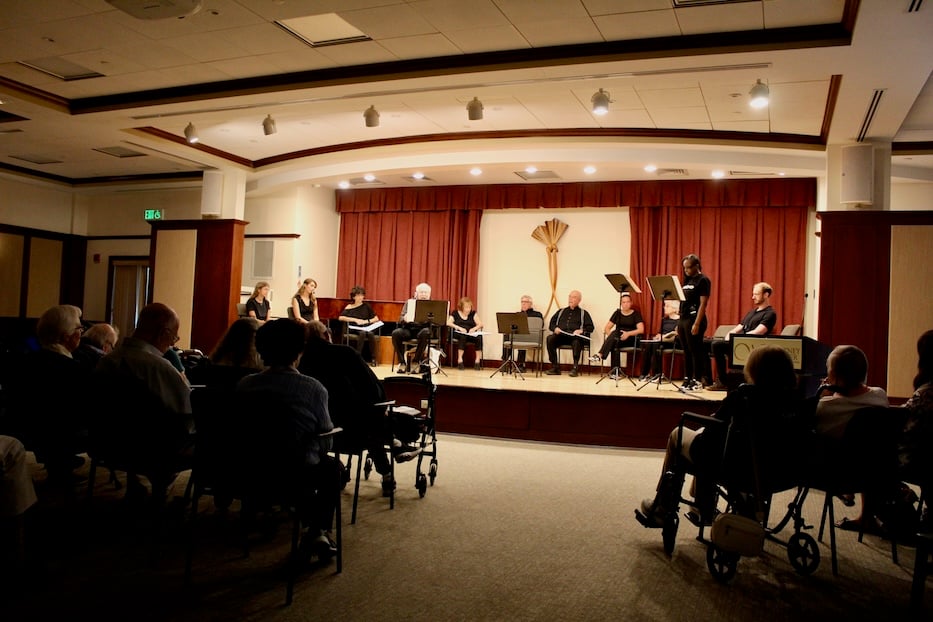
The goal of Shakespeare: Young and Old and New, Rose told a full house at the Whitney Center's Cultural Arts Center on opening afternoon, is to use scenes from Shakespeare’s canon—pulled from Romeo and Juliet, King Lear, King Henry IV Parts 1 and 2, and Pericles—to explore intergenerational dynamics that still resonate today.
“Intergenerational relationship is central to Shakespeare because it is central to us,” Rose said.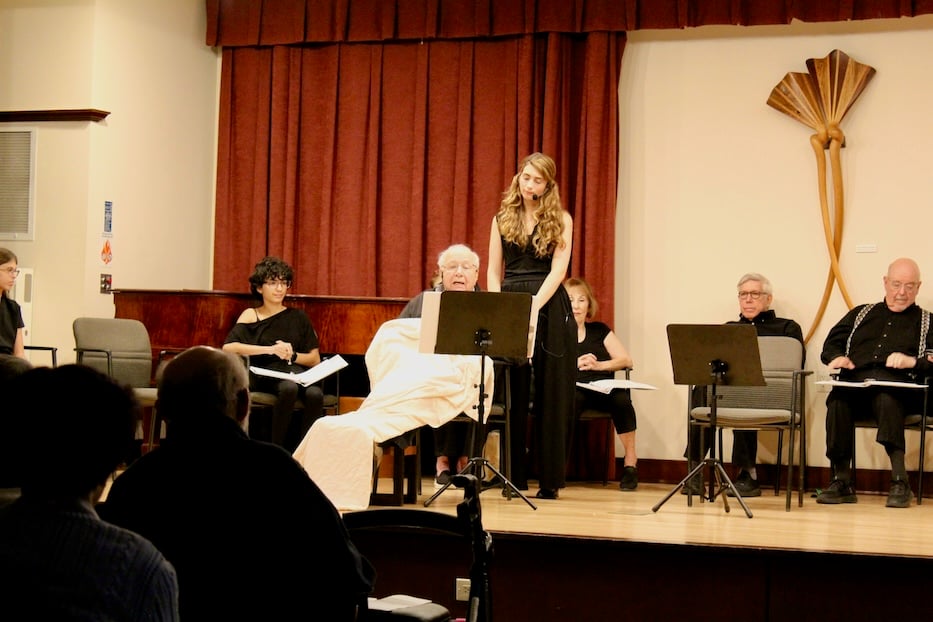
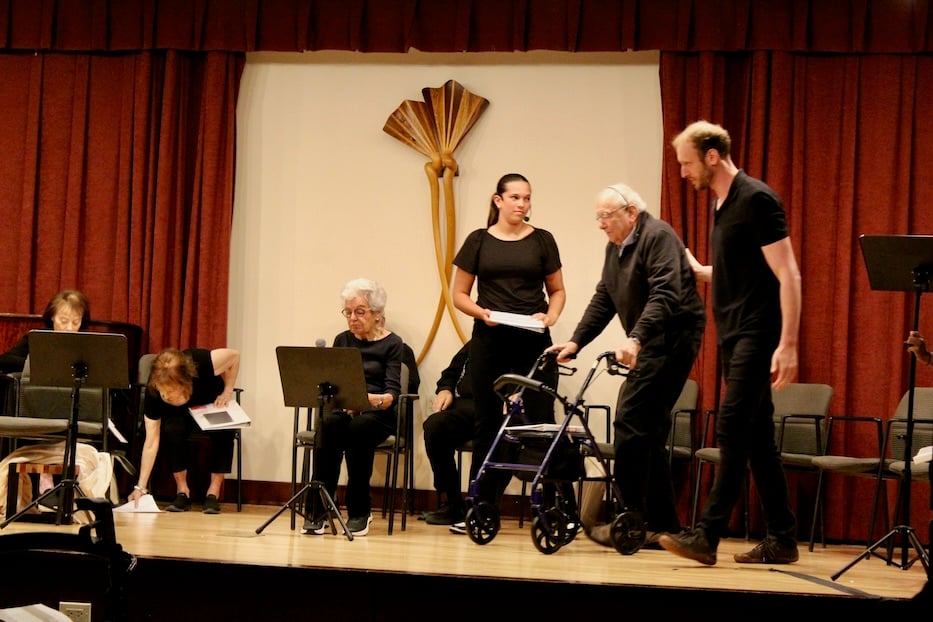
The featured scenes, which pair one or two young performers with one or two seniors, speak to the drama of life’s transitions—and it was in the transitions between scenes where the personalities of the performers, and the care among them, came through. Performers helped each other move from the semi-circle of chairs upstage to seats and music stands in the center, lending an arm, moving a walker, or offering a congratulatory back-pat.
Once settled, actors offered cheeky plot summaries of the upcoming scene. King Lear, Whitney Center resident Victor Altshul told the audience, is about a subject near and dear to many hearts in the room: “Elder care!” The king is in his 80s.
“Spring chicken!” Bette Horowitz, playing the Fool, crowed.
More than transition, these interstitial introductions were and are acts of translation. Introducing Romeo and Juliet, Ezra Academy student Anna Oppenheimer (here, playing Juliet) and Whitney Center resident Evelyn Krevolin (the Nurse), each used the lingo familiar to their generation to introduce the scene.
Juliet, Oppenheimer explained, “has been left on delivered,” while the Nurse, Krevolin said, nurses her own aching limbs after “schlepping all over creation.”
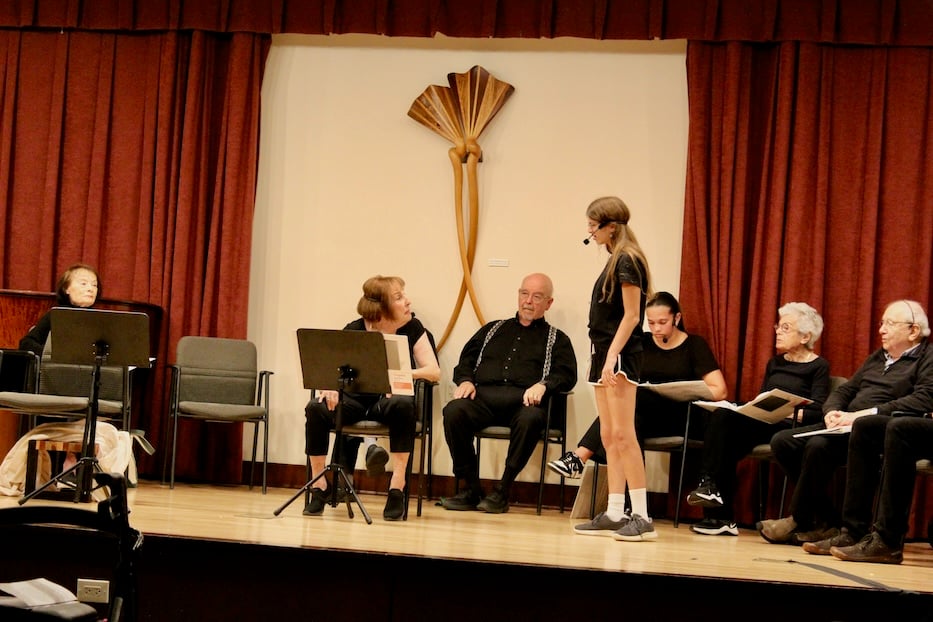
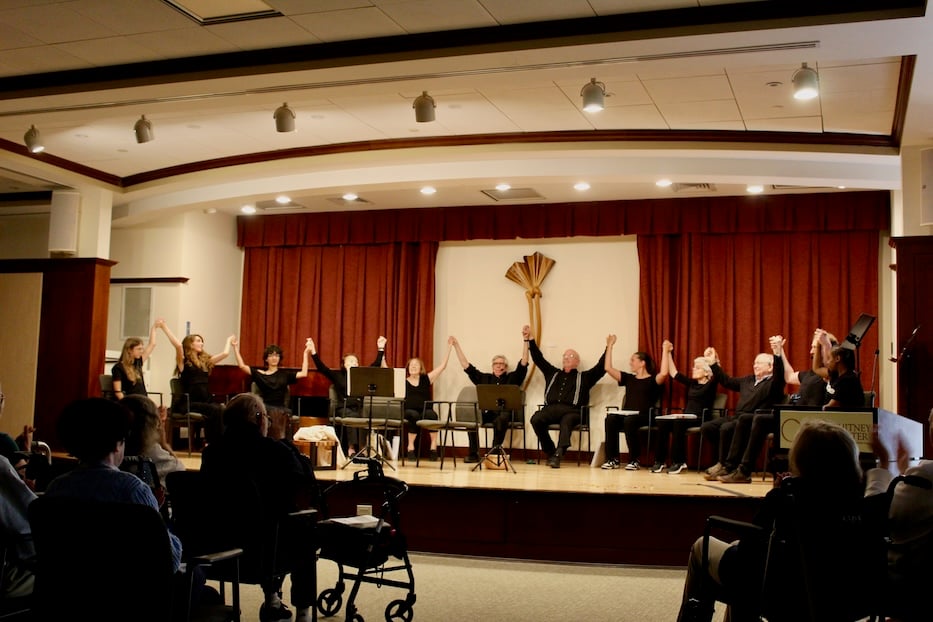
Self-deprecating humor throughout the performance elicited chuckles from the Whitney Center residents. As Juliet, a fully-memorized Oppenheimer bounded around the seated Krevolin, accusing teenage indignation.
“But old folks, many feign as they were dead, unwieldy, slow, heavy and pale as lead,” she said.
Later in the show, the laughter that met Prince Hal’s ( Rose) cruel rejoiner to Old Jack Falstaff—that “there is a devil haunts thee in the likeness of an old fat man”—was the laughter of recognition.
Though mostly lighthearted, the series of scenes didn’t (and doesn’t, as performances still remain) shy away from the genuine animosity, as well as the heartfelt care, that can exist in intergenerational relationships. As Regan, Cooperative Arts & Humanities High School Student A’mari Henderson shamed Altshul’s Lear with the chillingly pithy, “O sir, you are old.” Saturday, Altshul bit back: “Sharper than a serpent’s tooth it is to have a thankless child.”
As the title of the showcase suggests, “Young and Old and New” is as much about childhood as it is about old age; the two are inextricably intertwined. Both Lear and King Henry IV are about the rebellion of children against their parents. Pericles deals with losing a child, and Romeo and Juliet with the loss of childhood.
Saturday, Rose introduced his character, Prince Hal, as a son hungry for “the freedom every young man craves the most: the freedom to never grow up.” But he, and the other actors, also made clear that to grow up and to grow old is a privilege, one denied to too many. In real time, and language old and new, Whitney Center Theatre Company reminded its audience of the fraught joys and hard-earned discomforts of that sustained growth.
Covered in a white sheet, Watson’s King Henry IV lay dying. He entreated his audience: “But bear me to that chamber; there I’ll lie. In that Jerusalem shall Harry die.”
In the assembled rows of audience members were family, friends, roommates, and neighbors, many carrying bouquets of flowers to celebrate the performances of their loved ones. A man seated behind me whispered jokily to his neighbor, “If I fall over and faint, you can fend off the physicians.”
Both Shakespeare: Old and Young and New and its audience were more than willing to “play the fool,” embrace advice from yet another Shakespeare play, and “with mirth and laughter let old wrinkles come.”
There are still two chances to catch Shakespeare: Young and Old and New. Performances run at 7:30 p.m. on Thursday, Sept. 3 and Friday, Sept. 4 at the Cultural Arts Center in the Whitney Center, located in the South Building at 200 Leeder Hill Dr. in Hamden.