

Co-Op High School | Culture & Community | Dance | Education & Youth | Arts & Culture
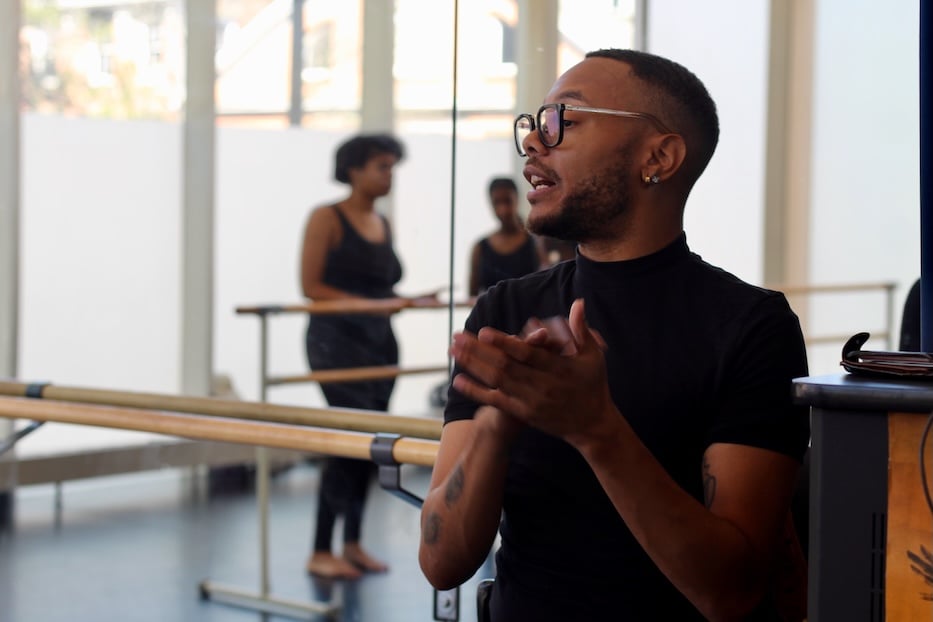
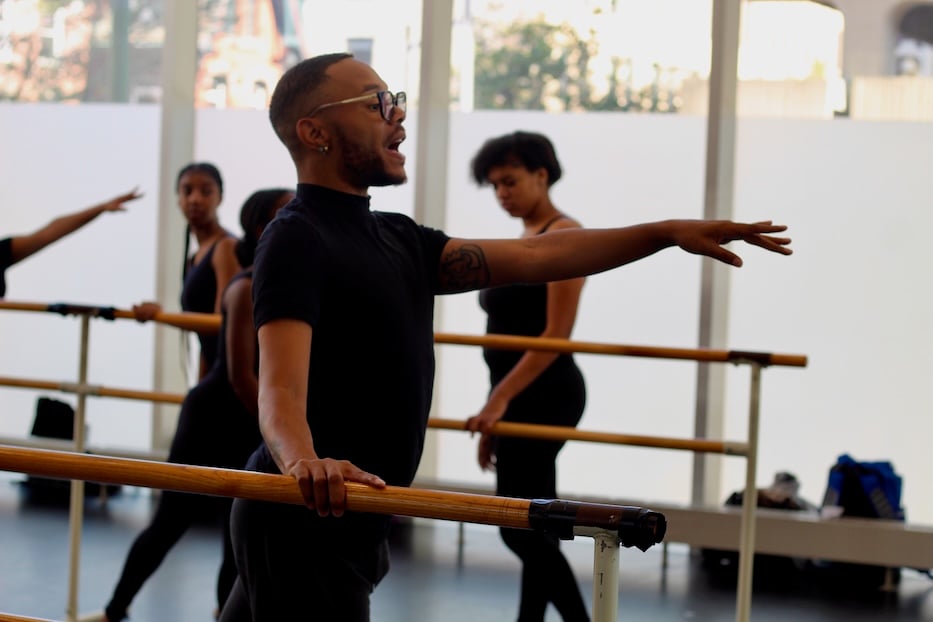
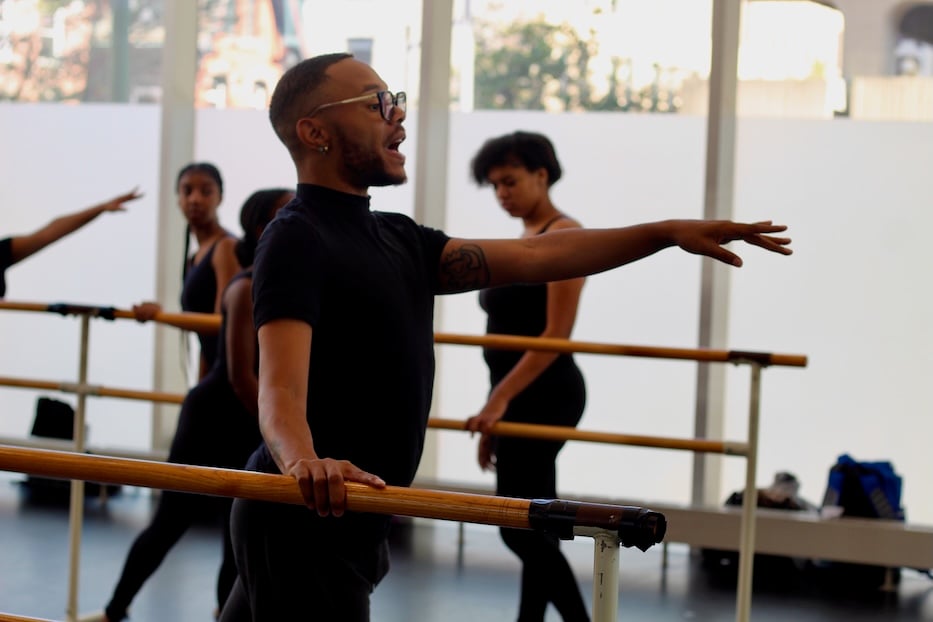
Top: Tavon Dudley, teaching his juniors ballet on a recent Friday. Lucy Gellman Photos.
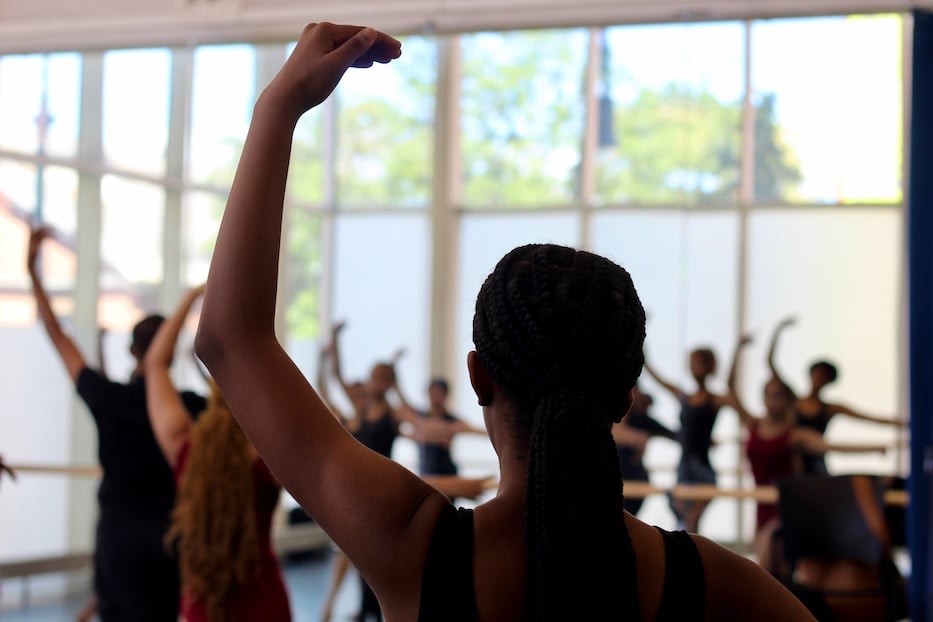
It was Friday morning just off College Street, and in Tavon Dudley’s second-floor classroom, the moment belonged to the cambré. Just minutes before, a piano arrangement of “Apologize” had filled the space, feet whispering across the floor as Dudley counted in a series of tendues. Now, he watched intently as carriages lifted, arms drifted back, and students turned their bodies into long, graceful backward C shapes. Every so often, he stopped to gently correct a position.
“Here’s a key point to learning how to have to balance,” he said, junior Alexandra Thompson listening to every word as he stopped just inches from her shoulder. “Having this death grip on the barre is not helpful to you. You have to let it go to figure out what you have to do.”
It’s one of the ways that Dudley, a son of New Haven who has returned to the New Haven Public Schools district to teach, is bringing both life lessons and rigorous technique into the classroom. This fall, he begins his third year at Cooperative Arts & Humanities High School, from which he graduated in 2009. As he finds his footing, he has both students and former teachers, many of whom are now his colleagues, cheering him on.
“I feel like I have my stride now,” he said after a recent Friday morning class at Co-Op, light streaming into the floor-to-ceiling windows of his classroom. “Dance is just a part of me,” but teaching in a high school has taken more time to figure out.
For Dudley, who teaches dance across the state six days a week, that story began when he was just a boy, growing up in New Haven’s West River neighborhood, and later in West Haven. When he was a young kid, no more than two or three years old, he loved watching his older sister, Alesha Riles, dance in the spotlight at Gloria Jean’s Studio of Dance.
Riles was close to eight or nine, and had been dancing since she was two. By the time she was on the cusp of her teenage years, Dudley was mesmerized. He would go home and practice “everything I saw” in his room, arranging choreography before he ever had the words for it.
The problem was, “I wasn’t allowed to dance,” he remembered with a catch in his voice. Everything he did was in private. His parents, concerned that dance was too effeminate, pushed Dudley into football instead. By the time he was seven, he was playing in a youth league that felt like a horrible mismatch for his body.
“I despised it!” he recalled with a sly, tight smile at the edge of his voice. While football players have been known to use ballet to improve their skills on the field, “they’re [dance and football are] polar opposites,” he said.
Riles, quietly, was his champion in the wings. After she blazed a path to Betsy Ross Arts & Design Academy (formerly Betsy Ross Arts Magnet School, or BRAMS), Dudley began his middle school years at the same school, pursuing dance while telling his family that he was studying theater. It was the early 2000s, and educator Nikki Claxton, herself a product of the New Haven Public Schools, took him under her wing (in June, Claxton celebrated 30 years of teaching at the school).
Claxton can still remember “this little boy, coming into Betsy Ross” in fifth grade, ready to dance like his life depended on it, she said in a phone call Tuesday. “He was hungry for it,” she recalled. “He worked so hard … he is the epitome of what the New Haven Public Schools should be.”
For her, he was also the personification of the maxim “Hard work beats talent when talent doesn't work hard,” which has become one of her favorite phrases over the years. He danced with his entire heart and body, as though he was making up for lost time. His dedication moved her profoundly; it still does decades later.
Back in the fifth grade, Dudley’s mother learned that her son was dancing only when it was time for the school’s first showcase, and he came to her with a list of costume supplies that he needed. By then, Dudley said, things had shifted: his parents had split up. But his mom, who “thinks in black and white,” was still worried.
After seeing him onstage, she promised that she would never keep him from dancing again. (Dudley credits Claxton, who he thinks of as “my fairy dance godmother, who made me believe it was possible” with helping her accept her son’s love for the art form.) That was it.
“I actually remember the first time I ever saw him dance,” remembered BRADA Administrator Amy Migliore, who began her career as an art teacher at BRAMS but was working at Co-Op as arts director when Dudley came on board in 2024. “He had just started dancing, and we all looked at each other like he was a star.”
Dudley was 10, and he committed himself entirely to the form. After studying with Claxton, he began his freshman year at Co-Op, where he studied with veteran teacher Christine Kershaw and Rob Merante, who now owns and runs Triple Threat Dance Co. in Meriden. To him, Kershaw—alongside whom he now teaches, and who has always reminded him of the matriarchs in his own family—was the missing piece in his dance education.
“I always say, my sister planted the seed, Nikki watered it, and then Ms. Kershaw took care of it. She nurtured it,” he said. “Ms. Kershaw was like my dance God. It’s not necessarily that I worshipped the ground she walked on, but I just knew everything she said was law, and she knew what she was talking about. She did it in a way that reminded me of the women that are my family, who care, but who care with an iron fist and did not take crap from anyone.”
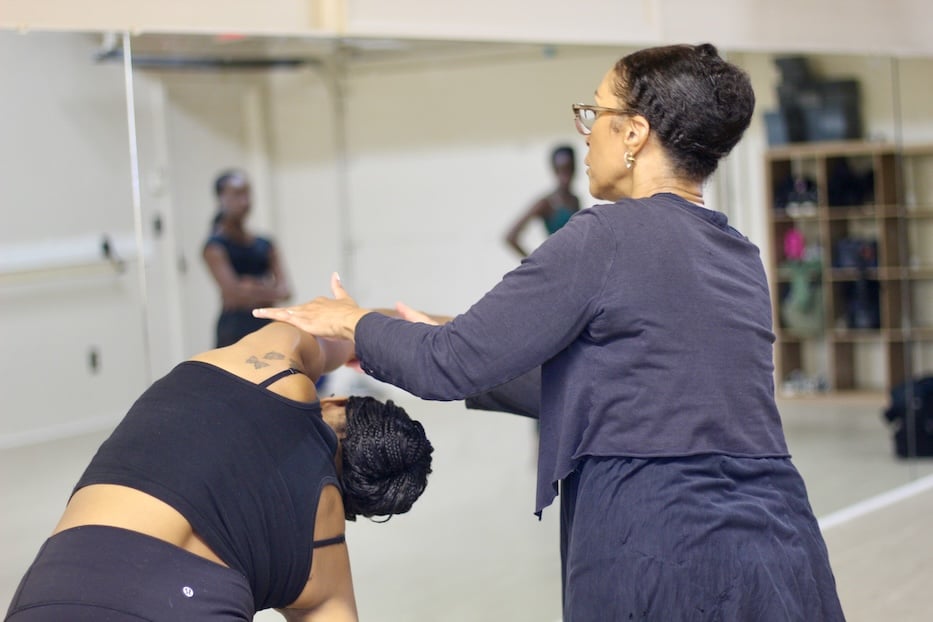
Kershaw in 2025, teaching at the Elements Dance and Movement Conservatory. Lucy Gellman File Photo.
The love is mutual. “It’s fantastic to have Tavon back,” Kershaw said on Dudley’s first day back at the school two years ago, words that still ring true as the two share a corner of the second floor dedicated to dance. She now teaches alongside him not only in the department, but at the Elements Dance & Movement Conservatory (EDMC) in Woodbridge, where Claxton is the artistic director. “You know how they say, ‘The students inspire the teacher?’ He was very inspiring. A lot of the choreography that his class did, it was inspired by his movement.”
“It’s just like, so amazing. He’s such a strong and gifted teacher,” she added. “To see him and to know that he has blossomed into this magnificent teacher … it’s just so beautiful.”
During his time at Co-Op, Dudley realized that he loved the process of dance—the precision, the rigor, the constant striving, the knowledge of how powerful and fragile his body was at the same time—much more than he did performance. When he graduated from high school in 2009, he begged his mother for a gap year, during which he devoted himself to practice, and auditioned for professional programs.
It led him to study at the Ailey School for three years. But when he finished there, “I became very depressed,” he remembered. “I didn’t feel adequate. I would go and audition, and audition, and audition, and I wouldn’t get anything back.” He felt defeated. The cost of living in New York was exorbitant. And then Claxton offered him a job, covering for one of her dance classes in Westport.
The rest was history, he said with a laugh. Claxton’s one class in Westport turned into teaching gigs in Old Greenwich, Hamden, North Haven and Woodbridge. In 2023, he stepped in as a long-term substitute at Betsy Ross, filling in for teacher (and fellow BRAMS and Co-Op alum) Hannah Healy when she had her second child. Only then did he realize that being back in the district that raised him could be a good fit.
“The thing I love about working with younger people is they’re like sponges,” he said. “When you find something that they’re really engaged by, or really intrigued by, the amount of fearlessness that comes with it, I find inspiring. I want to be in the same position to motivate and cultivate the next generation of artists that Ms. Kershaw and Ms. Nikki was to me.”
When a position became available at Co-Op in summer 2024, after the departure of teacher Lindsay Bauer, it felt like a sign.
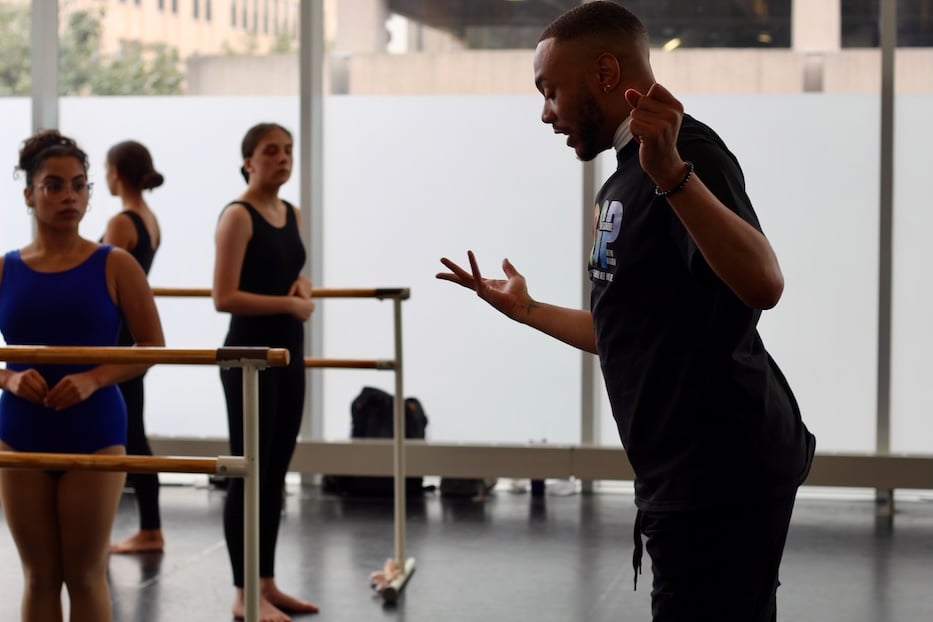
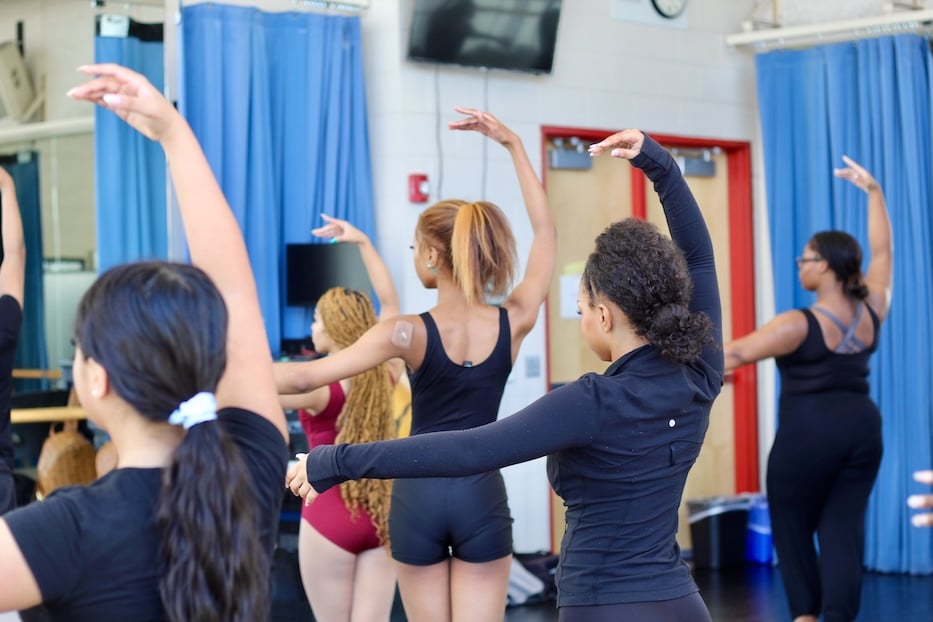 Dudley teaching at Co-Op in 2024. Lucy Gellman File Photo.
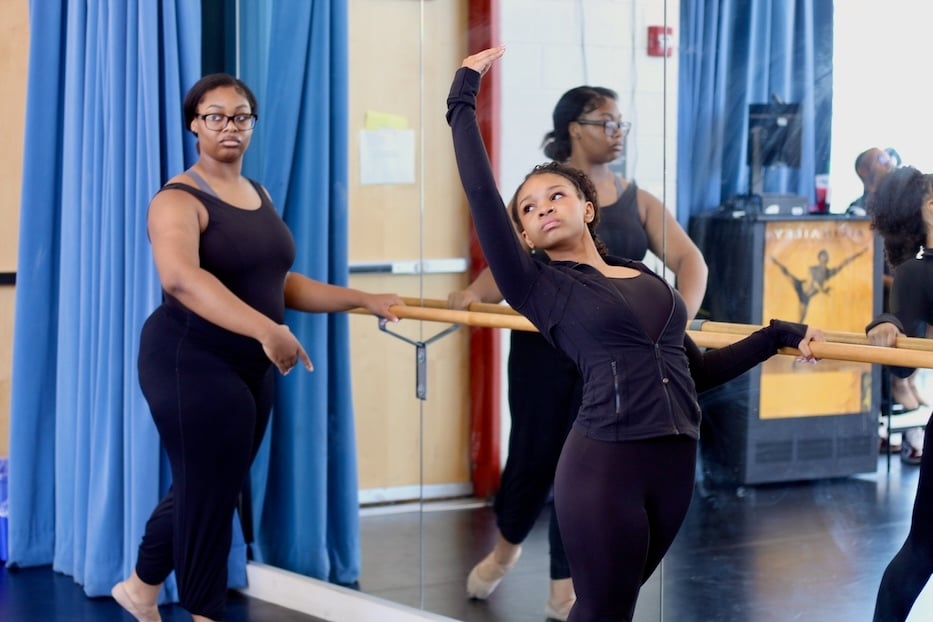
As he welcomed juniors into a second-period ballet class on Friday, a person could see his enthusiasm for the art form in real time, portable ballet barres spread out across the room as if they were just waiting for the right moment. As a slow, methodical piano cover of the Goo Goo Dolls’ “Iris” drifted through the studio, he focused on footwork, slippered feet shifting from first position to second, second to third.
Arms, which minutes before had swung casually into the room, now seemed sculpted and deliberate as they migrated down, then out to the side.
Outside, downtown New Haven was in full swing: cars rushed past on College and Crown Streets. Restaurants, too quiet during the summer months, prepared for an optimistic lunch rush. Even inside the school, voices floated through the hallway, as a few stragglers made their way to hours-long arts blocks themselves. In the classroom, Dudley studied each student, motioning to his own feet as he prepared to move to fourth and fifth positions.
“Turning out is not a position or a one-time thing, right?” he asked, a few students nodding their heads in agreement. “It’s something you’re always working on.”
Dancers shifted to fifth position, still listening. Their arms floated, nearly in sync, above their heads. “Push the floor beneath you!” he said, his voice even but insistent, before he moved on to dégagés. He later said that he likes to dedicate significant time to warmups, as both a foundation (that is very much a Kershaw-ism) and a reminder of how to respect their bodies.
It has taken him time to strike a balance of pacing, patience, and rigor, he said. Three autumns ago, Dudley introduced himself to students with a clipped “I talk fast! I teach even faster!” on the first day of school, mixing metaphors as he jumped from demi pliés to port de bras (“You ever been swimming in a pool and you feel the resistance of water?”) to sous-sus (“You should think about your ankles kissing!”).
By the time he moved to advice on how to balance using one’s core and upper body, it felt like he'd zipped through a small tome of material in an hour.
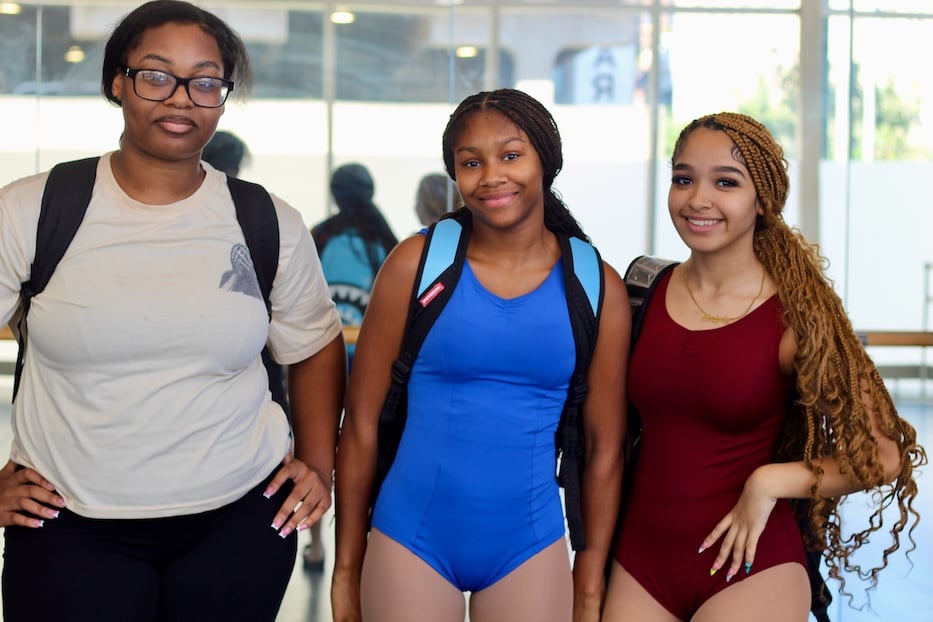
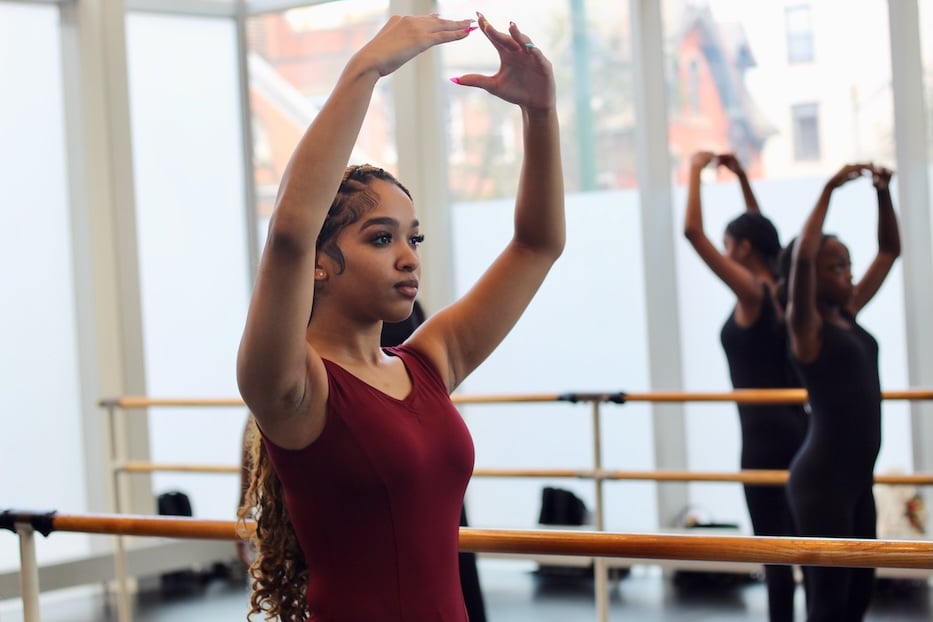
Ryan Saulsbury, Kaidyn Cook, and Neighalie Serrano. “I feel like I’ve grown, but I can still improve,” Cook said. “In the beginning, it was nerve wracking … but I just love performing dances. It’s fun to me. I like people to see how hard I’m working.”
It took him time to realize that sometimes he needed to slow down, while holding onto a quirky, relatable rhythm that resonated with his students. During a class last year, he walked around, carefully studying each student’s position, gently nudging them to raise an arm or deepen a plié where it was needed. He was halfway through a lesson on chassés—that’s a ballet step where one foot “chases” the other, creating a way for a dancer to travel across the floor—when he stopped to look around at dancers moving out of sync.
“Who has ever seen the movie Drumline? You know the line, ‘One band, one sound?’ It speaks to your cohesion as a group,” he said. “If you don’t warm up as one, you don’t dance as one.”
Five semesters in—and perhaps channeling Claxton, who has a way of teaching her students about the world through dance—he often folds advice on how to live one’s life, and navigate the harried landscape of an arts high school, into reminders on technique, routine, and ensemble work. When he says, for instance, “Don’t sit in your hips, think of your body as building blocks,” it’s another way of saying, “take care of yourself.”
Friday, he was in the final minutes of barre work when he spotted a tight grip on one side of the room, and encouraged students to relax. He modeled the transition from tense to relaxed, as if an exhale was moving through his whole body. As he watched, eyes intent but soft, the student mirrored him. He smiled.
“See!” he said. “See what happens when you go for it!? What’s the worst thing that can happen?”
Moments later, a person could feel his mix of technique and tough love as students pushed the barres out of the way, and he pressed play on a cover of “Man! I Feel Like A Woman.” It was time for croisés, arms floating in and out of fourth position as students angled their bodies. “I should be able to fit a whole human between you and your fingertips!” he said, and a few smiles flickered across the room.
“Remember, croisé just means your personal corner. Not everyone has the same corner.”
He’s gotten better at striking that balance, he said. On changements—that’s a jump in fifth position where a dancer leaps up, and flips the order of their feet in the air before they come down in a mirror image of that first fifth—he helped tease out the difference between a changement and an echappé—that’s a jump from fifth position to second. On a glissade-pas de chat combination, he clocked a student’s locked knees, and paused.
“Use that plié!” he said. “Otherwise you’re gonna have knee issues by the time you’re 25!”
He can be strict when he needs to, he added. When, mid-pirouette, a few students abandoned the turns, he pursed his lips to let them know it wouldn’t do. “My thing is this. Unless you all be out-twirling me, I don’t want to see you walk off,” he said. When he added “I don’t need all of you on my stage,” students straightened up and, on the next go, turned with sharp precision across the room.
Neishalie Serrano, who started dancing seriously when she was six years old, pointed to how Dudley meets students where they’re at. He expects students to commit themselves to the technique, but he never belittles a question or makes a student feel like they’ve misstepped simply by being curious.
“I feel like I can express my emotions through dance,” she said. Dudley, whose choreography is often technically precise but extremely emotive, helps with that.
“He has fun with us but he’s also giving us good information,” chimed in Ryan Saulsbury, agreeing. “I feel joy when I dance.”
Claxton, who like Dudley teaches several days a week after school, said in a phone call Tuesday that she’s been extremely proud to see how he’s grown as both a dancer and an educator. Her voice wavering, she stressed how proud she is to now work alongside Dudley at the Elements.
“It’s just full circle,” she said. “It’s a pride and joy story … he shows that if you want something, you can get it. You just gotta work hard.”
“I love him,” she added. “I’m so happy and so proud of him. That his job is dance, and that I had a tiny little part in that, it feels good …He was born to dance and I’m glad he was given to me.”