

Betsy Ross Arts Magnet School | Culture & Community | Dance | Education & Youth | Arts & Culture | Arts & Anti-racism | Betsy Ross Arts & Design Academy
Lucy Gellman Photos.
Julian Durio sat perched at the edge of the stage, his head between his hands, the sound of a choir swelling around him. He rotated slowly forward, then moved his body back, arms rising. Behind him, a photograph flashed across a screen in black and white, a snapshot of civil rights advocates marching arm in arm. As it faded into another, he rose, arms outstretched, and looked as if he might take flight.
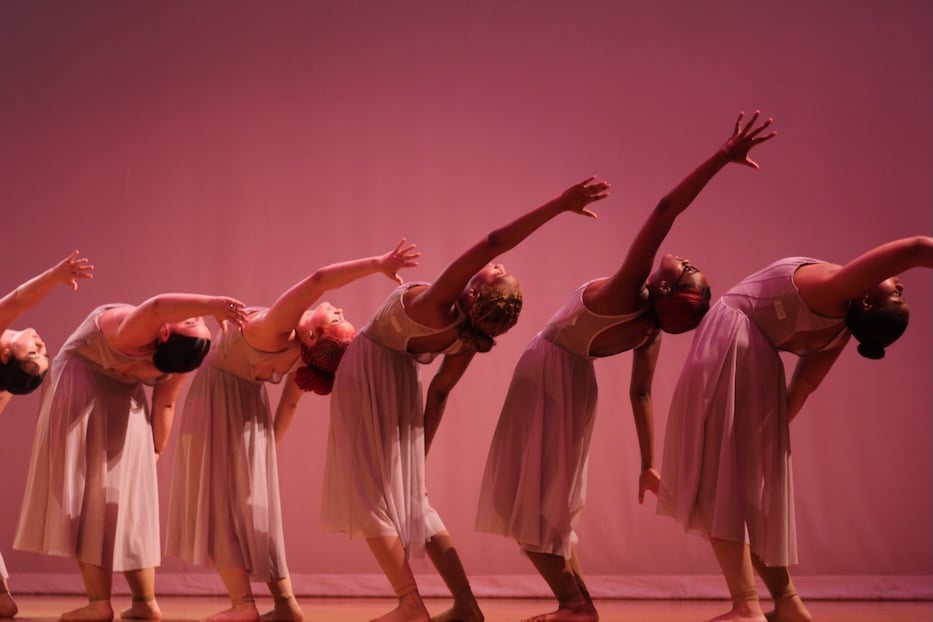
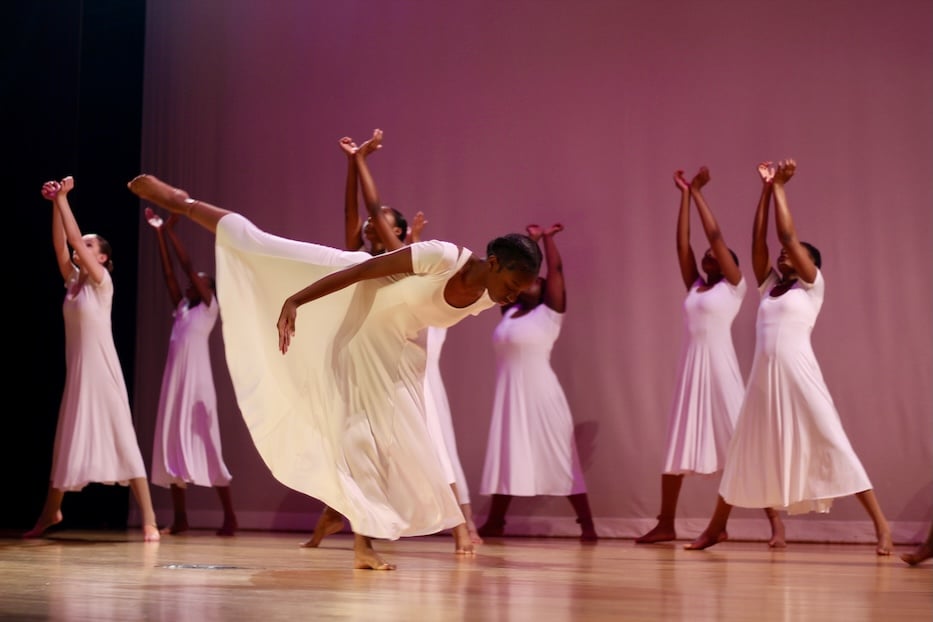
At the front of the stage, two dancers joined him, bending at the waist. Legs lifted high into the air, fabric glowing as it fell around them. Viewers, spellbound in the audience, didn’t know that they were about to receive a master class in grace—and in advocacy.
That moment, and so many others like it, unfolded at Betsy Ross Arts & Design Academy (BRADA, formerly Betsy Ross Arts Magnet School) on the cusp of graduation season, as dancers brought their 2026 spring showcase to the stage with teachers Nikki Claxton and Hannah Healey. In just over an hour, it became a lesson in how to teach history, build and maintain community, and speak truth to power through the arts, even and especially when it feels increasingly transgressive to do so.
Before the end of the night, the showcase also became a chance to celebrate Claxton, who has influenced generations of BRADA students during her 30 years at the school, and become a second mom to dozens of young people, some of whom are now parents themselves. Claxton, who is also the artistic director at the Elements Dance & Movement Conservatory and has built the dance repertoire in the summer program at the Connecticut Center for Arts & Technology (ConnCAT), accepted the recognition with a humility that she also brings to her work.
“I could not do this without you,” Claxton said to her students, presenting many of them with awards for their hard work and commitment throughout the year. “They are up here giving their all and I am so proud.”
“We have a world-class artist among us,” said Principal Jennifer Jenkins, whose daughter, Jayla Anderson, learned to dance with Claxton in middle school and is now choreographing her own work at Vassar College. Jenkins can still remember Claxton as a high school student, running track for Hillhouse while she danced outside of school. Decades later, “she is on the level of teacher of the year,” and “one who makes everyone around a better person.”
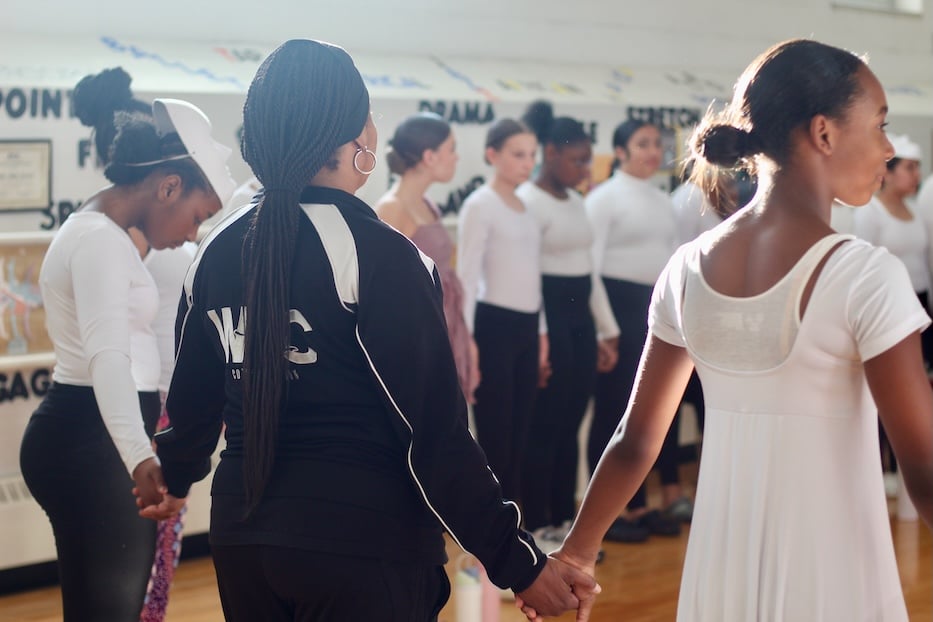
Claxton: “They are up here giving their all and I am so proud.”
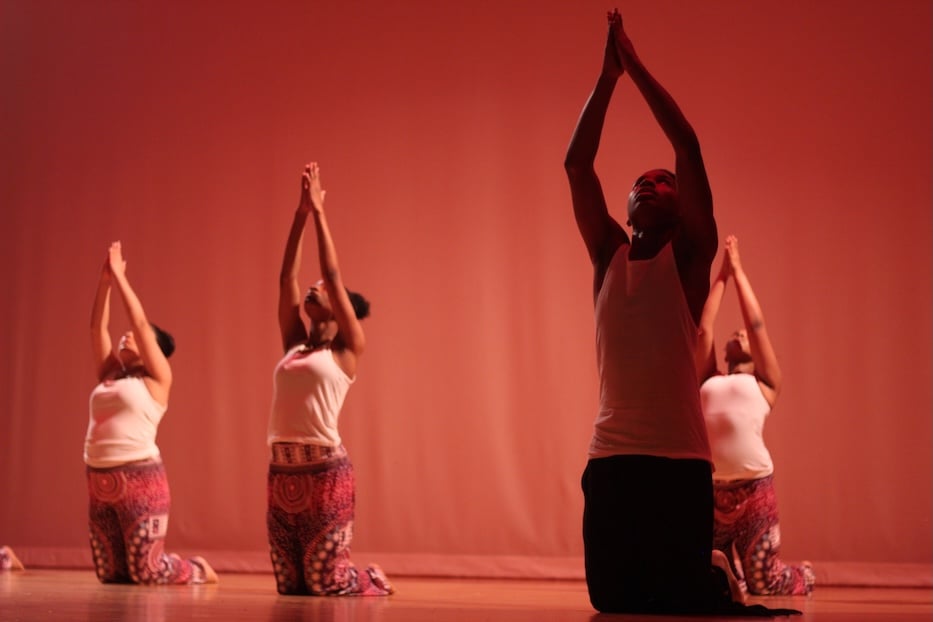
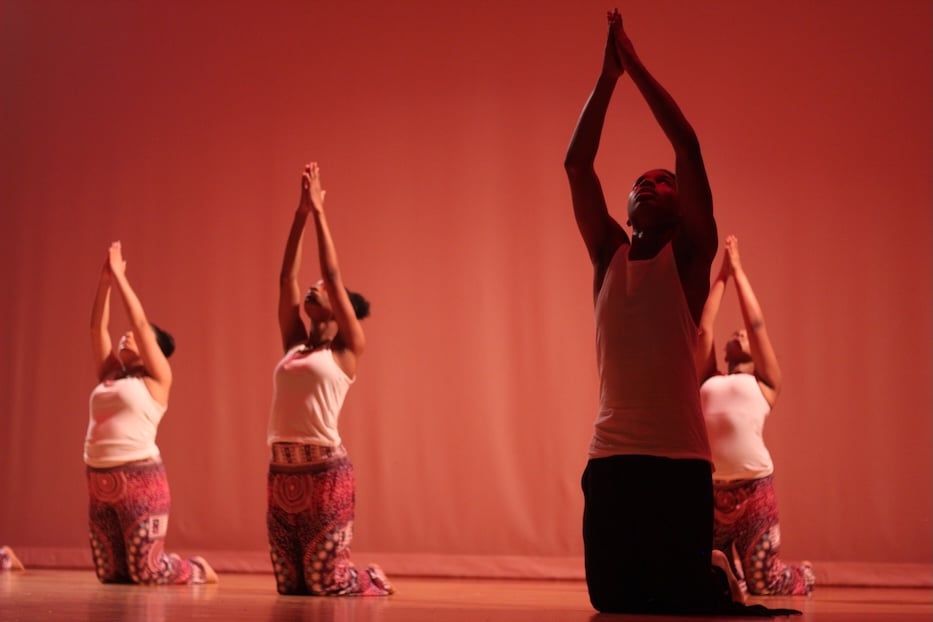
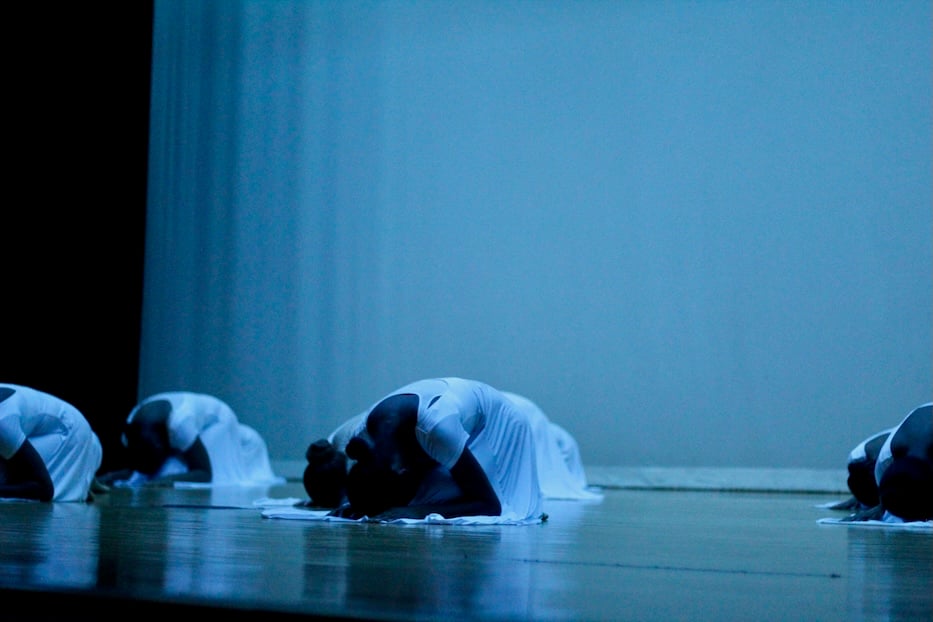
From the moment lights went up on Kirk Franklin’s “Now Behold The Lamb,” first performed during the school’s winter showcase in December, members of the audience could see that in real time. Before a packed house, dancers knelt with their heads pressed to the stage, arms bathed in blue light. With a flourish of keys, they rose row by row, arms drifting skyward with a precision that made the whole space look up, and snap to attention.
Dancers, without saying any words at all, moved slowly at first, savoring every heaven-raised arm, every foot planted squarely on the ground. They reached out towards the audience, then walked backwards so gently it seemed as though their feet were feather-light. As they looked on, eighth grader Tatum Cannon moved to the front, leaning forward before she leapt across the stage, and a few cheers of delight came up from the audience.
This was a benediction. This was reverence. This was community building, with no words at all. Behind Cannon, who fittingly had prayed for her peers before the performance, several eighth graders taught the quiet, shy sixth graders behind them how much strength there was in every slow, deliberate movement.
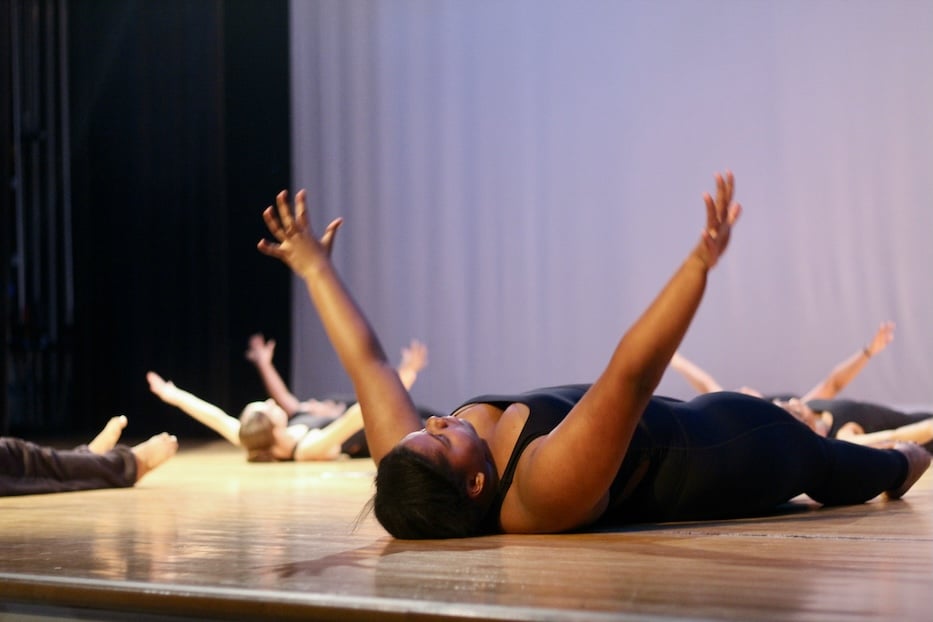
“I think I’ve really improved since last year,” said sixth grader Gabriella Moore, who started the year as a timid student, and feels like dancing in Claxton’s classroom has helped her grow into herself. As dancer Londyn Brockington leapt forward to a flow of voices, Moore let herself feel the music, arms rising and falling with the sound before she swiveled, and walked offstage one foot at a time. “I enjoy that I get to learn new things.” 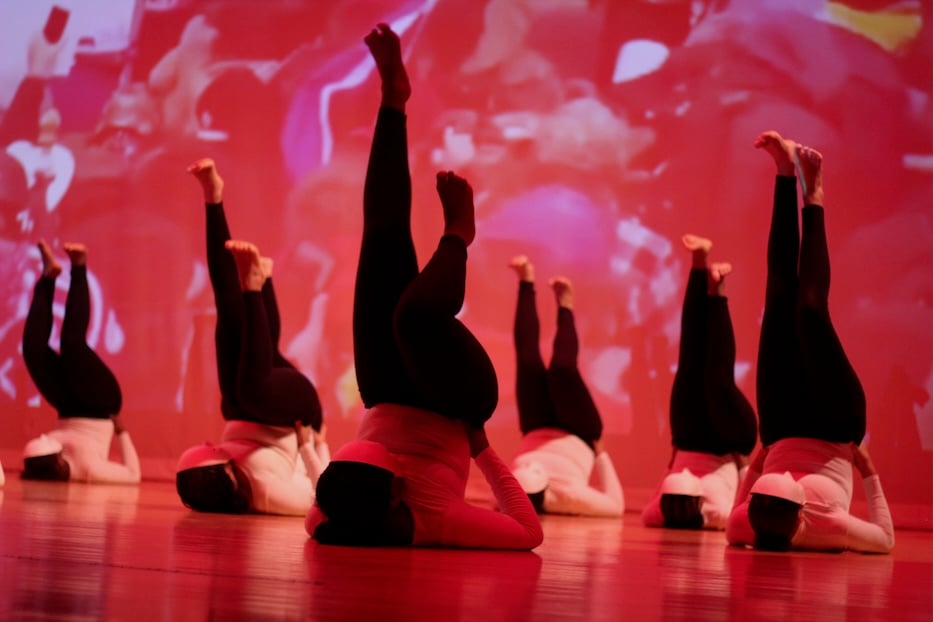
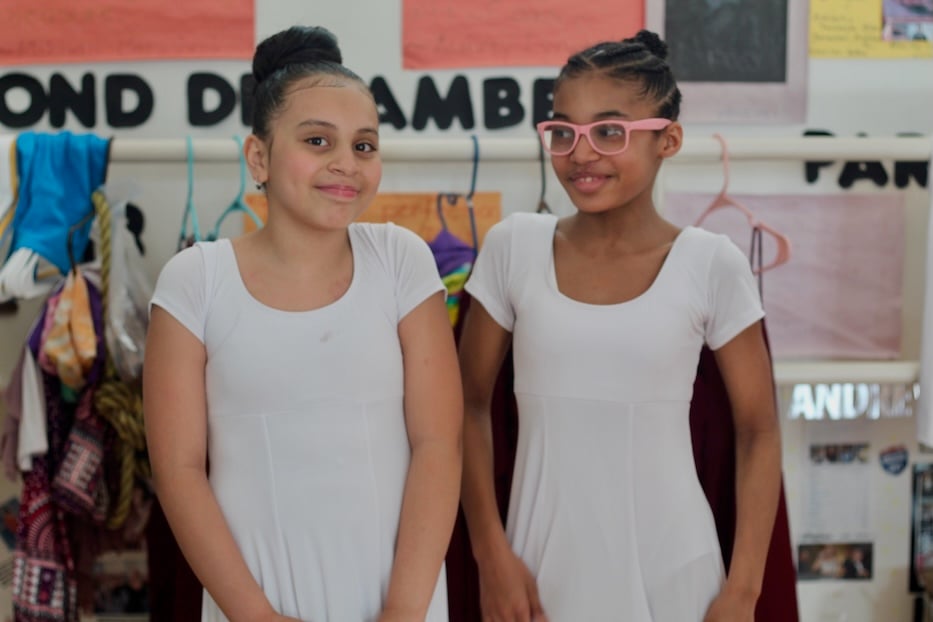
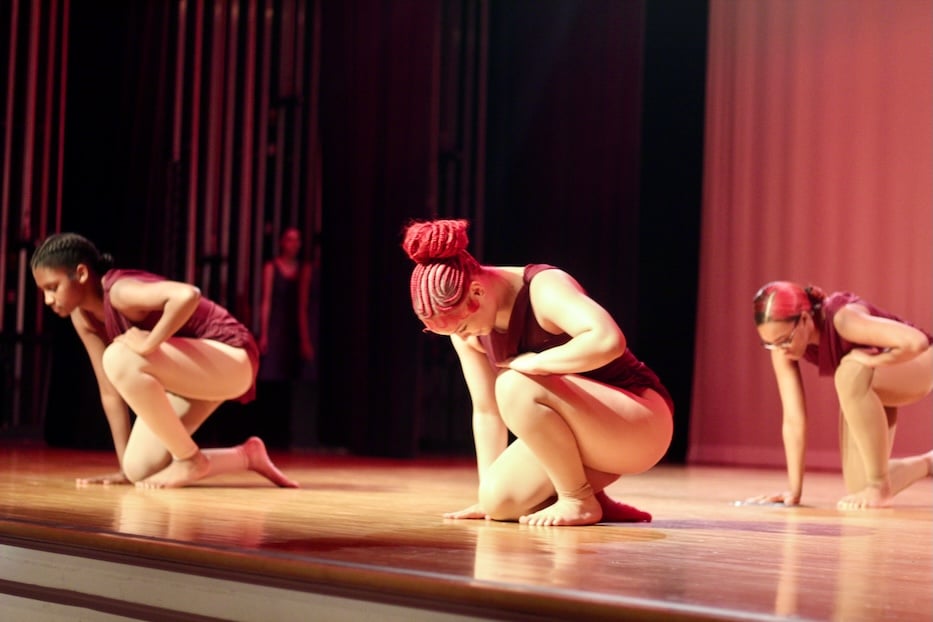
Top: Dancers in "Mad World." Bottom: Sixth graders Sofia Wiliams and Gabriella Moore both said they've grown as dancers and as students this year.
In the audience, whole families sat slack-jawed and wide-eyed in wonder, remembering themselves in time to cheer their dancers on. By now, many of them were talking back to the stage. As a trio of dancers padded to the center, white and yellow light falling around them, they sprang into action, their strength suddenly thunderous.
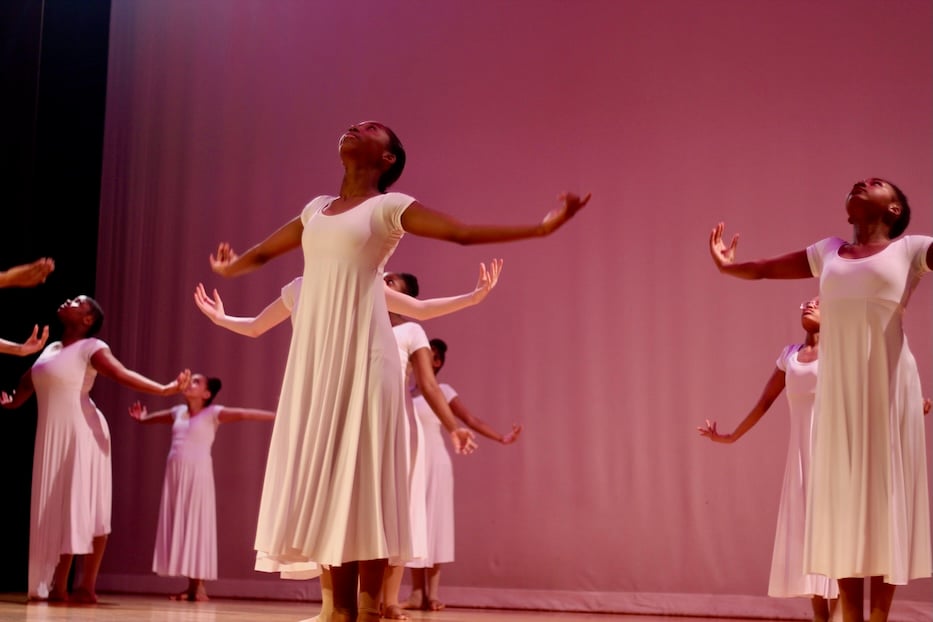
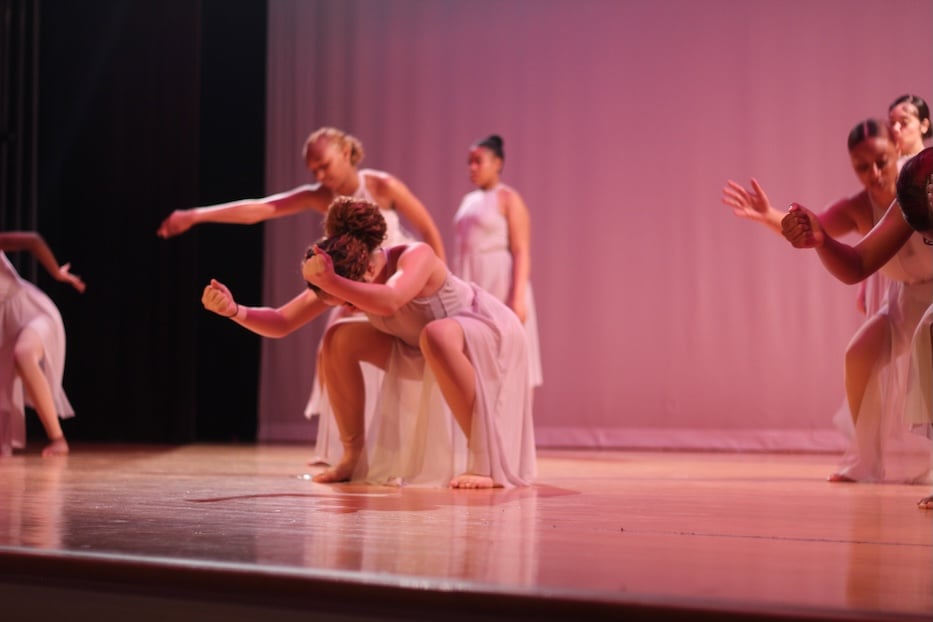
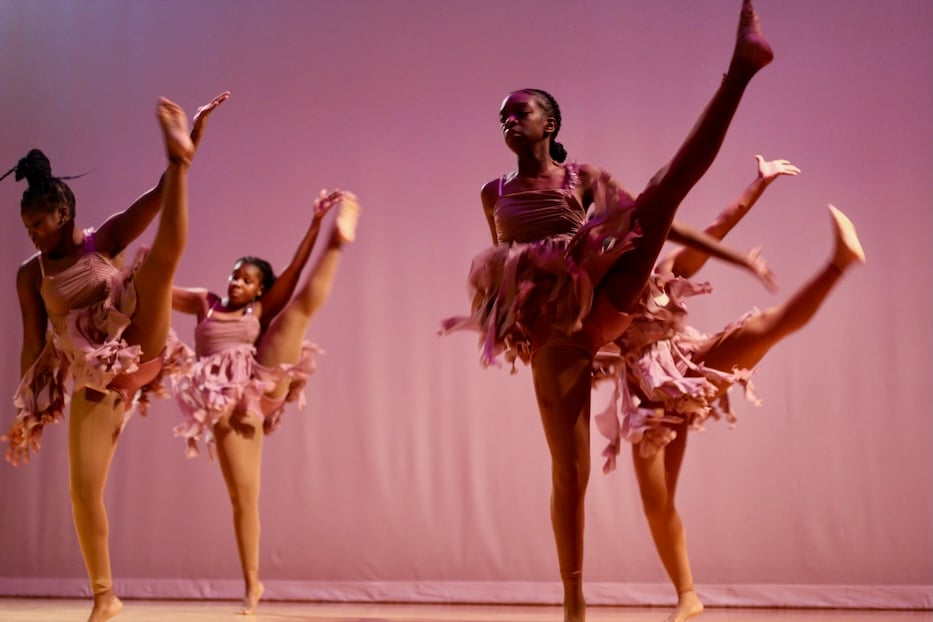
Once dancers had tapped into that emotion, it didn't stop. A sense of something sublime flowed through Healey’s “Keep Fighting” and “Hallelujah,” the latter set to Pentatonix' cover of the eponymous song. As voices floated over the stage, dancers moved across the space, dresses gauzy and diaphanous. They arranged themselves around eighth grader Kimberly Gardner, in a wide circle in which every student seemed to say, We got you.
Gardner ran between them, as if she was searching for something in their folded bodies, their outstretched arms and flattened fingers. She crouched to the ground and they rose, their arms rising in supplication. She balanced upside down, toes pointed and legs outstretched. Then she propelled herself toward the left side of the stage, an arm raised to the light in a way that made her appear holy, beatific.
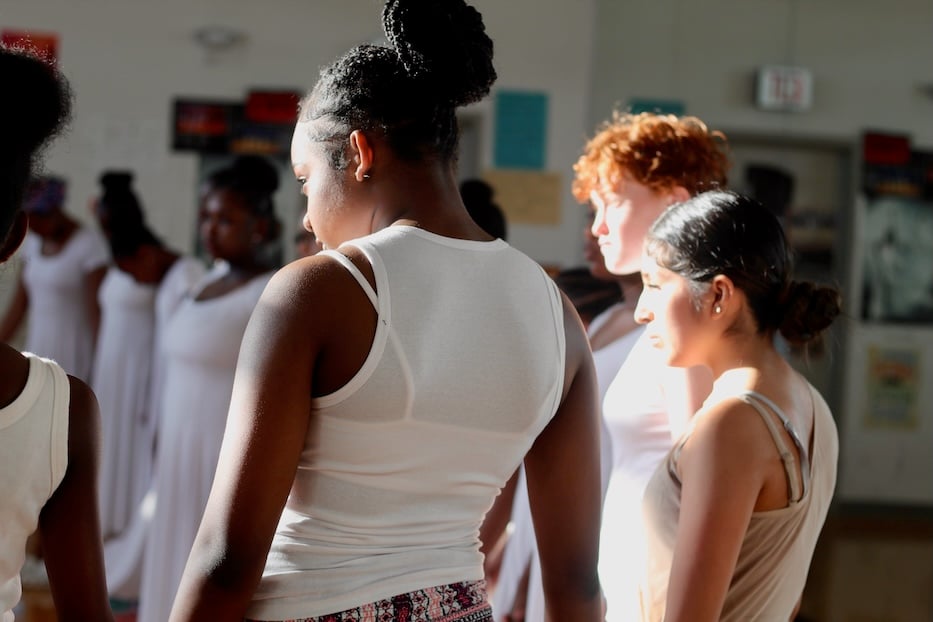
This was no longer the meek student she had been minutes earlier, her face slicked with tears as she prepared for her final performance before eighth grade graduation. This was a girl on the cusp of adulthood, who would dance right into her next chapter.
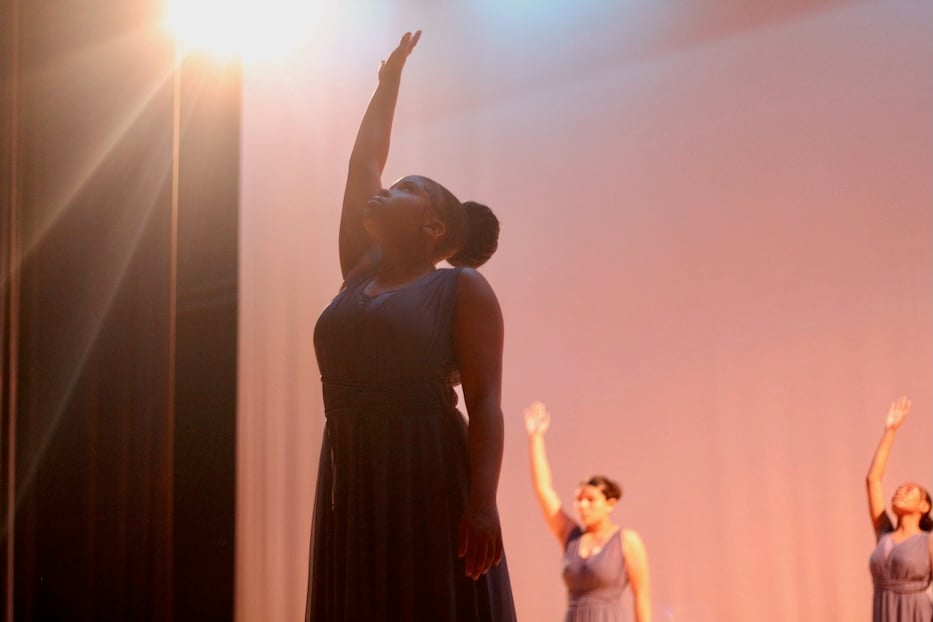
Top: Gardner, who will join New Haven Academy in the fall, said the transition is bittersweet.
“I’m just sad!” she had said before the performance as a sob threatened to rock her body, and she walked out of a first-floor staging area and toward the auditorium. In the fall, Gardner will start classes at New Haven Academy, where Carissa Kee has built a dance curriculum from the ground up. “I don’t want to leave this school.”
Just as they did earlier this year in the school’s Winterfest and Black History Month performances, students also looked to dance as an opportunity to educate the audience—and each other—about a world that is on fire, the flames coming ever closer to the people and places that they call home.
In “Rise,” performed by Healey’s eighth grade emphasis students, a person could feel it as they lurched forward, arms around themselves, and it felt for a moment that someone might need to catch them.
In “Mad World,” it was palpable beneath a red glow, as a slideshow of climate disaster, of global conflict, and family separation rolled behind masked dancers. In “How To Be A Person,” set to a spoken word piece by the poet Shane Koyczan, eighth gradersgave the audience a master class in transition, trial and error, and empathy, moving in calculated time with each other.
Nowhere was it as affecting and effective, perhaps, as in “Sparrow” and “Sweet In The Morning,” numbers choreographed by Healey and Claxton respectively that remained fully in conversation with each other—and with the audience—throughout the night. In the first, set to a version of “Sparrow” that artist Wyn Starks recorded with the The Fisk Jubilee Singers, students began shrouded in darkness, Durio at the front as the lights came up.
He turned to the audience, then to his peers, and two more dancers came to stand beside him, in a sort of promise that he would never be alone. As they raised and lowered their arms, three sparrows in flight, the ensemble moved slowly, deliberately, until they were one. Behind them, snapshots of civil rights marchers gave way to Olympians Tommie Smith and John Carlos, runner Usain Bolt and gymnast Simone Biles, then turned again to images from the Black Lives Matter Movement.
On the screen, a fist reached up against a blue sky, clutching a bouquet of white flowers that were already wilting. Durio, turning his back to the audience, leaned towards his fellow dancers, heaving himself from side to side as the screen shifted again, and George Floyd’s face looked out, haloed by the words There is no / Justice / In a / Racist / System. He faced back out, falling into a deep lunge as he reached his arms over his head, and Starks’ voice climbed and filled the theater.
On stage, the images were moving faster, jumping between past and present in a way that made a person’s chest contract as they watched. Dancers, who had spread out, bent back onto the stage, torsos raised as others literally held each other up. They came back to the front, bodies bending forward and then moving towards the floor in sync with each other.
As one row headed toward the curtain, the name Emmett Till appeared in white text on the screen. Then, seconds later, Amadou Diallo. Then Trayvon Martin.. All of them are victims of a police state that they never asked for.
The names started moving faster, a stone in one’s chest. Rumain Brisbon. Eric Garner. Michael Brown. Just three dancers remained on stage, running towards the screen as the names moved too quickly to keep up with. John Parker III. Tamir Rice. Jerame Reid. “All right, yes,” someone in the second row said quietly, his voice quiet enough not to make it to the stage. Dancers drifted back on, and the list slowed, Breonna Taylor. Ahmaud Arbery. George Floyd. These students, their bodies so young and so alive, glowed beneath blue-green light.
Is this the world, dancers seemed to ask, that we are leaving to our children, our students, ourselves? Don’t our future generations deserve more? Don’t we deserve more?
The answer, they continued, was a resounding yes. As a choir came in behind Starks’ voice, dancers rose against scenes of peaceful protest from the last ten years—a decade in which many of these children have grown up in the shadow of two pandemics, of unchecked racism, of white nationalism in the White House. Gardner, a powerhouse who can convey whole worlds of emotion when she dances, stepped to the front and took her moment in the spotlight.
Durio, who entered BRADA as a choir student, said after the performance that he had put his whole self into it, because he understood the weight and emotional heft of the message. When he first walked on stage, “I was nervous, I was very nervous,” he said. Then he looked at the members of his family in the audience and remembered that he was exactly where he was supposed to be.
As a choir student, “I realized I was just holding myself back,” he said. So at the beginning of eighth grade, he switched into dance, working with Healey as his main teacher and Claxton as an emphasis student. A year later, he turns to dance both in and outside of school as a form of stress management and emotional regulation. “I feel like she’s really helped me a lot,” he said of Healey, who in turn credited Claxton with her growth as an educator before the end of the night..
The number, too, found itself in conversation with “Sweet In The Morning,” a six-dancer piece that Claxton has been thinking about for years, and had students research long before they ever took the stage. In the work, which unfolds to Bobby McFerrin’s 1990 song of the same name, dancers walk on holding thick, braided lengths of rope that have been tied with a knotted loop, in the chilling shape of a noose.
On stage, Claxton had set up three wooden boxes, which sat like overturned milk crates, unused until they weren’t. “‘Sweet In The Morning’ is a dance that has memory in the body,” she said evenly in a voiceover before the piece, the audience bathed in darkness. “It moves with the history of Black America.”
And it did, sometimes so heavy that parents and friends who had lifted their phones to record stopped what they were doing, and lowered them, aware that they needed the moment to take everything in. From the first notes, dancers were in motion, three atop the boxes as three rolled onto the stage, legs windmilling over their heads. A slideshow of archival photographs, all depicting the lynchings of Black Americans in the 19th and 20th centuries, rolled behind them.
On stage, all six dancers (Jalona Barnhill, Londyn Brockington, Tatum Cannon, Carmella Cestaro, Oni David and Ralani Moody) moved in syncopated motion, arms clasped as they rocked from side to side, precise but never robotic. They fitted their feet into the ropes, raising them as they looked offstage and became a freeze frame, a reminder of grace and mercy in the darkest of moments. Behind them, an image of the Ku Klux Klan flashed across the screen.
The United States has had more than 150 years to formally label it a terrorist organization and has never done so, one sentence read, the words throbbing against these six dancers, who seemed almost ready to take flight. As they unfroze, more protographs appeared on screen: news articles from the 1860s, a meeting of Klan members, all of them hiding their faces beneath a banner that read Jesus Saves.
Dancers, moving through decades as they leapt into the air and came back down, looked forward, eyes locked on the audience. In their raised torsos, their bent legs, their skyward-facing arms and pointed toes, past knocked up against present: viewers could see the evolution from masked vigilantes of yesteryear to those of today. Behind them, a montage from the Jim Crow South moved through snapshots of segregation, each horrifying in its normalcy.
Dancers ran in place, their bodies straining against an invisible force. They clapped their hands together, as if they were rubbing something from their palms. They raised their arms to the ceiling and kicked their legs back, screaming one by one as a map tracking the murders of Black people appeared behind them. They sprang from the stage one by one, as if they were dancing for their lives, stilling for only a moment before dancing into the Civil Rights movement.
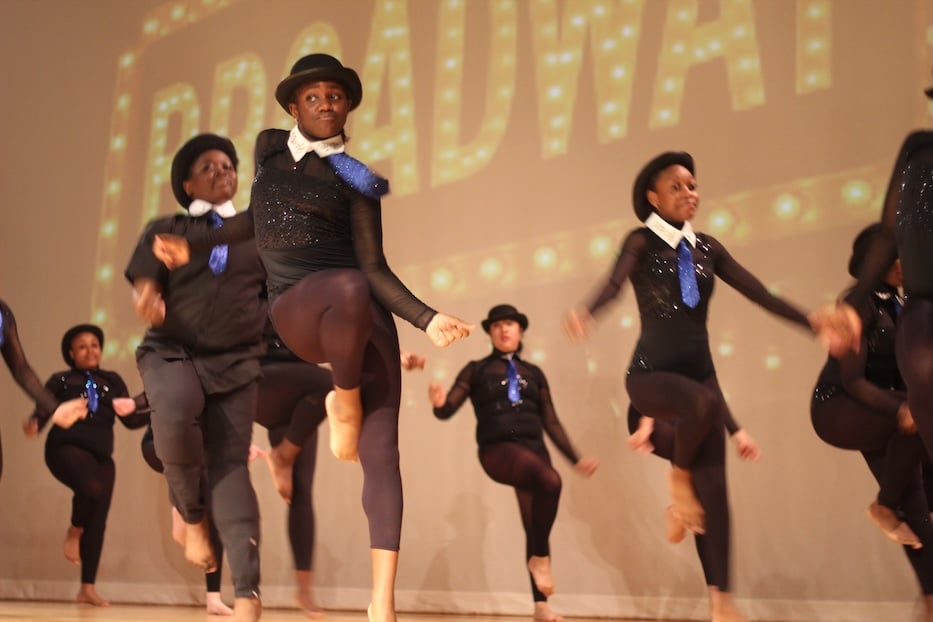
"On Broadway," an upbeat jazz number, dazzled.
In some ways, the dance is bigger in historical scope than any one thing BRADA has done: it covers four centuries of history in under six minutes. But it’s also a logical continuation of the dance department’s work that makes total sense. Claxton has never been one to shy away from hard subjects: her students have taken on Billie Holiday’s “Strange Fruit,” police violence, the Black Lives Matter movement, mental health and suicidality, school bullying, and the centuries-long work of liberation workers.
As a balance and a balm, she has also always included joy, with ebullient jazz and numbers like this year’s “On Broadway” and “Brand New Day.”
But when she was choreographing “Sweet In The Morning” this year, a few colleagues and fellow educators pushed back, worried that the work might get her in trouble. Some suggested she wait to present the piece, which she debuted during the school’s Black History Month showcase with a long voiceover about context and a program note to match.
But for Claxton—and for many of her students—waiting wasn’t an option. It’s the world in which they are living right now. “It was in my heart,” she said. “It’s history through dance.”
“We still see these things every year, but we can hope that the world gets better,” she added
Seventh grader Oni David, who is part of the work, said she was grateful for the chance to take it on. As Claxton worked with dancers, David researched the Jim Crow Era, which followed the American Civil War and period of Reconstruction. By the late 1870s, she learned, Jim Crow laws had become a way for white people to institute slavery and economic disenfranchisement by another name, with legislation that was meant to both segregate and subjugate based on race.
“It was like, it was just a lot of pressure on your back to make sure that you got this right,” she said. While the history was not all new to her—David’s mom is the historian Dr. Siobhan Carter-David—much of it was still incredibly jarring. As David did research and worked in the studio, she and her peers were reminded of how recent that history still is. She took time to let herself feel the full range of emotions that accompany the dance, including a heavy, deep sadness and fear.
“I hope people realize that humans are just all human,” she said. “The color of your skin doesn’t change anything.”
Fellow seventh grader Ralani Moody, who is part of the dance, researched the Civil Rights Era. When she gets on stage, she said, she thinks about everything “that we had to fight through, to go through” to get to that singular moment of performance. Before the show, she said, she planned to send up a prayer for extra protection, not just for herself, but for every artist and teacher in the building.
“I ask that He sends angels around the school to protect us,” she said. If the dance was any indication, someone was listening up there.
Even as schools break for summer vacation, the moment offers a new, and needed, challenge to arts educators: tell the stories, the full stories, of this country and of the world through craft. Assume that students can hold the weight of history, in part because many of them want to have these conversations too. Like “Mad World,” which prompted students to talk about Xenophobia, police brutality, and the country’s often inhumane treatment of immigrants, these dances are an opening and an invitation to engage.
“You all have worked so hard this year, right, and it comes down to the show,” Claxton had said before the show, and the words echoed long after the lights had gone down for the last time. “Do your best, work hard, you know what you’re doing. Make sure you dance from the inside out. That is, heart first. I need the emotion. I need the joy. Whatever it is, the story that you’re trying to tell, I want you to tell it. Tell it to the audience. That’s your job.”
“Be great. Be the dancers that I know you can be,” she added. “Beleive in yourselves, just as I believe in you.”