
Creative Arts Workshop | Culture & Community | Arts & Culture | Nasty Women New Haven | Literacy
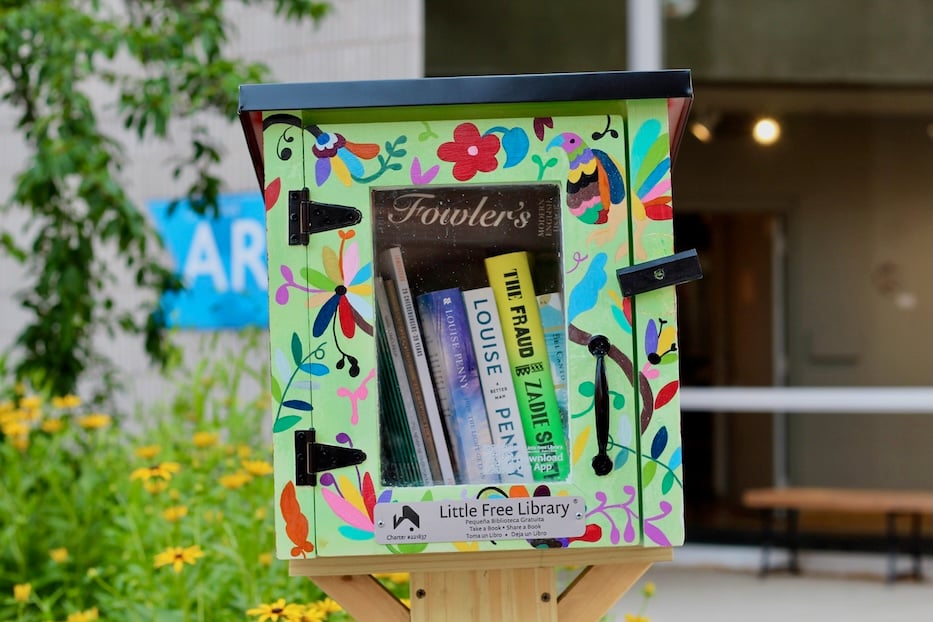
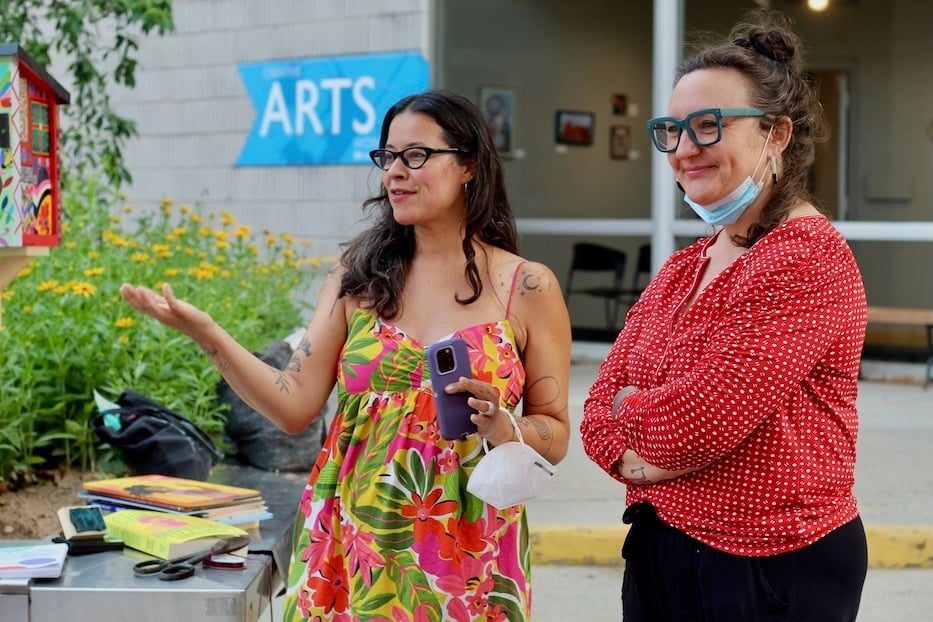
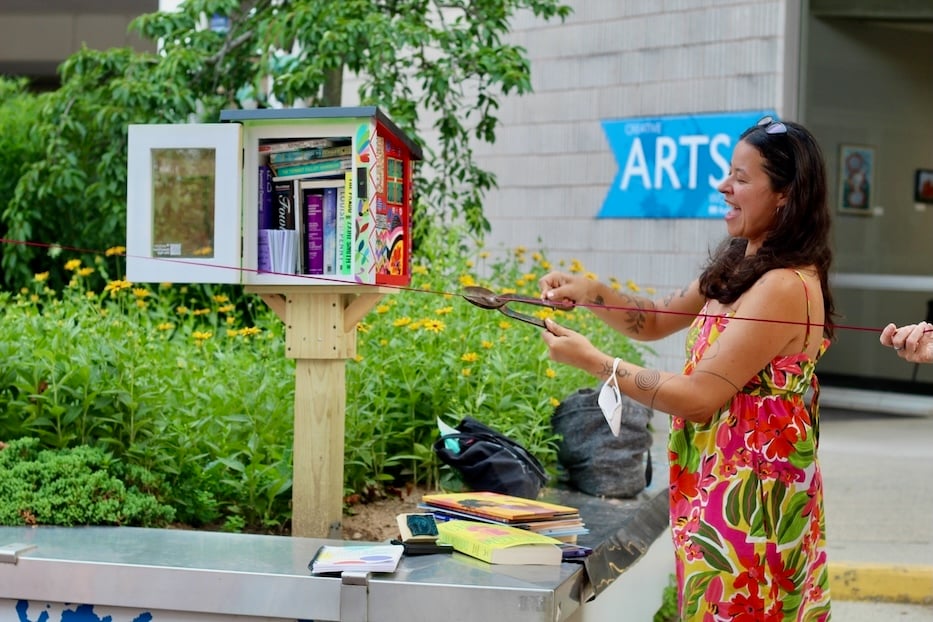
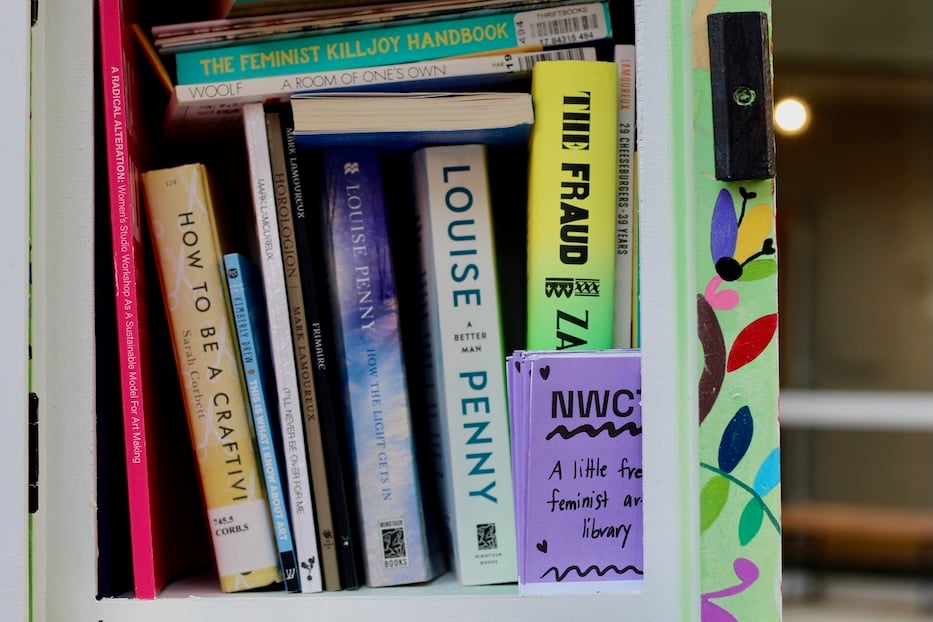
Top: The Little Free Feminist Art Library, which is now in operation. Bottom: Artists Luciana McClure Lewis and Michelle Beaulieu-Morgan. Lucy Gellman Photos.
The books looked out over a hazy, too-warm Audubon Street, as if they were waiting for something to happen. There was Bel Canto, with her strains of opera and braided, polyphonic story of love and fear and power. There Louise Penny’s A Better Man, the waters continually rising as the plot unraveled. Sandwiched cozily in between them, Amy Novesky and Isabelle Arsenault’s Cloth Lullaby waited for just the right pair of little hands.
Those titles, which sit snugly in a new, vibrantly painted library box from textile artist Michelle Beaulieu-Morgan, are part of New Haven’s first official Little Free Feminist Art Library, a new project from Nasty Women Connecticut that stands brightly outside Creative Arts Workshop (CAW) at 90 Audubon St. in New Haven.
Named in honor of the late Chilean artist, composer, activist and ethnomusicologist Violeta Parra, the library features books by and for women across countries, cultures and generations.
CAW is a fitting home for the project: the Audubon Street organization has been home to Nasty Women’s exhibitions several times over the past years, including just after the inauguration of President Donald Trump in March 2025. It’s also an institution, now 65 years old, that was founded by the tough-as-nails artist Ann Lehman, a welder who grew CAW from a grassroots space for artists in an old synagogue building to the Audubon Street institution that it is today.
“We’ve been thinking about, ‘What are the ways [beyond exhibition] we can activate community spaces?’” said Nasty Women Co-Founder Luciana McClure Lewis at a ribbon cutting last Thursday, laughing as she pulled a reel of raffia and a pair of thick, silver pinking shears from her bag. “Books, they awaken our imaginations.”
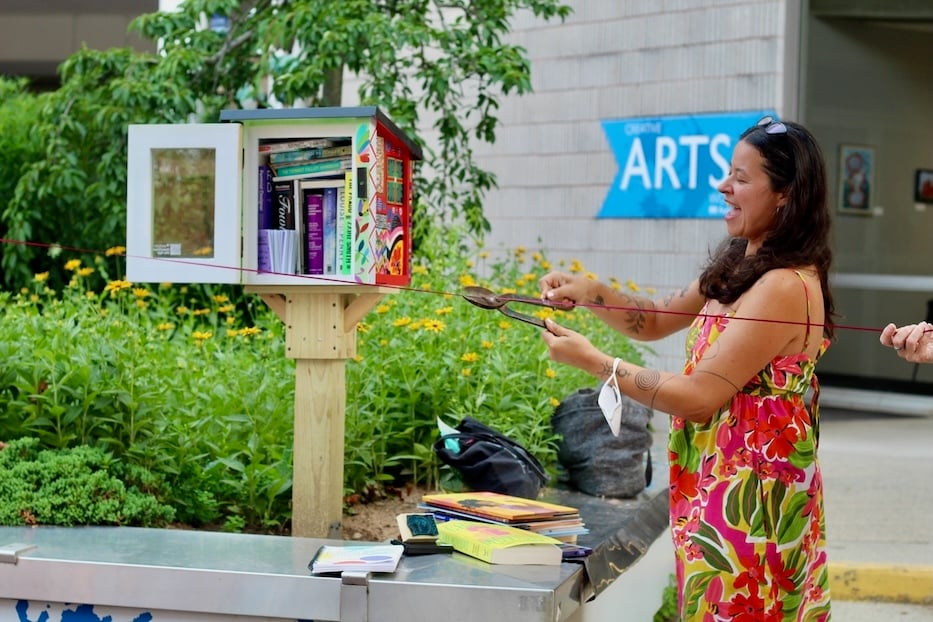
Luciana McClure Lewis: "We are not only birthing children, we are birthing movements."
Lewis, with Beaulieu-Morgan and CAW Interim Executive Director Jennifer Simpson at her side, explained that the project started several months ago, when she started thinking about how broad the nature of “feminist art” really was. For years, she’s explored that expansiveness in her curatorial, artistic, and academic work, which criss-crosses not only greater New Haven but the state.
She’s also the first to say that it is intertwined with the intimate and essential practice of mothering—Lewis has two adolescent children—which has become the beating heart of her own scholarship. So it made sense that at some point, she started thinking about how to better share feminist art, and came out with literature. Or in her words, “we are not only birthing children, we are birthing movements.”
In Beaulieu-Morgan, she has found a person who both understands the assignment and is something of a fierce feminist comrade, with whom she unsurprisingly often shares book recommendations. On the outside of the library box, flowers and vines climb up the sides against a cool green background, their leaves and flowers gem-toned and bursting into bloom. At the top corners, a bloom tilts its head towards a kind of parrot-hummingbird hybrid, its feathers exploding in almost a dozen bands of bright color.
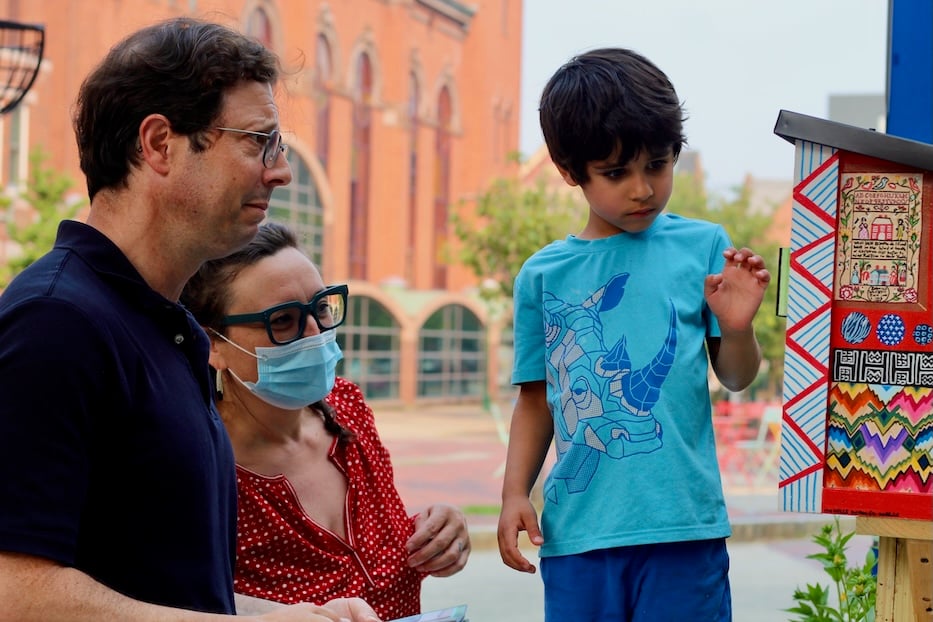
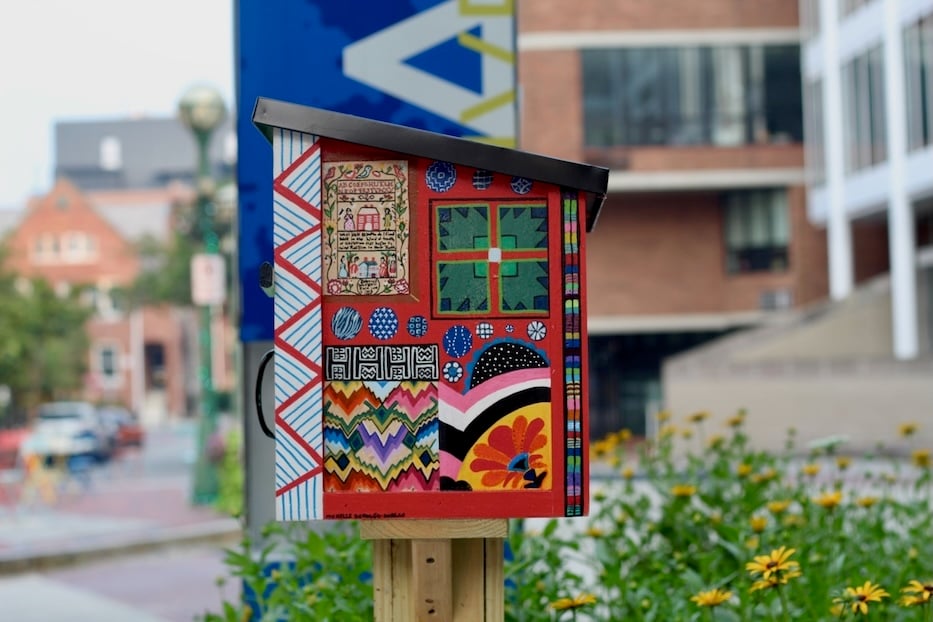
Top: Nasty Women supporter Elihu Rubin, artist Michelle Beaulieu-Morgan, and 5-year-old Mikayel ( his mom, artist and educator Yaminay Chaudhri, is just outside of the frame). Bottom: The box from the side, where Beaulieu-Morgan has shown several styles of craft from across the globe.
From this angle, Beaulieu-Morgan’s style is whimsical, like an illustration one might find in a beloved children’s book. On the sides, meanwhile, she has depicted different forms of craft, all of them practiced by women, and passed down through generations of matriarchs. They include richly detailed Molas from Panama, a red, white and black Navajo rug, the art of Phulkari from Punjab India, Chinese Li weaving, Indigenous Tíano beadwork, and Malian mud cloth, also known as Bògòlanfini.
Many of the traditions exist outside of the Western academic, largely white-coded idea of high art; almost all have also been subject to the devastation and pain of colonialism and cultural appropriation. While researching designs for the library, Beaulieu-Morgan made a zine about the project, with tiny, doll-sized illustrations of the different patterns that adorn the box. That’s part of the library’s wider vision, she and Lewis said: they want to spread knowledge freely and openly, at a time when vital feminist voices are being silenced.
“As everyday women’s artistic practices and innovations largely go dismissed or ignored, I wanted to highlight how art shows up in our everyday lives as well as bring attention to the ways artistic creation, for women, must often, from necessity, be expressed through objects with more ‘utilitarian purposes.’ These same objects and craft practices have often been pillaged by men who use them as inspiration for their own works of artistic ‘genius.’”
It’s one of the reasons that Parra, whose work she has known and loved for years, so resonated with her. During her lifetime, Parra was an activist, folk artist, and musician who in 1964 became the first Latin American Artist prominently featured in the Louvre, at the same time she was building the musical movement Nueva Canción Chilena.
While Beaulieu-Morgan has known about and loved Parra’s work for years, she only recently taught Lewis about it. The two decided just days before the dedication that naming the library in her honor seemed immediately, instinctively right.
“This is the other way the community works,” Lewis chimed in as she waited to cut the ribbon. “We’re always learning from each other.”
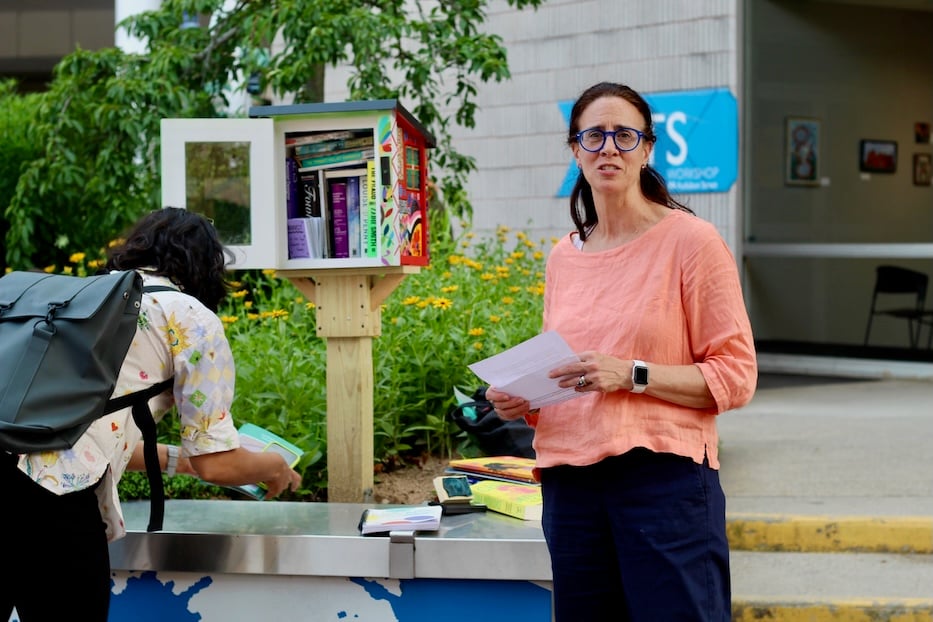
Yaminay Chaudhri (putting in a book) and CAW Interim Executive Director Jennifer Simpson.
That learning, of course, is the broader hope behind the library. Inside, titles range from contemporary fiction to third-wave feminist theory to poetry to children’s books, with beloved authors like Zadie Smith, Ann Patchett and Virginia Woolf packed snugly beside theorist Sara Ahmed, whose Feminist Killjoy Handbook pulls no punches. There are artmaking handbooks and surprise titles like Rebecca Solnit’s Cinderella Liberator and Waking Beauty. The library is rarely the same: as books disappear, new ones materialize, just like a magic trick.
Simpson, who has kept CAW afloat as its interim executive director for the better part of a year, had high praise for both the project—she’s now collaborated several times with Nasty Women Connecticut—and for volunteer Don Eiler, who worked through both sweltering summer heat and unending rain to prepare the ground and pour concrete.
Eiler has been an essential part of CAW’s operations, from retrofitting moveable walls to renovating the organization’s bindery during the Covid-19 pandemic. That project was also made possible by book artist Paulette Rosen.
“We are honored to serve as the home for this project,” Simpson said, tracing a narrative thread through both artmaking and the genesis and creation of literature. “Both ask us to see the world differently, to imagine possibility, to tell stories, and to build empathy.”
In the moments after the ribbon cutting—cut short due to poor air quality—a handful of attendees applauded the effort, excited to visit the cheerful box early and often. Rachael Toth, a marriage and family therapist in New Haven, said she was thrilled to see the library open, and had already donated a book. In her work, literature is one of the modalities she most often turns to—so having the library on Audubon Street gives her one more resource she and patients can turn to.
“I think the act of making is very important,” she said. As she spoke, she and Lewis flipped to the first page,pushed a signature stamp into an inkpad, and pressed it with the letters NWCT and the group’s symbol, an arm with a rolled-up sleeve, confidently holding a hammer. A single tulip surrounds it. Thursday, she’d come out with her husband and son, the latter of whom looked curiously at the books inside.
Nasty Women collaborator Yaminay Chaudhri, there with her 5-year-old son Mikayel, echoed that enthusiasm. As an artist and an educator—Chaudhri teaches at both the Yale School of Art and Gateway Community College—Chaudhri is excited to see feminist art wherever it pops up, including outside of academic and institutional contexts.
By the end of the ribbon cutting, Mikayel held a tangerine-toned copy of Oh The Things We’re For, written and illustrated by Innosanto Nagara. On the front, a starburst of light surrounded a little girl with thick, flyaway curls and a flexed bicep. When asked how he liked the feminist art library, he gave a shy thumbs-up.
“I love it. I love it!” added Chaudhri, noting the care and delicate research that went into making the piece. “I wish it was right outside of my house.”