
Culture & Community | Institute Library | LGBTQ | Politics | Protest | Arts & Culture
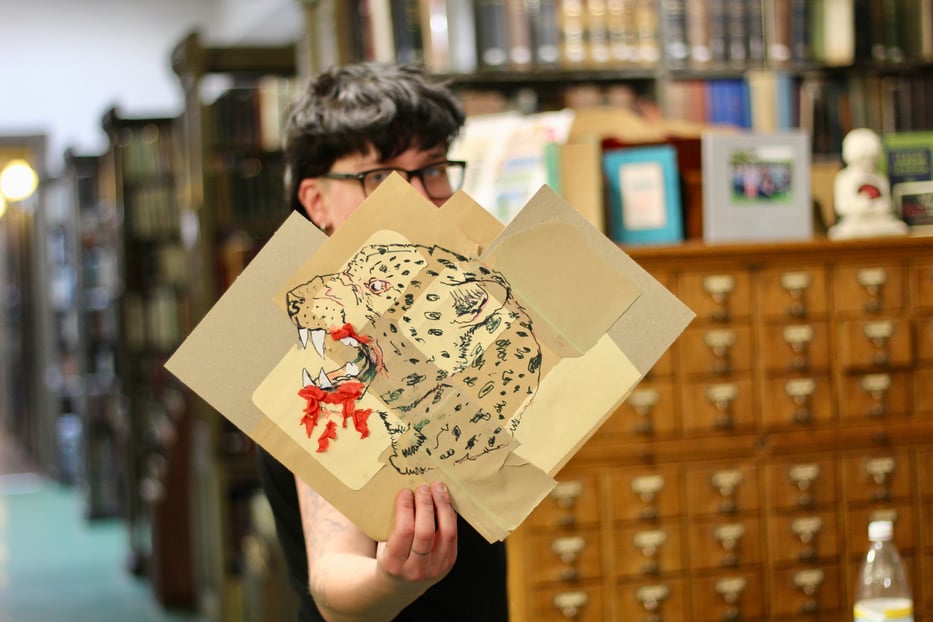
Maxim Schmidt, an artist and curator, with the beginnings of his sign. Lucy Gellman Photos.
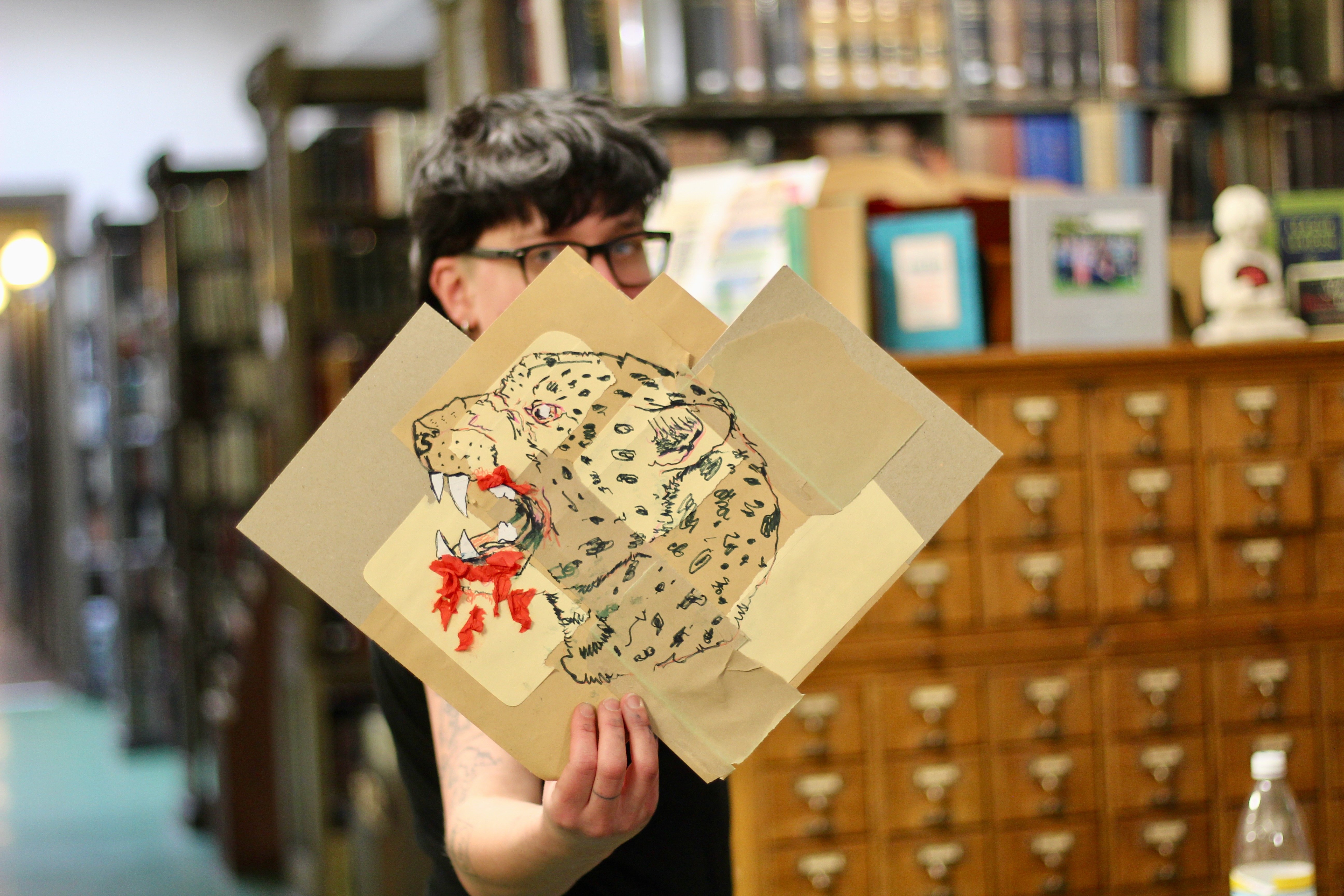
It was the leopard, still two-dimensional and already fierce, that started the conversation.
Laid out flat on a table, it looked forward with a mean snarl, blood collecting at its lips and jaw. At the front of its open mouth, four curved, menacing fangs ended in sharp points, ready to clamp down on their prey. Somewhere beyond the frame, a small, helpless creature was running for its life.
“You know, like the 'Leopard Eating Your Face’ party,” said artist Maxim Schmidt as he looked it over. “Like, ‘Oh, darn, I voted for the leopard, and now the leopard is eating my face.’”
Schmidt, who is both an artist and curator, joined a handful of attendees last Thursday at the Institute Library for “Beautiful Objections,” a sign-making workshop held in advance of Saturday’s “No Kings” protest on the New Haven Green, and in concert with Forecast: Reading The Signs in the Gallery Upstairs.
Organized by artist and curator Martha Willette Lewis, the evening encouraged participants to think critically about the use of public art in civic spaces, drawing on a rich history of protest and visual culture that is very much a part of New Haven's history.
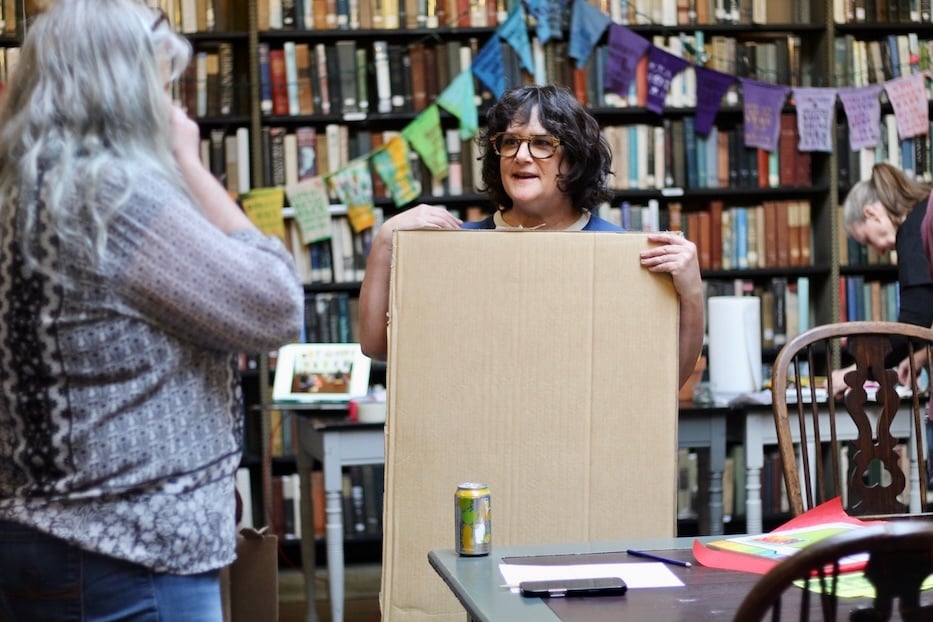
Artist Martha Willette Lewis advises Giulia Gambale.
“The idea was to get people not to just say ‘Fuck ICE’ or ‘Fuck Trump,’ but to say what’s really bothering them about this [moment],” said Lewis, whose work as an artist-activist has included vibrantly painted protest eggs, prayer flags urging gun reform, and multi-media pieces that foreground sustainability in every aspect of the process. “Something clever and witty and to the point.”
From one end of the Institute Library’s cozy back room to the other, artists picked up that prompt and ran with it, from messages that spanned LGBTQ+ rights to environmental advocacy to the importance of remembering, and therefore not repeating, history itself. Framed by pastel-colored prayer flags that read Fist Bumps Not Bump Stocks and Fire Flies Not Fire Arms, Bailey Murphy mapped out a message defending LGBTQ+ and specifically trans rights, still deciding exactly what she wanted the wording to be.
“It’s important to stand with your community and stand for what’s important,” Murphy said when asked why protest speaks to her. Nine and a half years ago, she started making signs after the 2016 Presidential Election—her first as an eligible voter, after a birthday in July of that year.
At the time, Murphy was a senior in high school, and the act of creating helped her make sense of a world that felt like it had been turned upside down. As a supporter of Bernie Sanders—even more so after seeing him speak on the New Haven Green that spring—Murphy was excited to vote from the jump. That remained true even after Hillary Clinton had clinched the Democratic nomination.
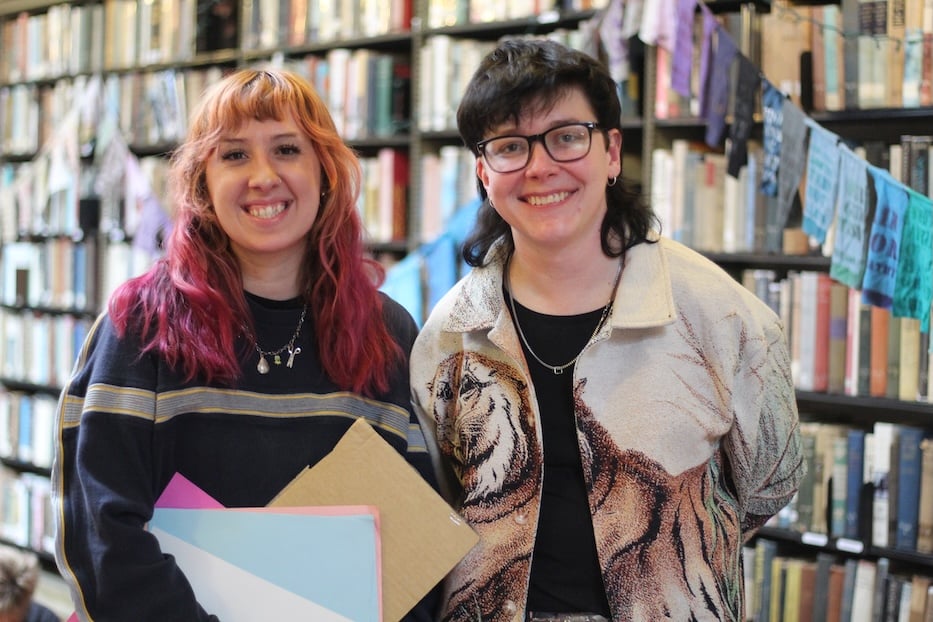
Bailey Murphy, who ultimately settled on a sign decorated with the colors of the Trans Pride flag, with Schmidt.
“At first it was so empowering to vote,” Murphy said. Then, as she stayed up to watch election results trickle in, that sense of empowerment turned to fear. And then, after an initial shock, that fear turned to resolve. Like Schmidt, who is her partner, Murphy is all about building community and affecting change on the local level: it helps sustain her.
“It’s about making sure everyone is cared for,” she said. During the last presidential election, she made sure that her voice counted, even though it meant voting between jobs. When Trump was elected for a second time, she was upset—but also determined to keep imagining a kinder world.
As he sidled up beside her, Schmidt added that he sees the act of making as a kind of opening; people may come with a rally or action for the first time with a handmade sign, and then remain engaged afterwards, with a new understanding of how to tap in. For him—particularly as an out trans person in the current political climate—that’s encouraging.
“I think about what allows us to to make our values actionable,” he said. “When you feel like you are expressing yourself in that way, you’re more present … art gives us the power to be ourselves in a way that emboldens us to do more.”
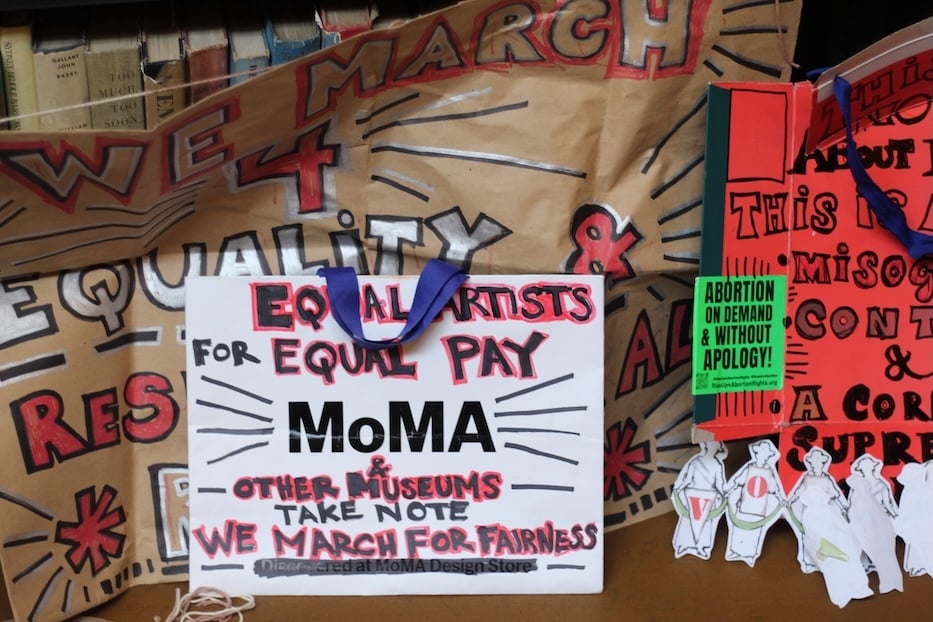
Lewis, who has never shied away from politics in her practice, brought in several examples for attendees to work from. In the photo at the top, she is pictured at the No Kings protest.
He added that he’s been encouraged to see people who haven’t always come out to rallies—older, white, straight, cisgender, male and female alike (lest we forget that a majority of white women helped elect the current occupant of the White House)—understand that they have an increasingly urgent role to play in keeping their neighbors safe. As advocates like Kica Matos, president of the National Immigration Law Center (NILC) and the Immigrant Justice Fund (IJF), have noted at previous actions, authoritarianism may start with one marginalized group of people—but it never ends there.
He’s also genuinely intrigued by the people who voted for Trump, and seem surprised or horrified that the bigotry he promised has come to pass, sometimes at their own personal expense. That’s the years-old origin of the phrase “Leopards Eating People's Faces Party,” he explained—people who voted for the leopard, and are still shocked when the animal moves in for the kill.
“They think, ‘Oh, it’s other people,’” he said. “But eventually, it will be you too.”
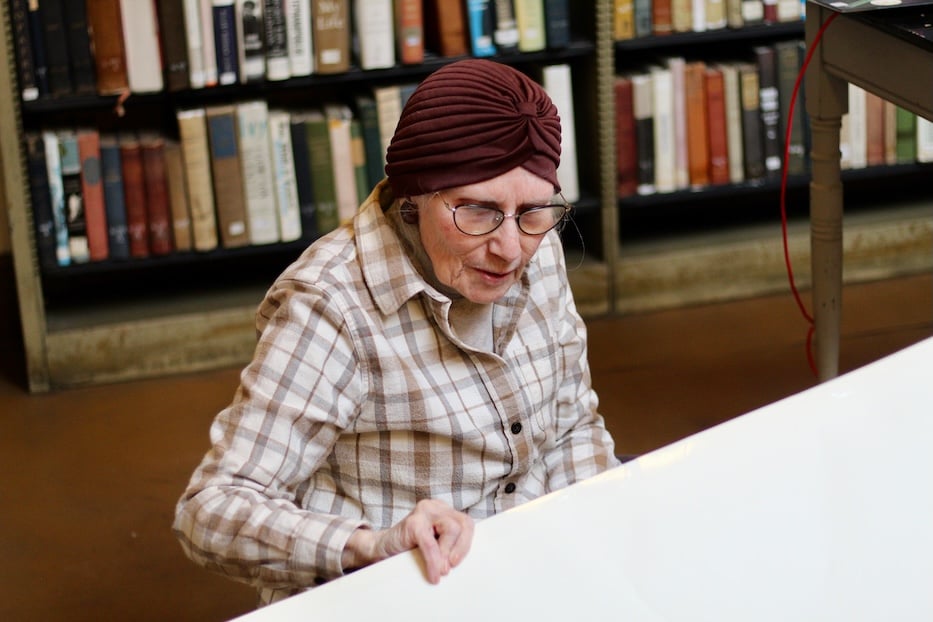
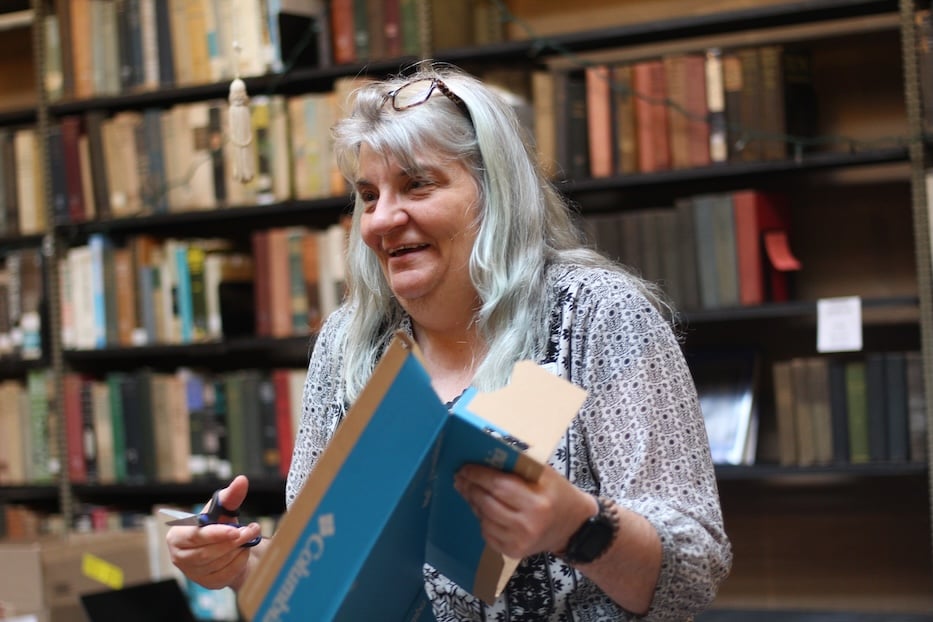
Ann Marlowe: “The climate in this country is awful.”
Across the room, Institute Library mainstay Ann Marlowe was folding lengths of poster board, still figuring out the intricacies of her sign. “Well,” she said when asked what brought her out, “the survival of Democracy is really important to me.”
Thanks to her parents, Marlowe said, she’s been aware of politics for most of her life, and landed in the progressive camp for as long as she can remember. Born in Canada, Marlowe came to the U.S. as a girl, when the pulp and paper business brought her father, Corwin, to the southern side of the St. Lawrence River. In was 1948, “and my parents said if they were going to live here, they would vote here.”
At the time, Harry Truman was president, but it was Dwight Eisenhower and John F. Kennedy under whom Marlowe gained a kind of political consciousness for the first time. By the time her first presidential election rolled around in 1963—President Lyndon Johnson versus Barry Goldwater—she knew exactly what her values were, and what she wanted in a leader.
“I was always voting against [someone],” she said. First it was against Goldwater. Then it was against Richard Nixon. Then against Gerald Ford, and Ronald Reagan, and George Bush. Even when she lived abroad with her husband, Marlowe never missed an election. A decade ago, she found herself voting against Donald Trump for the first time. She was devastated to see him win again—and equally determined to do her part to keep democratic values alive.
“He has appealed very expertly to the worst in everybody,” she said, adding that she’s felt a sense of political backsliding since the mid 1980s. “The climate in this country is awful.”
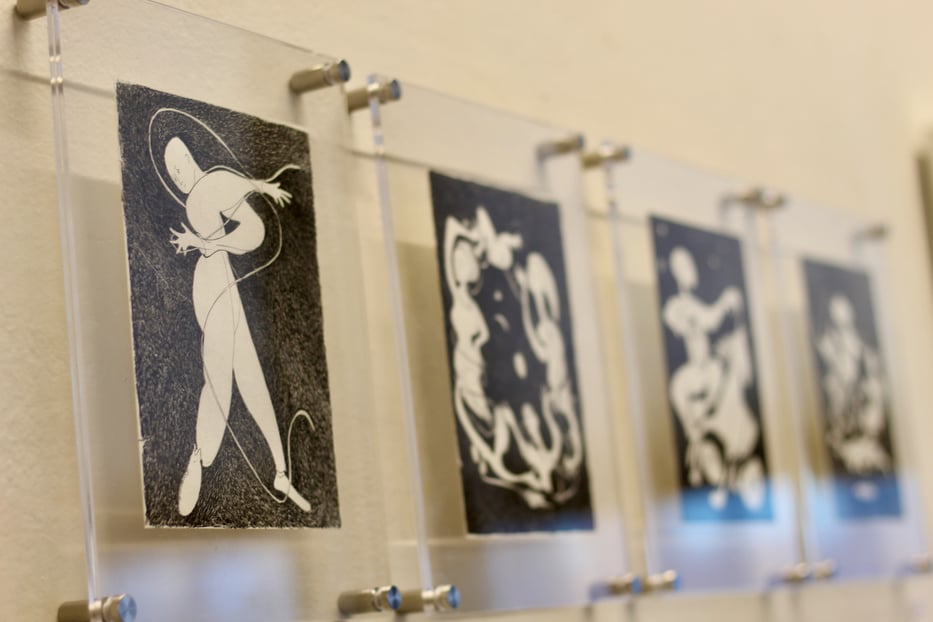
Andy Morgan's reimagined tarot cards.
At moments, the workshop felt very much in conversation with Forecast, a group show installed just one floor up, with books cozily packed alongside painting, sculpture, photography, drawing and installation. As Lewis buzzed around the back room with sign-building tips, the show beckoned above with a series of artistic riffs on tarot cards, fortune telling, psychic readings and the future—whatever it may be.
“I’m a big fan of the good old sandwich board,” Lewis suggested to Maryann Ott, as the words No Crown for the Orange Clown took shape across one poster. Upstairs, Andy Morgan’s pen-on-paper tarot cards stretched out across a wall, his Magician caught up in a thread that had wound itself around his body.
Suddenly, that figure—who usually represents self-determination—seemed unmoored, lost in his own universe. Beside it, figures swam in a sea of black around a tiny planet, the earth card reimagined. Nearby, Nadine Nelson’s Adrinka Divination tapped into an entire history of making meaning across a diaspora, a reminder of the power of the past in informing the present.
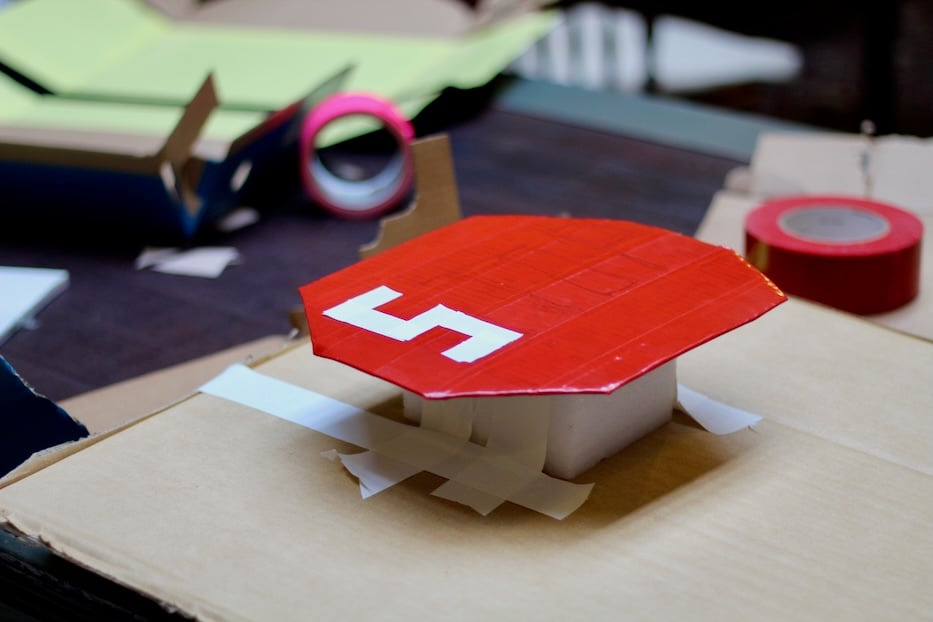
Gambale, with her in-process sign.
Back downstairs, Lewis looked over the work of Giulia Gambale, who was building a three-dimensional, lipstick-red stop sign for the message Stop Erasing History! For years, Gambale has been involved in hyper-local, grassroots activism, from office hours at the New Haven Free Public Library to gardening and environmental education.
“For your next move, I would do the P and make sure you have enough room for the other letters,” Lewis advised, and Gambale nodded immediately, mapping out the spaces in between where letters would soon be. Beside her, Dr. Faith Bailey worked on a larger-than-life black-and-yellow bee, a sign that would soon read No Kings! Queen Bees Only. In New Haven, she and Gambale have been doing community-based activism, like installing bee hives at the Davenport Community Garden.
Back in the gallery, which sat quiet as a tomb, Marsha Borden’s embroidered In The Palm of My Hand seemed made for the exact moment, with a reimagined palmistry chart that included a “What The Actual Fuck Line.” “Finger of Doom Scrolling,” and “Finger of Extreme Contempt.” It seemed to announce the need to stop, slow down and refocus in an entirely different way. Gambale, without even seeing it, seemed to take note.
“They keep taking things off the walls and replacing books,” Gambale said as she continued working. “They think they can erase people.”