

Culture & Community | Music | Politics | Arts & Culture | Puppetry


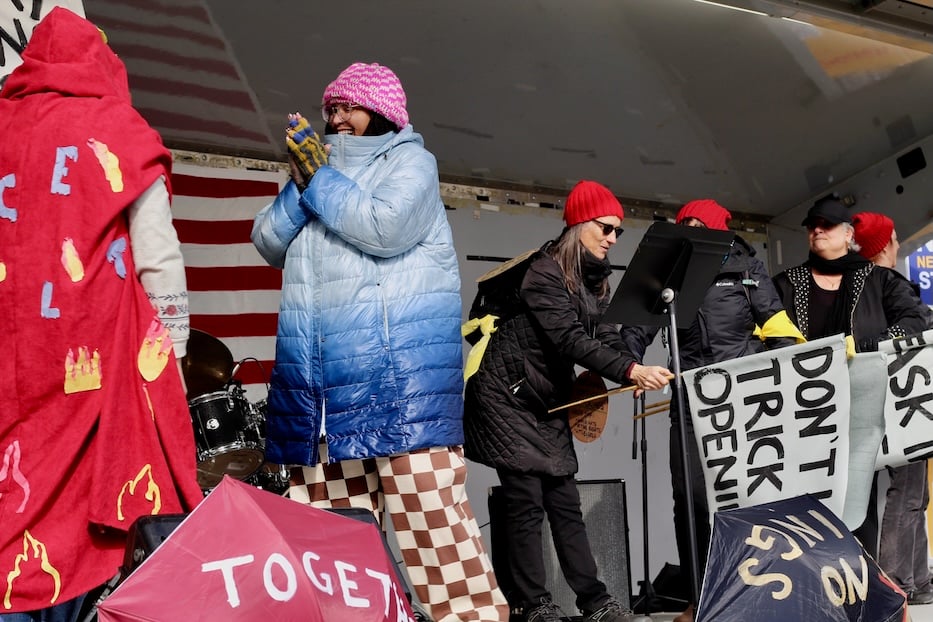
Top: Alyce Coleman with members of Singing Resistance New Haven. Bottom: Members of the Blue Steel Drumline with Rev. Scott Marks. Lucy Gellman Photos.
Alyce Coleman looked out over the New Haven Green, entirely prepared to make good trouble. “This is a public service announcement,” she began. Behind her, Clancy Emanuel coaxed a soft, steady heartbeat from a cajon. “If a police, ICE, or border officer approaches you—” Dancer Ginger Chapman reached for a flag that read Don’t Let Them Trick You Into Opening The Door. A lipstick-red knitted cap, inspired by resistance efforts during World War II, sat snugly atop her head. “Here are a few things you can do!”
Already, hundreds in the crowd were cheering; now many of them leaned forward to listen in. Dozens of huge paper cranes, hoisted up on wooden sticks, bobbed against the blue sky. In the distance, a curtain of bubbles rose into the air. The cajon picked up its pace, and voices joined in, joyfully echoing Coleman as she began.
Coleman, an artist, reproductive rights advocate, and organizer in New Haven, was one of dozens of artists—and hundreds of people—to come out to the New Haven Green Saturday afternoon, as New Haveners gathered for another “No Kings” action in the heart of downtown.
Organized by New Haven Rising, the New Haven Federation of Teachers, Greater Westville Indivisible, the ACLU of Connecticut and Connecticut For All with over a dozen other partners, the event centered the role of artists and makers, many using their work to communicate the urgency of the moment and probe the possibility of joy as a source of momentum. It joined thousands of similar rallies across the country, from small-town Maine to Minneapolis to Maricopa County.


Top: HSC's Japhet Gonzalez. Bottom: Artists Scott Schuldt and Martha Willette Lewis, the latter of whom led a sign-making workshop beforehand at the Institute Library. Hold tight for an article on that!
Speakers, of whom there were at least a dozen, included New Haven Mayor Justin Elicker, State Senate President Pro Tem Martin Looney, State Treasurer Eric Russell, the Rev. Scott Marks, NHFT President Leslie Blatteau, and representatives of the New Haven Immigrants Coalition, Unidad Latina en Acción (ULA), and Connecticut Students for a Dream. But it was the artists, throughout, who kept spirits lifted while urging attendees to stay engaged.
“We’re hoping to get these people to do more than just march and hold signs,” said Coleman, a board member for the REACH Fund of Connecticut who is also one of the leaders of Singing Resistance New Haven. “I feel like this, this is a way I’m able to give back.”
Those words—and a fierce call to action—resonated through many of the day’s performances, from Model Decoy’s soul-stirring cover of Curtis Mayfield’s “Move On Up” to steely drums, sassy brass, and a singing flash mob that rolled out the “Protest Pokey” on the corner of College and Elm Streets (video at the bottom of this article).
Early in the afternoon, it came barreling in through poets Japhet Gonzalez and Diana Paola Robles-Manso, both seniors at High School in the Community (HSC) who are also interns with the NHFT, and founders of the student-powered organizing hub La L.U.S. Taking the mic from NHFT President Leslie Blatteau (herself a former theater kid and punk rocker), Gonzalez got the crowd listening with a fiery call-and-response, a hand-painted sign just offstage.
“When we fight—,” he began.
“We win!” the crowd bellowed back.
Moments later, he was turning back the clock to the 1960s, and it was immediately easy to see and hear why he and Robles-Manso received awards from the Connecticut People’s World Committee for their written work. In front of Gonzalez, it was still March 2026, and hundreds of people looked back, handmade signs lifted proudly into the air with punchy one-liners from “So Many Crimes / So Little Cardboard” to “What You Permit / You Promote.” Somewhere else, it was 1960, and four Black students had just walked into a Woolworth’s in Greensboro, North Carolina during lunchtime.
“They were teenagers too / That’s what shakes me / Not statues / Not chapters in a book / with strong, bold, words like historic, landmark, amendment,” Gonzalez read, voice smooth and steady, sharp only at the edges. “They were kids / Backpacks on their backs and homework in their hands / Favorite sports, / favorite songs, / who decided Freedom / was more important than being young—”
Beside Gonzalez, Robles-Manso nodded, the kind of emphatic, nonverbal yes that traveled from her head to her toes. In just two stanzas, Gonzalez had begun to lay bare the young lives and futures that are at stake when decisions around public education, housing, Black and Latino voices, LGBTQ+ people, and basic human rights are suddenly up for debate. The lives that he knows about because American history—which he’s learning every day at HSC—has a finicky way of repeating itself.
“They sat at counters / Where coffee was served with forced smiles / They rode buses / Where the driver didn't stop eyeing the rearview / They crossed bridges / where the air tasted like tear gas—”
In under two minutes, Gonzalez was bringing together 65 years of history, first with a vivid portrait of the Civil Rights era, and then a personal call to action. Noting that knowing his history keeps him going, Gonzalez advocated for sustained grassroots action, with an understanding that advocacy cannot end with a two-hour Saturday afternoon protest and march on the New Haven Green.
Gonzalez practices what he preaches: he has testified at city budget hearings, attended New Haven Board of Ed meetings, called publicly on Yale to raise its contribution to the city, and taken multiple trips to the State Capitol to speak out against the state’s antiquated Education Cost Sharing (ECS) formula.
On one side of the Green, a series of tents and tables from service organizations seemed to take note, their beleaguered volunteers looking up with smiles and applause. Or as Gonzalez read before he handed the mic over to Robles-Manso:
“Because democracy isn’t an exhibit / It’s not encased in glass / It’s fragile / It cracks when people stop caring / It disappears when people decide / ‘Someone else will handle it.’”
In her poem “When We Fight, We Win,” Robles-Manso conjured a mantra that is has become both a mainstay in union organizing—like that led by New Haven Rising and NHFT—and an echo of Frederick Douglass’ 1857 warning that “if there is no struggle, there is no progress. Deftly, she wove together a history of both struggle and solidarity, looking to racial and economic justice as a through line. In front of her, hundreds of attendees cheered, cranes bobbing up and down to the sound of her voice, their wings ruffling as gusts of wind blew through.
“The unity of Black, Latino, and white organizers / Their stories are not history to admire from afar / They are instructions. / They are fuel,” she read. “They are proof that change is built / when people refuse to stand alone.”
Back in the crowd, some attendees seemed to be learning that for the first time, while others said they’d been coming out to protests and rallies for years, sometimes decades. There with her friends Molly Sakowicz and Bree Crum-Hieftje, educator Maddie Heine said that it had felt natural to come out, because she’s appalled by the country’s tilt toward authoritarianism.
.jpeg?width=933&height=622&name=NoKings_March28%20-%201%20(1).jpeg)
.jpeg?width=933&height=622&name=NoKings_March28%20-%203%20(1).jpeg)
Top: Friends Molly Sakowicz, Maddie Heine and Bree Crum-Hieftje. Bottom: New Haven Immigrants Coalition member Camila Torres.
As a teacher at New Haven’s Hill Central School, she sees firsthand how things like food security, wraparound services, language access, safety for immigrant and refugee families, and funding for public education—all of which feel like basic human rights—represent critical needs for many of her students and their families. When they shrink or disappear, as many programs have under the current administration, so does a lifeline.
“What’s going on in the world is disgusting, especially with schools,” she said. So when she heard about Saturday’s action, there wasn’t a question in her mind that she would attend.
Back on stage and off, musicians, puppeteers, vocalists and members of the Blue Steel Drumline and East Rock Brass Band carried that message home, from covers of McFadden & Whitehead and Curtis Mayfield to homages to Bread & Puppet Theater, a social justice theater troupe that builds ensemble, multi-part and explosively musical pieces with giant puppets, poetry and soaring lyricism.
Nowhere, perhaps, was it more successful than in a performance from Singing Resistance and the New Haven and the New Haven Immigrants Coalition, which has worked to protect and sustain New Haven’s vibrant, diverse and polyphonic immigrant community in the midst of Immigration and Customs Enforcement (ICE) arrests, raids, and deportations in New Haven and across the country.
For months now, NHIC has used multi-media artmaking as both a balm and a powerful tool for communication, with skits and videos about how to respond to, document, and protect oneself, one’s family and one’s neighbors from ICE. So it made sense, maybe, that the group looped in both the Resistance Singers and a song from Bread & Puppet, which graced New Haven last spring, and again in the fall.
Taking the mic as members held up the group’s rapid response number—854-666-4472, in case you happened to be wondering, reader—Coleman looked out over the crowd, and began to sing, the lyrics doubling as directions (here is the original, which Bread & Puppet performs with a winged papier-mâché pig and ensemble member sporting a butterfly costume).
Beneath her resonant vocals, Emanuel held it down on cajon, and fellow singer Jo Wilber began to bounce in a blue-and-white one-piece with pink at the wrists and ankles. Only when Wilber jumped up and turned could the audience see that it was a giant unicorn costume.
“Ask for their name and badge number! Take a video on your phone,” Coleman sang, and hundreds of attendees took mental notes. “Ask for a warrant—”

Top: Ward 7 Alder Christine Kim. Bottom: Tina Santoni, an organizer of New Haven's "Umbrella Brigade."
“Signed by a judge!” fellow singers cried out on cue. Coleman beamed and continued, “In a private setting or a home.” By the following call-and-response—Don’t say anything! Don’t sign anything! Don’t let them trick you into opening the door!—the crowd was singing along with a cacophonous bellow. On stage, Wilber conducted as singers, dressed in red and pink knitted caps, unfurled huge, hand-painted warnings about ICE.
“We sing songs for different reasons,” said Emanuel after the performance. “Songs for grief. Songs for joy. Sometimes songs for fighting back. We sing to harmonize with each other and really try to embody that [in community].”
Minutes later, artists kept that harmony going as hundreds of attendees lifted their signs, filling downtown as they marched from Temple Street onto Chapel, and Chapel toward York. At the front of the crowd, members of the Blue Steel Drumline hammered out a beat, the sound rolling through downtown as the wind picked up, and the temperature began to drop.
Just behind them, Gonzalez began to walk in time with the sound, holding a hand-painted sign that read We Have A Constitution / Not A King. And somewhere half a block behind him, members of the East Rock Brass Band started to tear it up, the sound of classy, spirited brass threading itself through the drums.
Further back, a dazzling papier-mâché ship and all manner of larger-than-life, fantastical and storybook characters soared over the crowd, grace à artist Muffy Pendergast. One, a sea creature with fins erupting from its blue-green back, peeked out with the word Equality attached to one of its scales. Another, bobbing above people’s heads with buck teeth and a purple snout, announced the word Truth from a thought bubble. The ship, attached to a bike helmet, rocked the word Justice at its hull, with weathered, miniature sails that sported big red Xs over yellow crowns.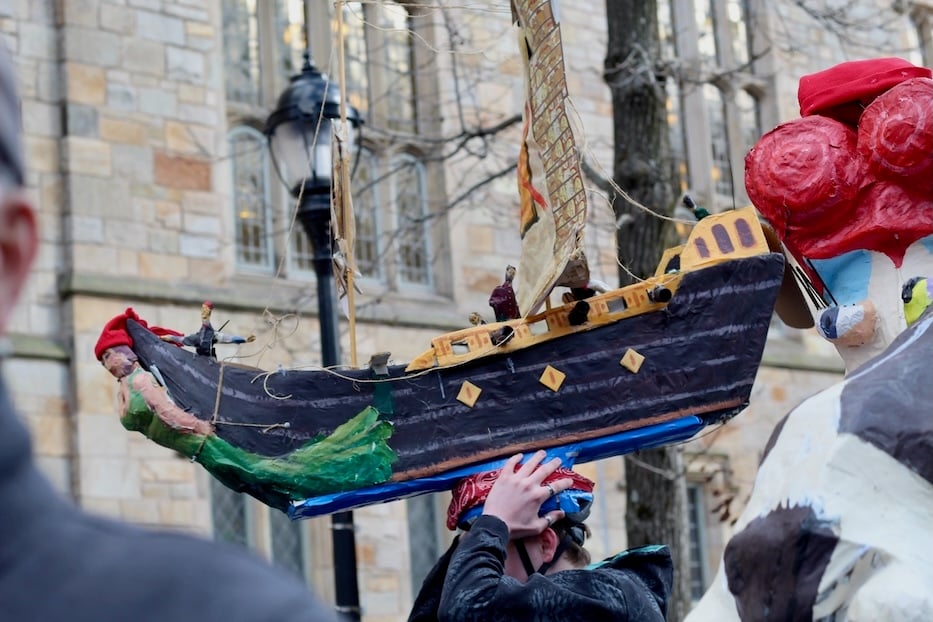

The queen of Westville’s giant puppets, Pendergast hosted artists at her Westville home for at least two artmaking sessions, in which fantastical creatures emerged from rolls of green and blue crepe paper, tubs of paint, and plenty of extra felt and fabric just waiting for hands to stitch it into place.
One of those artists, fellow Westvillian Janet Brodie, also spent time building 120 large paper cranes with community members, inspired by a similar activity that she did with artist Susan Klein in 2003, to oppose U.S. military intervention in Iraq. Twenty-three years ago, she and Klein carried them on the train to Manhattan, where they joined thousands of protesters in the streets.
“We started to think that it was time to bring them back,” Brodie said. Working with Klein, Brodie bought 1,000 feet of paper, and launched sessions at Creative Arts Workshop and the Mitchell Branch of the New Haven Free Public Library, in which community members could work together to make the cranes. At the same time, she was also working with dancer Ginger Chapman to form “Dancing Resistance,” a group of dancers who led the crowd in the “Protest Pokey.”
“One of the greatest things—the paper’s big, it’s three feet square—is that people started doing it in twos and fours, so the whole table would be folding one together,” she said. She loved that the project, which was about protecting the community, helped build community by its very nature. “People loved doing it.”
“The world is awash in hate and horribleness, and everything I care about is being destroyed,” she added. “There’s nothing better than getting together with a Green full of people who you know share your concerns to try and make it more beautiful, to try to get it singing and dancing.”