

Culture & Community | Dance | Immigration | Arts & Culture | Yale Peabody Museum | History
Lucy Gellman Photos.
It was the sound of the drums, rolling like the ocean beneath four pairs of hands, that first called to Caprice Taylor Mendez from where she stood at the back of the room. Over the sound, she could feel Addys Castillo’s deep, muscled voice, enough to summon generations of ancestors.
Tambo, tambo! De La bomba oye'l tambo! Castillo sang out, a maraca movingl in one hand as the other wove through the air. Que te suba por los pies / Y llega al corazón. Mendez felt the sound travel from her feet to her hips to her ribcage, and began to move.
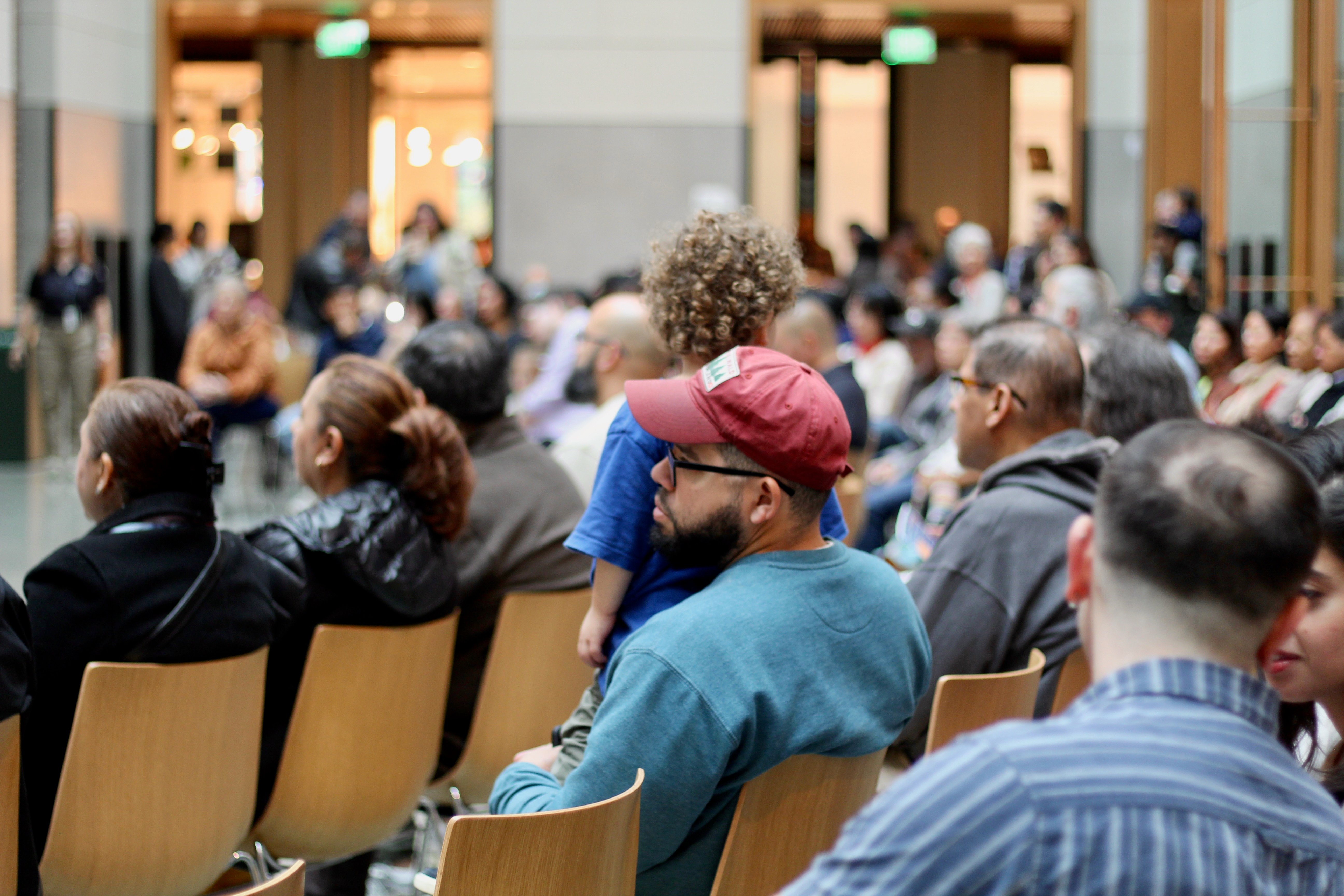
That sound, which bridged continents and centuries of history, filled the Yale Peabody Museum Sunday afternoon, as a joyful, ringing and resilient ¡Fiesta Latina! danced away the threat of rain across the museum’s floors and galleries. Held in collaboration with Junta for Progressive Action, the day welcomed over 1,000 visitors to the museum, with education stations, information booths, and music and dance in almost every gallery.
The festival, which has become an annual tradition, falls during Hispanic Heritage Month, which since 1988 has taken place from September 15 and October 15 (when President Lyndon Johnson first signed it into law in 1968, it was just a week-long celebration). For the second time this year, the Peabody offered expanded Spanish-language programming, from crafting activities and storytime for kids to lectures from professional scientists, curators and academics in the field.
Throughout, it celebrated the sheer breadth of a diaspora—and the vitality of a diverse cultural community—in a time when anti-immigrant violence has continued to grow across the U.S., including in Connecticut. Junta’s Fair Haven-based events, initially scheduled for Saturday and postponed due to weather, will now take place on Saturday Oct. 10. More information is available here.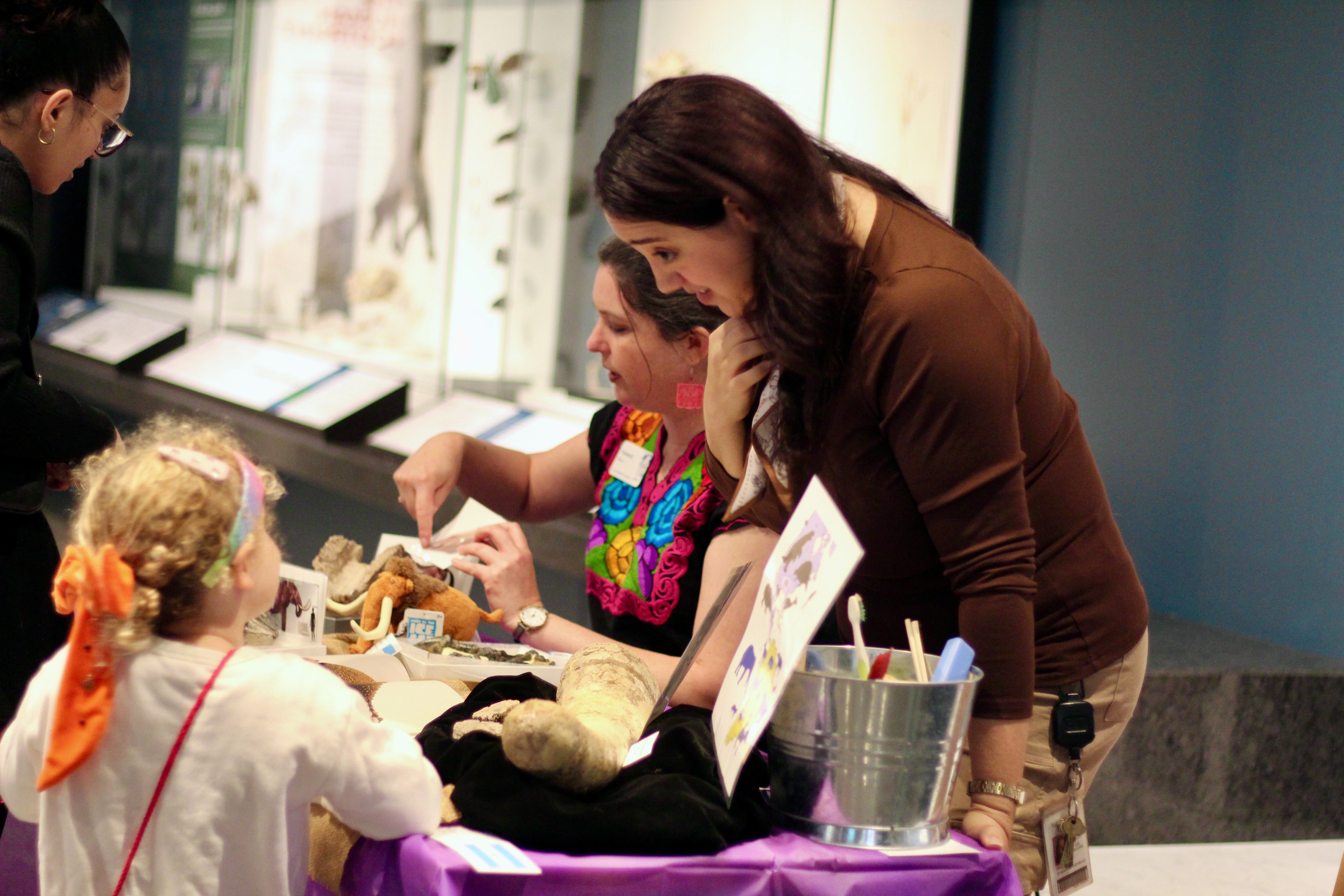
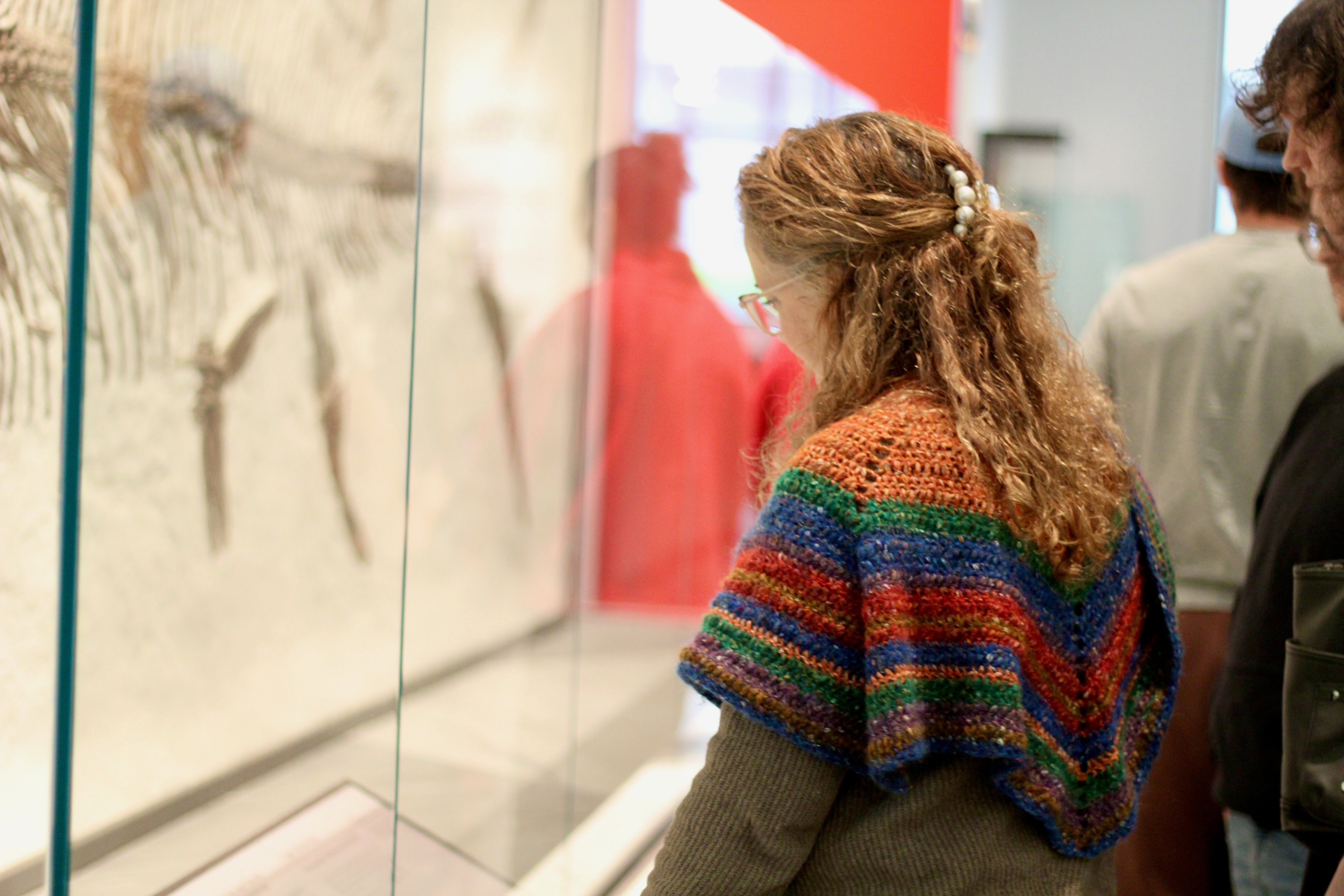
Top: Vanessa Rhue and Mariana Di Giacomo. Bottom: A visitor in the Hall of the Dinosaurs.
“We're very excited to be working with Junta to plan another celebration of Hispanic cultures that are represented here in New Haven and the broader community,” said Janae McMillan, assistant manager for public and youth engagement, in a press release before the event. “We hope to foster connection and solidarity through education, performance, storytelling, and hands-on cultural activities.”
And from the Hall of the Dinosaurs to a living lab aflutter with poison dart frogs and monarch butterflies, it was. As young attendees padded toward millenia-old, glittering fossils in their still-wet coats and pint-sized rubber boots, staff members like Vanessa Rhue and Mariana Di Giacomo were ready for them, standing over a display that featured large and small vertebrate fossils from Argentina, Ecuador, and Mexico.
Di Giacomo, who was born and raised in Uruguay, said she was excited to see the day’s festivities spring to life around her. Beneath her and Rhue’s rarely-still hands, fossils from assorted mammals seemed to peek back at attendees who got close enough. She pointed to evidence of a glyptodon—that’s a large, armored mammal that looks a lot like today’s armadillos—and the bones of a ground sloth nearby.
Rarely was the station quiet: Di Giacomo chattered with tiny and grown attendees alike in a mix of English and Spanish, as Rhue waited to join in, sporting a gem-colored blouse from Oaxaca that made her easy to spot. The day is a celebration Rhue can relate to on many levels: she’s always glad to share her research, but her family also hails from Mexico
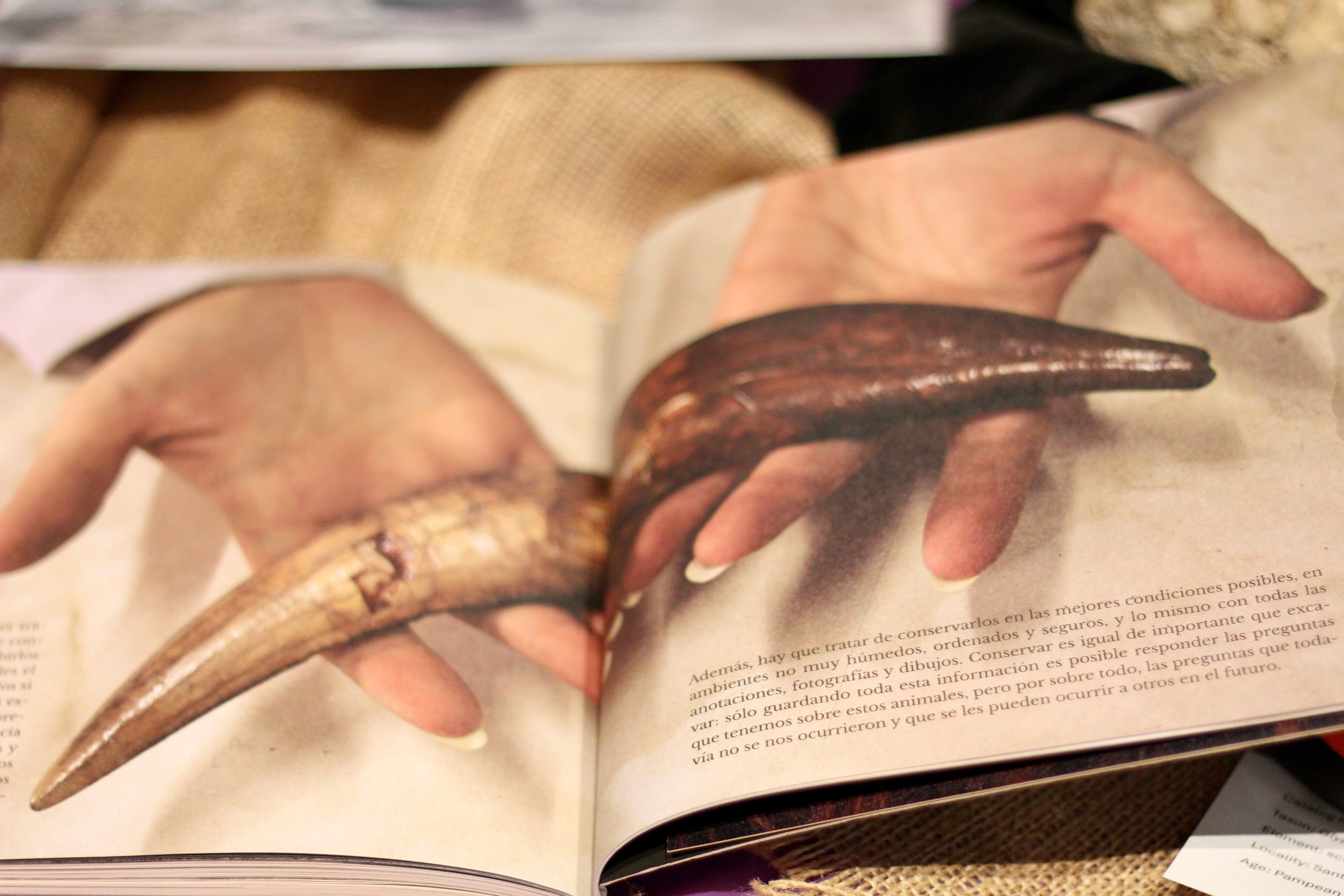
“To me, it’s a wonderful thing that we get to have a day where our culture gets shown in such a beautiful way, and such a diverse way,” Di Giacomo said. Two galleries away, Mariachi players were packing up after a performance from the Spanish Community of Wallingford, the bright dresses of their Ballet Folklórico dancers soon adding pops of color to the galleries.
Di Giacomo added that for her, ¡Fiesta Latina! is as personal as it is professional. Before her research brought her to the U.S., where she pursued a doctorate at the University of Delaware and was a conservation fellow at the Smithsonian National Museum of Natural History, she nurtured her love for science at the Universidad de la República in Montevideo.
Now, she loves being able to share her work as a conservator, which is often not public facing, with New Haveners of all ages, who hail from multiple cultural backgrounds and may speak any mix of languages. As if on cue, she held up a copy of the Spanish-language book Megafauna, on which she worked with several colleagues, and she flipped to a page with a glossy, large fossil. Across two pages it seemed to come to life anew. At the end of the table, a young girl looked on curiously, her dad beaming.
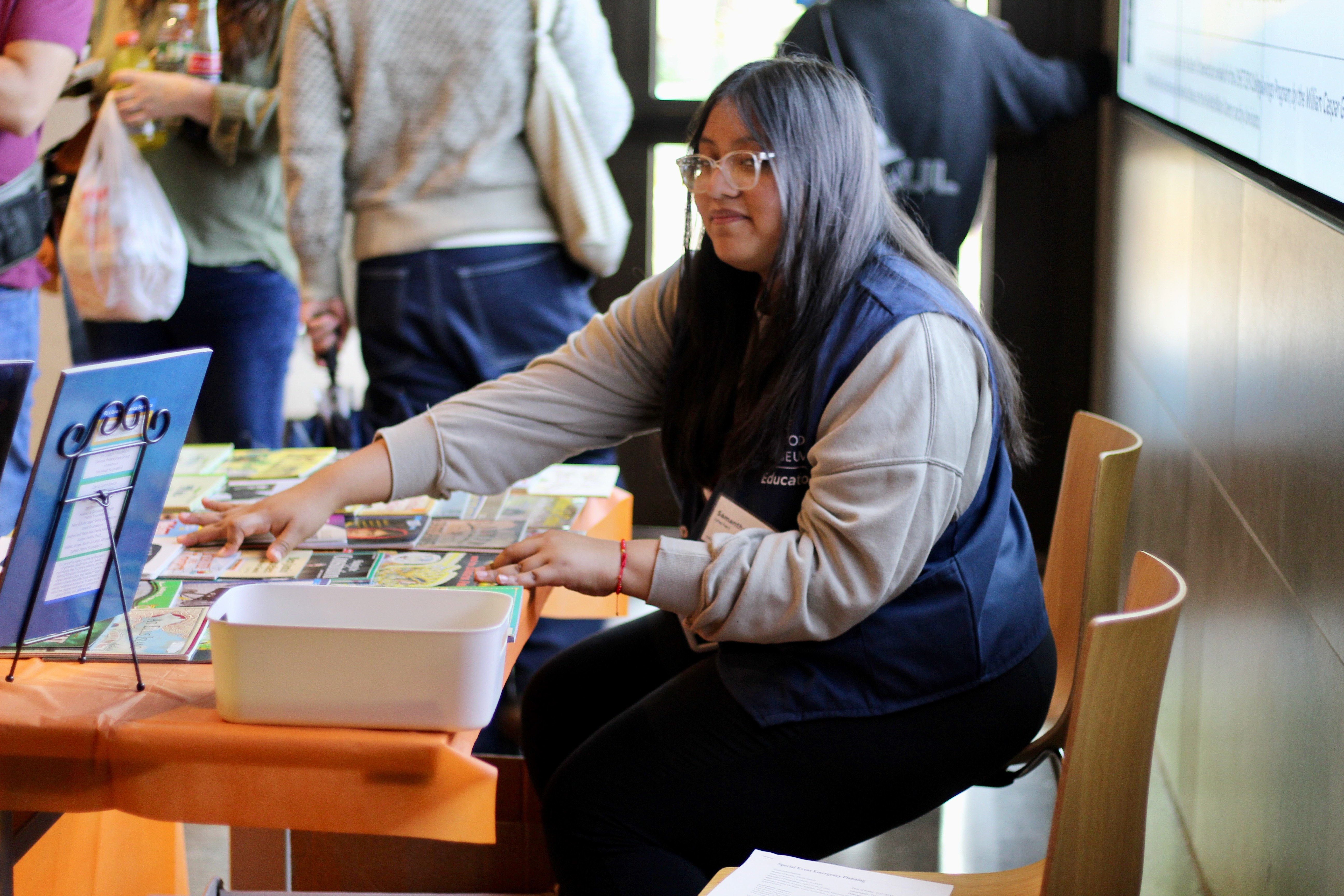
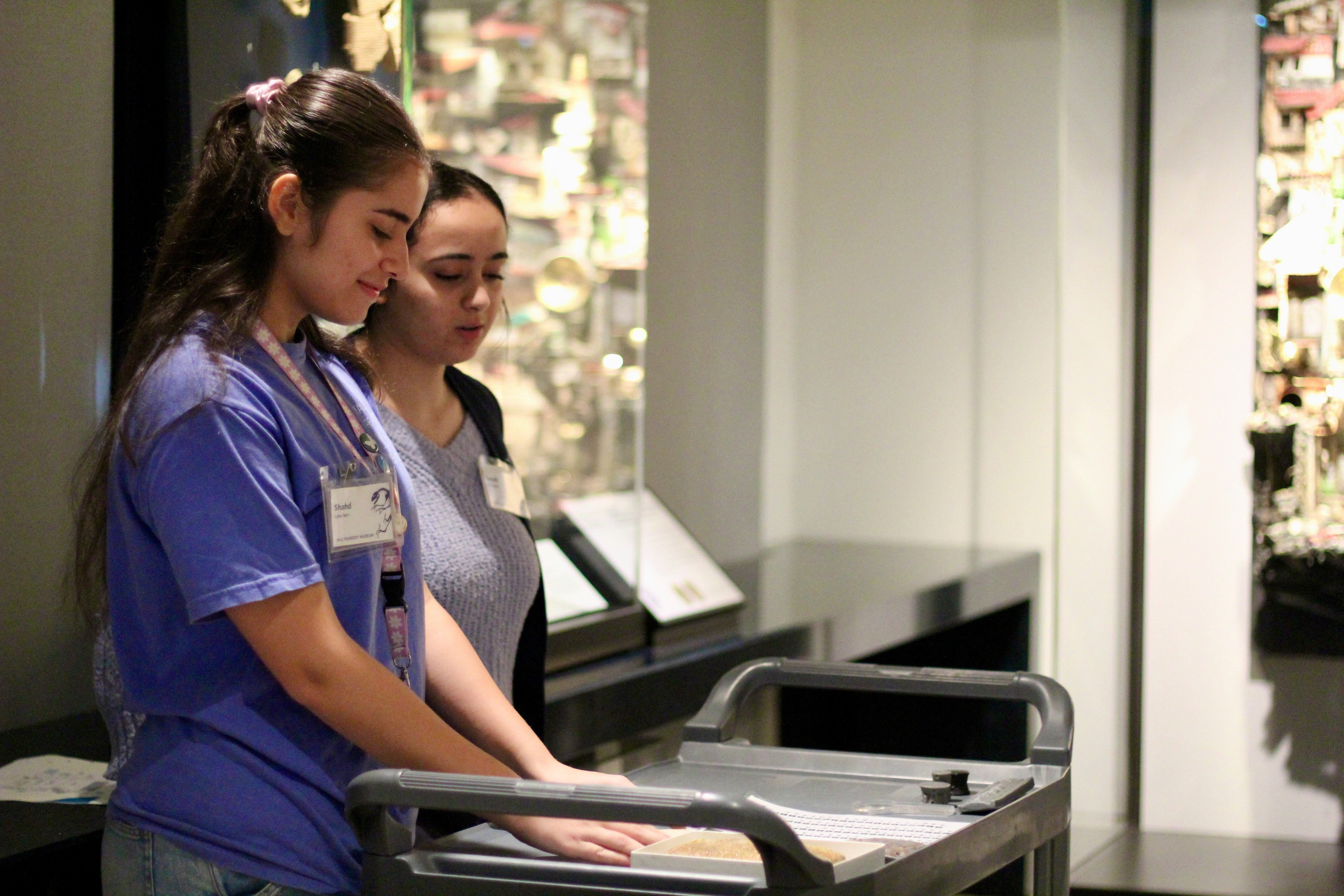
Top: Evolutions program member Samantha Garza manages the book giveaway table. Bottom: Evolutions members Shahd Mahaini and Sarah Nakhi.
Back in the lobby, New Haven Academy junior Samantha Garza welcomed attendees to a table covered in free children’s books, from Debbie Levy’s I Dissent to a National Geographic survey of sharks across the globe. A member of the museum’s after-school Evolutions program, Garza called the day a chance to center the richness and resilience of the community in a safe and welcoming space.
Her family, like many in New Haven, hails originally from Tlaxcala, Mexico, a heritage that her parents remain very proud of as they raise their children in New Haven. Across New Haven, so many families come from Tlaxcala that the city has since 2010 recognized San Francisco Tetlanohcan, a state within Tlaxcala, as one of its eight sister cities. Since 2022, the city has also recognized an annual Tlaxcala Friendship Day every year in April.
“This feels great,” Garza said, nodding to volunteers from the New Haven Immigrants Coalition who sat at an info table just a few yards away. “We are really getting seen. Having that support touches my heart,” particularly as Immigrations and Customs Enforcement (ICE) agents ramp up their activity in Connecticut, often separating families in the process.
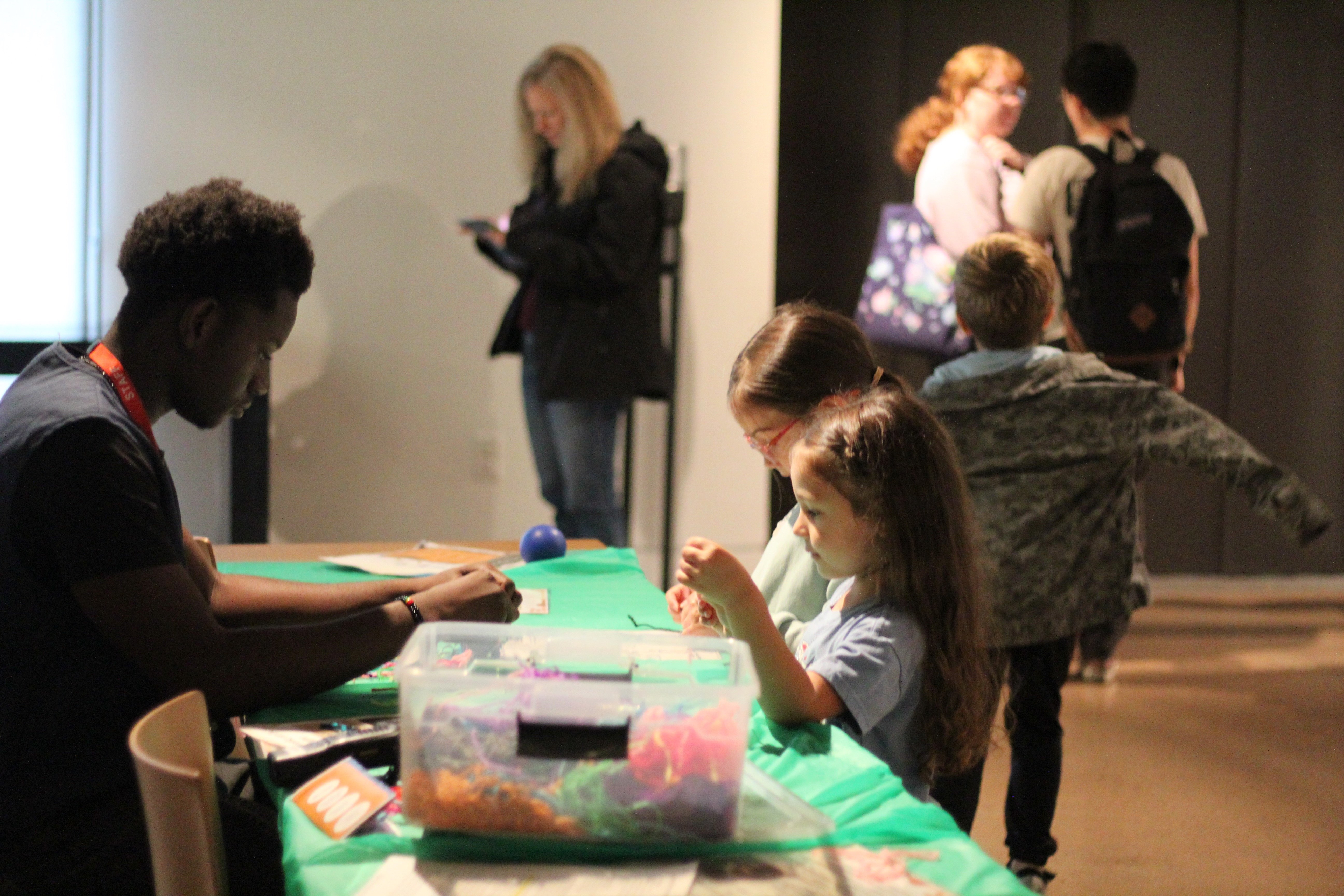
Apprekhu works with Isabella and Amariana.
Just past the Egyptian galleries, that enthusiasm for the day radiated to Joceline Colón, there with her three young children. At a long table, Evolutions member Daniel Apprekhu walked her daughters, 7-year-old Amariana and 4-year-old Isabella, through making knots for a community quipu, a device that was used to track time and record stories across the Inca empire.
Apprekhu, a junior at Engineering and Science University Magnet School (ESUMS), steered them toward a chart that described the meaning behind different knots. As the two settled on a single knot in bright yarn, their mom looked on, bouncing 2-year-old Adonis on her hip.
Raised in the city’s Fair Haven neighborhood, Colón had originally spotted ¡Fiesta Latina! on social media, and was interested in learning more. While she is Puerto Rican—her family hails from Cayey—she feels separated from the culture. For a while now, her eldest daughter, Amariana, has wanted to learn more about her heritage. This felt like the perfect way in.
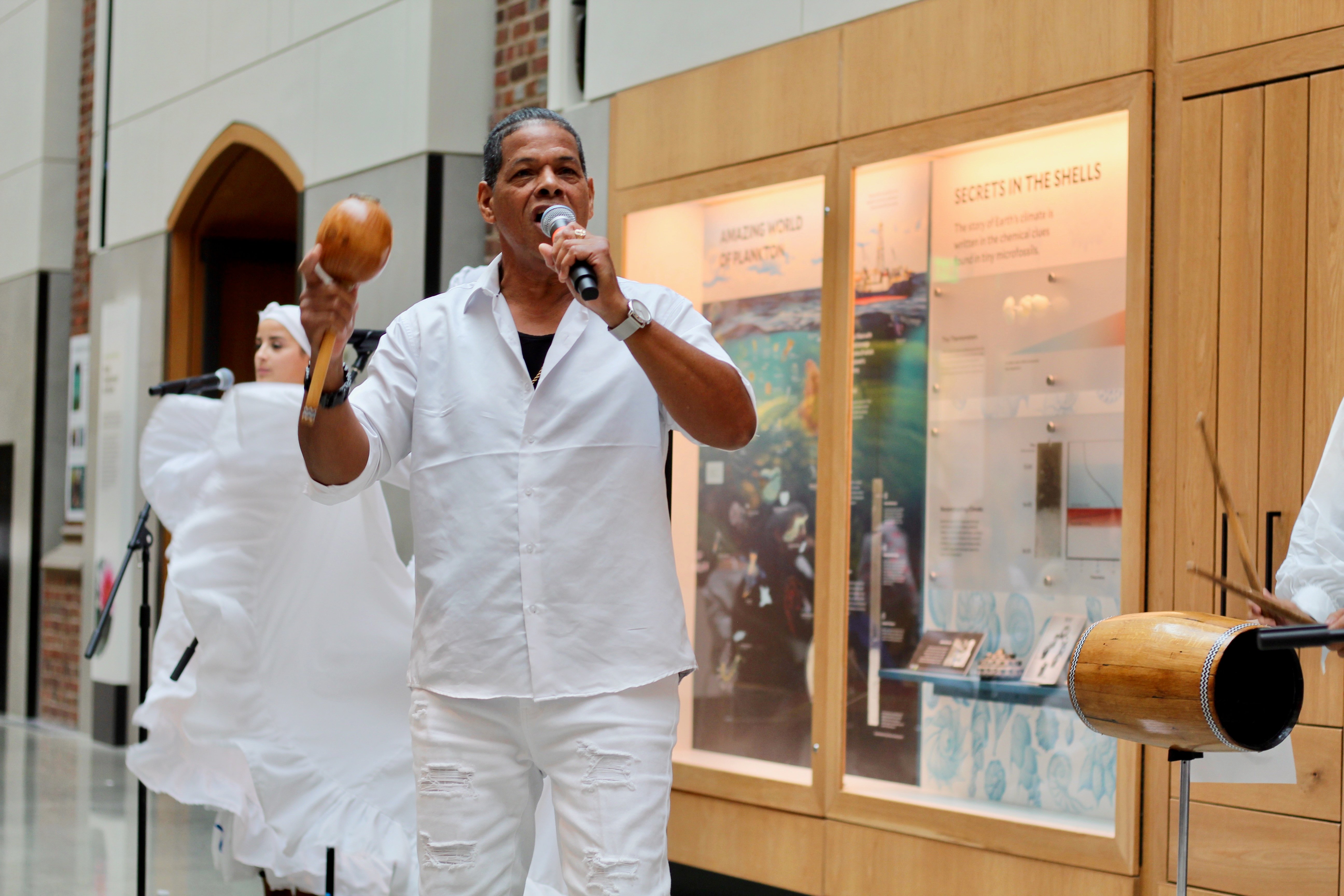
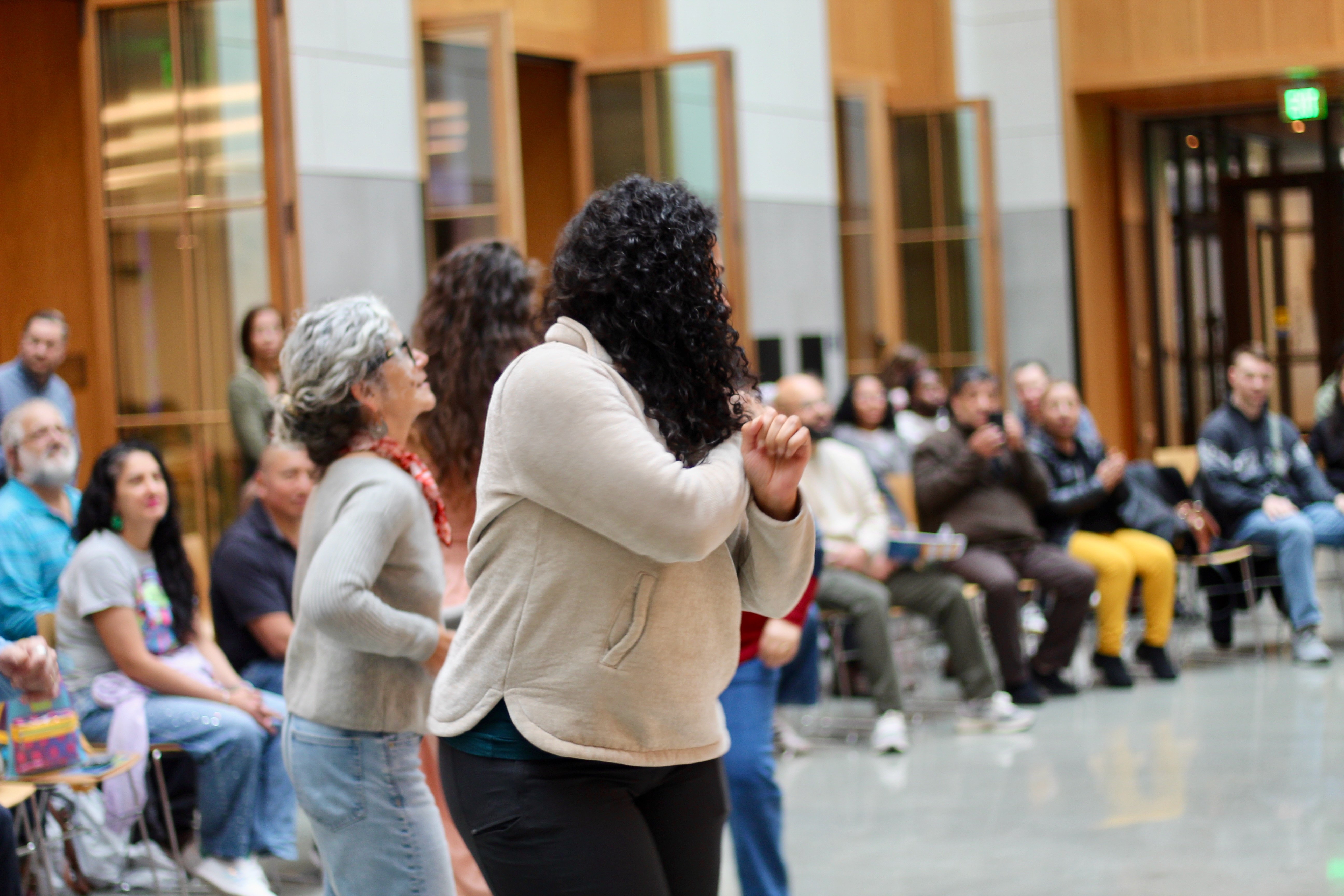
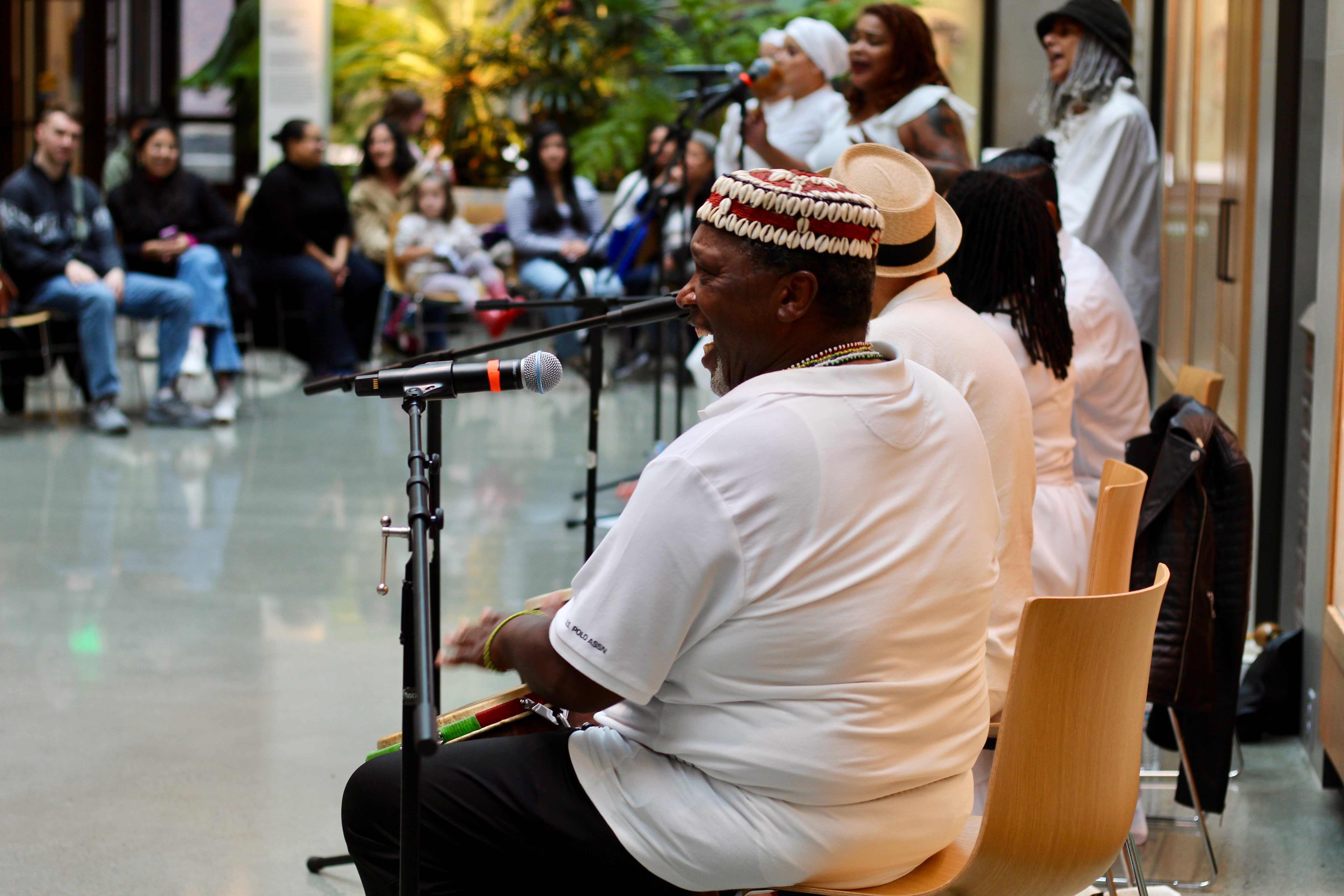
Top: Carlos Cruz. Bottom: Mendez. "To know where we come from gives us strength in how we choose to create the future together," she said.
Downstairs, the rumble of barrilles drifted towards the museum’s high, vaulted ceiling, where the giant, hanging skeletons of an Archelon and Mosasaur seemed to dance along from close to the rafters. On a second-floor area overlooking the hall, children and parents alike looked on, some already moving their shoulders and feet as the members of the bomba group Proyecto Cimarrón took the stage.
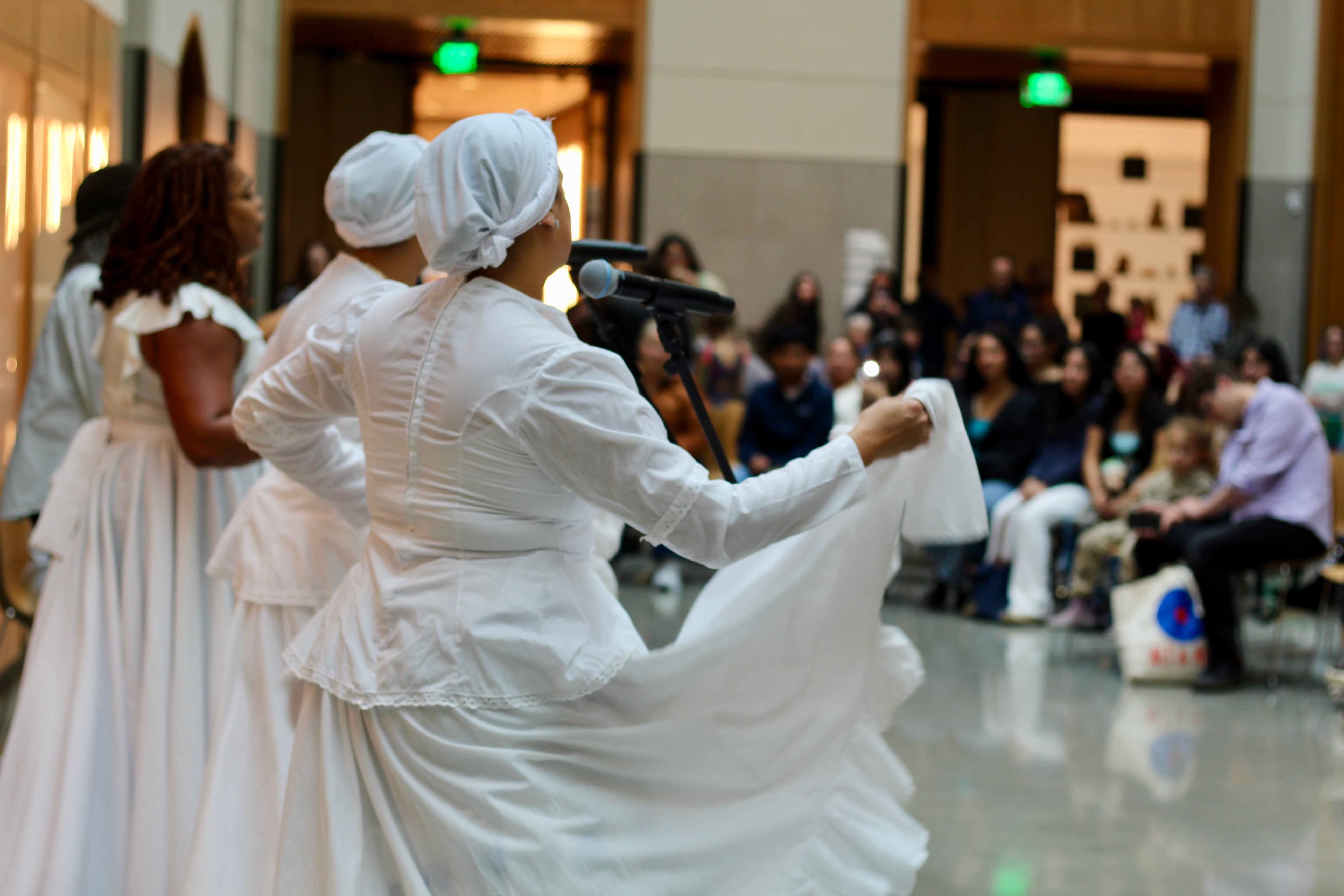
From the moment they began, hands drawn to the drumskin, attendees watched, spellbound, letting the music take them back in time and bring them squarely back to the present. At first, a wide slice of floor between the group and the audience remained unoccupied, like a gulf between speaker and listener. At some point, twin sisters Natasha and Naomy Velez exchanged a look, one making her way out onto the floor as the other hung back, and danced at a mic.
Bomba, member Addys Castillo later explained, is a music of resistance: it comes out of the painful history of the Afro-Caribbean slave trade, and of the essential and human need for communication even and especially in the most dehumanizing of circumstances. In 1513, Spanish colonizers—acting within the Spanish monarchy’s authority—began bringing enslaved Africans to Puerto Rico, where the port city of Loíza was for many the first point of entry.
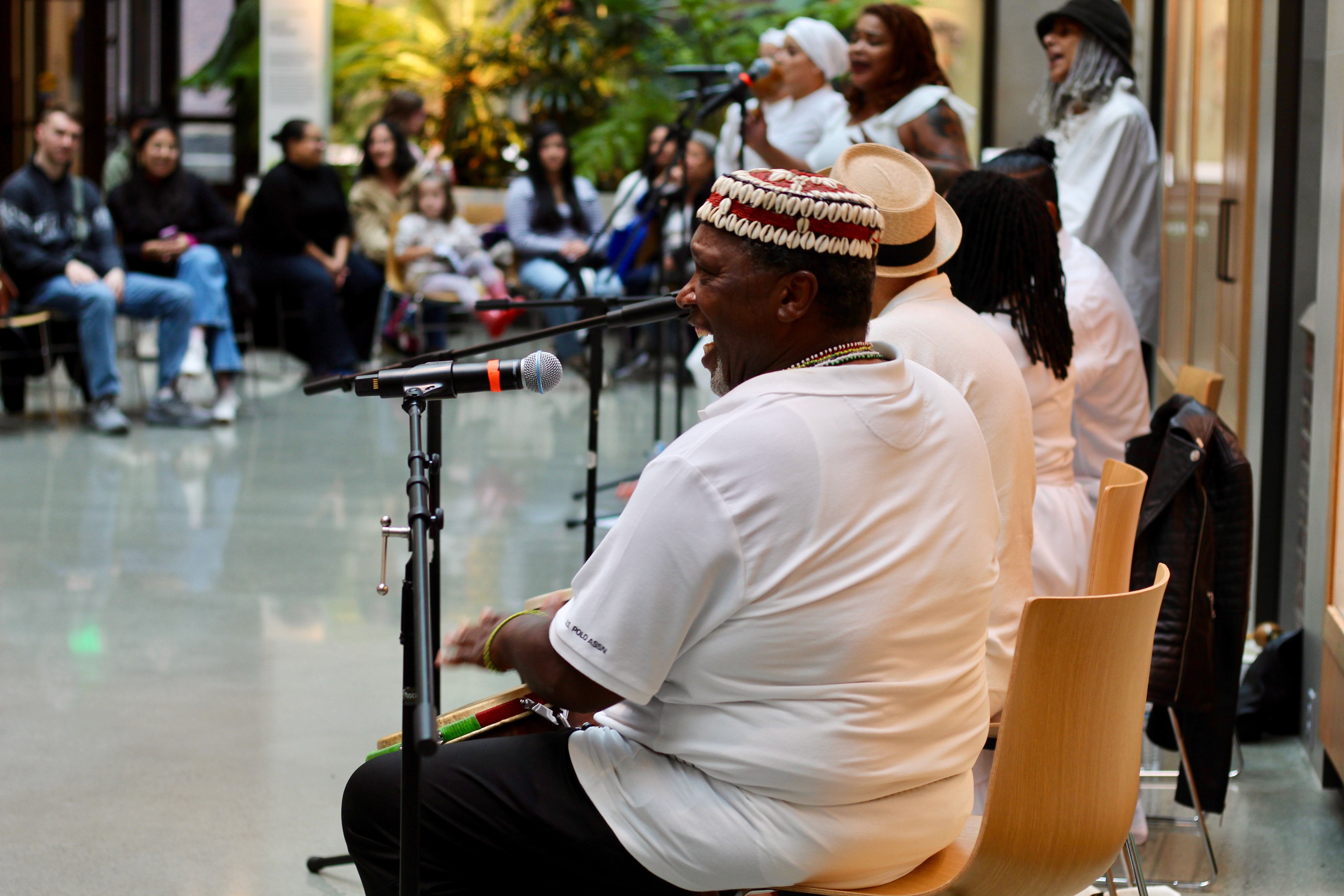
That forced migration and labor, with which Puerto Rico has still not fully reckoned centuries later, ultimately birthed Bomba, as a call-and-response that became a form of messaging through drums, footfalls and full-bellied song that telegraphed vital information through its lyrics.
As a drizzle picked up outside, Castillo invited the audience to turn the floor-turned-stage into a bombazo—a communal space for the conversation that lives within bomba to unfold. Before moving onto a piece from mentor Norka Hernandez Nadal, who co-founded BombaWorksNYC, she motioned to the open space, then looked out across the crowd.
“This music enters your soul from your feet,” she said, a primer to Hernandez Nadal’s lyrics in the next song. “It goes right into your heart.”
As the drums rose around her, Castillo held a maraca with one hand, and gestured to the heavens, to the audience, and to her fellow musicians with the other. On one side, the Velez twins let themselves sink into the rhythm. On the other, musician Monica Matos hammered out a rhythm on the cuá as drummers Carlos Cruz, Kica Matos, Asher Delerme and Davis Calderon let the sound wrap all the way around the room.
Mendez, who migrated to the U.S. at five from Guatemala with her family, could feel something moving through the soles of her feet. As if by a magnetic force, she gravitated toward the dance floor, rocking back and forth to the sound until she had found her rhythm.
While she may not have been technically dancing bomba, that negotiation is part of the style’s rich tradition: the dancer communicates with the primo, or lead drummer, through a series of movements, and he or she responds with a drum that seems to speak. It leads to an entire story told in music, the sound of percussion a heartbeat throughout.
“I feel joy,” Mendez said afterwards. “[There’s a] connectedness in rhythm. It feels nice to be in community with people who share common values. To know where we come from gives us strength in how we choose to create the future together.”