

Culture & Community | Dixwell | Arts & Culture | Youth Arts Journalism Initiative | Dixwell Community Q House
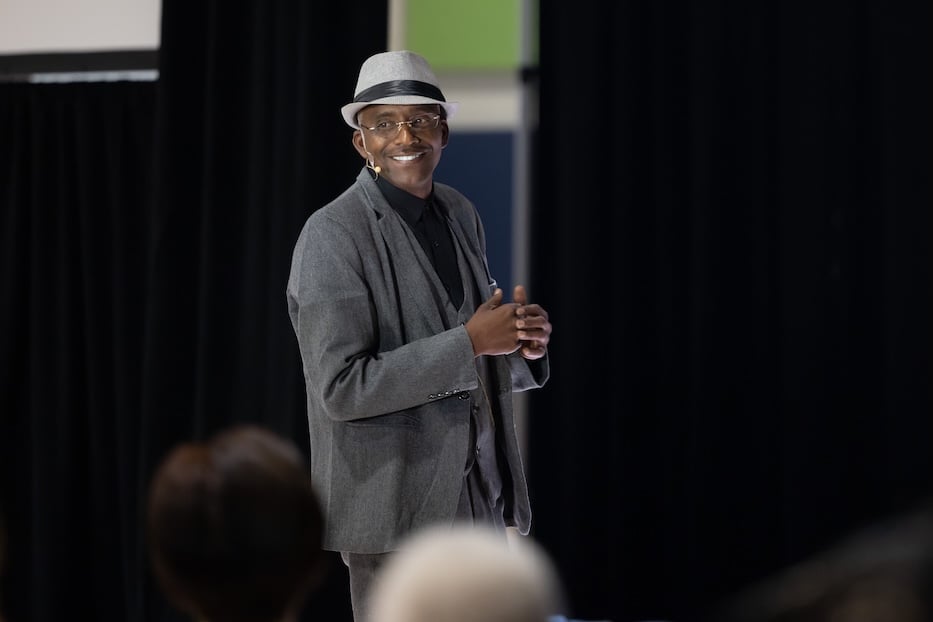
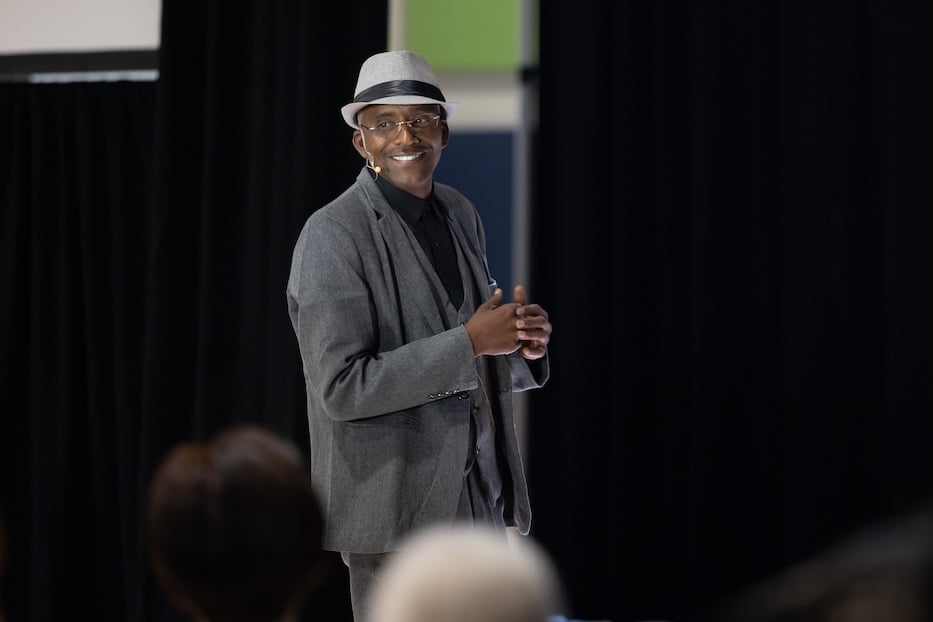
Moore in "Be Your Own Hero" when it premiered. Chris Randall File Photo.
The words “My Name is Doctor Fred F. Smith” filled the gymnasium at the Dixwell Community Q House as a spotlight shone on actor Rodney T. Moore, fully in character as the man of the hour, the Dr. Freddy Fixer. He smiled brightly as he prepared to take the audience on a tour of his life, his history, and his legacy.
“Have you ever been asked, if you could go back in time, what would you say to your younger self?” he asked the audience. And like magic, the room was transforming, tumbling back in time to the turn of the 20th century and the origin story of one of New Haven’s most beloved men.
This was the treat that audiences were in for on Friday night, as the second annual showing of Be Your Own Hero: A Tribute to Dr. Fred F. Smith opened at the Q House for a short two-day run. Written and directed by poet and playwright Steve Driffin and organized with the city’s America 250 Coalition, the play is a celebration of Smith’s life and work as a trailblazer in New Haven’s Black community, where he may be best known as a founder of the original Elm City Freddy Fixer Parade.
In its second iteration at the Q House—the first took place last year, in early August—it also reminded people of how recent some of the city’s history still is. Even the ground that the cast was standing on is sacred: the first Q House was a haven to generations of Black New Haveners including Judge Constance Baker Motley, a beloved and still-remembered “Mr. Bill,” dancers like Angela Bowen, and dozens of others.
An ensemble included Donte Warren as George Cannon, Curtis Reason as Raymond Anderson, Shiloh Peterson as Deckle McClean, Jeremiah Brabham as Youngest Fred, Belito Garcia as Al Tucker and Fred Sr., Nyjah Young as Annie, Monique Coward as Mae, and Neveah Collier as Dancer One, Jayla Anderson as Dancer Two and Amayah Smith as Girl Three.
“It's the history of New Haven,” said Driffin, who is also the director of programs at the Connecticut Center for Arts & Technology (ConnCAT). “When I moved here…I knew the parade but nobody could give me context. I was fortunate enough a couple years ago to meet Fred Smith Jr., his son, and he had a whole story on his father, so this is Fred Smith’s story … This is what he wrote about his father.”
Written lyrically by Driffin with consultation and context from Fred Smith, Jr., Be Your Own Hero tells the story of the life of Dr. Fred F. Smith, who persevered through emotional hardship and personal and professional trauma to become a practicing physician at Yale-New Haven Hospital and a champion of Black New Haven. In just under two hours, it centers an older Smith traveling back in time to tell his younger self (Christopher Samuels) not to give up—and to show him the future that awaits him.
As Moore walked zippily onto the stage Friday night, the audience could see that in a series of carefully crafted vignettes, each sewn together in Driffin’s careful hands (throughout the process, he’s been quick to thank Smith, Jr., choreographer Nikki Claxton, and producer Jackie Downing, who became his cheerleader many times over). That the work is polished is not a surprise: Driffin joked at last year’s premiere that he had counted 47 rewrites.
From the moment he stepped onstage, exposition swirled around him: there was the death of his mother, Cindy Smith, the reality of a childhood marred by racism and racial violence, the love Smith had for his grandparents, who were both born enslaved (“How good is anybody that owns another human?” Driffin writes, with an emotional heft that is palpable). Then the old and the young Smith were together onstage.
“They’re here to learn about the past!” the older Smith informed his younger counterpart. And later: “Yes, you can [do this]! You can be your own hero!”
On this stage—a large gym that has become home to steel drum players, student orchestras, after-school leadership programs and cacophonous campers, including this summer—every actor played a part in making that history come alive. As Samuels embodied young Smith, his hunger for knowledge of his future seeped from his dialogue and mannerisms, his defensive instincts and love for his family (present and future) already visible in his eyes.
He longed aloud for the future he didn’t know he would have, and Samuels conveyed that with precision. The actor only had a month or two of notice before going on stage to replace the previous actor, who had undergone an accident and couldn't perform.
Across from him, both Moore and fellow ensemble members found a place to marry past and present. As the older Smith, and the narrator of this story, Moore was witty and wise, on the mission of preserving his future as he hands the torch to his younger self. He allowed himself to laugh and cry with his younger self as he relived his rather challenging past. He showed the care that he had for Young Fred, and for every version of himself he’d ever been.
Around him, cast members let Smith know that he was never alone. “You was born free. You'll never know what it's like to work from can't see in the morning to can't see at night,” said Smith’s Grandma King (Tamika Pettway) at one point, with expression folded into each line. She gave a performance that was refreshing yet grounding, telling the audience stories without sugarcoating.
In the process, she wove a story of enslavement, of anti-Black racism, of her late husband, and of the roots of Fred's family. So too Jessica Carl, who played Smith’s wife Minnie, the great love of his life. Traveling back in time for the role, she challenged her husband to be better, and get involved in New Haven not just as a doctor, but as a community figure and activist.
In one scene, for instance, Minnie convinced her hesitant husband to advocate for a new elementary school to be built (this, we now know, was the Winchester School), resulting in a better New Haven, and a better Fred Smith. It made it all the more crushing when the audience learned that she passed away in 1959, at the age of just 52.
That storytelling throughout was magnetic and contagious like this: Be Your Own Hero is a vital history lesson in a community member whose legacy is not yet widely taught across New Haven. In 1920, Smith broke barriers as a student at Columbia University, entering the school on the cusp of what became the Harlem Renaissance. From Columbia, he went on to medical school at New York and Howard Universities—a feat for any young person, but especially an aspiring Black physician.
It was, for years—and as Driffin nimbly illustrates—a life where Smith had to balance joy, incredibly hard work, and real emotional exhaustion. In 1933, during the Great Depression, Smith’s father took his own life, just as Smith was at the beginning of his medical career. In that same constellation of years, he moved to New Haven “to sharpen my mind with the best medical minds.” He met and married Minnie ( Carl, who has for years served as the mistress of ceremonies at the Freddy Fixer Parade), and welcomed his daughter, Linda.
That balance was Smith’s whole life. He served the U.S. during the Second World War, and then organized health fairs in the city’s Dixwell neighborhood. He welcomed his second child, Fred Smith, Jr., and at the same time had to advocate for both himself and his patients harder than any of his peers, simply because he was Black and they were white. He served on the board of the Q House and fought for students at New Haven’s former Winchester School
Driffin has never been one to shy away from talking about racism, and Friday’s performance was no exception. Throughout the play, audience members get to know a recurring, maniacal character named KKKHAOS (James Hyland; pronounced like “chaos”), dressed in white robes as a member of the Ku Klux Klan.
It became a repeated, not at all abstract symbol of the blatant and violent racism that Smith faced every day, as affecting as it was effective. And a smart one from Driffin: at one point, Hyland took off his Klan robe and donned a doctor's coat and tie. “I find it's easier to hide in plain sight,” he said. It was the embodiment of racism, evolving like a virus.
Throughout, the production aimed to deliver truth, and did. Through his narrative framing, which came together across dozens of virtual meetings with Smith, Jr., Driffin told the story of a community hero who is not fêted enough for his contributions to Black New Haven—and New Haven more broadly—during the 20th century.
By folding in dance and music (a nod to Claxton), dancers Nevaeh Collier and Jayla Anderson gave standout performances, showing the passage of time through movement. From African-inspired drums to the roaring twenties and beyond, these dancers showed how Black culture in America changed with time.
“They [people] had no idea what the Freddy Fixer was really about,” Smith, Jr. said at a Q House premiere of the work last summer. Now, it’s clear (or it was to those who are in the room Friday) why the “Fixer” refers to Smith’s additions to his community, which contributed to the wellbeing of his patients and neighbors.
Indeed, the audience could feel it when Moore announced, towards the end of Friday’s performance, that “Dr. Fred F. Smith’s spirit is still alive.” He lives on in engaged citizens,in neighborhood cleanups, in doctors like anesthesiologist Shay Taylor, in the marchers that fill Dixwell Avenue each year.
“What a rich collaboration,” Smith, Jr. said at the premiere, and the words echoed Friday night. “We [he and Driffin] developed a friendship and a brotherhood. I never knew what questions might arise, but what we got from it … collaboration doesn't begin to describe.”
Olivia Tapia Ko is a graduate of the Arts Council's Youth Arts Journalism Initiative and a rising junior at New Haven Academy. Lucy Gellman contributed reporting.