

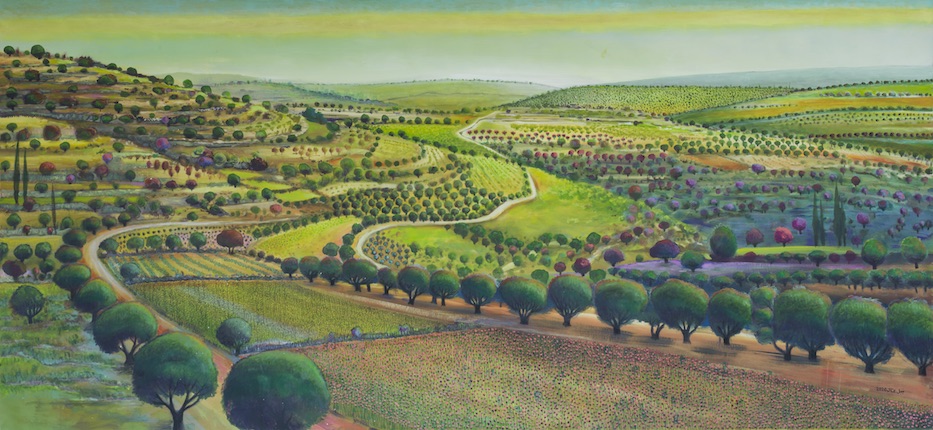
Visual Arts | Woodbridge | Palestine Museum U.S.
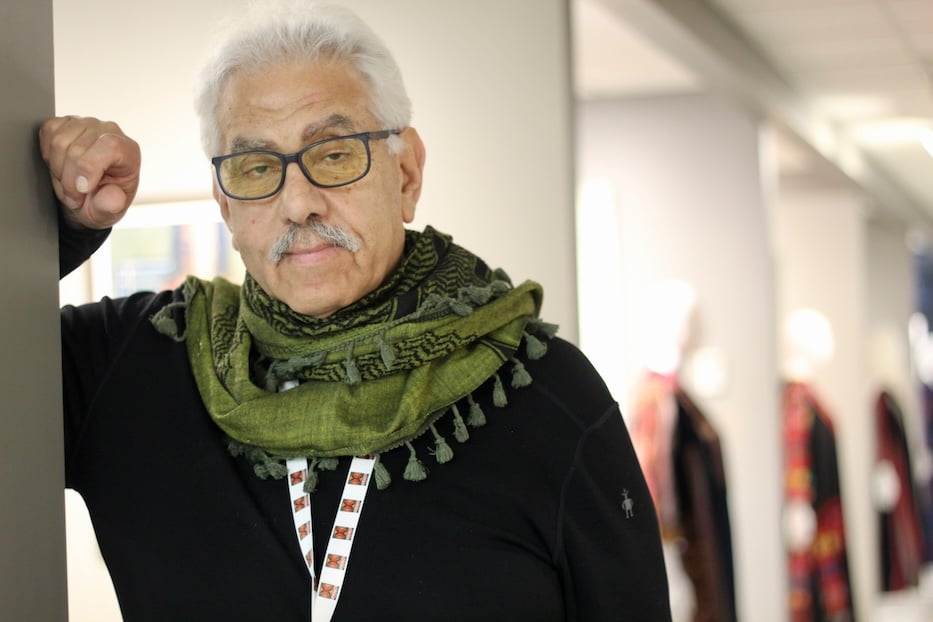
 Top: Faisal Saleh. Lucy Gellman Photo. Bottom: Nabil Anani, In Pursuit of Utopia #7, 2020. The piece now hangs in Edinburgh. Photo courtesy Ziad Anani, Zawyeh Gallery.
The bands of color are enough to stop a person in their tracks, so vibrant they seem to vibrate against the cool, polished marble of the floor below. There are shades of dusky purple, bending towards the sky; yellows speckled with grey and black; vast, flat stretches of blue and slate that reach towards a horizon line. Across the canvas, figures trudge forward, their bodies long and cloaked in shadow. They are all making their way towards something, although the viewer doesn’t know quite what.
Except, it isn’t canvas. Not in this iteration, at least. It’s a print, rolled out to turn a floor into a temporary exhibition space and bring attention to an artist half a world away.
That approach, which joins hundreds of pieces of original artwork across two countries, is the newest initiative from Palestine Museum US founder Faisal Saleh, who last year also opened a branch of the museum in Edinburgh. The original location in Woodbridge, filled with art and located in an office park at 1764 Litchfield Turnpike, is open by appointment with a weekly film series on Saturdays.
“There are times when you cannot get artworks because of war, displacement, time, shipping costs, and space availability, ” Saleh said of the new exhibition practice in a recent interview at the Palestine Museum US, framed by a new mural by the artist Taqi Spateen. “The main purpose of this is to make it available to the public. Think of all these nice corporate buildings that have marble floors that are so clean you could lick them. And they’re completely wasted.”
Intended to broaden the museum’s reach, the practice places thick, skid-proof and fire-resistant prints on the floors of office buildings and cultural venues, encouraging viewers to stop scrolling and start learning about new art and artists in the process. After running a sort of beta test at King’s Place, a concert venue in London, last year, Saleh is actively seeking other institutional partners.
Saleh, himself a photographer whose family was forced to flee their home in Salama, Palestine in 1948, is the first to say that the prints cannot and do not replace original artwork. That artwork, however, is not always accessible to the public, or to curators who have smaller budgets to work with. He sees the prints—and the floor—as a seldom-used cultural bridge.
The idea is both very old and relatively new, he added. Long before Saleh thought about best installation practices or how to achieve the right salon-style hanging or boost visitor engagement for a specific show, he was thinking about the millenia-old mosaics that populated much of the ancient world, from Greece and Rome to Syria to what is now recognized as the Jordan Valley. Those, of course, live in spaces where people might expect to encounter art, particularly houses of worship.
And yet, he still thinks of them when he walks into corporate spaces like the quiet, mostly empty office park in which the Palestine Museum US is located. For Saleh, these buildings—already a relic of a different time for American workplace culture—seem so obsessively clean that they are almost antiseptic, indistinguishable from one another.
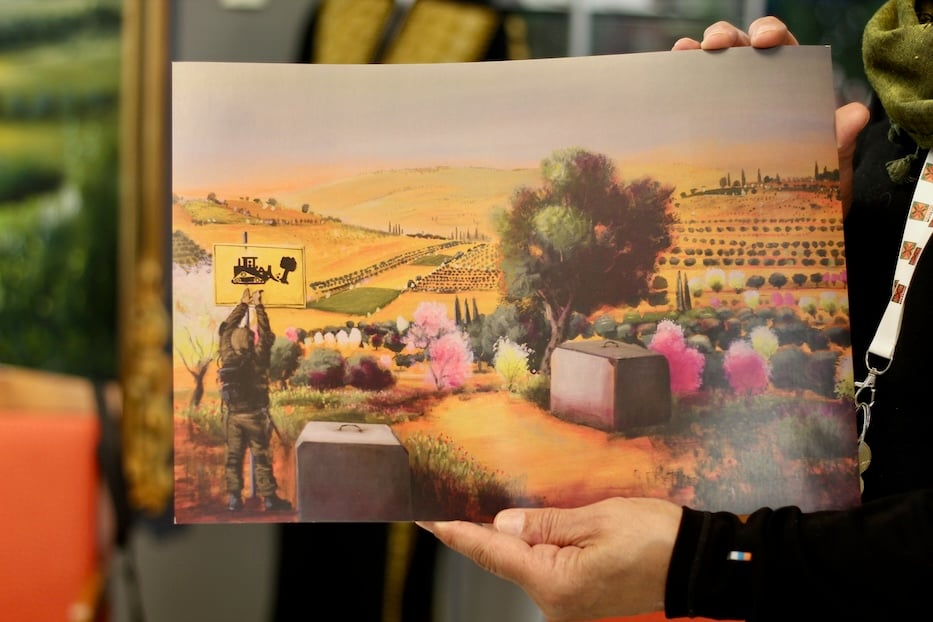 Visual art, which enlivens them instantly, is meant to flip that script. In folding in pieces from the museum’s collection, by artists including Mohammed Alhaj, Nabil Anani, Haya Ka'abneh, and New Haven’s own Margaret Olin, Saleh seeks to offer a master class on displacement and diasporism, with a focus on cultural preservation and shared humanity that drives much of his work. His hope, in part, is that the artworks can be a doorway, through which people become more interested in Palestinian culture and history.
It also makes sharing the artwork more widely possible, he said. To mount an exhibition of original artwork overseas—as he has twice now in Venice, for instance—Saleh is looking at a price tag of $30,000 to $40,000 in shipping alone, a cost that is often prohibitive for him. A print, meanwhile, is just a small fraction of that, and can ship internationally for $500 or so.
Last month, he mounted an exhibition in Edinburgh with a sort of hybrid model, with 14 original embroidered pieces that the Woodbridge museum first displayed last year, accompanied by a handful of prints. Displaying work on the floor has an additional purpose, he added: it compels people to slow down and take in the full sensory experience of being in a space dedicated to visual culture.
To that practice, Saleh said, he’s excited to be growing a second branch of the Palestine Museum in Edinburgh, a 1,410 square foot space on Dundas Street in Edinburgh’s New Town neighborhood that opened in May of last year. Since that time, it has welcomed a steady flow of foot traffic, with anywhere from dozens to hundreds of visitors a day. Currently, it is run by a dedicated fleet of 60 volunteers, split into 10 different teams that run like clockwork. Saleh said he’s thrilled to have a five-year lease on the space.
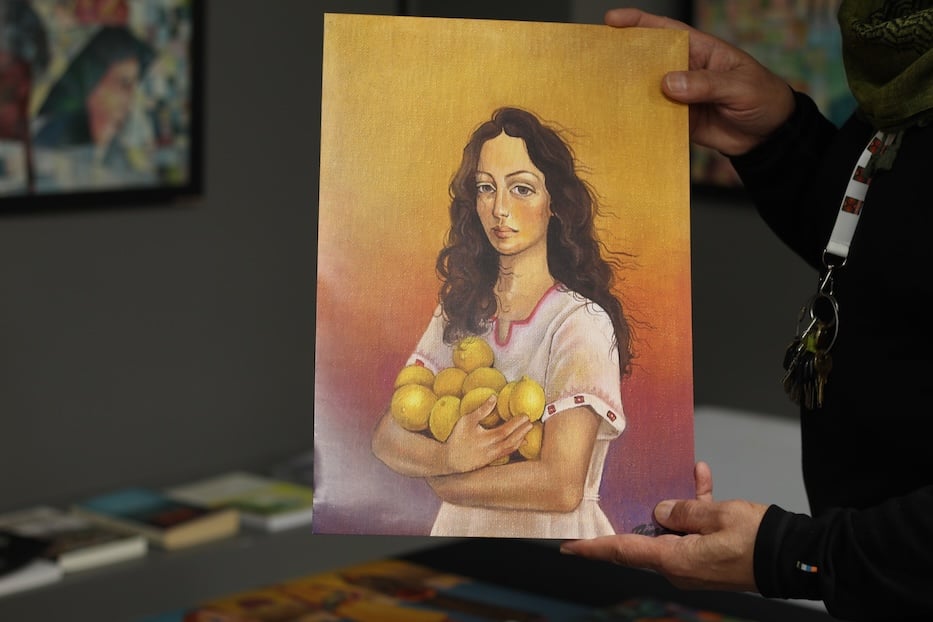
Tucked into a Georgian-style building, the branch features pieces by Samia Halaby, Fadi Deeb, Nabil Anani, Sana Farah Bishara, designer Ibrahim Muhtadi and the late Heba Zagout among others, as well as exhibitions of Palestinian embroidery and artwork by Palestinian children, many of them displaced by war (in October of last year, it also hosted a solo show of Alhaj’s evocative work). Many of the artists on display are familiar names to visitors who have been to the original collection in Woodbridge; some also appeared in the museum’s “Collateral Event” at the Venice Biennale in 2022.
Since opening, it has also welcomed scholars, historians, and culture-bearers, including chefs Sami Tamimi, Izzeddeen Alkarajeh and Eman Aburabi.
“It feels great! This was the intention all along,” Saleh said, noting that his short-term dream is to expand to a satellite location in Chicago, and a longer-term vision is to open branches across the U.S. and Europe. It helps that it’s easy to get to by foot and public transportation, he added; the Woodbridge space is more of a destination. “On the bad days, we get like £100 [in donations]. In the summer, there are days when we’ve gotten £2,000 in donations.”
For Saleh, the work that goes into maintaining the two spaces is a form of self-care: it helps him remain grounded, and focus on the mission of sharing Palestinian arts and culture, when the sheer amount of trauma and violence he is absorbing is mentally and emotionally exhausting (he’s still not really sleeping, he said in a recent interview). That’s especially true of his weekly film screenings, which are presented in a hybrid format on Zoom and in-person at the museum in Woodbridge.
“When I’m working, I know I’m doing something that’s going to have an impact,” he said. “There is a lot of information that needs to get out to people,” and film, literary and exhibition programming is one way to do it. In the past weeks alone, for instance, he has presented Hind Under Siege, Dima Abu Ghoush’s Emwas: Restoring Memories and Carole Mansour’s moving Stitching Palestine.
“Here, people go out to dinner, they have parties, they continue with business as usual,” he added. “What are these people going to tell their children when they ask, ‘Where were you when this happened? What did you do?’ People need to stand up and talk about it.”