

Culture & Community | Education & Youth | Arts & Culture | New Haven Academy
Contributed Photo.
It’s the first day of senior year, and student Veronica Sawyer is writing in her diary, reading out the words as she puts pen to paper. In her mind’s eye, she pictures the popular girls—the Heathers—making their way down the hallway. They have a spring in their step and a sway to their hips that she can feel. “I would give anything to be like that,”she says.
But would she, actually? And what will it take for her to find out?
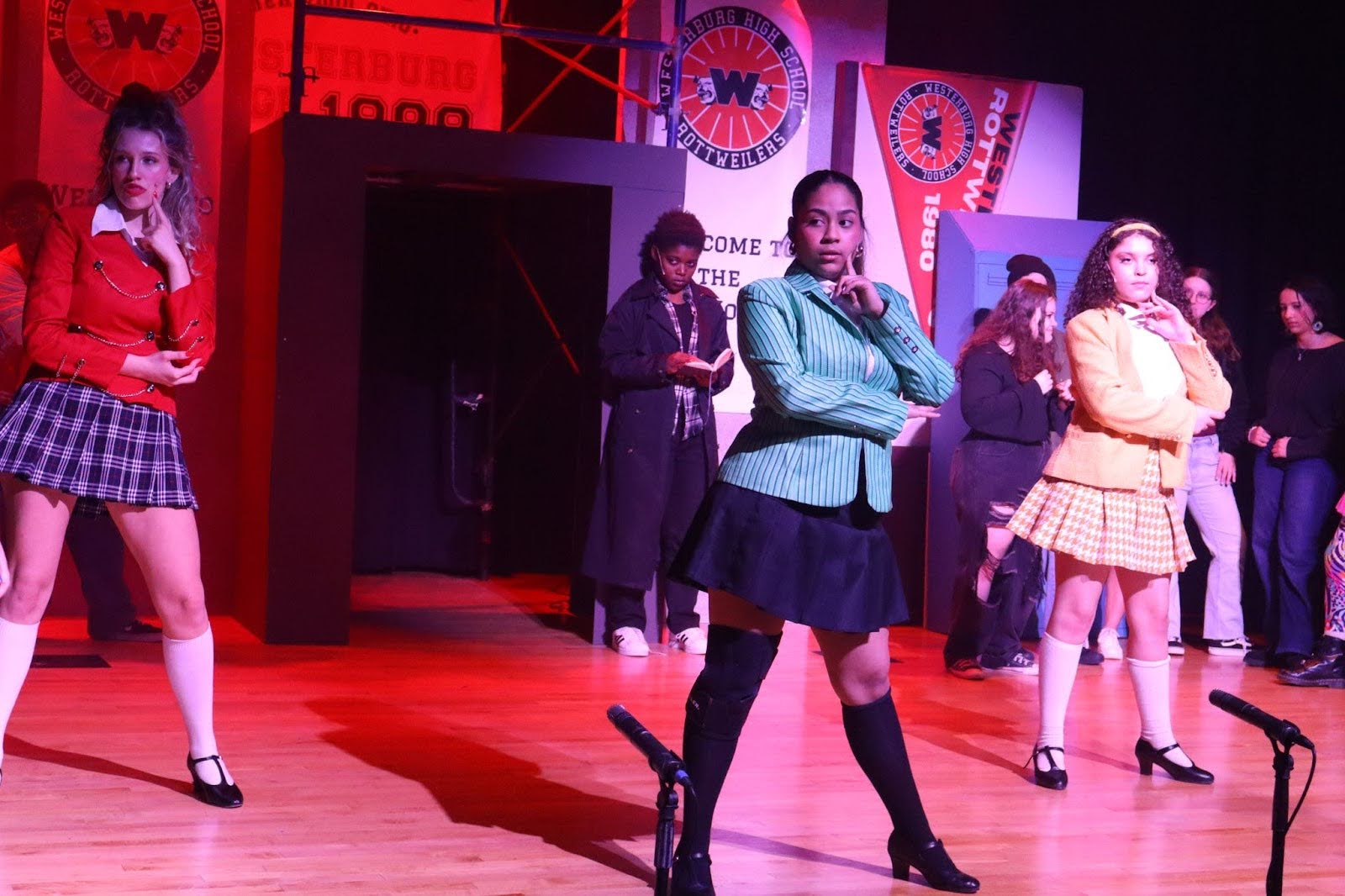
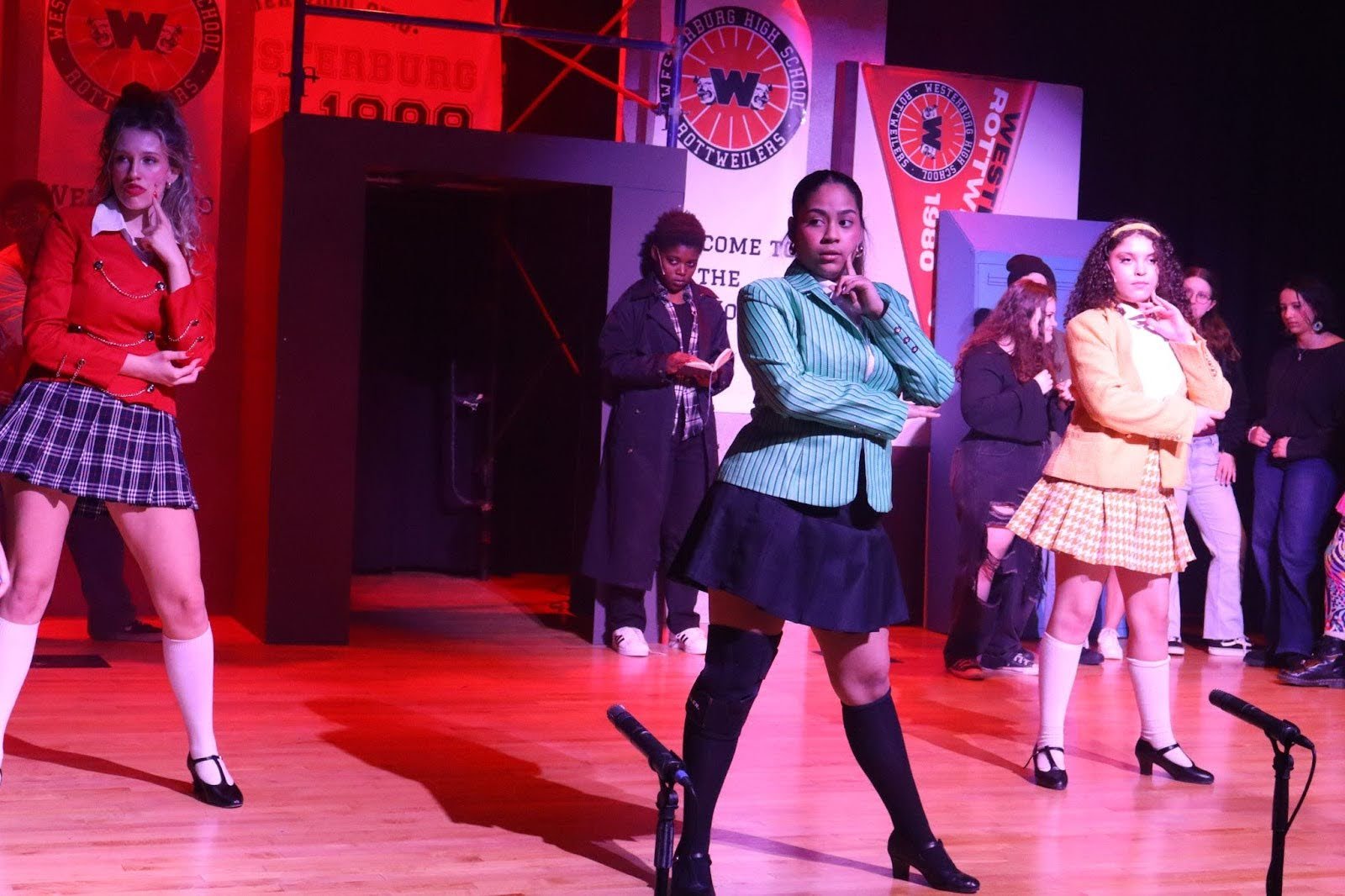
The gymnasium at New Haven Academy teleported to the 1980s last weekend, as the school’s Legacy Studios Drama Club mounted Kevin Murphy and Laurence O'Keefe’s Heathers just before a blizzard descended on the city, granting actors a well-deserved snow day (three, in fact). Based on the 1989 cult classic of the same name, the musical is steeped in dark comedy, with themes that include bullying, gun violence in and outside of school, sexual assault and harassment, teen suicide, and classism.
Performances ran Thursday through Saturday; read about opening night here. The final show, set for Sunday evening, was cancelled due to the then-impending snowstorm. Just as in previous years, Legacy welcomed students from both NHA and other high schools, with cast representation from Wilbur Cross High School, Cooperative Arts & Humanities High School (which performed the show in 2017), and the Educational Center for the Arts.
“This show holds up a mirror to high school culture-where social hierarchies can feel absolute, where fitting in can feel like survival, and where being different can feel dangerous,” Director Ty Scurry wrote in an introductory note in the playbill. “While the world of Heathers is exaggerated, the emotions are real. The pressure to belong. The fear of being invisible. The consequences of cruelty. And the quiet hope that kindness, empathy, and courage can change the narrative.”
That narrative—and the sense of being in a high school twice over—came to life as soon as attendees walked into the space, engulfed by the aroma of popcorn. Across the room, Scurry and students had transformed an aging stage into Westerburg High, where the stage glowed green, blue, red, and purple and a fog machine sent clouds of white dust into the space. Madonna’s “Like a prayer” erupted through the speakers as the band practiced their songs before the prologue. Drinks, hot dogs, and other snacks were available to anyone that wanted a blend of dining and entertainment.
In both the iconic film and the musical adaptation, Heathers follows Veronica Sawyer (Olivia Tapia Ko) as she navigates an increasingly dystopian high school experience, at once annoyed by and drawn to the popular Heathers ( Lexi Kochanowicz as Heather Chandler; Solimar Quintanilla as Heather Duke, and Sophia Olivia Quiñones as Heather McNamara) and a new, enigmatic student named JD ( Leonato Jones) who has, it turns out, extremely murderous tendencies.
Around them, there are the usual high school culprits, including football players who also happen to be bullies (Christopher Samuels and Christian Ortiz as Kurt and Ram), an ex-best-friend (Molly Davis as Martha Dunnstock), and an ensemble that can dance through third, fourth, and fifth periods like it’s no big deal. But the way the show unfolds is anything but: Veronica’s own grudges give JD a revenge fantasy that undoes the social hierarchy of high school itself, and spares no one in its path.
As the curtain opened on 1980s Ohio, where the fictional Westerburg is based, the discomfort and pain of bullying bubbled quickly to the surface. The mechanisms may have been different—Heathers came out a full 10 years before the Columbine shooting, and the decades of horror, violence and now constant online bullying that have followed—but the feeling, deftly delivered in Tapia Ko’s performance, was the same.
In speech and song, Veronica was willing to compromise her morals to fit in with the Heathers, her hunger raw and palpable from the stage. For anyone who has made it through high school, it was understandable, too: as the queen bee, Kochanowicz owned the stage as Heather Chandler, making it clear exactly who was in charge and what students would do to worship and serve her. Or, at least, that’s how it initially seemed.
In the audience, an attendee could see and feel that in real time, brought vividly to life by students who left it all on the stage. In one such scene, set at a house party, Davis-as-Martha became the laughing stock of the night, there because she believed that Ram had feelings for her. In reality, Veronica has forged a note, in an act of allegiance to Heather Chandler that distances her from her friend.
Davis brought the character to life by evoking a sense of humiliation that was so loud and uncomfortable it filled up the whole room, and attendees had no choice but to witness it. On stage, time felt like it stopped while the characters laughed and whispered to each other. But it was propulsive, too: before her character’s arrival, there was a dance break that had hints of a pool party scene in High School Musical 2, minus the water.
In another, Heather MacNamara sang affectingly through her struggle with suicidal ideations in “Lifeboat”—only to become the subject of Heather Duke’s ridicule, embarrassed publicly in front of her peers. As she grieved her status, believing her life to be over in “Shine A Light,” it opened up a vital and too-often stigmatized conversation about bullying, perspective, and the very real threat of self-harm among peers who may seem to be doing just fine. When, in agony, she tried to take pills to end her life, a person could feel the tension rising in the audience. When Veronica intervened, there was a moment of relief, like a very real collective exhale.
Audience members were expressive during both acts, including a mother who shielded her children’s eyes from a fake, simulated kissing scene between Veronica and JD.
During the 15-minute intermission, the groove of the 80’s came back as Whitney Houston’s “How Will I Know” electrified the gym. Other songs such as New Edition “If It Isn’t Love,” Tears for Fears’ “Everybody Want To Rule The World,” and Bobby Brown’s “Girlfriend” flowed through the room.
By the second act, Veronica had finally started to see the light—and attendees were left wondering, was it too late for her to make a change? In the reprise of “Dead Girl Walking,” Tapia Ko forcefully reclaimed her power from JD, crooning the words “I let his anger fester and infect me.” It awakened in her—and the audience—a growing sense of strength, and it was only a matter of time before Veronica fought back.
The curtain call was a scene like no other as the audience erupted into loud applause and even stood for each actor. It was nearly 10 p.m. by the time actors headed home, and the night still felt young.
“I hope audiences left entertained first because theatre should be fun, energetic, and alive. But beyond that, I hope they walked away thinking,” Scurry said. “This show reminds us how powerful kindness is, how dangerous silence can be, and how much young people are navigating every day. If someone left the theatre laughing but also reflecting on how they treat others, then the show did its job.”
“I just want to emphasize how proud I am of these students,” he added. “They built something special in a short amount of time, often under challenging circumstances, and they did it with heart, discipline, and real love for the work.”