

Culture & Community | Arts & Culture | Cheshire | Ball & Socket Arts
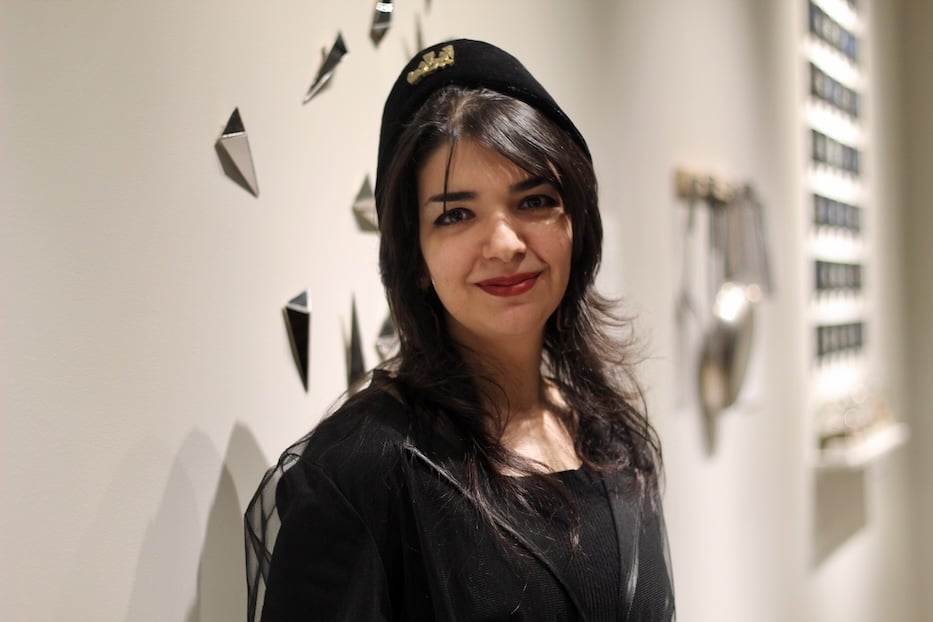
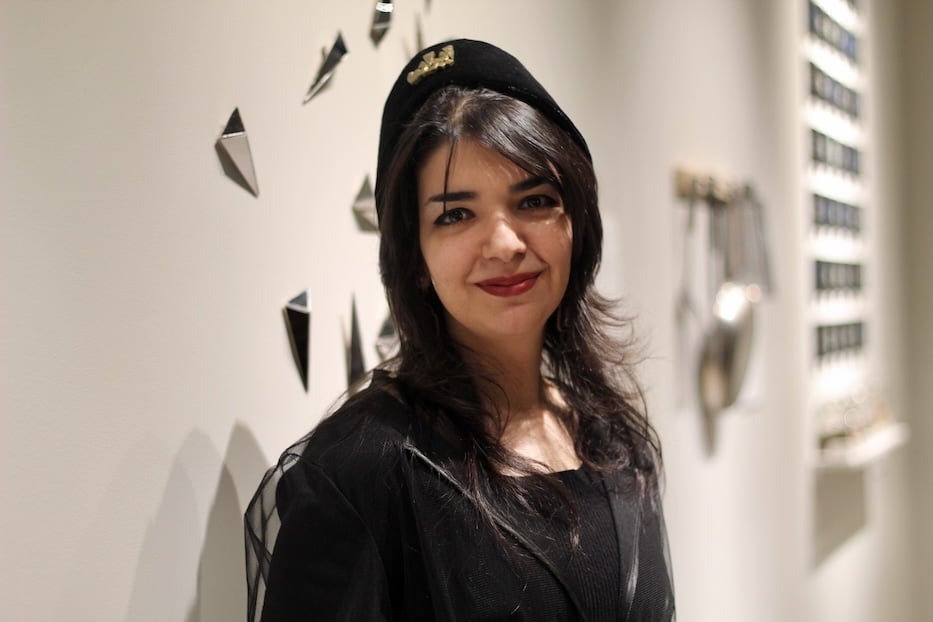
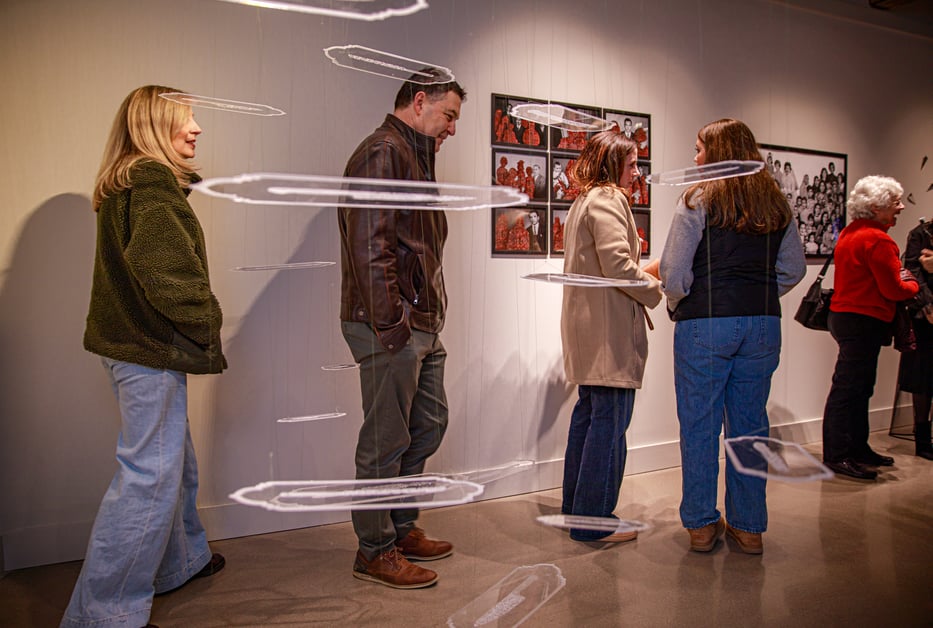 Top: Artist Mahsa Attaran. “My family, they are okay now. But I have 90 million family members and I am worried about every single one of them,” she said at an opening reception last month. “I have cried for each of them.” Lucy Gellman Photo. Bottom: Attaran’s 2024 Under The Shows We Exist installed at Ball & Socket. Yakov Binyamin Photo.
From across the room, it looks like a mirror breaking apart in slow motion, triangles of glass flying out on the long, cream-colored wall. Come closer, and the work shifts into focus, the clean, raised edges catching in the light. Where the mirror has shattered, over a dozen shards float outwards, scattered as if in midair. On what’s left, the words “My heart is bloodied for you” (دلم برات خون شده) spread out in thick white and red Farsi letters. Beneath the language, a viewer can see bits and pieces of their own reflection.
The mirror, a timely homage to the people of Iran, is the titular work in My Heart Is Bloodied For You, a solo exhibition from Iranian artist Mahsa Attaran running at Ball & Socket Arts in Cheshire through March 15. Installed in the building’s first-floor gallery space, the show marks a feat of both craftsmanship and storytelling, with a kind of deep longing for home and homeland that is palpable through the work.
It is also incredibly prescient. Two weeks into the exhibition—and months into anti-government protests roiling the country—U.S. President Donald Trump declared that the U.S. was at war with Iran without Congressional authorization, on the day of an artist’s talk that had been rescheduled due to heavy snow. Attaran, whose art is a form of activism, could feel the ground shifting beneath her.
“People are more hopeful than ever for the transition leader [exiled Iranian Prince Reza Pahlavi],” she said in a phone call Monday evening, adding that she was overjoyed to learn of the killing of Ayatollah Ali Khamenei on Saturday, shortly before giving a talk about her show. “I am speaking not just for myself, but for 99 percent of Iranians who are celebrating that this dictator, this murderer was killed. This is our Berlin Wall moment.”
“It’s a very critical moment for Iranians around the world right now,” she had said at an opening reception last month, and the words still rang true Monday. “This is a very hard moment for us. Almost every Iranian family knows someone who has been abducted by the regime, executed, or killed on the streets. Some of the families are completely gone … I’m here to be their voice.”
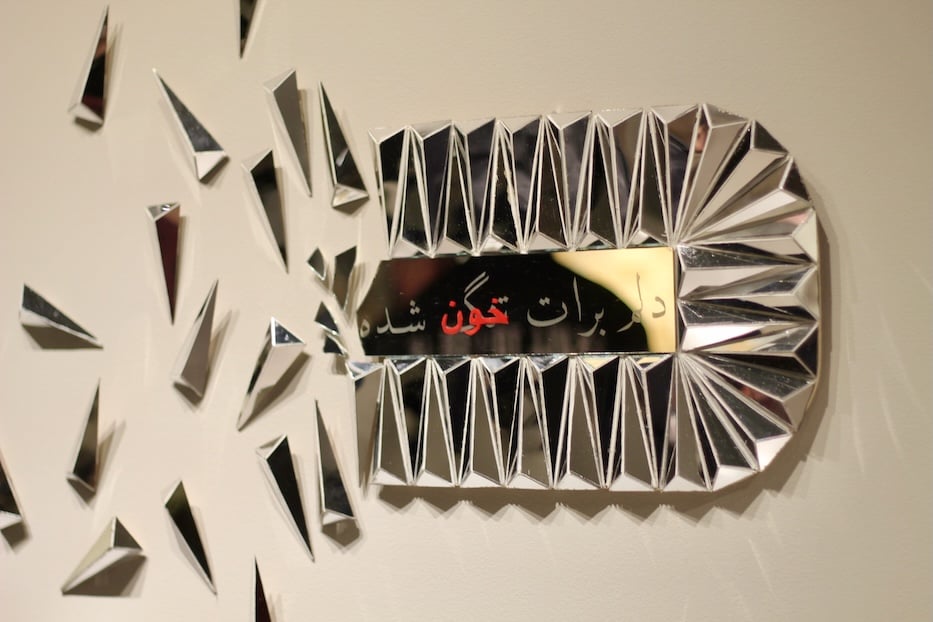
Detail, My Heart Is Bloodied for You. Lucy Gellman Photo; all artwork by Mahsa Attaran.
Part of that comes from Attaran’s experience as an Iranian artist living and working abroad, thousands of miles from her parents, siblings, and extended family. Attaran grew up in Shiraz, Iran, a city of nearly two million people that is home to thousands of years of cultural and intellectual tradition. In college, she studied anesthesiology, but was intrigued enough by the practice of photography to begin teaching herself. For years, she ran a studio called Teamcheh, which did a mix of commercial and wildly creative photography.
Then about four years ago, Attaran moved to the U.S., first to the bone-cracking cold of the great plains, and then to the East Coast. While she began her graduate work at the University of North Dakota, the artist ultimately transferred to the University of Connecticut, from which she graduated with a master’s degree in fine arts last year. She now works at the prestigious Loomis Chaffee School, and lives on the border of Connecticut and Massachusetts.
It was at UConn, in 2022, that she became inspired by the protests that followed the horrific death of Mahsa Amini, a 22-year-old Kurdish woman who was arrested and beaten by the country’s morality police for allegedly wearing her hijab the wrong way. Thousands of miles away, Attaran watched as peaceful protesters flooded the country’s streets, only to be met with violent, retaliatory force from the government.
“And what was the response of the government to that? They killed more people,” she said at an opening reception last month, the anger adding a hot edge to her voice. ”They killed more people to prove that they didn’t kill that one girl. And that was a very hard moment …Iit was the moment that I thought, ‘I need to do something as an artist.’ I felt a responsibility.”
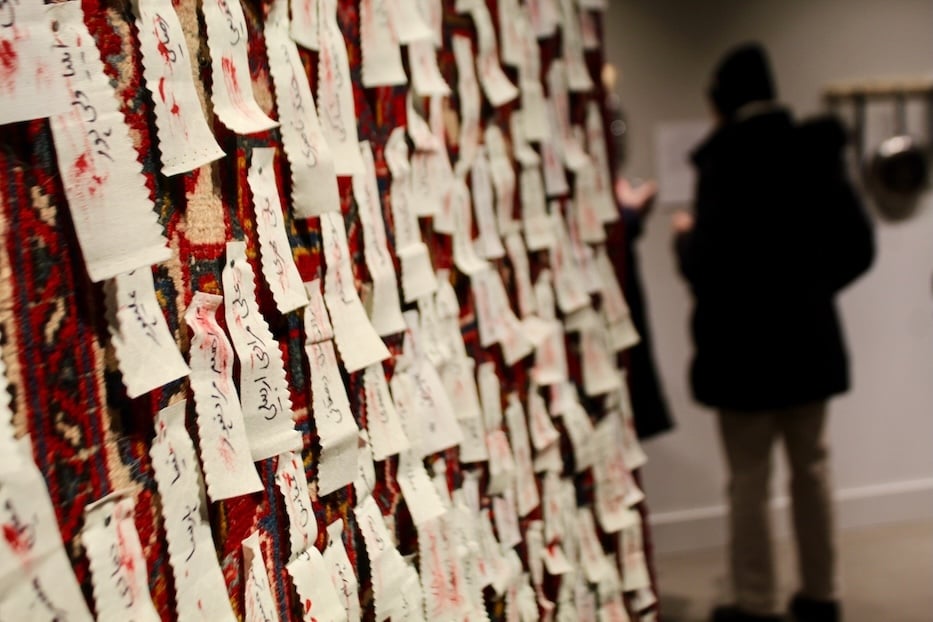
Detail, Javid Nam (Eternal Name). Lucy Gellman Photo; all artwork by Mahsa Attaran.
If she had still been in Shiraz, Attaran knew, she could risk arrest or physical violence if she made so much as an Instagram post with a piece of protest art. But in Connecticut, she had the freedom “to be the voice of the people,” she said. “They are risking their lives on the streets, seeking a life of dignity.” Making artwork that addressed the protests, and the patriarchy and authoritarianism that undergirded them, felt like the least she could do.
My Heart Is Bloodied for You, retitled from My Heart Is Tight for You in honor of the anti-government protests that have for months shaken the country and claimed thousands of innocent lives, grew directly out of that urge to create. In a choice that is as effective as it is affecting, she tells the story across media: Attaran has included photography, collage and assemblage, fiber arts, film, and sculpture.
Initially, Attaran began with domestic spaces, and the generations of matriarchs that had shaped her. She thought about her mother, and her grandmother, and her great-grandmother, and the women who had come before them. She made layered, sometimes hard-to-process images of women covered and wrapped in Persian textiles—a point of artistic pride that is also a cultural touchpoint across the globe—and transferred their images onto cookware and kitchen utensils in pieces like her installation I Can Still See! She asked her viewers to grapple with what it meant, and means, for their faces, their stories, their labor to be unacknowledged and obscured.
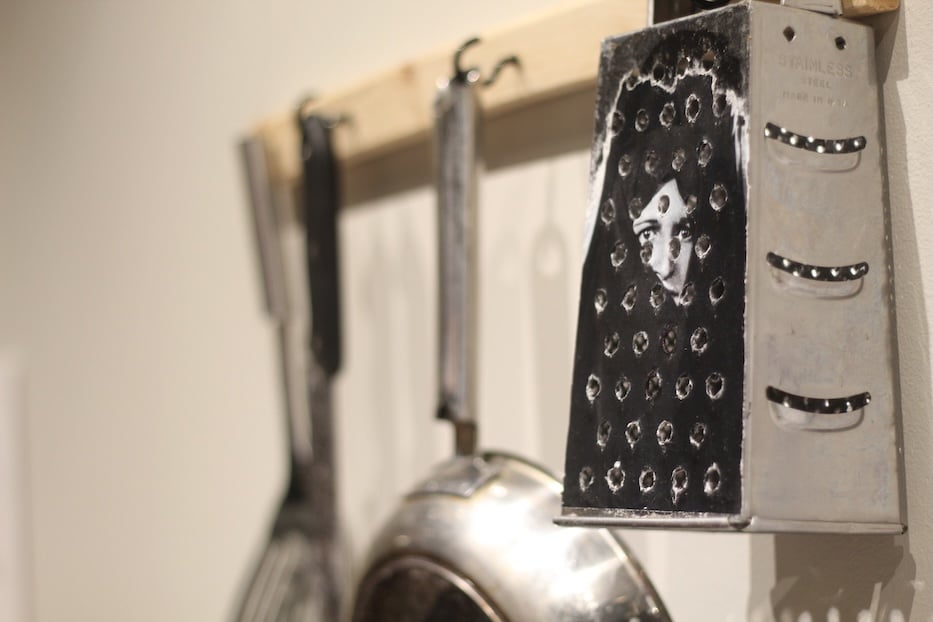
Detail, I Can Still See! Lucy Gellman Photo; all artwork by Mahsa Attaran.
In I Can Still See!, for instance, a collection of well-loved kitchen utensils hangs from a series of hooks, as if the objects are just waiting for use in somebody’s cooking routine. From afar, there’s nothing particularly remarkable about them: the knife is speckled in a coating of white dust that appears, from across the room, as a film that might need a quick scrub before cooking.
The twist comes only in the act of close looking. As a viewer approaches the installation, faces emerge—matriarchs in Attaran’s family—in fragments, such that a person’s brain must do extra work to piece a full face back together. But the work is not confining or claustrophobic, so much as subversive: by placing faces on common culinary tools, Attaran both calls attention to the high and often unacknowledged cost of domestic labor, and demands that the objects be repurposed as pieces of fine art. She uses her power as a maker to absent them of their original meaning.
This kind of attention to small detail, and the expectation that a viewer will take the time to witness and appreciate these women, is doubly moving in works such as Where You Tread and Ja Oftadan (Settle In), which also tell a story of the artist’s growth and experimentation with media. Like Sweep It Under The Rug, a 2024 series that literally weaves archival photographs into (and sometimes beneath) sections of Persian textiles, Where You Tread finds its footing in the layering of different media, compressing the lived experiences of Iranian women and the eye-catching, utilitarian objects on which both they and others place their feet and bodies.
In the work, which is in fact multiple works, Attaran has depicted Iranian women covered in sections of ruby-colored Persian rugs, their bodies obscured by the thick, vibrant textiles. There’s a flattening there: of the literal image, but also of their distinct personalities, their thoughts, their speech, the children they have brought into the world and raised up. These women are literally responsible for the continuance of Iranian culture, and yet they have been hidden from view.
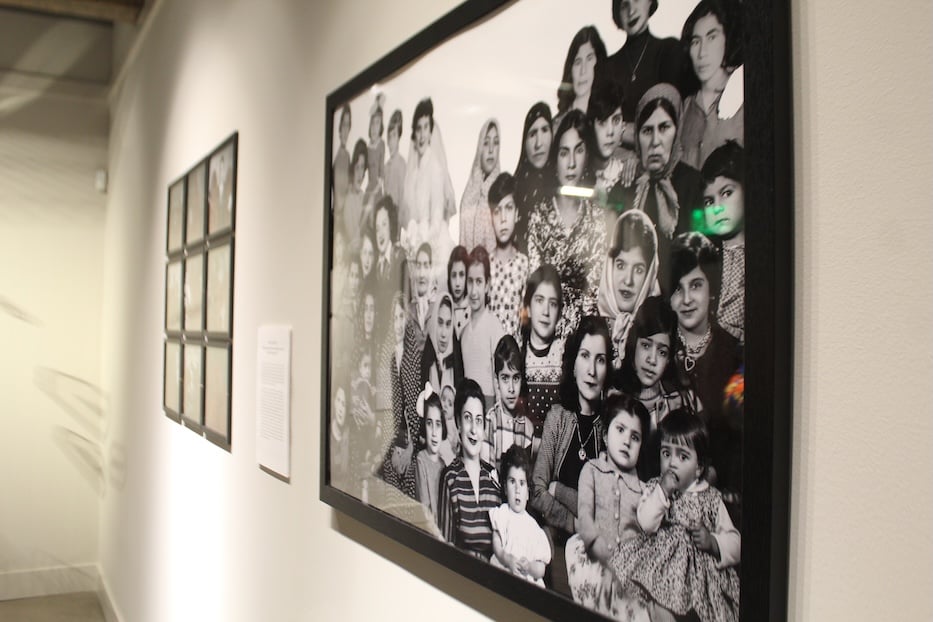
Detail, Where You Tread. Lucy Gellman Photo; all artwork by Mahsa Attaran.
“Like the rugs, women have historically been stepped on, overlooked, or suppressed, no matter how precious their labor, presence, and contributions are,” Attaran writes in an accompanying label. “This concealment reflects how society has often sought to hide women ‘for their own good,’ masking control as care, while undervaluing their essential roles and strengths."
There’s a deep humanity there—that sense that Attaran lives with her heart wide open, and sees in all Iranian women some of her own beloved family members. And indeed, when she ran out of women in her own life, she looked to the archives of Iranian families at the University of California, Los Angeles (UCLA) to continue the series. In a second part of Where You Tread, she has pulled together over two dozen of such women, who together make up a new kind of family portrait.
Unlike the images in which bodies are covered with rugs, these women are fully visible, vibrantly present. Together, they represent three or four generations: young girls with thick, curly hair that is still just growing in, mothers and sisters and aunties, their cheekbones high and lips drawn in tight smiles, grandmothers with loose headscarves knotted beneath their chins. It is as much a feat of craft as it is a political statement: some of these women, fixed in time and space, likely represent life before the 1979 Islamic Revolution, after which mandatory hijab laws were put into place.
That fusing of the personal and the political (and the personal as the political) surfaces again in Ja Oftadan, a multi-media piece with installation, photography, and film that brings a viewer into Attaran’s inner life, and spans thousands of miles between Ball & Socket’s factory complex in Cheshire, and her first home in Shiraz. Across one wall, framed labels float in neat, orderly lines above huge glass jars of spices, a reference to a suitcase filled with spices Attaran first brought with her when she travelled to North Dakota.
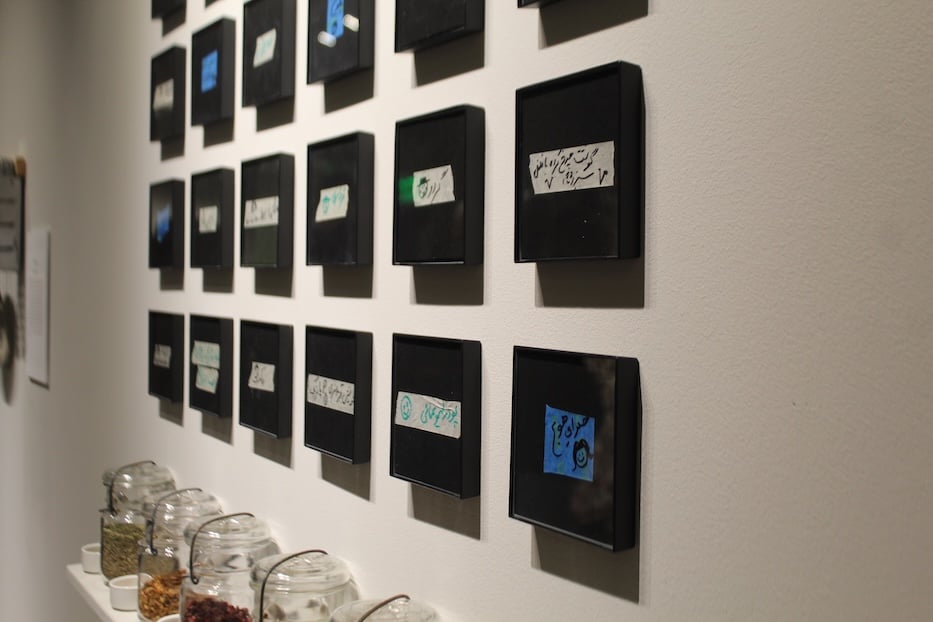
Detail, Ja Oftadan. Lucy Gellman Photo; all artwork by Mahsa Attaran.
There are seaform-toned cardamom pods, whole nutmeg, saffron, and turmeric, among others. Beside the labels—sweet, quick scrawls of Farsi beside cartoon faces, some with cropped hair and others in little tophats—Attaran has included a photo of an open suitcase, the rich, electric blue of its interior arresting against the vibrant weave of a Persian rug. Inside, where clothes might otherwise be, is a kind of reimagined Vanitas shot from above, the frame crowded with fresh and dried fruit, Iranian rials, spices, and pink-and-orange wax-resist eggs, common for Nowruz celebrations.
In a photograph of the work, the valise sits propped open against the bright weave of a Persian rug. The actual suitcase sits in a vitrine nearby, as a video with its journey to the U.S., in which Attaran’s hand guides it from the airport to her home, plays on loop in the corner of the gallery.
This sense of being suspended between two worlds lives in every part of the exhibition, from the title of the show itself to the faint, lace-colored imprints of knives, suspended in midair in works like Attaran’s 2024 Under The Shadows We Exist. By opening that window to her world, she invites a viewer not just to walk through, but to also be in community with her—to feel her pain, which is the pain of an entire country, to learn her story, and to educate themselves about Iran.
Nowhere is this stronger, perhaps, than in Javid Nam (Eternal Name), a Persian rug that hangs from the ceiling, glowing red and resplendent from where it appears in the gallery windows. On the back, initially obscured from view, Attaran has attached strips of fabric with hundreds of names, each written out carefully, crisply in her hand. Each is individually attached by a nail that comes all the way through the rug, "making it impossible to step on," she explained.
It’s a tribute to the tens of thousands of people who have died at the hands of the Iranian government since protests began in January. Or as she said in a text message, "It reflects the idea that even when names are hidden, they find their way back to the surface—blood does not simply disappear into the ground; it floods."
“No one should die for speaking, for protesting, for seeking justice,” she writes in an accompanying label. “We cannot become accustomed to this violence, and we cannot remain silent. Javid Nam calls on viewers to witness, to recognize the scale of this atrocity, and to stand in solidarity with those resisting oppression. Every name matters, and every act of awareness and action matters.”
That’s also true in the titling of the show itself, she explained at the opening last month. Taken from the Farsi for “I miss you,” “My heart is tight for you” is one of those phrases that defies translation, and reminds a viewer (at least, this viewer) that language alone is sometimes inadequate. In this sense, it feels fitting that an earlier iteration of the show ran at TheaterWorks Hartford last year, alongside Sanaz Toosi’s play English. Attaran said she saw the show, which does with language what her work does with fiber, photography and installation, multiple times.
“Iran is not an ideology, it is not a regime, and it is not a headline,” she said during an artist’s talk last weekend. “It is women weaving rugs, building libraries, writing books, even when their names are erased. It is doctors, engineers, artists and scholars. It is a generation of people educated, thoughtful people, who would rebuild their country without hesitation.”
“The regime may be loud, but culture is deeper,” she continued. “My work is not only about resistance, it is about care, inheritance, and memory. It is about holding onto what is precious—language, food, photographs, tenderness. People. Human lives. And refusing to let it be erased. We are not fighting because we hate. We are fighting because we love.”
Mahsa Attaran: My Heart Is Bloodied for You runs at Ball & Socket Arts, 493 W Main St Building 3 in Cheshire, through March 15. Attaran will give a closing talk in partnership with the Cheshire Public Library on March 12 at 6:30 p.m. For more information on Ball & Socket events, click here.