


Culture & Community | Hanukkah | Klezmer | Music | Arts & Culture | The Hill | Tower One/Tower East
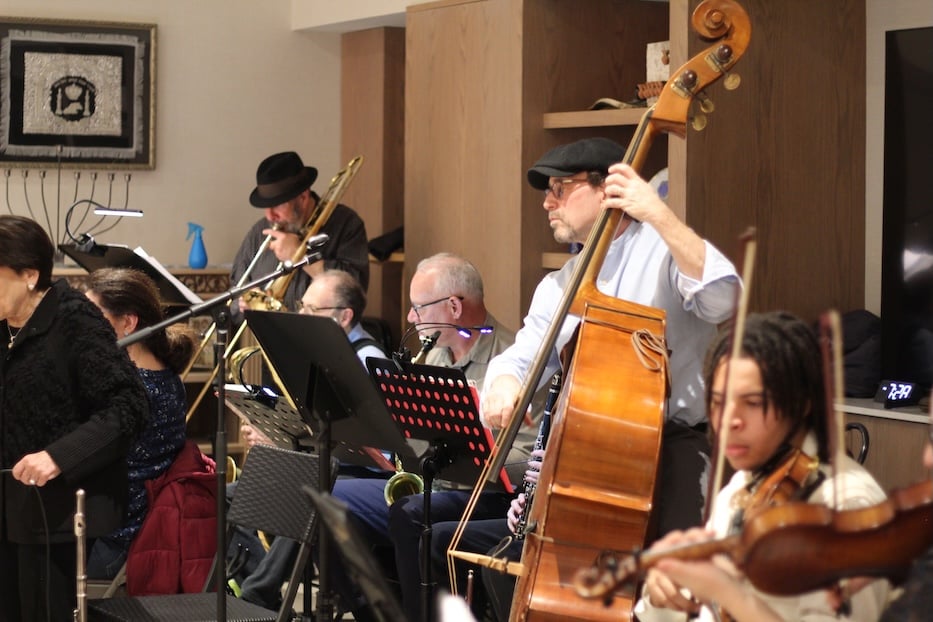
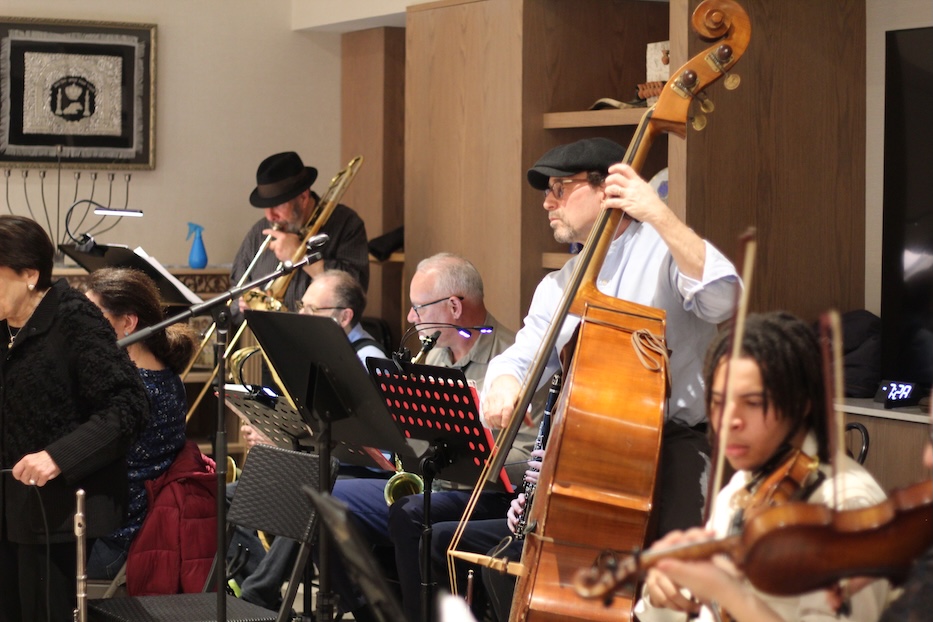
David Chevan, surrounded by musicians. Members who performed Thursday included Chevan on bass; Hedda Rubenstein on flute and vocals; Dalton King on alto sax; Mark Kaplan on tenor sax; Noah Schwartz on clarinet; Isaiah Cooper on trombone; Anna Reisman and Cary Jacobs on flute; Eli Jackson, Steve Jacobs, and Tova Dreyfus on violin, and Eric Wolfe on trumpet. Lucy Gellman Photos.
It was the low-bellied rumble and hum of the bass, a bow swiftly making its way across the strings, that brought the room to attention. Beside the image of a menorah, Isaiah Cooper joined in on the trombone, and it became a spirited, bouncing dialogue steeped in the old world. “Eyns! Tsvey! Eyns, tsvey, eyns, tsvey!” bassist David Chevan called out, and woodwinds and trumpet gleefully joined in.
In the audience, listeners began to dance along from their seats, a few bobbing their heads in time with the music. For Chevan, leaning over the bass like an old friend, it was a form of resistance.
Chevan is a founding member and director of the Nu Haven Kapelye, an intergenerational klezmer orchestra composed of New Haven area musicians that treats Hanukkah as its official business. Last Thursday (on the fifth night of Hanukkah, if anyone is counting) he and fellow musicians brought their sound to The Towers at Tower Lane, where residents and family members filled the sanctuary to listen.
As they played, musicians worked to banish a heavy, deep darkness—of the Bondi Beach shooting that killed 15 people, including a child and a Holocaust survivor, who were celebrating Hanukkah, in a year upturned by rising antisemitism and violence at home and abroad—with a bright, mellifluous light.
The group plays its annual December 25 concert at Congregation Mishkan Israel this week. Tickets and more information are available here.
“I'm glad that I have the opportunity to play Jewish music publicly right now,” Chevan said in an email after the concert. “Oddly, it feels political. When we play a Hanukkah song or a hora, we are celebrating Jewish culture and making people happy, and we are also standing up to the white nationalists and other antisemites.”
Part of that is the music itself. Klezmer is a sonic reflection of migration and diaspora that has followed European Jews across oceans and decades, transferred from one generation to the next largely through oral and musical tradition (as well as valuable documentation and the preservation of cultural heritage). The form is not a monolith: songs might soar from wry humor to working-class solitarily to ecstatic wedding dances in a single set. For the Kapelye, they often do.
For many of the musicians who play it—and the audiences that listen—it’s also a cultural container, big enough to hold the language of parents, grandparents and great-grandparents who are no longer here in body, but may remain in recipe boxes, prayer books, and ritual items that generations of hands have shared. In songs like “Ale Brider” or “S’iz Nito Keyn Nekhtn,” musicians can sit down amongst each other, and tap into nineteenth-century labor politics (many of which remain trenchant today) or childhood stories that their elders might have been attuned to a world away.
For Chevan, it’s also a potent reminder that antisemitism “is not all that new” at all, although it seems louder and more jarring in recent years. In the 1990s—when his sons were just small kids—someone painted a swastika on his synagogue, Congregation Mishkan Israel in Hamden. Three decades later, the same sanctuary received bomb threats and made the decision to step up security in 2023. He’s played in houses of worship that feel increasingly under attack, and considers the music as much of a spiritual balm for himself as it often is for congregants.
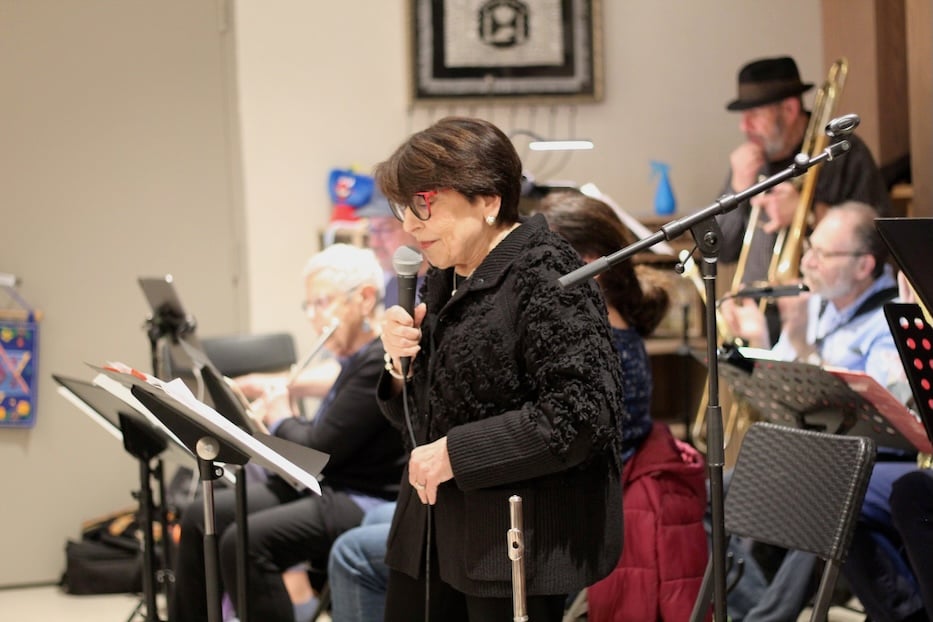
Hedda Rubenstein, who did double duty on flute and vocals.
Thursday, he and musicians held on to all of that as they filed into the Towers, unlatched instrument cases and began to set up inside the sanctuary, where a stained glass ark stands on one side of the room, and a temporary fabric banner patterned with a menorah had been placed on the other. In the audience, residents like Albert Zax and 104-year-old Sylvia Rifkin waved to several members of the band, excited to see them for another Hanukkah of joyful music making.
They didn't have long to wait. Just a few minutes after 7 p.m., the group kicked off its 12-song set with the upbeat and well-loved tune “Bagopolier Freylekhs,” Chevan shout-counting the group in in Yiddish. As the trombone picked up its step beneath the bass, warbling trumpet joined in, with a swirl of strings and woodwinds not far behind that made it a party. Flutes trilled an excited hello, and sax responded with a brassy cheer. Violin stepped forward, and horns matched them at twice the volume.
By the song’s midway point, attendees were dancing along in their seats. “Everybody!” Chevan shouted excitedly, and the band got ready to come together and then drift apart into sections once again. If a listener closed their eyes, it seemed completely possible that the instruments themselves had stood up, and begun to dance.
“Are we too loud?” Chevan asked afterwards, and attendees responded with a cacophonous and delighted “No!”
“I can ask the saxophones to turn their volume down,” he added with a smile, and listeners rejected the suggestion immediately. Instead, they urged him to go on to the next song, many laughing when he announced the title “Oy Meyn Kepele” (“Oh! My Head!”) a song from Di Shikere Kapelye (The Drunk Band) that he recently learned at KlezKanada's annual Jewish music festival.
“Should we let them in on the joke?” Chevan said with a wry smile, when it became clear who in the audience spoke Yiddish and who did not from where the laughter came from. Of the residents at the Towers, more than a handful have held onto the Yiddish they grew up with, whether bandied about in tight Brooklyn kitchens or exchanged over candlelit Shabbos tables in Vienna.
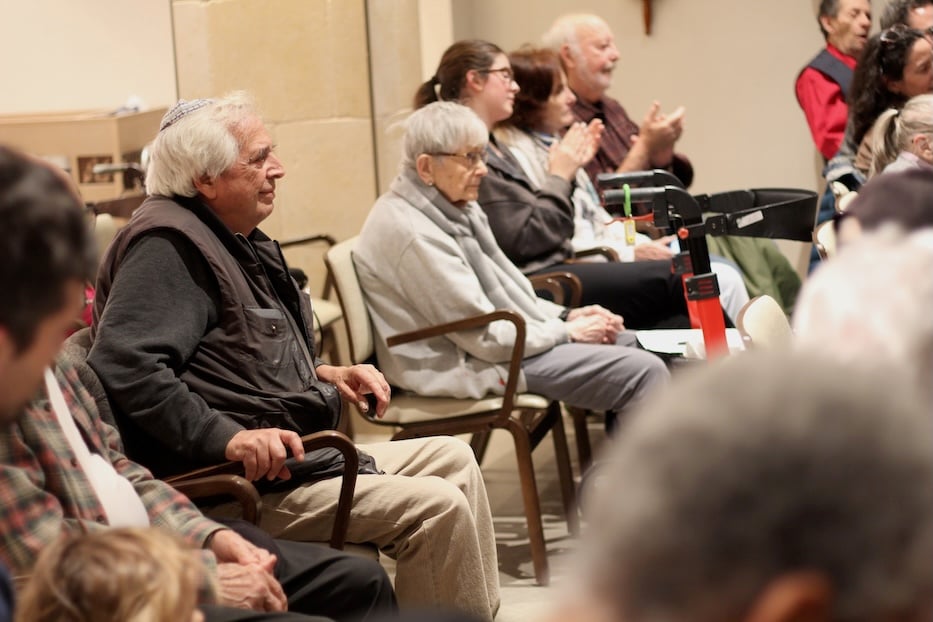
Eliot Sovronsky.
Queens transplant Eliot Sovronsky, who arrived at the Towers in October, soaked it in note by note. In an interview before the show, he said he’s been grateful to have a space for ritual, including during the High Holidays and Hanukkah. “Between what happened in Israel and Hanukkah in Australia, Jewish celebrations are becoming massacres,” he said. To be in a safe space where he can practice ritual and celebrate culture anchors him.
At the Towers, “it’s great being part of a Jewish community,” he added. As a kid, Sovronsky spent summers at the historic Camp Ramah, soaking in the joy of summertime with other Jewish kids. When he was old enough to work there, he returned as a counselor. During his decades in New York, including years spent as a cab driver, Judaism was just part of his life, a trusted and constant companion.
For years, he celebrated the High Holidays with his sister, who lived in Boston and attended a synagogue that offered hybrid services. After she passed away last year, he had to figure out a new tradition. In what felt like divine timing, he moved into The Towers the week before Kol Nidre and Yom Kippur, during what in the Jewish calendar is referred to as the Days of Awe.
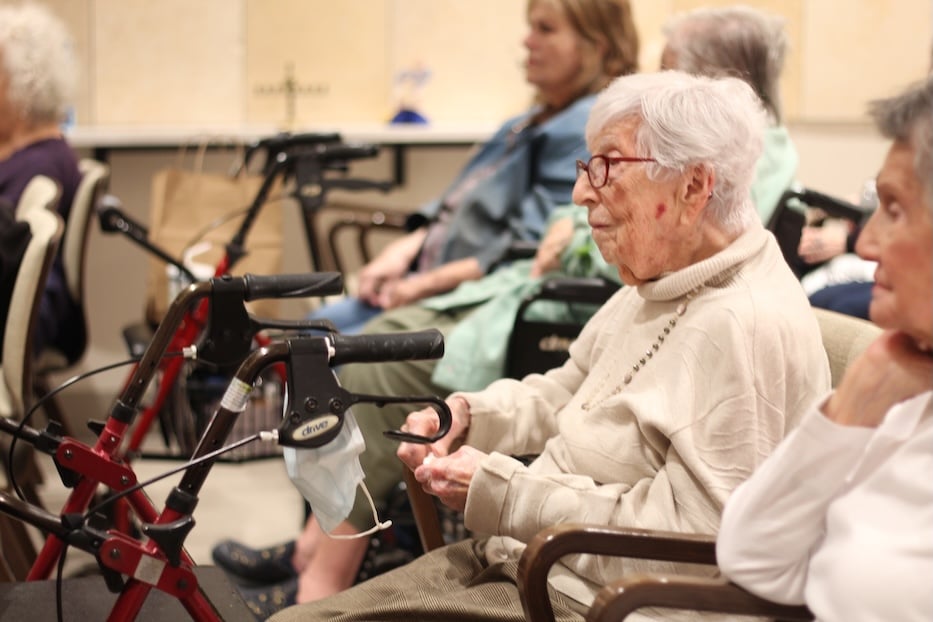
So too for 104-year-old Sylvia Rifkin, who moved into the Towers 16 years ago, and if asked can still dance a mean tango. This year, she’s been especially appreciative of the Towers’ nightly Hanukkah celebrations, from candle lighting and prayers to klezmer music, as she navigates new “aches and pains” that come with age.
“It’s been very nice, “she said. “We’ve really been celebrating every night. It’s a wonderful community. People care for each other.”
Growing up in Brooklyn, “Hanukkah was not as festive as it is now,” she added. The kids and her family didn’t get presents, but they celebrated every day. Now, the rituals connect her to not just memories of the past, but also the experience of the present. By “Ocho Kandelikas,” a Ladino tune that fêtes Hanukkah while weaving in a sultry tango, she swayed along to the rhythm, mouthing every word.
“I’m very distraught by the political scene,” she had said beforehand, and for a brief hour in the sanctuary, a person could feel that heavy weight lifting. “I just feel that this isn’t our country anymore.”
.jpeg?width=933&height=622&name=NHK_2025%20-%201%20(1).jpeg)
This year, the performances have also been healing for Chevan in ways he couldn’t have imagined. On the Sunday that marked the first day of Hanukkah—which also happened to be the day of his son Noah’s wedding—Chevan and his wife woke to the news of a mass shooting at Bondi Beach in Australia, where over 100 Jews had gathered to celebrate the first night of Hanukkah.
Chevan told himself that he had to compartmentalize, and help his son get down the aisle. But even as he helped set up the space, he kept refreshing the New York Times app on his phone to see if there were updates. The news, which came on the heels of a mass shooting at Brown University the night before, grew more unsettling the more he checked. After the joy of watching his son get married, he let himself feel the full weight of his grief—and the need to feel and address it through his work.
“The images have haunted me all week as the Nu Haven Kapelye has played at least one Hanukkah event every single day,” he said. “There is this way that music can transform us and heal us that goes beyond words, and I am grateful that we are able to do that for others.”
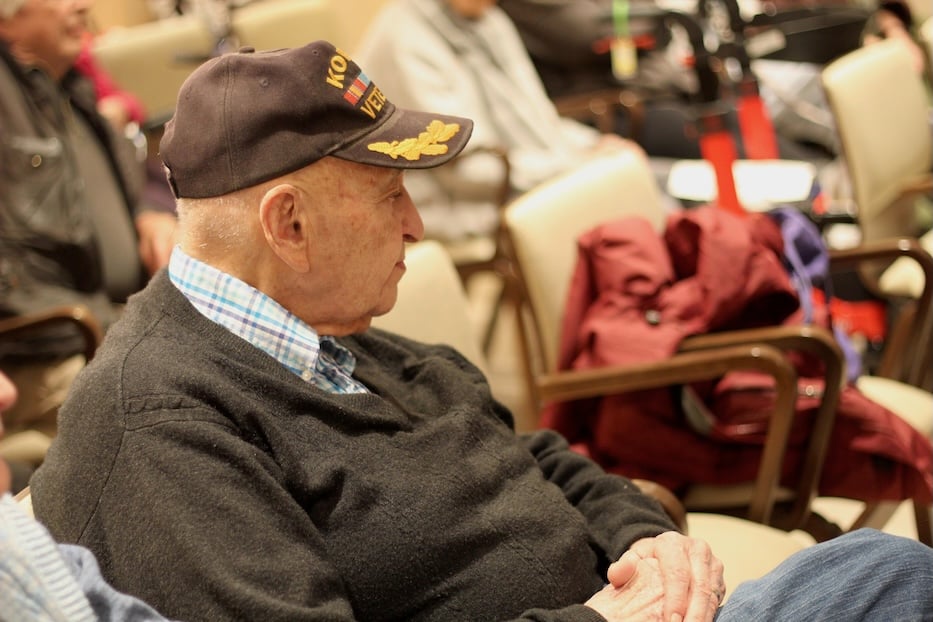
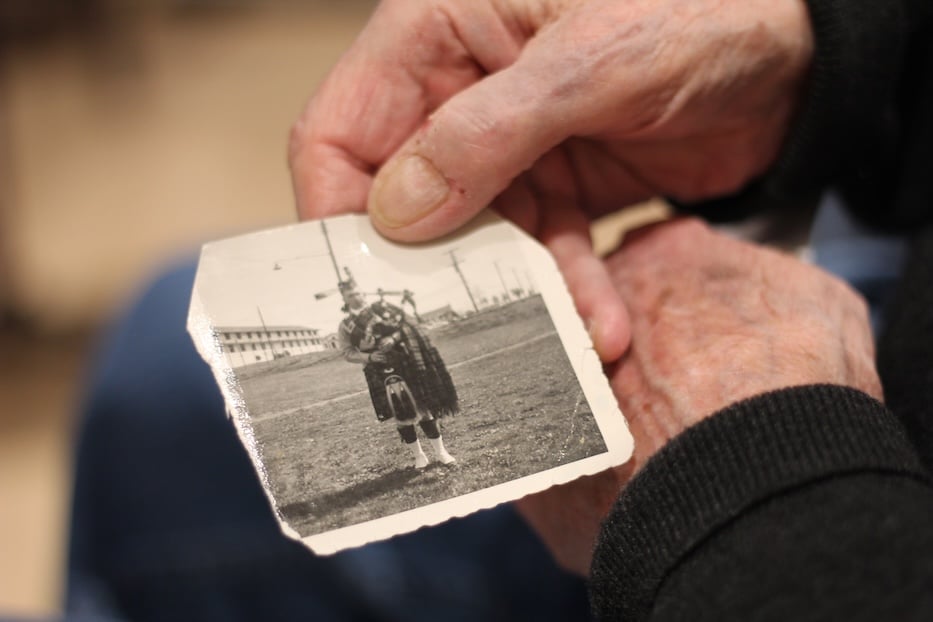
As they listened intently from the front row, husband and wife duo Simeon and Toby Gillman made those words feel alive. A lifelong New Havener—he traced his trajectory from Troupe School to James Hillhouse to UConn to the U.S. Army, where he played the bagpipes—Simeon had high praise for the group, which he’s enjoyed since he moved to the Towers two years ago.
When Rubenstein got to “Happy Joyous Chanuka,” it appeared that he and Toby might jump up and start dancing. Instead, they settled for a spirited clap. The two have been married for six decades, Simeon said with a luminous grin.
“I think this is important!” he said of the gathering, looking around at a crowd of attendees that included both Jews and non-Jews. “You have this crowd of different countries and beliefs,” all gathered to listen to music. “I think it’s so important to have people together like we do now. It’s important to build community.”