

Culture & Community | Jazz | Music | Arts & Culture | Yale University
Bill Shea Photo.
The samba starts with mellow piano, the notes dancing from side to side. Drums glide in, smooth and succinct. Just as the keys flow into bouncing, shimmering layers of sound, the bass begins to hum beneath them, so polite at first that it takes a moment to realize it’s there. As the piano rolls out, it steps forward, ready for its chance in the spotlight.
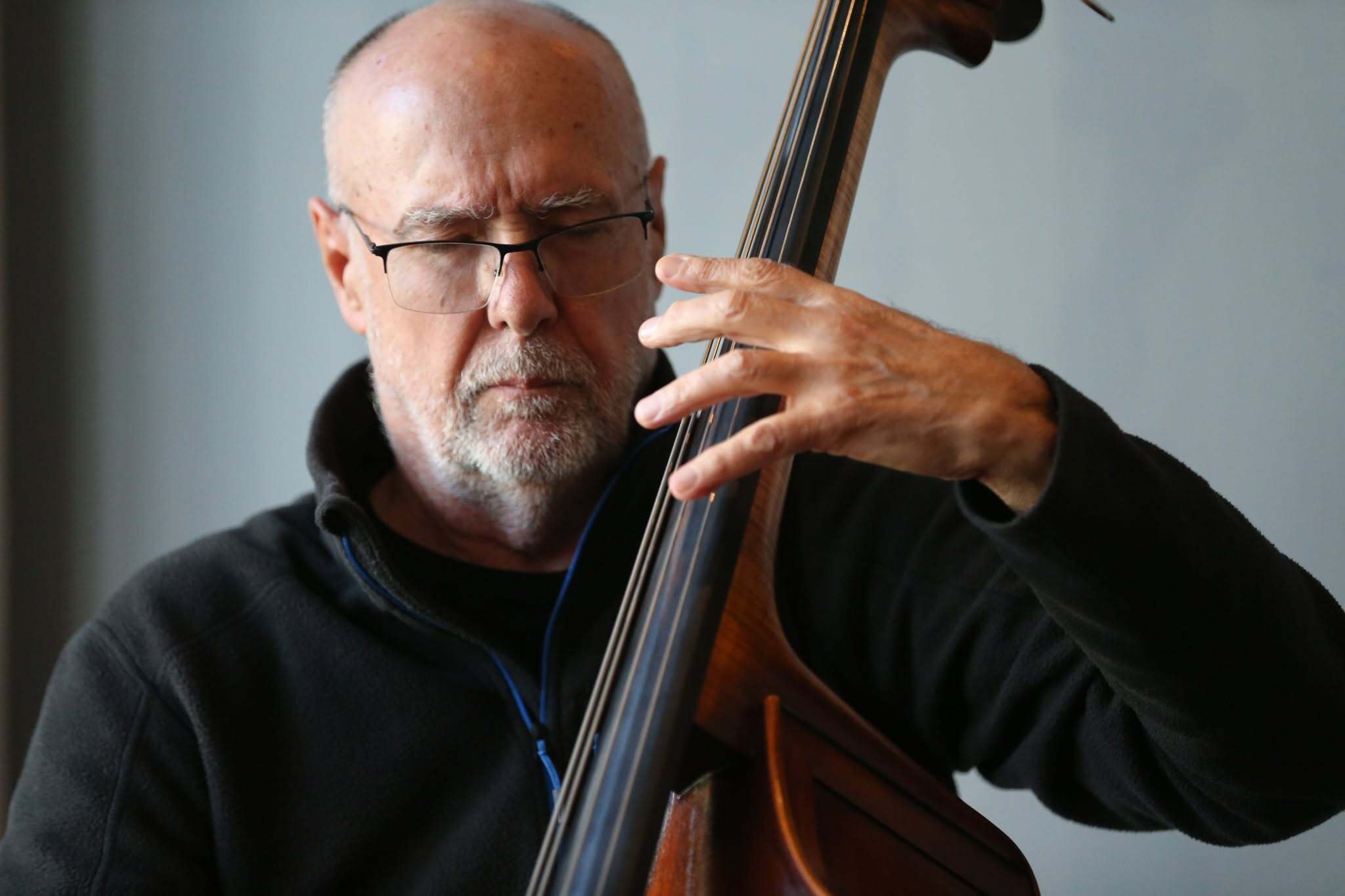
Bassist, musician and educator Jeff Fuller, who has lived in New Haven for four decades and played music for over seven, plans to bring that sound to the Morse Recital Hall next Friday night, as his group, Jeff Fuller & Friends, launches the 54th Ellington Jazz Series at the Yale School of Music. In a career that has criss-crossed the globe from Connecticut to Cuba to Germany and back, he’s excited to play a stage that he’s come to love.
Musicians for the evening will include Fuller on bass, Naomi Wharry on vocals and trombone, Haneef Nelson on trumpet, Nigel Regan on sax, Paul Lieberman on flute, Darren Litzie on piano and Ben Bilello on drums. Tickets and more information are available here.
Fuller’s love affair with music started when he was just a boy, growing up in Fairfield County. His father, the author John Grant Fuller, Jr., was an amateur pianist, with a deep fondness for jazz tunes and an interest in music theory that rubbed off on his son. At some point, Fuller started tagging along at jam sessions, getting into a groove as his dad played with his peers.
Even before he completely understood what it was, “I remember the excitement and the heat and the passion that these players played with,” he said on an episode of WNHH Community Radio’s “Arts Respond” last Friday. That love for music flowed through his mother’s side, too: his mother, Marion Hedrick Fuller, was a musician “who loved to sing the old standards,” which became Fuller’s introduction to the music of Ella Fitzgerald, Rosemary Clooney, Billie Holiday and Sarah Vaughn.
By elementary school, Fuller was immersed in music lessons, first on the violin, and then on the saxophone. He added classical piano, and then classical and rock guitar, when he was a teenager. When he fell in love with his high school’s jazz band—including jams with pianist Darius Brubeck, son of musician Dave Brubeck—there was no looking back.
Before graduating, he had also started to learn about Bossa Nova, a Brazilian cousin to jazz that bloomed out of the samba tradition. It opened the door to a curiosity that he’s still feeding decades later, from his studies of Indian music with S. Ramanathan to an interest in salsa that has taken him from Cuba to the hopping jazz clubs of New York City.
When Fuller began his studies at Yale University in 1963, “I took every music class that Yale had to offer,” he remembered. He soaked up knowledge in music history and music theory, then jumped right into performances with his peers. At the time, it was still primarily the guitar that called to him, he remembered: it was the instrument that made him feel most in his element.
“I did end up playing a lot of music in New Haven,” he remembered, including with the now-legendary Buster Brothers, guitarist Wayne Boyd, James “Dinkie” Johnson and living jazz legend Jesse Hameen. “Any kind of jazz gig, I tried to get on it.” When he finished his undergraduate studies, he stayed on at the Yale School of Music for a degree in composition, using jazz “as a way to express myself.”
Around him, New Haven’s jazz scene was still vibrant, from the historic Monterey Club on Dixwell Avenue (although it was by that time slowing down, and closed for good in the 1990s) to Blue Bartz (now Café 9), to the Foundry Café on Audubon Street and Erica’s nearby.
Initially, playing the bass seriously never crossed his mind (although, as he pointed out, the violin is just a tiny bass, so maybe it was always predestined). Then when Fuller was 28 and gigging as a professional musician across Connecticut, three bassists all left New Haven at the same time. He could feel their absence, he remembered—and stepped in to fill a gap. He found an old Juzek bass for sale, and within months was hopping around to performance venues.
“I did theater gigs at the Shubert, I did weddings and society gigs and jazz gigs,” he remembered. “The jazz people who were doing gigs at that time were people like Sonny Costanzo … [they] would bring in guest artists to play with the local trio.”
Before long, Fuller was an essential part of that go-to trio, along with musicians Frank Bennett on drums and Tony Purrone on guitar. The group gave him a chance to play with professional, big-name musicians who rolled through New Haven, including the late Phil Woods, Frank Foster, an elder Teddy Wilson, and the still-living jazz trumpeter Jon Faddis.
In the late 1970s, Fuller—like Hameen, who left New Haven and then later came back to it—went on the road for the first time. In those years, he was playing in a jazz series at Erica’s that had been organized by saxophonist Allen Lowe, who is another of the region’s longtime and living jazz legends (Lowe and Fuller now both bless Best Video Film & Cultural Center monthly).
It gave him the chance to play with many musicians, including saxophonist Lou Donaldson and drummer Billy Kaye. From New Haven, he traveled with them to New York City, where they played a still-young version of the Greenwich Village jazz club Sweet Basil. Ultimately, he remembered, it bloomed into a 15-year collaboration that took him across the country, and then around the globe.
It was “a PhD in jazz history,” Fuller recalled. In part, it was the music itself—Donaldson pushed Fuller as a jazz musician to deepen his practice, and he did every time he got onstage. But it was also the people Fuller was able to meet in New York and as the group traveled, who each gave him a master class (or many) in jazz history and the genre’s collision with the Afro-Latino diaspora.
As he played with Donaldson, for instance, he was also learning about the Latin bass with guitarist Mike Glick and percussionists like Gene Golden and Frankie Malabé, who have since both passed on. In 1978, that music took him to Cuba for the first time, where jazz jam sessions came in piping hot, with now-beloved names like Pedro Luís Ferrer, Chucho Valdez and Paquito D'Rivera.
“A lot of times, I’m just happy to be in the right place at the right time, he said. “I thank my lucky stars for those opportunities … Music by itself is a language, a language that happens to involve pitch, rhythm, form, harmony, timbre, all of the various parameters that make music music.”
Those connections have helped build a career that is both local and global. After meeting D'Rivera in Havana, Fuller reconnected with the musician in New York City, and ultimately played with him for six years. Through his work with Donaldson, he crossed paths with Chilean-born, Germany-based saxophonist Raúl Gutiérrez, who had played with Tito Puente before leading Grupo Irazu. During a residency at New York’s West End Café, he played with “Papa” Jo Jones, who had been the drummer for Count Basie.
In 1986, Fuller returned to New Haven with an interest in music education. For two decades, he taught music composition and theory at the ACES Educational Center for the Arts, teaching young phenoms including the Sands brothers, Ryan and Christian (with whom he has continued to collaborate professionally), Zwelakhe-Duma Bell le Pere, and Marty Peters among dozens of others.
Just across the street, he also began to lead the Premier Jazz Ensemble at the Neighborhood Music School (NMS), where the organization’s storied and beloved jazz program has grown for over three decades, and raised generations of musicians.
“Jazz is so expressive, and so much in the moment, and that’s what I really love about it,” he said, adding that he’s been grateful to serve as an educator long enough to now play with many of his former students. “It takes passion and saying, ‘I’m gonna do this. Nothing is gonna get in my way.’”
Next Friday, New Haveners will have the chance to see and hear that in action. Fuller is no stranger to the Morse Recital Hall stage: he’s played bass for several of the musicians who have appeared in the series, which began in 1972 with the awarding of 30 Ellington Medals to prominent Black musicians such as Max Roach, Dizzy Gillespie, Benny Carter, and Milt Hinton.
Of the musicians who have received Ellington Medals, Fuller has played with 17 of them, including Gillespie, Papa Jo Jones, Dave Brubeck and of course, his mentors Donaldson and D’Rivera. In recent years, he has been particularly excited to see the annual series honor several hometown heroes who are also world-class musicians, including Hameen and Christian Sands.
“For me to put together this band, I wanted to honor the musicians I’ve been playing with for a long time,” he said. In addition to several of his own compositions, they’ll be playing some favorites from his time with Donaldson and D’Rivera, and may fold in some of Ellington’s work as well (in a kind of kismet, Ellington received an honorary degree from Yale the same year that Fuller graduated, in 1967).
While that began with a trio he’s played with for 13 years—that’s Litzie on piano and Bilello on drums—it has grown to a full septet. Wharry, a recent graduate of the Yale School of Music who is the principal trombone for the Boston Ballet, is “an amazing trombonist, but she’s [also] an earthy singer.” Regan was his student at ECA, and went on to study jazz at University of North Texas. Nelson, a composer, musician and educator, is bringing a sound that is more known in Hartford to New Haven. Lieberman, meanwhile, is an old friend and fellow Yalie.
Professor Tom Duffy, who has directed the Ellington Jazz Series for the past eight years (prior to that time, the program unfolded under founding director and musician Willie Ruff) and led the Yale University Bands since 1982, had high praise for Fuller. In a phone call on Tuesday afternoon, he said he’s excited to welcome Fuller for the first concert of the year, and to recognize his sheer talent in the heart of downtown.
“There is a fairness and logic of finding our own heroes, and starting the year [with this concert] is saying, ‘This is a jazz great … he has credentials that are amazing,’” he said. “The rightness of this is overwhelming.”
To listen to the full interview on WNHH-LP, which hops from Cuban jazz to basketball to yoga to sobriety, click on our download the interview above. Jeff Fuller & Friends kick off the 2026-27 Ellington Jazz Series on Sept. 18 at 7:30 p.m. Tickets and more information are available here. To learn more about where Fuller is performing each month, subscribe to his newsletter here.