

Culture & Community | Arts & Culture | Neighborhood Music School | Community Heroes
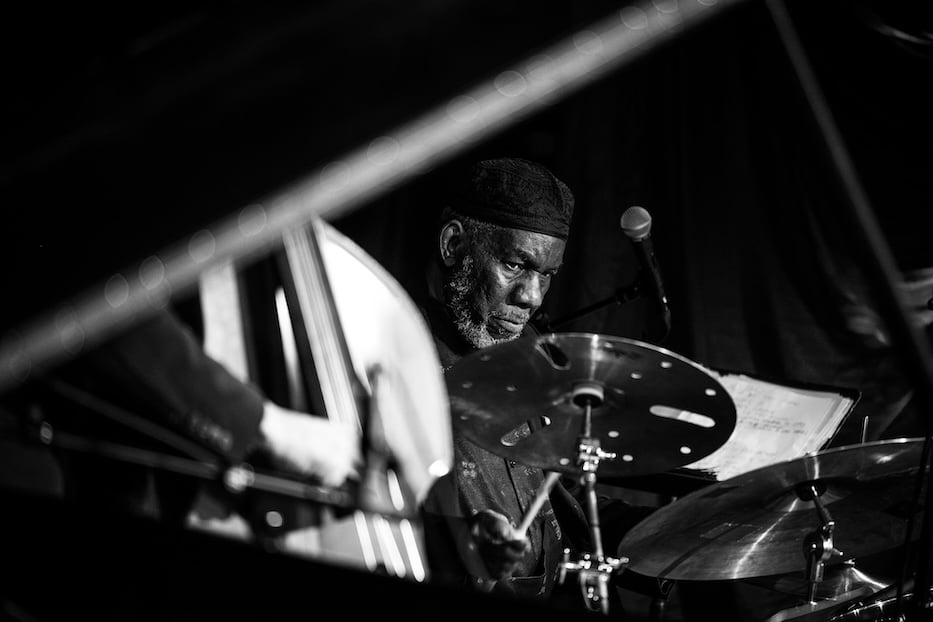
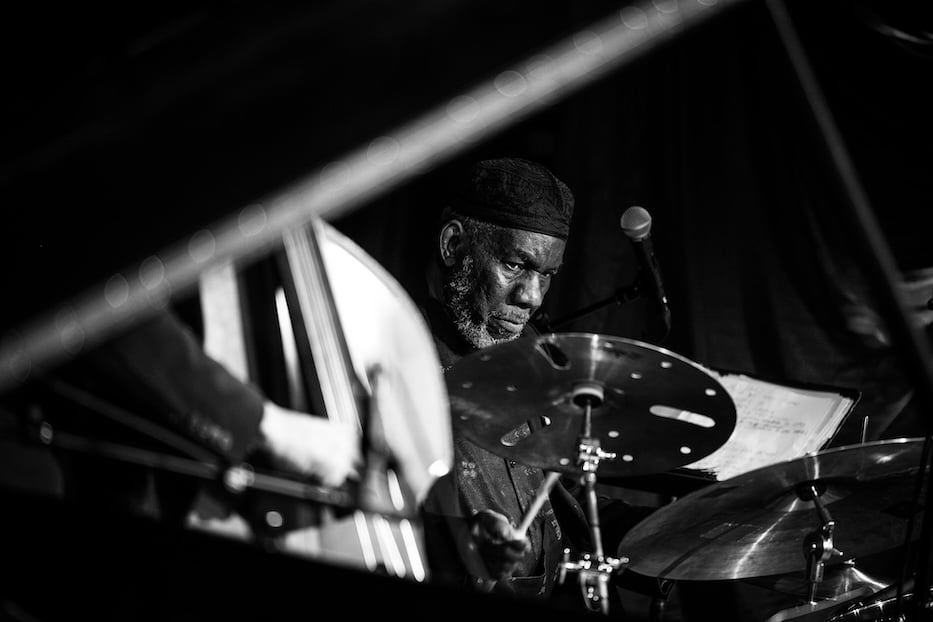
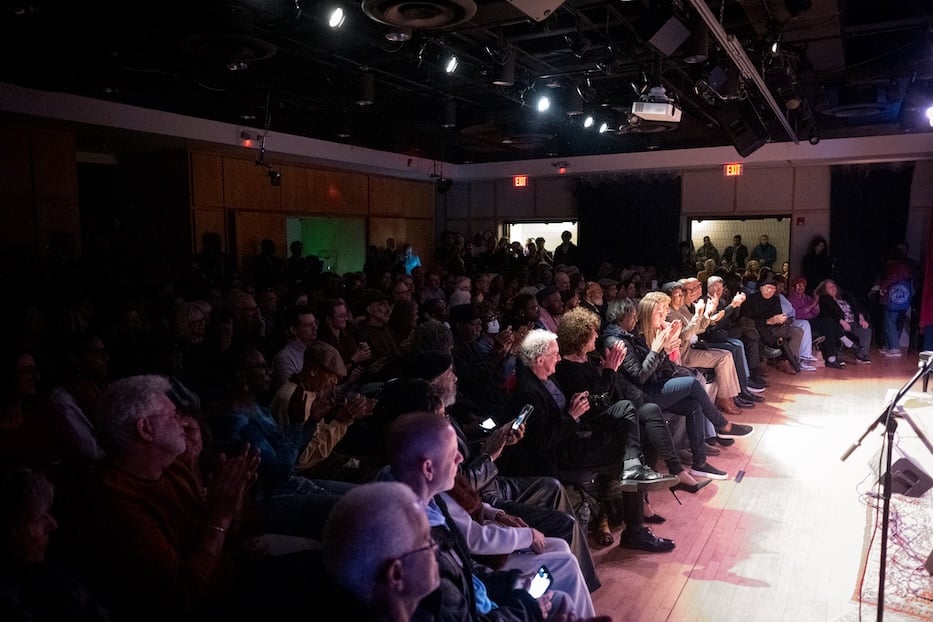
A night of musical journeying filled the Neighborhood Music School (NMS) Friday, as Hameen rang in his 85th year with a standing-room-only crowd of friends, family, students and fans that spilled out into the hallways and on to an overflow area. Held to honor a master of his craft and generous mentor in the field, the evening fused performance, tribute, and of course, a candle-studded carrot cake well before the end of the night.
“Thank you all for being out here,” Hameen said at the top of the night, wiping his brow with a smile. “I want you to kind of get into it with me, so you know where I’m coming from.”
The night has been, well, 85 years in the making. Born Jesse Kilpatrick, Jr. to Jesse and Catherine Kilpatrick, Hameen grew up in New Haven’s Dixwell neighborhood, at a time when it was still a jazz hotspot and self-sustaining hub for Black business, arts and culture. Even as a small child, he had that keen, otherworldly sense for rhythm, beats delivered alongside his first words. Or as his parents often told him, he was playing “soon as I came out the womb.”
Around him, the music scene was thriving. Less than a decade before Hameen’s birth, Rufus Grenlee had opened the Monterey on Dixwell Avenue, where it remained open until the early 1990s. The Buster Brothers, just a decade or so older, were still just kids themselves. Soon, other venues popped up in the neighborhood, like the Golden Gate, the Democratic Club and a few years after that, the Playback and Malcolm’s Jazz Café.
Hameen’s first exposure wasn’t in those clubs, although he later graced many stages both in and far beyond New Haven. Instead, his first musical home was the Winchester School, a brick building that rose off Gregory Street until 1952, and then moved to 209 Dixwell Ave., close to where the new Q House now stands. As a student, Hameen learned to play percussion on old Chock full o’Nuts coffee cans, later moving on to learn “hambone,” a centuries-old Black rhythm technique that uses the body as an instrument.
As he looked out over the audience, he jumped back at least a century, to a time Black families would share or reuse a hambone to stretch the flavor and function, from the meat to the marrow.
Stephanie Anestis Photography Photos.
When he began to sing—Hambone, hambone, where you been?—populized and preserved by musicians like the late John Dee Holeman, a few members of the audience joined in, watching mesmerized as his hands flew from his lap to his chest to his knees and back. Around the world and back again. On the piano, Zaccai Curtis (who won a Grammy last year, Hameen said glowingly) joined in with a kind of soft, bouncing accompaniment.
He was also surrounded by rhythm each Sunday in church, as his family joined other Baptist worshippers in the pews at Pitts Chapel, a Brewster Street institution that has been in New Haven since 1914 (Hameen, who is Muslim, did not convert until he was older). As he spoke, he reached for a tambourine, and the bright, glittering sound filled the room.
“So now, in my music, you might hear some of this,” he said, playing out the same rhythm on a drum kit that felt like a mere extension of his body.
By 1951—or maybe it was 1950, he said with a big, broad smile—Hameen was playing in a band at his school called the Cuban Nights, dressed to the nines each time the group performed. Back then, he didn’t know that he would be playing for the rest of his life. He just knew that it felt instinctively right, like breathing.
Three quarters of a century later, he’s become one of the living legends he once admired.
In between, it was some of his own idols—Houston Person, Vernon Biddles and Frankie and Sonny Williams chief among them, who helped get him there. Hameen remembered rehearsing with them when he was still very young, and insisting that he wasn’t ready. He offered to practice for another year, and then return. Fellow musicians cursed him out.
“They said, ‘You don’t even know what’s going on!’’ he recalled to rolling laughs. “Said, ‘If we wanted them, we’d train them! We training you! When we get through with you, you can go anywhere!’ So sure enough, when I went to New York, I was like Mike Tyson, hitting hard … floating like a butterfly like Muhammad Ali. I took New York by storm.”
“Everywhere I went, I’d tell everybody, New Haven did this,” Hameen said.
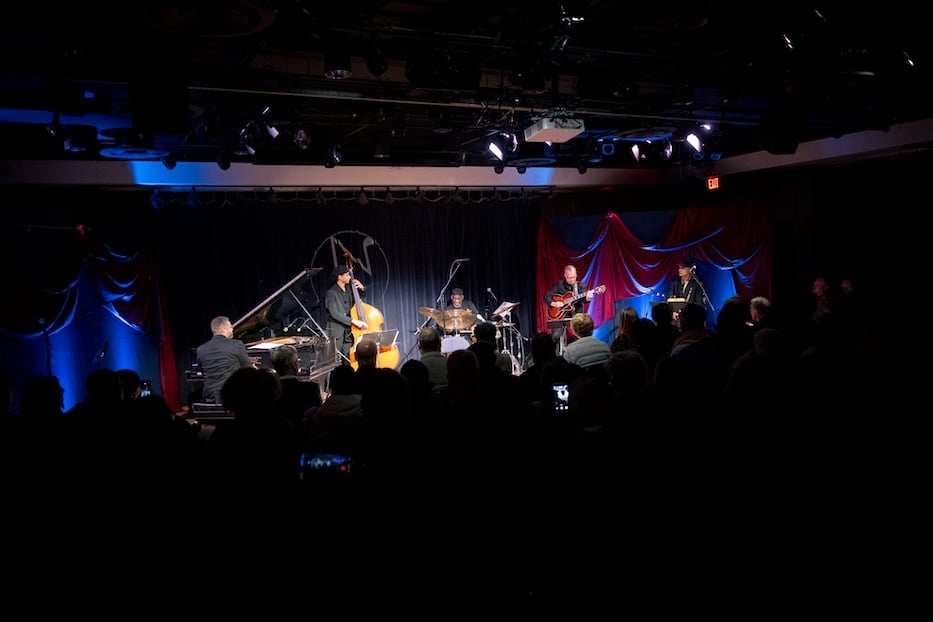
That love for the place that raised him was fully on display as the band dipped into “Sign of the Times,” off Hameen’s 2008 album of the same name. As Hameen counted out a clear, spirited “One! Two! A-one-two-three!” musicians slipped into a steady groove, Rodney Jones laying down a rich, bouncing sound on the guitar as Curtis joined in on the piano, and bass rolled and rumbled its way in. It was mellow, soft but sizzling in Zwelakhe-Duma Bell Le Pere’s hands. Beneath it, drums and cymbals began a joyful, polite two-step with each other, Hameen beaming as he played.
From Hameen’s left, musician TK Blue stepped into the spotlight, with flute that was at once muscled and delicate, a kind of warbling that could have come from a Wood Thrush in one moment, and the deep, delicious blue-black of a club like Barbès in another. It wrapped musicians in its sound, so light that it seemed one with the air itself. That Blue has looked to music’s ability to heal is not surprising here: by the time he had set down the flute for his sax, he and fellow artists had the room in a trance. Only applause and the occasional Oh! or Yess! Or Come on now! drifted through the space, listeners dancing along in their seats.
Musicians were just getting started. Picking up the saxophone as Jones and Le Pere had a whole conversation, Blue hopped back in as if no time had passed, the sax buttery smooth as it dipped into a low register, then jumped back up towards its brassiest edges. Around it, the bass thrummed, answering to a guitar that sounded almost bell-like. The drums, cool and steady, wove through it all, knitting the piece together. It was only later, as Hameen took a solo, that they seemed red-hot, not angry but ready to speak out all the same.
Surely, the room could feel the conversation as it unfolded. Le Pere leaned in, his hands traveling up and down the long neck of the bass, and he looked as though he was praying, swaying just slightly as he closed his eyes, and his mouth fell slightly open at the sound. To a fierce rumble of the snare drum, Hameen pursed his lips, whispering to himself as he traveled from drum to drum to cymbal, and then back again.
Stephanie Anestis Photography Photos.
Jones, seated to his left, placed his hands on his guitar and listened with a kind of reverence. In the audience, other attendees took note: there was ample head-bobbing and shoulder rocking that became a full body experience by the end of the first number. In the second row, arts reporter Jisu Sheen, in a rare moment off the clock, let herself move in time with the music. Around her, the sound became a balm, hundreds of years of music knowledge floating through the room.
When, after the piece, Jones mused of Hameen that “he’s a great musician, but he’s a greater man, I can tell you that,” murmurs of agreement rose instantly in response.
It’s Hameen’s willingness to share that knowledge with others, including in the NMS summer jazz program that he has helped run since 1998, that has made him not only a masterful performer, but also a mentor to hundreds of artists in New Haven and across the region. During his time on the road, Hameen has played with artists like Lena Horne, Gloria Lynne, Brook Benton, Charles Brown, Leon Thomas, Kenny Burrell and many others.
But no title has perhaps suited him as well, and as naturally, as teacher. During his time building out NMS’ summer jazz intensive, Hameen has coached generations of musicians through the program, many of whom are now educators themselves. Friday, they included faces like Le Pere, an internationally recognized bassist who came up through the program, and drummer Ryan Sands, who is carrying the tradition forward for another generation of artists.
As he took a seat in the hallway Friday, master drummer Brian Jawara Gray marveled at the years he’s spent learning from and collaborating with Hameen, who he looks up to as a sort of older brother.
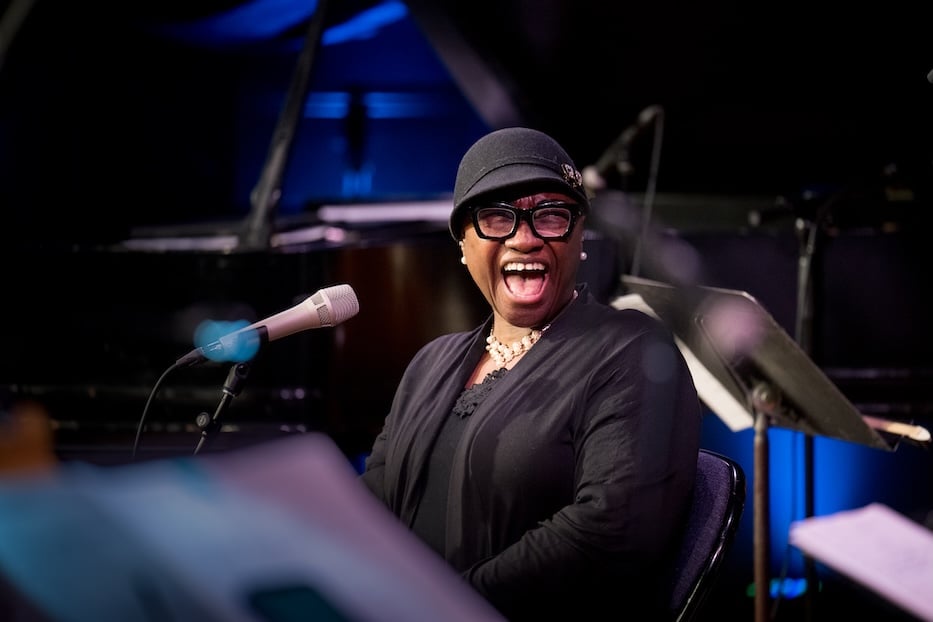
Joy Brown. Stephanie Anestis Photography Photos.
“I stopped counting!” Gray said with a laugh when asked how long he and Hameen have known each other. The two, both raised in New Haven, are almost exactly 13 years apart: Hameen turned 85 on March 17, and Gray turned 72 on March 19. In those early years, Hameen was the reason Gray wanted to be a musician; the two would visit and jam together when Hameen came home from his time touring. The age difference between them fell away the older they became.
“He was out there playing when I was just tappin’ on the drums,” Gray said, adding that their approach to drumming—“it’s like breathing”—has become similar over the year, despite working across different parts of a diasporic tradition. As the group began to play the composition “Sirius B,” named after a white dwarf star of the same name, an audience member could feel those words in real time. “I always looked up to him.”
NMS Director Noah Bloom, who has led the organization since 2019, praised Hameen as warm and generous, with a care for colleagues and students that is as rare as it is contagious. When Hameen steps into NMS for his weekly roster of classes, Bloom said, he makes a point to check in on every person in the building. He extends that kindness to his students. That’s just the kind of person he is.
“I can't overemphasize that as an educator and as a human, he is on a quest to have everyone take themselves seriously,” Bloom said in a phone call Sunday afternoon. “Jesse just sees potential in all of us, at all levels. That he has time for everyone, in an era that we're all distracted … to have someone who can take the time for everyone is amazing.”
“Jesse has this saying, ‘I gotta share all this knowledge while I'm still alive,’ and that’s the epitome of who he is. He’s one of the most selfless people there is. He means so much to so many people.”
Friday night, one of those people was vocalist Joy Brown, a jazz phenom who also graced NMS’ Audubon Street stage at an outdoor celebration of jazz last summer. Introducing her as “the best there is,” Jones invited her up to the stage to thunderous applause, the audience ready to welcome her back to New Haven. Brown, beaming with a laugh that was at once girlish and grown, seemed right at home, her back arched as pearls glimmered against a black dress, dainty cap, and matching jacket.
“I’m honored to be here, and I’m honored to sing for this great man, Jesse Hameen,” she said. “I’m telling you, this is a privilege for me. A privilege and an honor—along with the rest of the band. Everyone’s just wonderful.”
No surprise that she did not disappoint. As drums, guitar and bass rolled out a carpet of sound command—two snaps was all it took—Brown dipped into her deep bag of musical tricks, and came out with George and Ira Gershwin’s “Our Love Is Here To Stay,” the most well-known version of which may be a 1957 adaptation from Ella Fitzgerald and Louis Armstrong. Piano entered the fray, walking that tightrope between sassy and soft. As sax swirled around her, she let the lyrics carry her voice across the room, no crack or crevice left untouched.
The ra-a-a-d-io and the telephone—her voice neared a delicious, polite climax, and then dipped right back down—And the silly movies that we know/ May just be passing fancies / And in time may go!
She had hit her stride, driving the band forward. But oh, my dear! Ah! Our love is here to stay / Together we're going a long, long way! As the audience grooved along, the lyrics felt right on time. One woman, so moved by the sound, stood to dance, pulling her chair closer to the front of the room before she sat again.
The night was still young. And there was so much partying (and cake, grace à Adrienne Kane of Itty Bitty Bakery) left to do. So it was only right when Hameen brought the crowd back from intermission with his song “Thank You,” which is guided by his deep faith and care for the people around him, including those who were not always as kind as he was in return.
“It’s saying, ‘Thank you, all you people, for the good things you have done for me.’ My life has been so wonderful, God has really showered blessings on me,” Hameen said. Noting that a second word for faith is “Iman,” he thanked his wife, fellow artist, filmmaker, organizer and chronicler of Black life and history Iman Hameen, for her deep love and constant support, remembering the story of when the two first met in the 1970s
“I have traveled to many places, and that knowledge has helped me to grow,” he said to the room, quoting the lyrics before he went into the piece, and dazzled with a second set. “I have faith in the human family, and that’s something I want everyone to know.”