

Culture & Community | Dance | Downtown | African Drumming | Arts & Culture | Yale University

Lucy Gellman Photos.
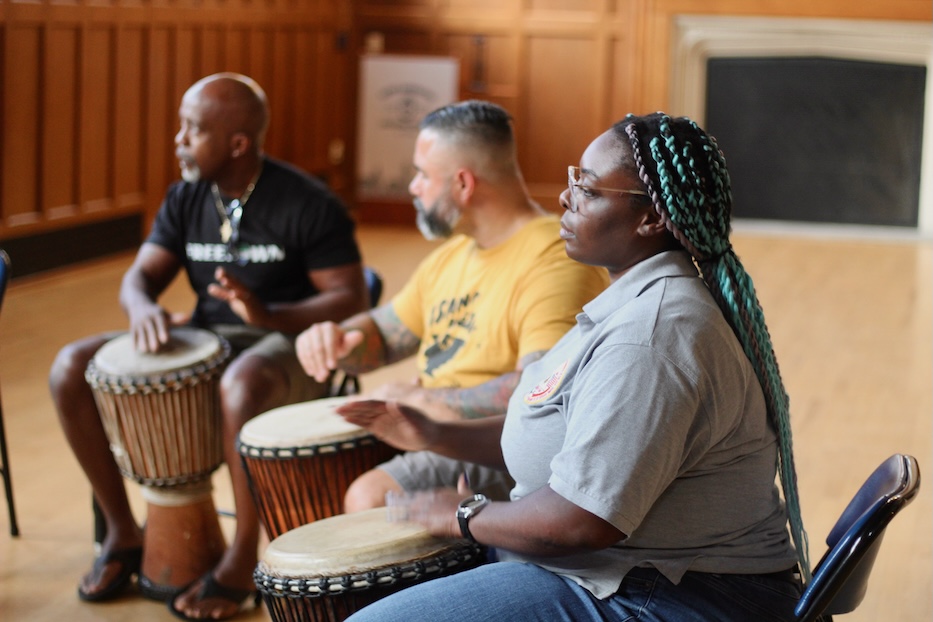
Shantel Green sat down at the djembe, a weight lifting as she straightened her back, and pressed her hands to the taut drumskin. She took a breath in, and then listened for an opening. Halfway across a circle of chairs, Brian Jawara Gray and Grey Freeman had already begun to play, their hands soaring through the air. As Green joined in, the drums started to speak, the sound filling up the whole room.
Green, a systems engineer by day, is a regular at African drum and dance classes at the Afro-American Cultural Center at Yale, where they unfold every Monday evening through the Artsucation Academy Network and Blackfist Music Productions. The mellifluous brainchild of Gray and Dr. Hanan Hameen Diagne, they seek to spread traditional African arts and culture while also creating a safe, all-ages educational space, including for adults who may not otherwise have the time to plug back into the arts.
Classes run from 6 to 9 p.m. at 211 Park St., with the first 90 minutes dedicated to drumming, and the second 90 minutes dedicated to dance. The cost is $15 for each session for community members; Yale students can attend for free with a school I.D. Now that Yale is back in session following winter break, they have resumed. Learn more here.
“It’s about building community,” said Hameen Diagne, who has invited colleagues like Kim Holmes and Shani Collins to teach when she is in Senegal, where she spends part of the year. “Shutting everything else out and getting into your holistic and spiritual self, about just learning and being together. We are sharing history … this is how our teachers received it.”

The classes in their current iteration have been years in the making—and need a steady flow of students to keep going. For years, classes took place on the weekends through the New Haven School of African Drum and Dance, which brought them back after Covid-19 forced students to go remote (Seny Tatchöl Camara, who learned to drum before he could walk, co-taught those classes with his father, Aly Tatchöl Camara).
But those ended in the spring of 2023, and there was a void. As longtime colleagues and collaborators, Hameen Diagne and Gray formed the New Haven African Arts Alliance, giving summer classes at Bregamos Community Theater after their vibrant Juneteenth celebrations on the New Haven Green. When classes at Yale resumed that fall, the two found a home at the Cultural Center, where they have been since. Classes take a hiatus in December, during exams and winter break, and again in the summer.
“It’s all of these connections taking place,” Hameen Diagne said, with a reverent nod to Black dancers and dance educators like Katherine Dunham, Pearl Primus, and Chuck Davis who transformed how she understood and lived her life within the art form. “It opens doors and [fosters] that diasporic connection.”
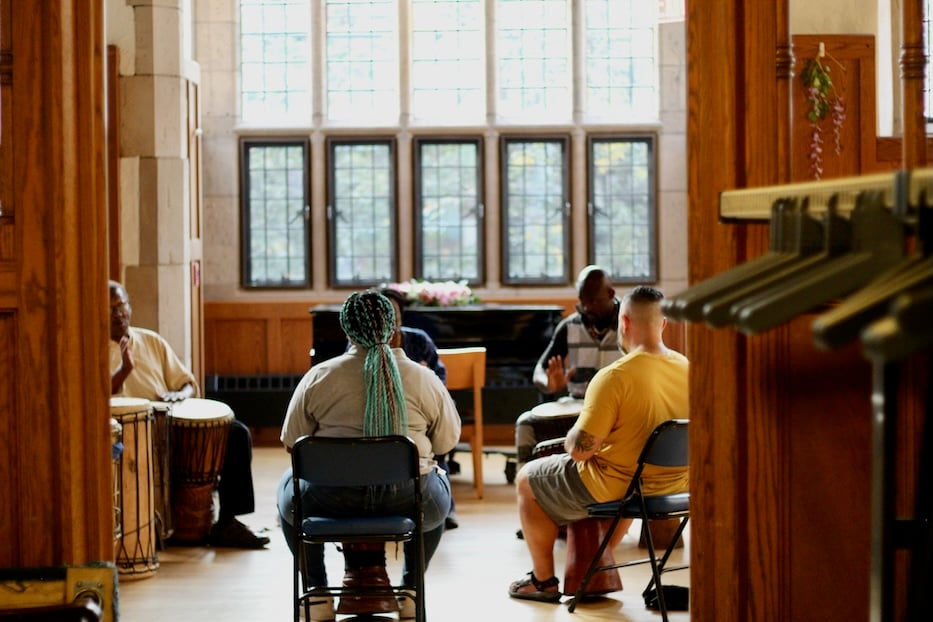
On a Monday night last fall, that sense of exchange was fully on display as long rays of sunlight fell across the floor, and students began to trickle into the room as Gray finished setting up. Green, who first found Gray’s classes four years ago during the Covid-19 pandemic, got comfortable in a chair, slipping herself easily around a djembe as if it had always belonged there. There was a conversation that was about to begin, and she was very much ready.
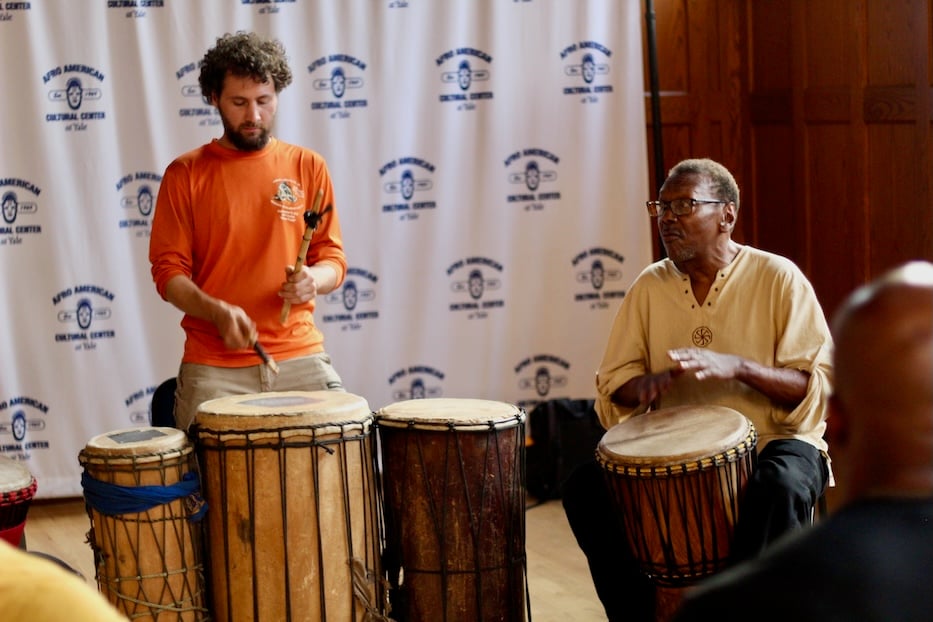
Grey Freeman and Brian Jawara Gray.
She smiled, a kind of recognition that said, even from behind her glasses, I needed this today without any words at all. Then she began to listen, joining in with a clear, sharp focus on the rhythm that had the drum singing beneath her palms.
Every so often, the glossy, bright bands of color on her nails glinted in the fading light. The room, quiet just minutes before, became a back-and-forth, drumbeats weaving in and out of each other. If a listener closed their eyes, they could see a tapestry in reds and oranges beginning to form, the thread still silky as it made its way quickly across the fabric.
A few seats away from her, Gray was just getting started. Ta-ta / duh-duh-duh-duh the drums crooned, their voices high and light, and Green responded back with the same rhythm, the sound rolling in and out of the foundation Gray had laid. In between them, Freeman played a trio of djun djuns, a pair of mallets bouncing in his hands. To the sing-song back-and-forth Gray and Green had created, he churned out footfalls, sharp and insistent.
The sound swelled as students trickled in, some taking a seat and beginning to play as their own sort of hello. By 6:30 p.m., eight people had materialized, with some who had driven from as far as Simsbury, Watertown and New York to be part of the community. By 7 p.m., there were so many that Gray had run out of chairs, and nobody seemed to mind. When he paused to give feedback, a few exchanged hugs and big, broad smiles.
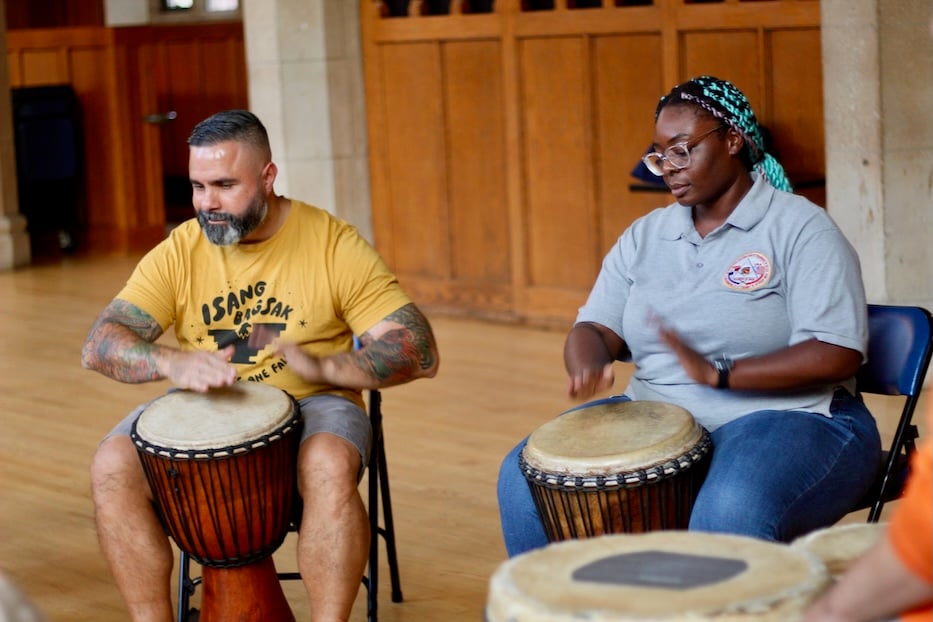
“You need a clearer tone,” Gray said gently to Green and Edgardo Figueroa, who had rolled in sometime during the first 30 minutes of class. “I don’t want to hear hands. I want to hear drums.”
He took a beat, and then brought down his hands once, twice, three times, palms outstretched and so delicate that it seemed they could have been birds. He nodded to Green to try it out, making a quiet, nearly purring “uh huh” sound when she did.
Figueroa, whose family hails from both Willimantic, Conn. and Aguadilla, Puerto Rico, later said that feedback is one of the things he values about the class, as he deepens a craft that connects him to his own Afro-Caribbean cultural heritage.
“It’s a new skill set, an expression of art, an opportunity for me to be expressive,” he said before returning to the task at hand. And it is: to play with a master like Gray is to also learn and respond to a history of forced migration, cultural heritage, and diaspora that is still unfolding. “I feel grateful to have Jawara as an instructor.”
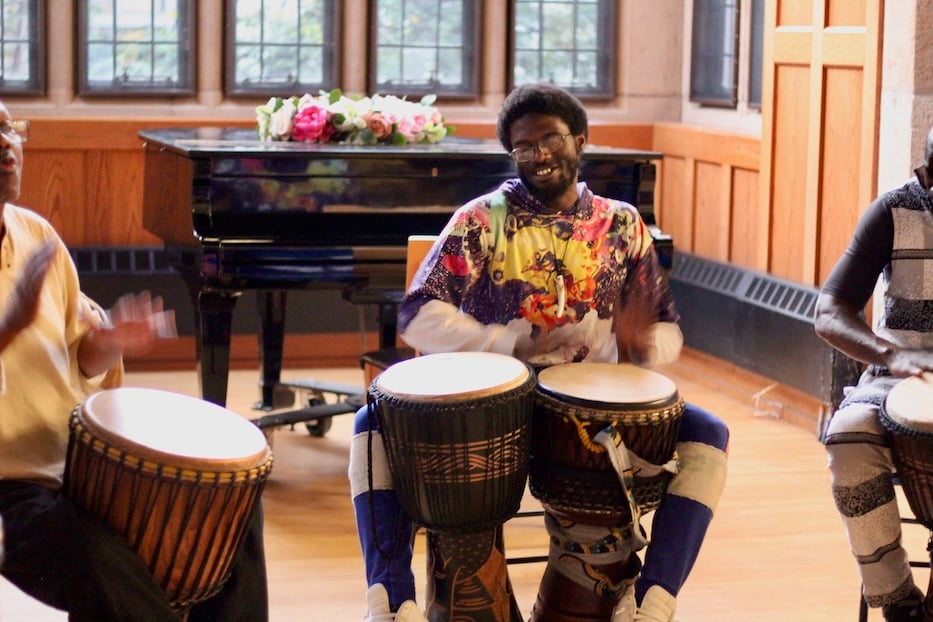
Gray smiled at something he’d spotted out of the corner of his eye: a beaming Seny Tatchöl Camara, all grown up and still baby faced, had entered the room, radiating light. Colors swirled on his sweatshirt, and for a moment it felt like the universe had stopped to recognize the moment, a beloved returning to exactly where he was supposed to be. He bowed at Gray, then fit two hand-carved djembes, one wrapped in strips of batik fabric, between his knees. Within seconds, his hands were flying, the sound undulating through the room.
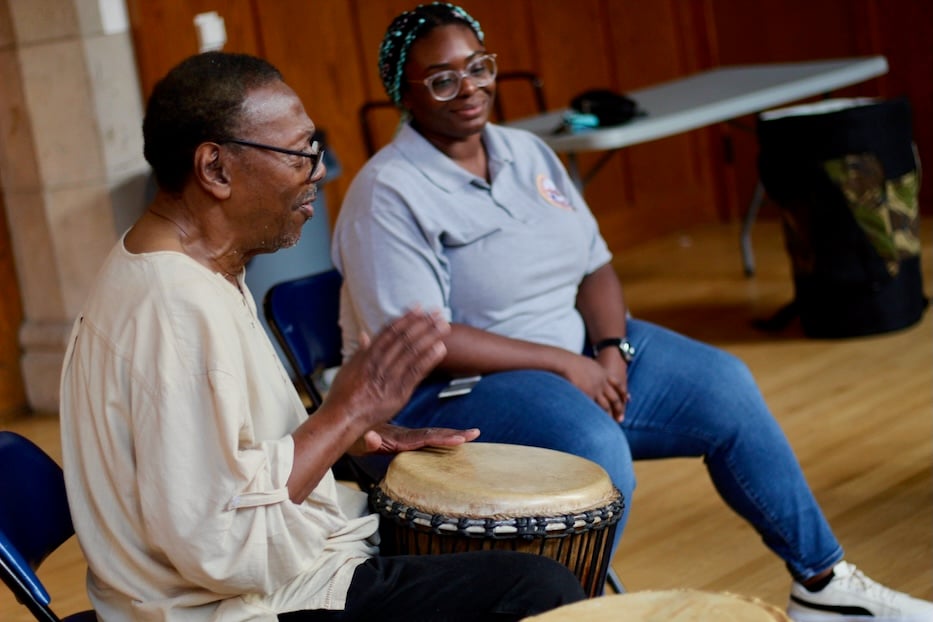
That’s precisely the kind of community Gray seeks to create, he said in an interview in the building’s tight kitchen, the sound of feet shuffling across the floor outside as Hameen Diagne prepared to take over (Gray and several of his students often stay to provide live accompaniment, as they did on this Monday night). Like Hameen Diagne, he learned through apprenticeship and embodied practice. Now, he sees it as a duty to keep the music going.
Growing up in New Haven, he started drumming in elementary school, when a certain Mrs. Cunningham encouraged him at the former Conte School, he said. What began as a music class bloomed into an entire love story; Gray (who most New Haveners know simply as Jawara) was soon learning from mentors like Baba Paul Huggins. He knew the Afro-American Cultural Center in its early years, when Khalid Lum was still figuring out how to bridge town and gown through the space.
“There was a social value to it,” he said of drumming. Well before his music brought him to Conakry, Guinea and to Morocco, well before he saw Sunny Adé and knew what he wanted to do for the rest of his life, New Haven was all the diasporic education he needed. “It was something that fully kept me from being in the street. I learned a lot right here.”
Part of that learning, he continued, was the realization that someone had to carry on Huggins’ legacy and teach the next generation of artists (“During the summer, the Center closes down, but the culture don’t close down!” he said with a knowing smile). In New Haven, “it’s not a priority,” he said of drumming education, or teaching the diaspora. Hameen Diagne, who is also known for her “Africa Is Me” curriculum, felt like a natural collaborator: the two have worked closely together for years.
“Every drum has a different purpose,” Gray said, pointing out how the djembe, the djun djun, the sangban and the kenkeni, the shoulder drum and the talking drum all have different voices.
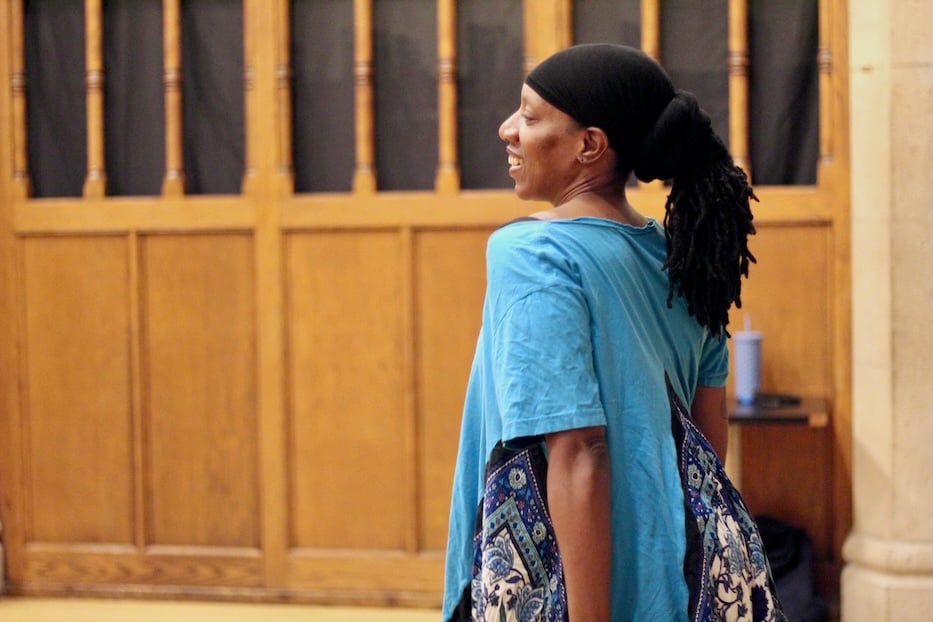
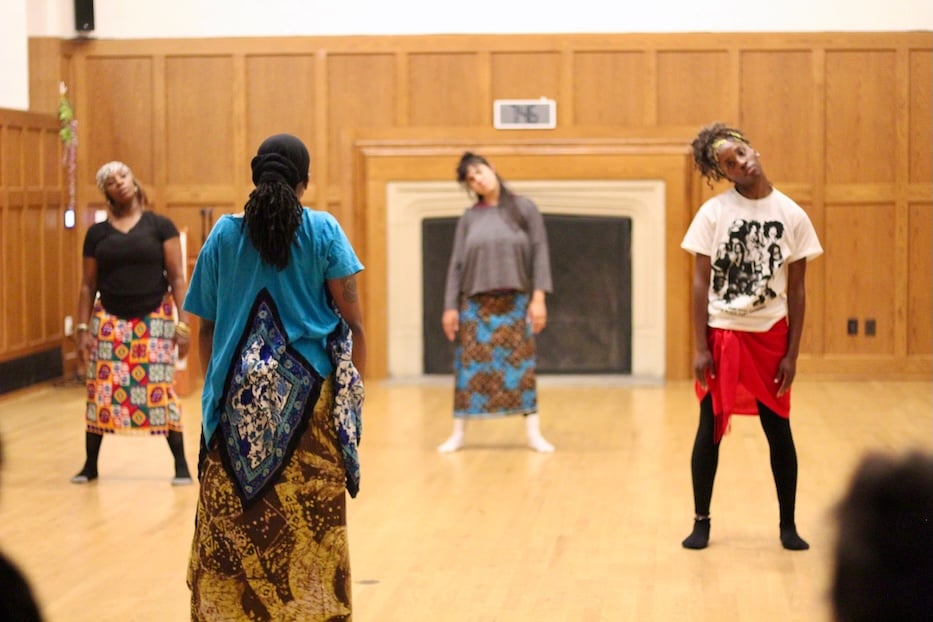
Back in the Center’s large first-floor room, Hameen Diagne had started to move to the drums, her feet pressing into the ground beneath her. Facing her, three dancers in cotton sarongs began rolling their heads from side to side, making time to let the tension in their necks and shoulders go. Lacina Coulibaly, a lecturer in theater, dance and performance studies at Yale who had arrived during the drumming session, hurried over to a back corner and joined in.
Hameen Diagne kept her eyes focused on the group, her knees, feet and legs keeping time with the drummers behind her. “Ago!” she yelled, bringing the room to attention.
The call-and-response, which translates roughly to “Are you present?” “I am present!,” comes from Ghana's Twi language. For Hameen Diagne, who each year leads dance and drumming during Juneteenth celebrations on the New Haven Green, it has become woven into the work she does.
“Ame!” the room shouted back. Beneath the space’s high ceilings, dancers spread out, letting the sound of rolling, ringing drums wash over them. As Hameen Diagne clapped out a slow one-two-three rhythm, dancers rose to the balls of their feet, coming back down with bent knees that transformed into lunges. They rose and came down again and again, the movement becoming meditation.
Hameen Diagne moved from one side of the room to the other, speaking out the whole time.
“Okay! Again!” she said. Dancers, on an unspoken cue, began to bounce on the balls of their feet. Before long, arms became pliable, coming out to the side before they swiveled, and found their way back to the front. Touching the ground as they moved, dancers began to walk forward, arms and legs long as their spines elongated.
Holmes, who has danced with artists including Salt-N-Pepa and Lil’ Kim, said she’s grateful for the opportunity to teach—and to learn—with Hameen Diagne, who is one of her longtime friends and collaborators. Like Hameen Diagne, she sees her charge as teaching across a diaspora, with modern and contemporary forms like jazz, house, and hip-hop that all reach back to a shared foundation of West African dance and the heartbeat-like drumming that has carried it.
“It’s a way of connecting the dots through generational dance,” she said.