

Culture & Community | Arts & Culture | Yale Peabody Museum
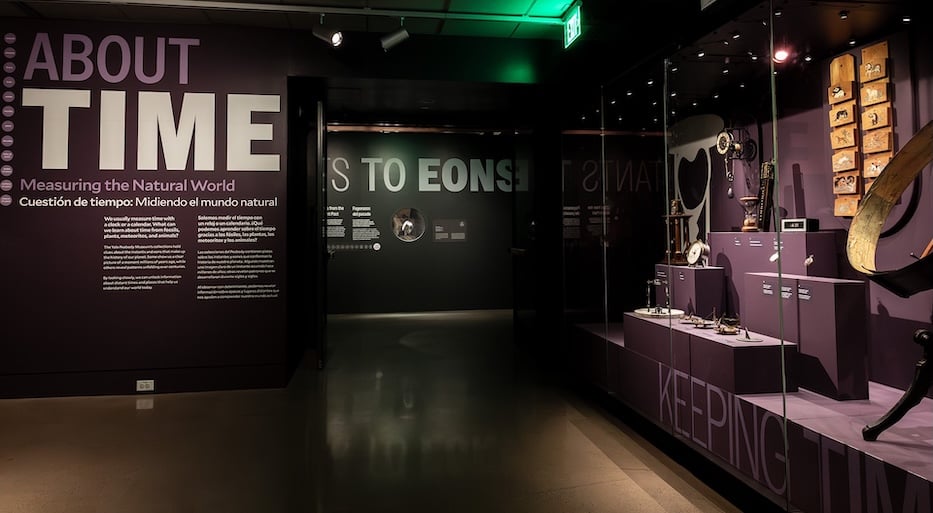
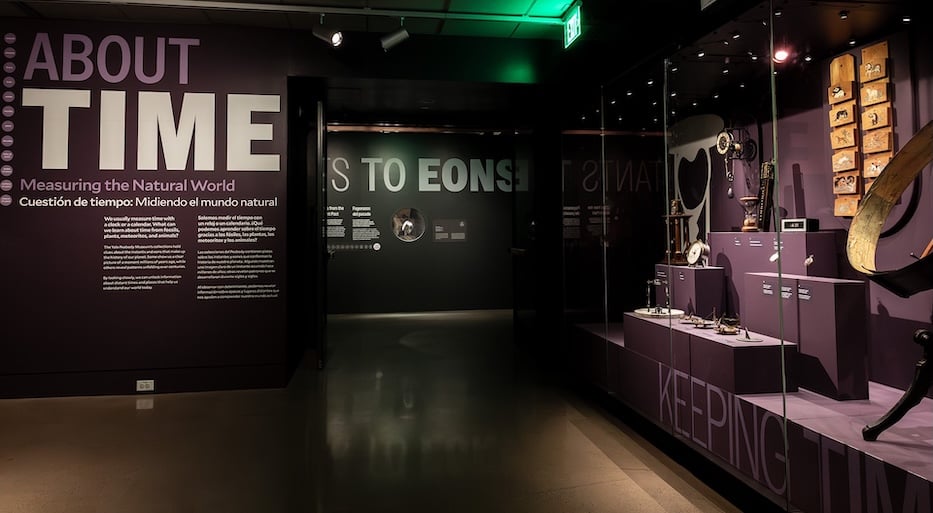
Andy Melien/Yale Peabody Museum Photos.
Imagine this: you’re out herding sheep on your family’s ranch in Wyoming when the sun catches something sparkly. It’s a geode, but not just any geode. This one formed inside an egg 50 million years ago. This unusual fossil, discovered by 12-year-old Lillian Jones in 1930, captures both fleeting and protracted periods of time. Before the embryo could hatch, the shell cracked. Flies arrived over the following days. Then, over millions of years, the thin bird bones inside the egg and fly pupae casings on its exterior fossilized.
Inside About Time: Measuring the Natural World, objects like this fossil—with its contrasting notions of time—are distilled into accessible visual design and interpretive texts, clarifying the exhibition’s central argument: that natural history can make time legible in striking new ways. The exhibition continues at the Yale Peabody Museum through August 9, 2027.
Four years ago, this fixation on time was ever-present as the Peabody prepared to reopen to the public following a major renovation project. Associate director of exhibitions Kailen Robins recounted rushing from meeting to meeting, often wondering, “Where in time are we, and how much time are we talking about at once?” Those practical questions became the catalyst for this show. We all experience time, but how can a natural history museum sharpen our understanding of this unwieldy subject?
About Time is both expansive and focused. It covers the breadth of the museum’s collection, with featured objects ranging from meteoritic materials from 4.56 billion years ago to specimens collected from a Ginkgo tree this year. Roughly 55 objects occupy one large, dark gallery, representing all 10 of the museum’s collections, which are collectively home to over 14 million specimens and cultural artifacts. The gallery is spare, but the spacing feels strategic—metaphorical and literal breathing room.
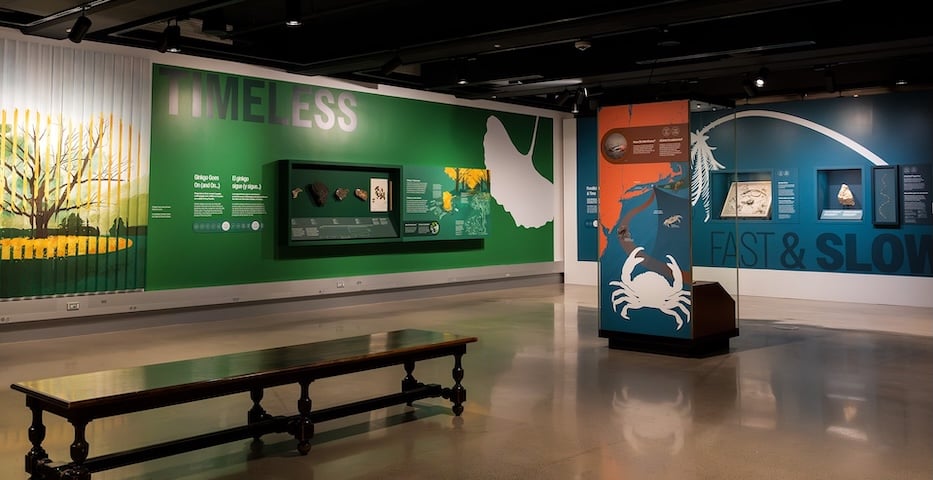
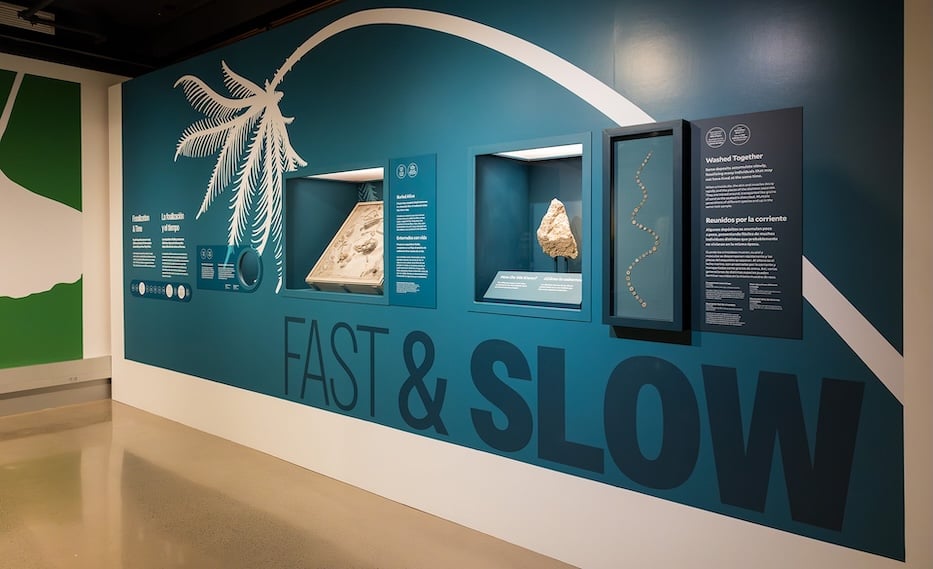
The exhibition design emphasizes clarity, with large texts spelling out the subtexts—“Fast and Slow,” for example. Summary texts begin with the big idea and become progressively more detailed as a reader continues. Multiple walls also feature a horizontal band of circles that decodes the different types of time involved, from an instant to an eon and everything in between. Almost all the texts are translated into Spanish, too.
Andy Melien/Yale Peabody Museum Photos.
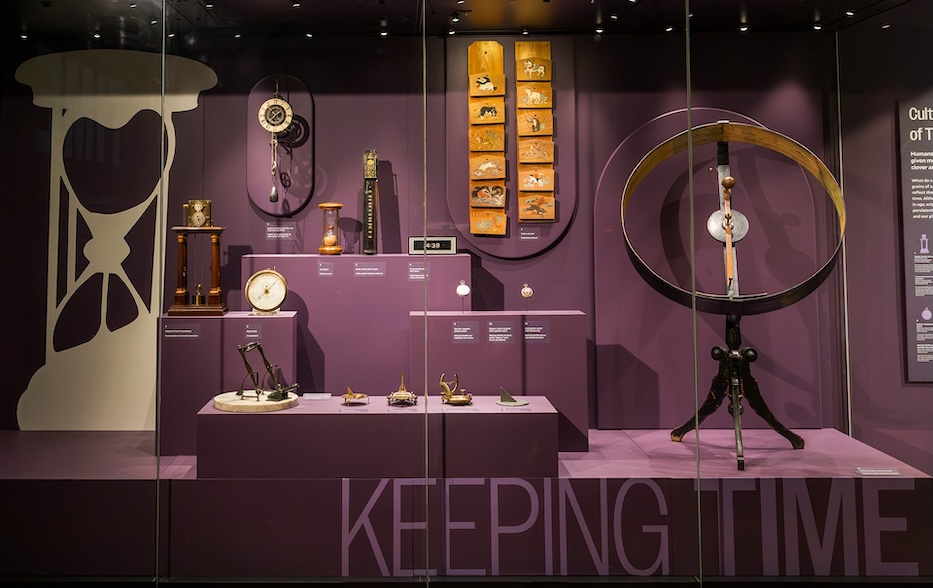
One key premise illustrated in About Time is that our understanding of a month or a millennium varies wildly across species and human cultures. Consider how your day would flow if it were composed only of hours. Near the introductory text, a collection of extraordinary time-keeping devices includes the Oignon, a silver-plated pocket watch from France dated around 1670. A cloudy glass dome covers its intricate inner workings, which measure time with only one hand—to the nearest hour, like a sundial. The array of watches, hourglasses, and clocks underscores the myriad ways humans have tried to make sense of time across the globe and over several centuries.
What if you measured time, not in hours, but in 17-year cycles? Along the back wall, a row of display cases matches 17-year cicadas with facts from recent history. Each emergence of the bug corresponds to an innovation or broader cultural trend, linking natural cycles to human change. These juxtapositions help make this small splinter of the natural world feel more relatable. This section is a focal point of the exhibition, with its success credited to a focus group of New Haven public school educators.
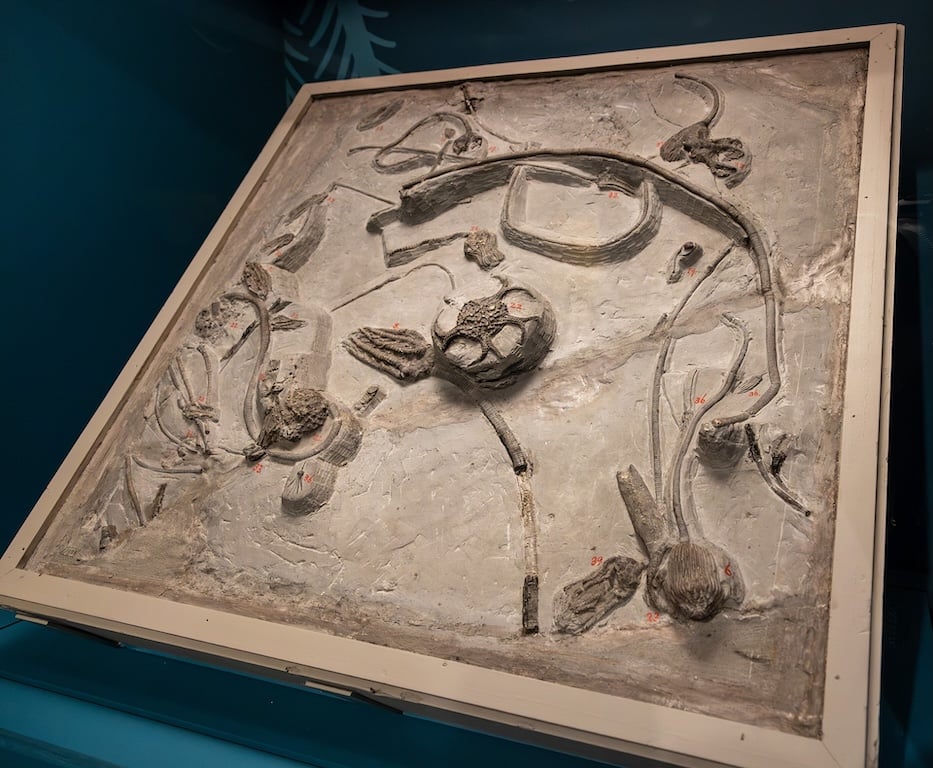
That time moves both quickly and slowly is a common idea, and the exhibition highlights how certain natural processes vacillate between speeds. One wall text explains that fossil deposits, for instance, preserve very different kinds of information depending on how they formed. A nearby display of toads caught in a salty lake in California offers a striking amount of detail. By contrast, the skeletal discs of crinoids—a relative of the starfish—inside a lump of sediment are harder to pinpoint.
Here, one fossil occurred rapidly, while the other stretched out over decades or even centuries. The toads are one species, while the crinoids represent many.
Andy Melien/Yale Peabody Museum Photos.
How do we know? A text below the Crinoid Fossil Assemblage tells visitors that the various discs indicate different kinds of this creature. This question is asked and answered throughout the exhibition, reinforcing transparency for museum-goers.
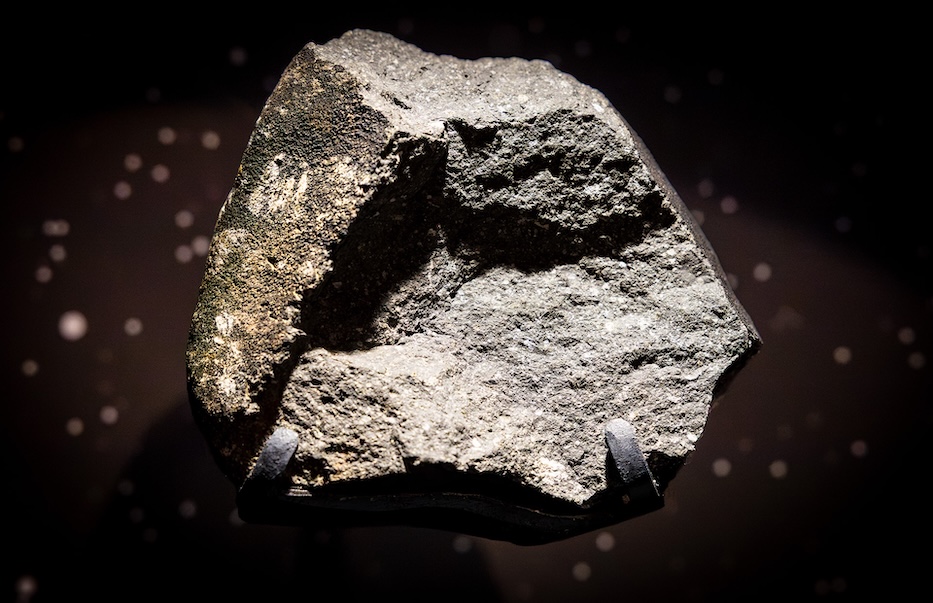
Taken as a whole, About Time errs on the side of generosity to its audiences. The exhibition was crafted with the understanding that you might breeze through the material on your lunch break or spend repeated visits exploring ghost crabs from the nineteenth century to the present. Either way, the meteorites are not to be missed: they preserve clues from the earliest moments of our solar system—the deepest type of time in the show.
The exhibition's greatest achievement is making immense spans of time tangible without overwhelming visitors with complexity.
About Time continues through August 9, 2027, at the Yale Peabody Museum, 170 Whitney Avenue, New Haven.