


Culture & Community | Arts & Culture | Visual Arts
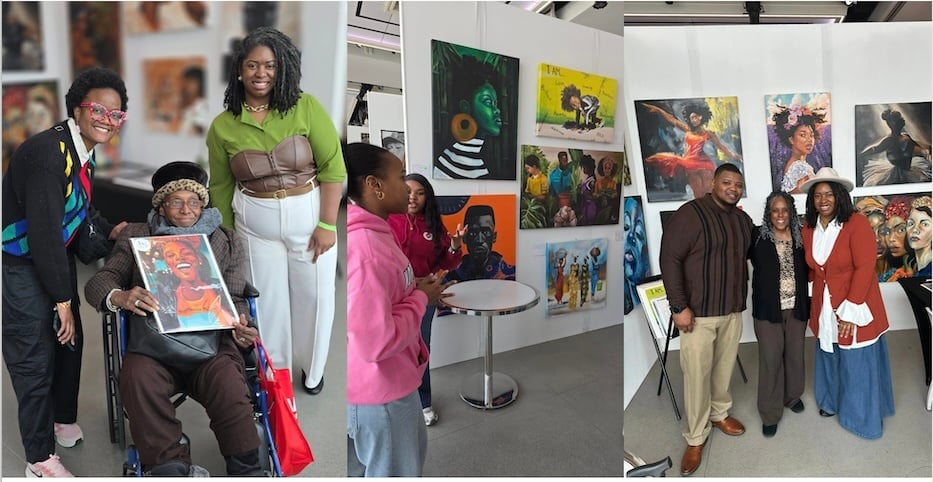
Images courtesy of Jasmine Nikole.
The little boy crouches down on the sidewalk, his eyes bright, brown skin luminous. Beneath a prefect, full head of hair, teased out into a halo, his smile is radiant. Beneath his hands, even the pavement seems to take note. The grass glows in the sunlight. Around him, words like Enough, Courageous, Bold and Wise float through the air, all completing the phrase I Am.
In his pint-sized orange and purple sneakers, he’s ready to take on the world, one measured footstep at a time.
The work, titled The Child I AM, is the exquisite brainchild of New Haven painter Jasmine Nikole, who with fellow Elm City artist Rashana Miller presented her work at the Harlem Fine Arts Show (HFAS) at the end of February. For both artists, as well as Hartford’s Andre Rochester, it closed out Black History Month in a cultural and historical epicenter of Black artmaking, creating a chance to celebrate their work—and forge new connections—on an international stage.
It’s a win for New Haven: the thousands of artists, art-lovers and patrons who attended the show now have another cultural touchpoint for the city. In part, that’s also thanks to publicist Stacy Graham-Hunt, a West Havener who runs her own PR Firm, and has long championed artists in and across the region.
“I think it shows proof of concept that New Haven is a world class place with world class artists,” said City Cultural Affairs Director Shamain McAllister, who Nikole credited as extremely supportive in the lead-up to the event. “New Haven does have it all, and it shows how rich we are with talent. For Jasmine to represent New Haven in such a way, we were honored to wrap our arms around her.”
For both Nikole and Miller, it was a transformative weekend months in the making. When Nikole first thought about exhibiting her work, she was aware that "it is definitely an investment," including a $2,500 fee that HFAS artists are expected to pay. As a rising star in the New Haven art world—in the past five years alone, Nikole’s work has entered collections including CT Innovations, the Cornell Scott Hill Health Center, and the Center for Inclusive Growth among many others—she also knew that attending meant creating new work, which translates to extra time and labor.
She credits a creative village with getting her there. McAllister, who promised to champion artists and uphold New Haven’s Cultural Equity Plan when she began the job last year, did exactly that, rallying members of the cultural community to support one of their own. Filmmaker Isaiah Providence, a teacher at Cooperative Arts & Humanities High School who also does work for the Department of Arts, Culture & Tourism, shot a promotional video. Artist Shaunda Holloway, in the midst of curating her own show at Creative Arts Workshop, kept Nikole company over the phone while she painted, making the process feel less isolating.
Then, in the whirlwind of days before the show, Nikole’s partner William took over the lion’s share of the housework and care for their two young children (“He was my quality control,” she said with a laugh). Her parents travelled to Harlem, her mom making the trip all the way from Georgia to be there. Members of New Haven’s Cultural Affairs Commission also showed up in force, with enough social media content by the end of the weekend to start a small firm.
“As a Black artist, to be showing at this was the most validating experience,” said Nikole, a self-taught artist who has shown her work in New Haven, across the Northeast, and in San Francisco, and found the HFAS scene completely unique and supportive. “It went so well. People really truly saw a reflection of their own story through my art.”
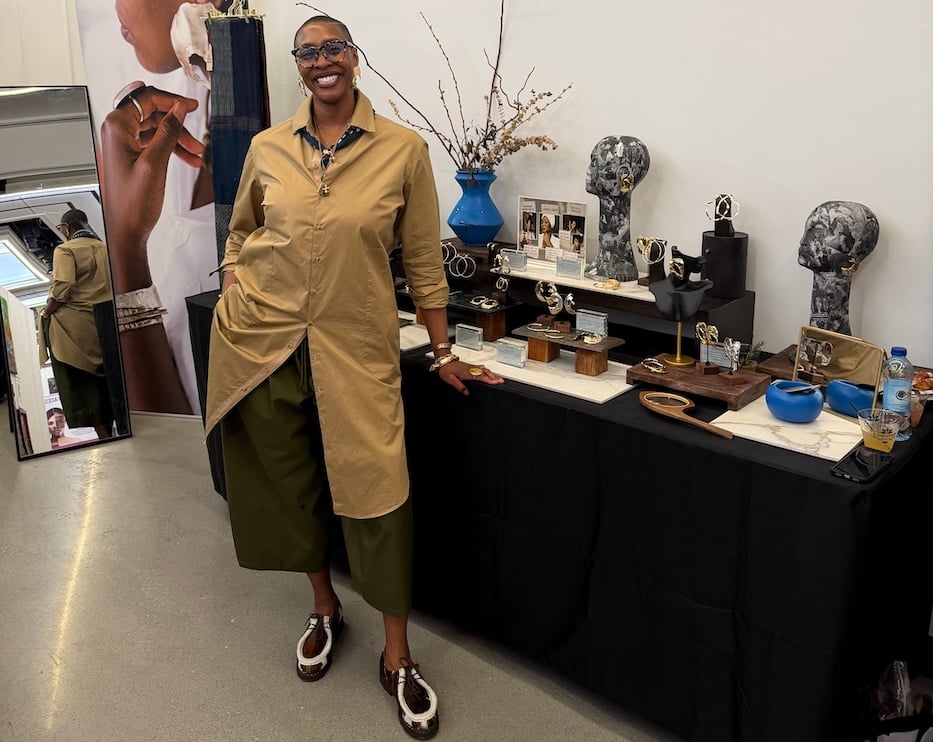
Rashana Miller with her work at HFAS. Image courtesy of the artist.
Miller, a metalsmith and sharp-eyed thrifter who runs Free Maiden Studio, could also feel that sense of celebration—and of collectors, viewers, and artists witnessing other artists—humming through the weekend. Several years ago, she picked up metalsmithing on a whim, after a move to Richmond, Virginia left her looking for work. For a decade before that, she had been an educator and administrator in West Philadelphia, where she grew up.
The metalsmithing class seemed like a fun, community-oriented thing she could do while on the job hunt. She wasn’t expecting it to move her in the way it did.
“And like 20 minutes into it, I was like, ‘I want to do this for the rest of my life,’” she remembered in a phone call earlier this month. From that moment, it would never just be a hobby. “I loved doing it.”
It turned out she was good at it, too. When Miller’s husband got a job at Yale, the two moved from Richmond to New Haven, where they are now raising their two young children. While Miller works for Hartford Promise during the day, Free Maiden has become much more than a passion project: she is a frequent face at pop-ups and artist markets (and Possible Futures, where bookspace founder Lauren Anderson often rocks her hoops), with designs that are instantly recognizable as hers. When she got a call from the Harlem Fine Arts Show, it was an easy yes.
“This was reinforcement that I’m on the path that I need to be on,” Miller said. Like Nikole, she’d never experienced anything quite like HFAS before. “Just being around other Black artists” of all media, and many nationalities, moved her profoundly. She was grateful not just for the network she was able to tap into, but the deep sense of cultural community that came out of the event.
“Creating is an act of resistance,” she added. “ Staying in this keeps me going.”
Kulturally LIT Fest Founder IfeMichelle Gardin, who sits on the city’s Cultural Affairs Commission, said that she is incredibly proud of the New Haven representation, and was excited to cheer both Miller and Nikole on. As a lifelong lover of the arts, Gardin started attending HFAS years ago, when it was still at a church on Harlem’s Riverside Drive.
“Oh my gosh, it was like a super exhibit,” she said. “ You know, it was just an overwhelmingly beautiful exhibition showing the talent of artists and creatives of color from all over. It has just evolved so much, and it's a great opportunity for the artists.”
As a commissioner and a literary luminary herself, Gardin also sees HFAS as a valuable and necessary opportunity for artists to break out of their silos. In New Haven, she sees firsthand how small the city can become for artists, despite a number of both formal and informal gallery spaces, and chances to network like the Black Wall Street Festival and neighborhood pop-ups from the International Festival of Arts & Ideas. Getting out of New Haven means remembering how big the outside world can be.
“It’s a nice opportunity for them to know that there are collectors outside of us. We kind of go through the same circles of folks and see the same people in these spaces,” she said, praising how collaborative this year’s atmosphere seemed. She noted how many artists she saw who were speaking other languages, part of the show’s work to invite artists from across the Black diaspora. “You get another perspective when you see what’s really out there.”
That artistic footprint goes beyond the single HFAS weekend, McAllister added: there are six additional New Haven and Hamden artists featured in HFAS’ virtual extension show, called the Virtual Arts District. They include Linda Vauters Mickens, Shaunda Holloway, Marquis Brantley, Kim Weston, Amber Cohens, and Candyce “Marsh” John.
In a phone call Monday, McAllister pointed to the way artists are helping each other: artist Gio Roper photographed their work, making their participation in the virtual exhibition that much more possible.
“It’s all the artists who helped make that push,” she said.