

Culture & Community | Music | Southern Connecticut State University | Arts & Culture | New Haven Symphony Orchestra | Jamaican American Connection
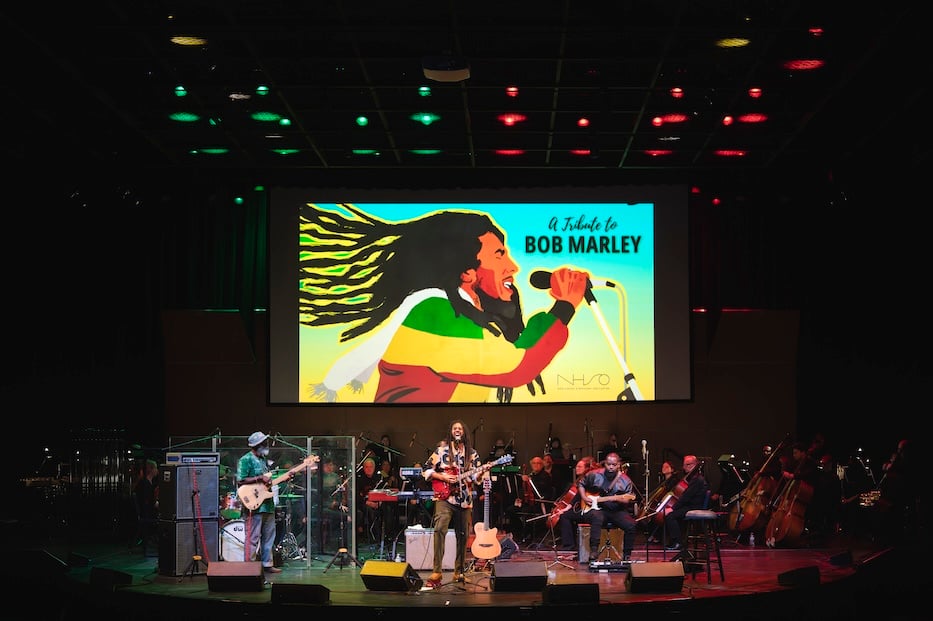
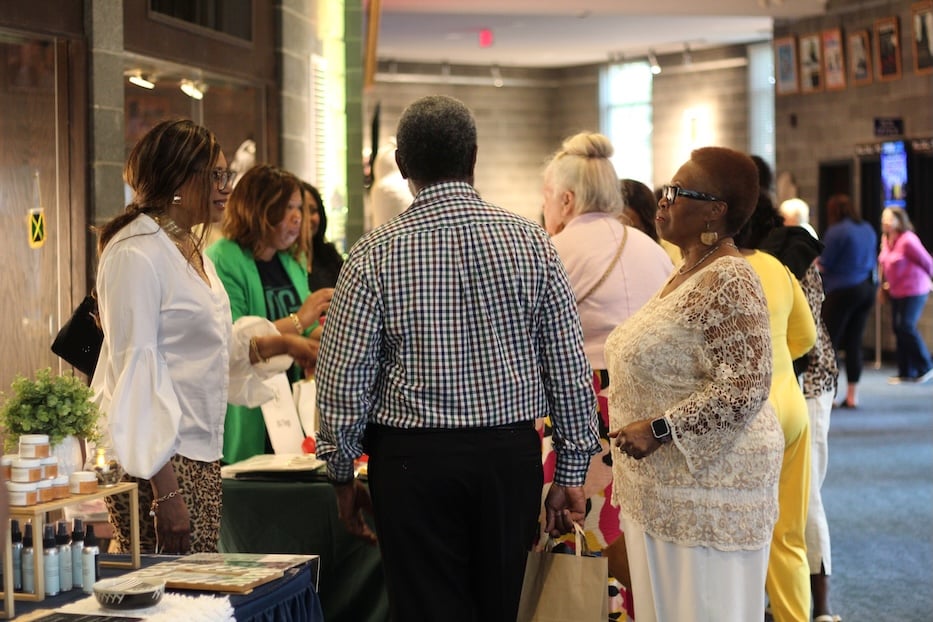
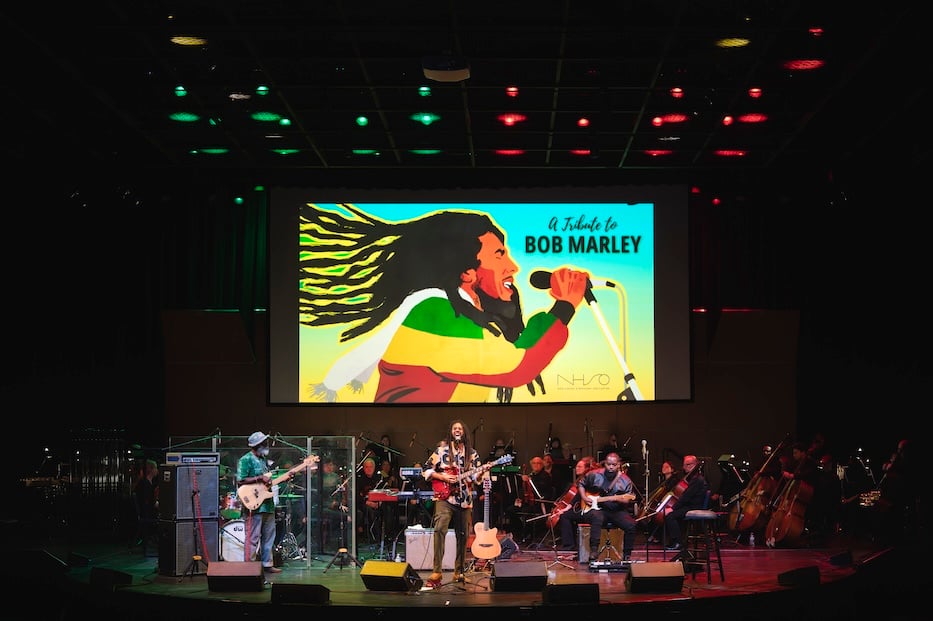
Top: Musicians in action. Matt Fried Photo, c/o New Haven Symphony Orchestra. Bottom: From the "One Live" Marketplace. Lucy Gellman Photo.
At first, the sound was triumphal, as if the symphony was welcoming royalty to the auditorium (and in a way, they were). Horns sang and bellowed, and timpani rolled beneath them. Strings and woodwinds released bright, full notes that shimmered in the air. Maestro Chelsea Tipton looked up, the brass blooming all around him. A chime rang out, echoing through the auditorium.
Then, in the purple, hazy darkness, the sound of bass guitar rose from the stage, spare and somehow resonant at the same time. “All right,” a voice half-whispered from just off stage right. From where he sat in the center of the audience, 22-year-old William Higgins was a little boy again, his dad vibrantly alive and asking, “Are you listening? Like, are you listening?”
Last Saturday, that sound filled the John Lyman Center for the Performing Arts, as the New Haven Symphony Orchestra (NHSO) fêted Bob Marley in its penultimate concert of the season. A collaboration with the Jamaican American Connection and musicians Yendi Songbird (vocals), Josh David Barrett a.k.a. Tobijah (vocals and guitar), Wahkiba AL-Kabir Julion (drums), Obed Jean-Louis (bass), Eric Toussaint (keyboard) and Jeff “Simba” Matthew (guitar), the two-hour program featured sweeping symphonic arrangements of Marley’s work, bringing his legacy into the present. It ended with a joyful dance party in the lobby that made the Lyman Center feel more like a good dance club in the early 1990s, playing all the right music.
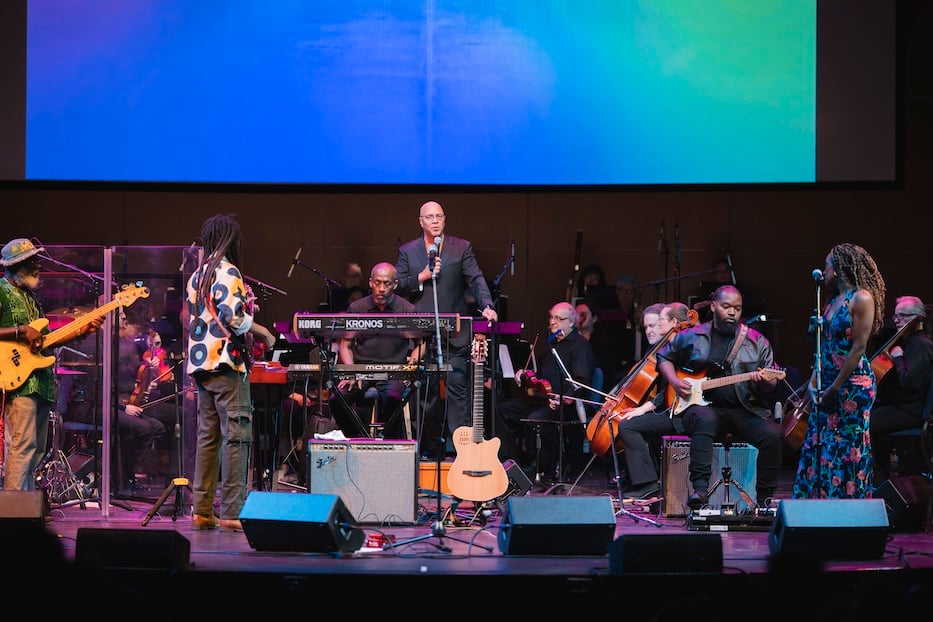
Tipton: "It instantly puts you in a good mood.” Matt Fried Photo, c/o New Haven Symphony Orchestra.
The pieces, orchestrated by Rebecca Pellett, marked the U.S. premiere of the work, which grew out of a conversation that JAC President Karaine (Kay) Smith-Holness had with Inner-City News Editor Babz Rawls-Ivy, and then with Marley’s daughter, Cedella (she credited Rawls-Ivy with bringing the concept to NHSO President and CEO Elaine Carroll). The evening included an official citation from Mayor Justin Elicker, declaring June 6 “Bob Marley Day” in New Haven.
The NHSO next performs on June 27, during the second and final weekend of the International Festival of Arts & Ideas, at 6 p.m. on the New Haven Green.
“One of the major things about Bob Marley’s music is it instantly puts you in a good mood,” said Tipton, who has been the pops conductor at the NHSO for over a decade, before kicking off the concert with an arrangement of Marley’s “Waiting In Vain.” “It don’t matter where you’re from. It’s one of those things that brings people together.”
Saturday, that resonated from a “One Love” marketplace to the concert itself, which ended with a shoulder-to-shoulder song and dance party in the lobby of the building. In the lobby of the Lyman Center, which sits on the campus of Southern Connecticut State University’s (SCSU), several New Haven and Connecticut-based makers had set up tables stacked neatly with their products, from screen-printed t-shirts and skincare to small-batch pikliz, a seasoned slaw kissed with vinegar and Scotch bonnet peppers that is popular in Haiti.
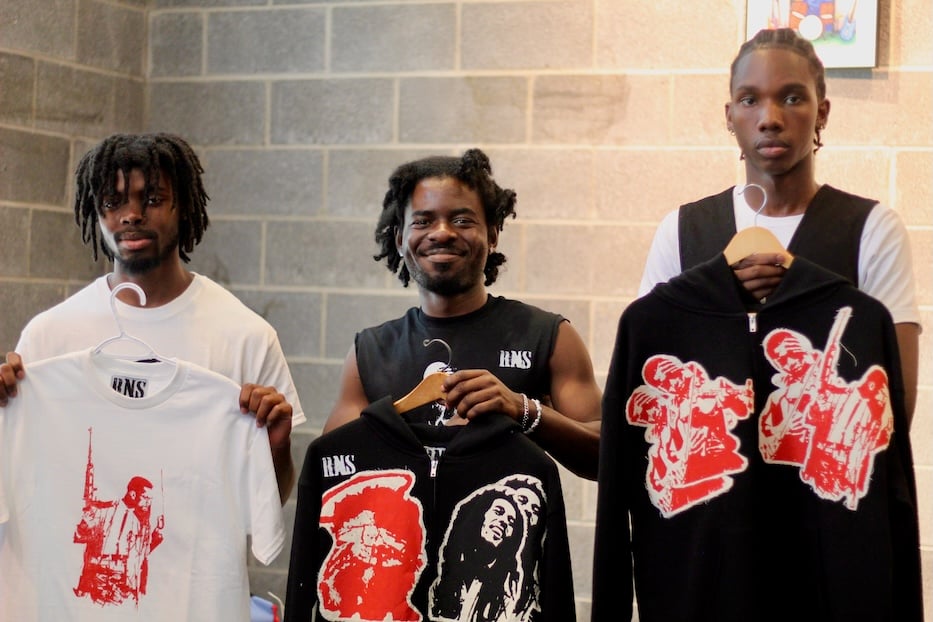
Nigel Lowndes, William Higgins, and Isaiah Summers. Lucy Gellman Photo.
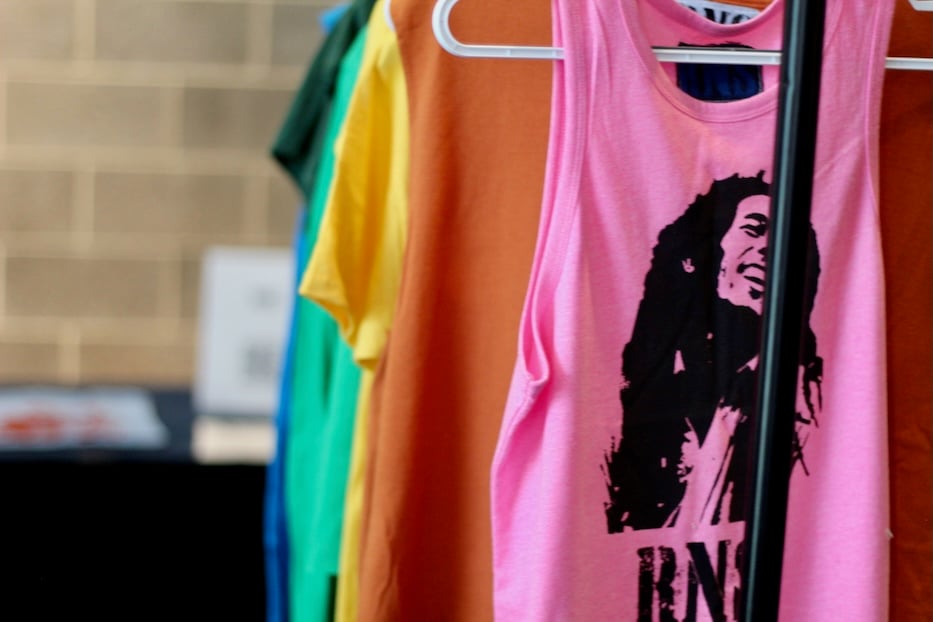
At a table for RNS—that stands for Real New Haven Shit—Marley’s likeness peeked out from the front of bright cotton shirts and tank tops and delicately-sewed patches, each of them printed lovingly with the image. On one, the musician turned his toward the sky, eyes half-open as he smiled. He seemed so full of life, and for a moment, it was possible to picture the old man he would have become, face joyfully etched with age. Marley, who died of cancer at 36, would have turned 81 this year.
On a nearby clothing rack, a red, screenprinted Malcolm X appeared, eyes narrowed as he leaned toward a window, one hand grasping a machine gun as his the other cautiously parted the curtains. For a moment, it was 1964 again, and both he and Marley were alive, two revolutionaries moving the world forward with their words.
For Higgins, who moved to New Haven in 2024, the designs are a way to both honor his Jamaican-born father, the late Frank Higgins, and celebrate a brand that he and his peers are building in New Haven. Growing up in Durham, North Carolina, Higgins soaked in Marley’s music “really without a choice,” learning about his easy, sometimes splintered and rising, bottomless voice through his parent’s love for each other, and for Marley’s music.
Lucy Gellman Photo.
He remembered standing in his home in North Carolina as just a kid, his dad singing Marley’s “Is This Love?” to his mom as the track played in the background. “He would be like, ‘Yo, are you listening?’” Higgins remembered. “Are you listening?” He didn’t really understand what his dad meant until years later, when he heard the music with fresh, older ears and realized that Marley had mapped out a blueprint to life without capitalism, racism, and colonialism.
Fashion wasn’t really on Higgins’ radar until it was. “Like, I always wanted to look nice,” he said—but he didn’t start designing clothes until a few years ago, making mock ups on his computer. By then, he had made the move from Durham to New York, and then New York to New Haven. He met Nigel Lowndes, the child of Jamaican immigrants who grew up in the Elm City. Something clicked; it was the collaborative piece he didn’t know he was missing.
Unlike Higgins, Lowndes had always loved fashion. Part of that came from his own thriftiness: Lowndes grew up with an interest in reimagining the hand-me-downs he received while growing up in Fair Haven, and a kind of know-how that gave him a knack for design. He credited Brenton Schumaker, who runs DeadBy5am out of the Henry Street arts incubator NXTHVN, and Sweets & Sounds Entertainment Founder Angel Dahfay, as two of his mentors and inspirations.
“That’s who I wanna be,” he said of Dahfay.
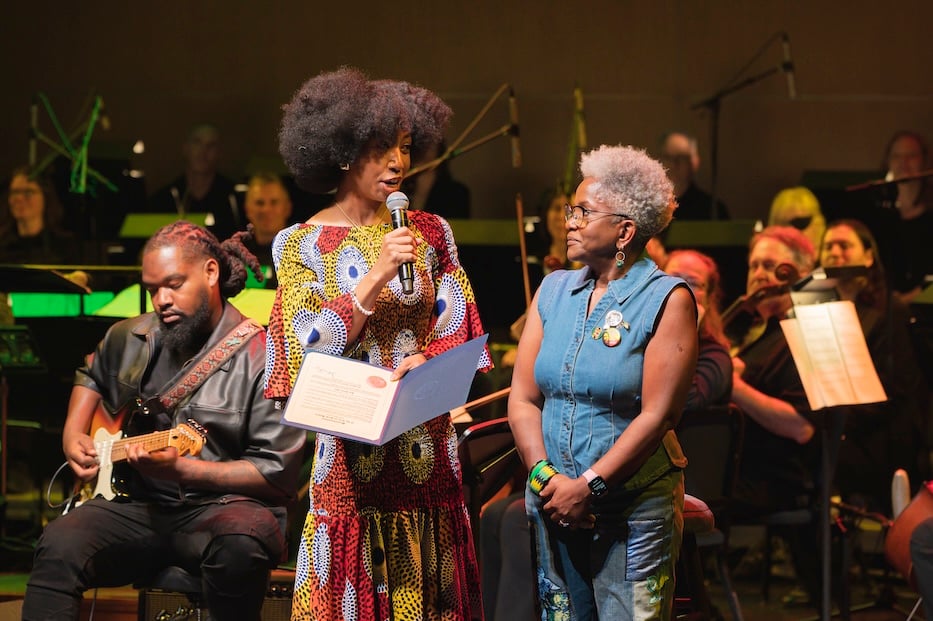
Sha McAllister, director of Cultural Affairs for the City of New Haven, reads a proclamation designating June 6 as Bob Marley Day in New Haven beside JAC President and Co-Founder Karaine (Kay) Smith-Holness. Matt Fried Photo, c/o New Haven Symphony Orchestra.
In the spring of 2025, he and Higgins founded RNS, which operates a storefront at 97 Campbell Ave. in West Haven, hungry to collaborate with regional partners across the arts (the brand has, for instance, an upcoming fashion show at The Devil’s Gear Bike Shop). So when his colleague Isaiah Summers, a sophomore at SCSU, saw an ad for the NHSO’s concert on social media, it felt like a no brainer for the group to collaborate. Summers reached out to learn more.
“RNS is about who we are as Black people,” said Lowndes. “Everyday experiences. We started expanding it [the name] ... It can be Real New Haven Sounds, [or] Revolutionary Negro Society. Our ultimate goal is to be a resource to the community.”
He added that his own love for Marley, whose beaming face features prominently on many of the brand’s shirts and jackets, has deepened in recent years. As a music lover, he grew up with the sounds of Sister Nancy and Barington Levy, Jamaican musicians to whom he still gravitates. Then a few years ago, Lowndes heard Marley’s album Trench Town, inspired by the neighborhood in Kingston in which the musician grew up.
He could picture his dad, vibing to the music. And it touched something in his soul.
That’s the idea behind RNS too, Higgins said. “We really want to tell a story through our clothing.”
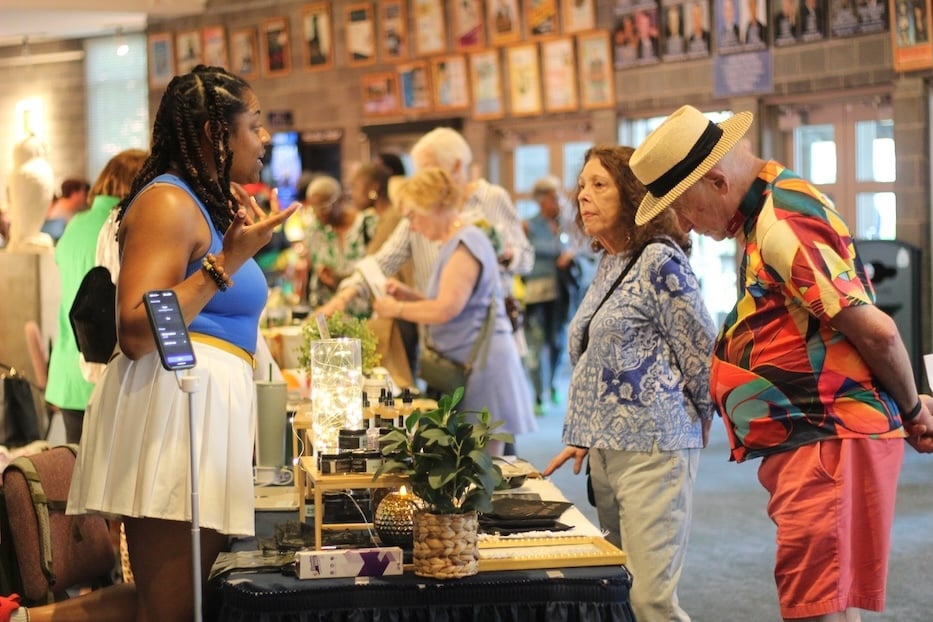
Dormon of EKOW Body. Lucy Gellman Photo.
Around him, vendors and attendees alike became a testament to the breadth of the Caribbean diaspora. Candice Dormon, who runs EKOW Body out of a first-floor studio in Erector Square, took a moment to soak everything in, paying homage to her own roots while welcoming a steady flow of customers. Since opening the space in Fair Haven last year, she’s been excited to bring EKOW into new places, and soon was fielding questions around lavender and citrus-scented body butter and whipped sugar scrub as musicians unlatched instrument cases and took their seats inside.
“This feels really good!” she said. Dormon, whose mom is from Belize and whose dad is Jamaican and British, grew up listening to reggae, soca and calypso, meaning that Marley was informally in her wheelhouse before she knew the music as his. When she met and married her husband James, who is from Ghana, and became a mom, her commitment to keeping diasporic traditions alive became even stronger. “As an adult, I'm always trying to find a way to keep my kids connected,” she said.
So when she heard about the “One Love” marketplace, she was excited to get involved. While Dormon lives just blocks away from the Lyman Center in New Haven’s Beaver Hills neighborhood, she doesn’t often go to the NHSO’s concerts (she did have high praise for the organization’s annual holiday extravaganza, to which she took her boys last year). As new customers—and some EKOW Body faithfuls—surrounded the table, she wove the symphony pop-up into her journey from early childhood educator to small business owner, personal trainer and line dancing teacher.
“It was just one of those things I didn’t think was possible,” she said of the growth of her business. “And the universe conspired to make it happen.”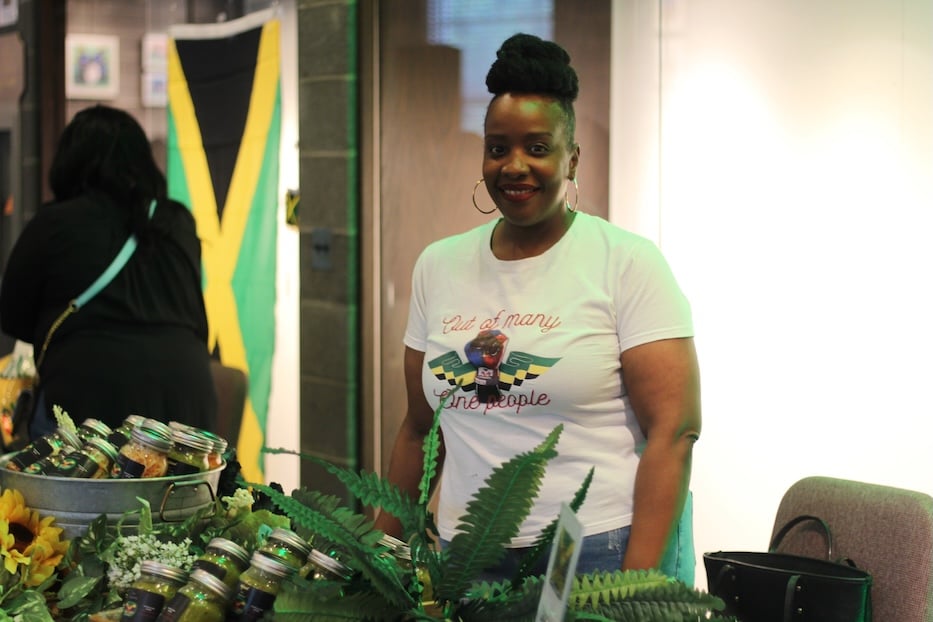
Lakay Cuisine owner Leticia Jarrett.
As she buzzed from one vendor to another, Smith-Holness savored the moment too, already buzzing with energy a good 45 minutes before the music had started. While pausing for hugs gevery few minutes—everyone seemed to know her, and she knew everyone—she stopped by Lakay Cuisine, a blend of Jamaican and Haitian cooking that sells spicy, vinegary pikliz and gem-colored épis, a seasoning blend of vegetables and spices that can become a foundation for meals.
Lakay owner Leticia Jarrett, whose husband is Haitian, started the business as a meal service in 2020 (she also does natural hair braiding), and has watched it grow from there, traveling in both Connecticut and Massachusetts to get the word out about her products. As the child of two Jamaican immigrants, Jarrett pointed to the motto for the business, “One Love,” as an homage to Marley’s impact and legacy. For her, it also dovetails with Haiti’s motto, “L’union fait la force!” showing how much continuity there is between the cultures.
“I love being here!” Jarrett said. “I love community.”
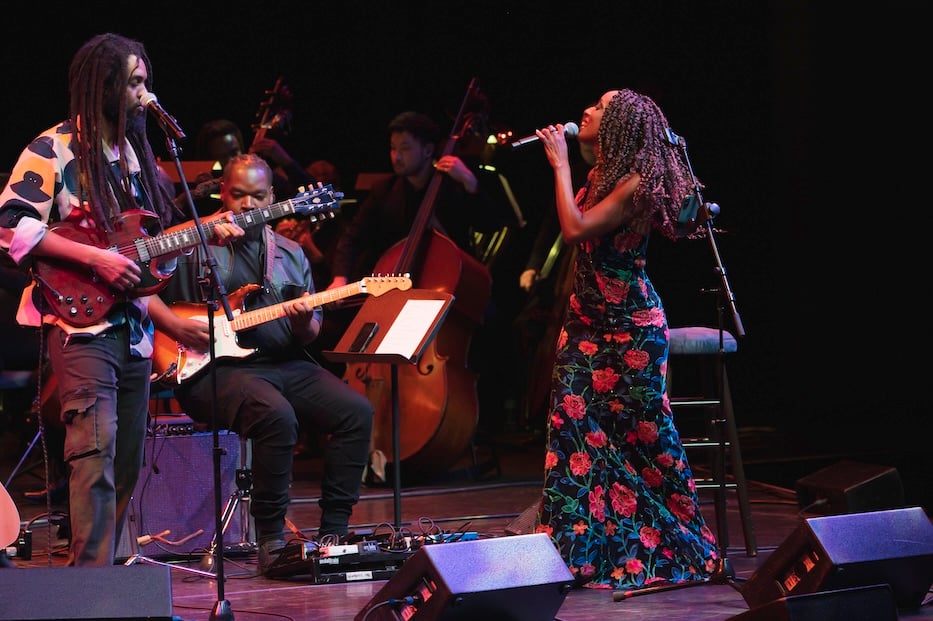
Josh David Barrett a.k.a. Tobijah (vocals and guitar) and Yendi Songbird. Matt Fried Photo, c/o New Haven Symphony Orchestra.
Inside a nearly-full auditorium, that sense of community radiated from the stage to the rows and rows of attendees, their faces aglow with purple light. On a screen behind the orchestra, the word “Roots” flashed brightly in all capital letters, musicians sweeping onto the stage to cheers and applause. Somewhere in the mix, violists Marvin and Carol Warshaw prepared to say goodbye to a group that they’ve called home for decades, a dedication for which they received their literal flowers. After comments, Tipton raised his hands, and musicians began.
At first, it took musicians a moment to find their musical footing, the sound in lockstep with the symphony, but somehow momentarily distant from it too. And then, something clicked. Brass and strings rose up gently to meet Songbird’s vocals, with layers of honeyed sound that bloomed across the space. From the stage, she was radiant, in a blue dress patterned with pink flowers that seemed to climb towards the ceiling.
She exhaled, and began to move in a way that let the audience know she was feeling the music from her head to her feet. And around her, every musician on stage followed suit. By Marley’s 1977 “Waiting In Vain,” the two groups had hit their stride, performing as one. It was as if Marley had entered the room, his belief that music could both unify and drive revolution suspended over the stage for hours.
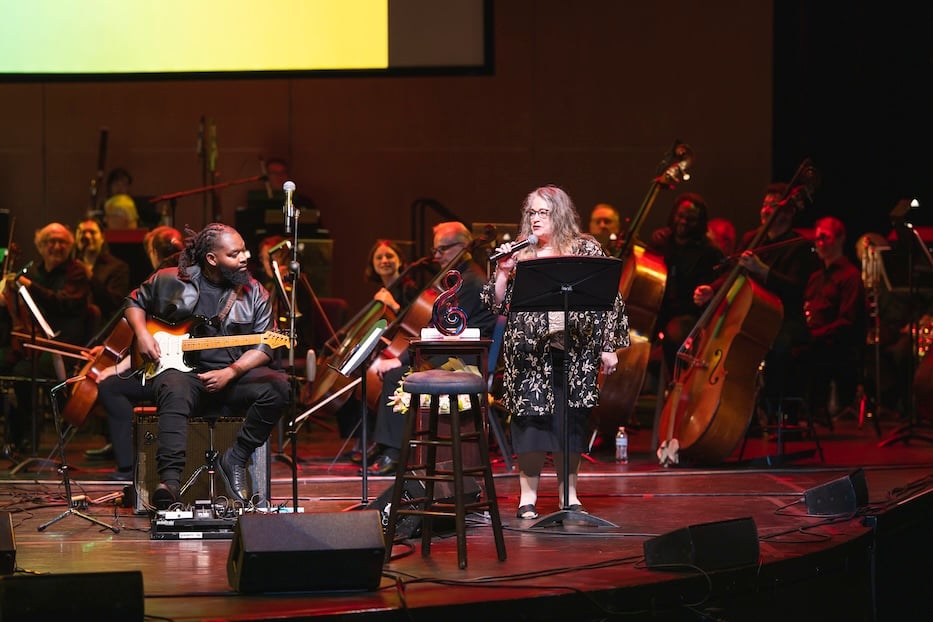
Matt Fried Photo, c/o New Haven Symphony Orchestra.
From the podium, Tipton listened carefully to the swirl of bass and guitar, the vocals wrapping the audience. In their seats, attendees swayed and bobbed along; some stood to dance, arms drifting over their heads as their knees bent, muscles unclenching. Then, with arms raised, he ushered in the brass, and the whole room filled with sound, the horns never overpowering. Back in her seat, Smith-Holness sat with her eyes wide in wonder.
“It’s in my sinews, my capillaries, my veins,” Dr. Janice Hart, a Jamaican-American educator who teaches people about her culture through storytelling, said of the music before heading in to find her seats. As the symphony played, her words danced among the rows—and members of the audience did too. “It’s spiritual. It’s monumental.”
And it was. When musicians took on “Is This Love?” it was not long before the whole auditorium was singing along, hundreds of voices climbing over and around each other, as Tobijah and Songbird held it down on the stage. Is this love!? Is this love?! Is this love!? the audience half-crooned, already aware that the answer was a resounding yes.
Back at the podium, Tipton began to wade into heavier waters. In the early 1970s, Bob Marley and The Wailers recorded “Concrete Jungle,” which both names and mourns the stifling captivity of racism, poverty, and capitalism. Over five decades later, the questions Marley longingly asks in the song—Where is the love to be found? Won't someone tell me? —are still just as pertinent.
As it came to the stage, a listener could hear how Pellett had transformed the music into something distinctly made for an orchestra, horns coming in to augment guitar rather than to overpower it, strings creating a gentle, velvet-smooth wave of sound so steady that musicians could nearly lean back into it. At one point, Tipton pointed to the violins as if to say, “not yet,” and they held off as vocals hit the hook. Moments later, he was ushering them forward, a yearning palpable as the woodwinds cried out from their place on the stage.
“He wasn’t afraid to celebrate real life,” Tipton said of the song. “It [Marley’s music] also spoke to joy and to perseverance, the belief that better days were ahead.”
Nowhere in the first half, maybe, was that clearer than in Marley’s “Redemption Song,” which ushered in intermission, and left members of the audience on their feet and cheering. When the work began, Tipton’s arms lifted to the ceiling as if he were dancing, horns rose up and over the audience, percussion deep and bombastic beneath them. A chiming rang over the stage, and instruments fell to a whisper, oboe taking a moment in the spotlight before strings joined back in.
It wound around the stage, and Tobijah let it envelop him for a moment, clear and steady as a person’s voice calling out in the half-darkness. Strings joined back in, and Tipton raised his baton in time with the percussion, his wrist easy, limber. The drums built until they were a heartbeat, brass ready to crescendo above them. And then, just as quickly, they melted into that signature riff that starts the song, the audience applauding as bass guitar took over. Strings folded themselves back in, and Tobijah began to sing, the audience a constant, tender chorus beneath him.
Emancipate yourselves from mental slavery / None but ourselves can free our minds!, he sang a verse in, and the words echoed through the theater, some listeners dancing along with their eyes closed. Others leaned on partners and friends, or held their kids tightly. Outside the auditorium, the world was burning. Inside, a kinder universe seemed entirely possible, a community of listeners knitted together by the hope Marley sang into being so many years ago. It was right on time.
“I don't even know if words can explain this,” Smith-Holness said in a phone call after the concert. “When the partnership started, I knew that the symphony was amazing. But to see how they were able to interpret Bob Marley’s music … It was a once in a lifetime opportunity. If we open our minds and our hearts, we see that change is beautiful.”
“When they did ‘Redemption Song,’ I was done,” she added. “To know that this little island, and the influence that this island has worldwide … It was overwhelming. My heart was full. It’s the beginning of a great relationship.”