

Beinecke Library | Culture & Community | Environment | Arts & Culture
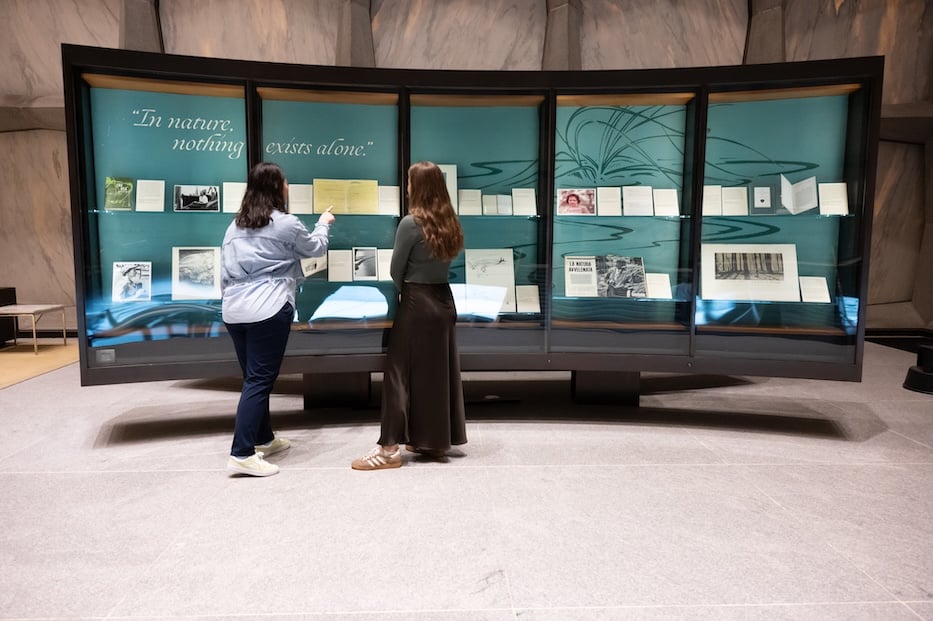
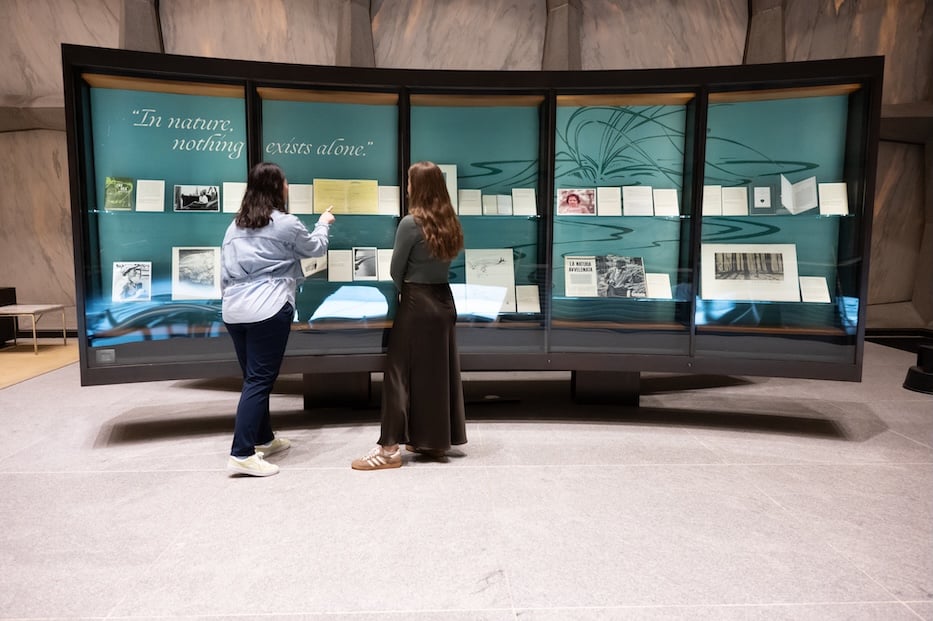
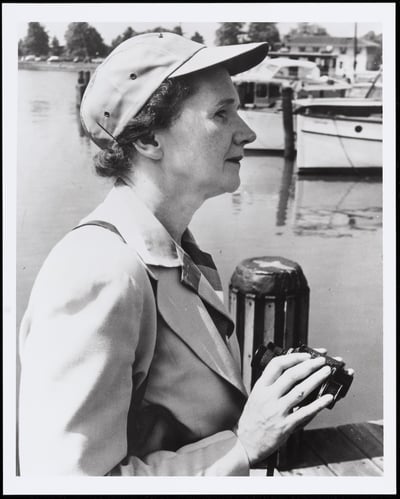
Installation view of Silent Springs, Windswept Seas: Rachel Carson's Environmental Vision at Beinecke Library, Yale University. Photo by Samantha Annette Photography. Courtesy of Yale University. The image below is Rachel Carson holding binoculars, 1951. Photo by Norman Driscoll. Beinecke Rare Book & Manuscript Library. Image: Norman J. Driscoll, with permission of the Rachel Carson Council, Inc. Courtesy of Yale University.
It’s no accident that “The Sense of Wonder” appears twice in the exhibition, Silent Springs, Windswept Seas: Rachel Carson’s Environmental Vision, on view at the Beinecke Rare Book & Manuscript Library through October 4. For curators Carla Baricz and James Kessenides, this text—first appearing as an article in the July 1956 issue of Woman's Home Companion and later included in a posthumous book—gives a glimpse into the attentive and perceptive worldview of the American biologist and author. Carson wanted us not only to bear witness to the world around us, but also to care for it.
Inside the first display case on the library’s second floor, The Sense of Wonder (the book) is propped open to a page encouraging readers to buy a magnifying glass, which will “bring into being a new world.” Toward the end of the show, a double-page magazine spread shows a small boy holding a basket of flowers inside a sunlit forest, with thick tree trunks lining the composition.
The accompanying label shares this excerpt: “One way to open your eyes to the unnoticed beauty is to ask yourself, ‘What if I had never seen this before? What if I knew I would never see it again?’” Between these two thematically linked objects, a loosely chronological sketch of Carson’s life unfolds—contextualized by the politics of her day and the continued relevance of her contributions.
 Silent Springs, Windswept Seas pinpoints key moments within the arc of a career wholly devoted to the natural world. Carson’s oeuvre has its roots in conservationism and ends with a more ecological mindset, a distinctly twentieth-century movement. Her manuscripts, notebooks, and previously unpublished letters—alongside magazine articles, illustrations, and photographs—account for the nearly 100 items on view. Most are drawn from two of the most in-demand collections at the Beinecke: The Rachel Carson Papers, donated by her literary agent, Marie Rodell, shortly after her death, and The Rachel Carson Papers Addition.
The popularity of these collections, especially in recent years, reflects Carson’s lasting legacy and the enduring significance of the issues she raised. Two decades have passed since the Beinecke’s last show focused on Carson, making this an opportune moment to look again at her life. (And as Baricz asked, when is it not a good time to talk about Carson?)
Carson once said in a speech, “I can remember no time, even in my earliest childhood, when I didn’t assume I was going to be a writer.” She began her college studies majoring in writing at the Pennsylvania College for Women (now Chatham University). She then switched to biology after taking a course taught by a charismatic professor named Mary Scott Skinker, thus fortifying her longstanding love of the natural world with scientific rigor.
Even in Carson’s early texts, of which there are many to see in this show, humankind is undermined within the vastness of the landscape, sometimes named “a trespasser.” From the beginning, Carson’s voice blurred into poetry with her lucid descriptions and unconventional perspectives, collapsing the boundary between literature and science. Her hierarchical shift—man now stooping below nature—felt unprecedented, as were many other accomplishments within Carson’s career.
After completing her master’s degree in Zoology from Johns Hopkins University, Carson began working at the U.S. Bureau of Fisheries, a predecessor of today's U.S. Fish and Wildlife Service. This job allowed her to support her family, but her ever lyrical writing was destined for other outlets. Her first article for The Atlantic, titled "Undersea," was published in the September 1937 issue. The text became the basis for her first best-selling nonfiction work, Under the Sea Wind.
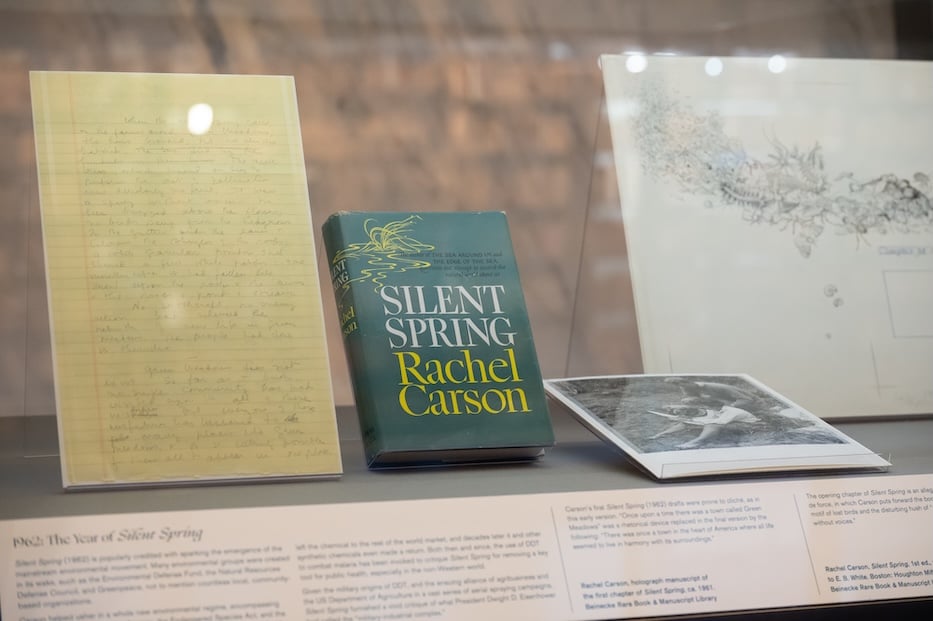
Installation view of Silent Springs, Windswept Seas: Rachel Carson's Environmental Vision at Beinecke Library, Yale University. Photo by Samantha Annette Photography. Courtesy of Yale University.
This book and the others in her Sea Trilogy—The Sea Around Us and The Edge of the Sea—are a focal point of the show, laying the foundation for her most famous book. The former was one of the first books about the environment to employ the point of view of the natural world and its inhabitants—excluding people—and the winner of The National Book Award for Nonfiction in 1952, while The Edge of the Sea painted the shoreline as a dazzling place of liminality.
Possibly Carson’s most personal book, the final installment of the trilogy was dedicated to her dear friend Dorothy Freeman and her husband Stanley. One display case features a photo of Dorothy and gently hints at the intimacy of their relationship, one that some believe transcended friendship. In fact, Dorothy read the final section of the book that was devoted to her at Carson’s memorial service.
The exhibition stresses the serialization of Carson’s work, an important force in bringing her writing to the masses. The Sea Around Us was broken into three consecutive issues of The New Yorker magazine beginning in June 1951—the publication’s first profile on a nonhuman subject. Her best-known work, Silent Spring, also first appeared in the same magazine the following summer, before the book came out in September 1962. In a letter dated February 14, 1959, to The New Yorker editor William Shawn, a lifelong advocate of Carson’s work, Carson expressed her interest in writing about the deleterious impact of pesticides—a topic first raised with (and rejected from) Reader’s Digest in 1944.
Among the many exquisite illustrations in the show is a delicate, contour-line drawing of bugs that was included in Silent Spring. Beyond the cascade of interconnected insects penned by Lois and Louis Darling is an empty box, a placeholder for the forthcoming title of the chapter. In “The Rumblings of an Avalanche,” Carson discussed how these creatures were evolving to resist the chemicals that were meant to poison them through natural selection.
While there was substantial backlash against Silent Spring (see pesticide manufacturer Monsanto’s magazine article warning that bugs would take over our world), a suite of comics points to Carson’s hold within the zeitgeist of the early 1960s. In one cartoon by Charles M. Schulz from his famed Peanuts series (published in the Boston Herald in 1963), Lucy van Pelt repeatedly shouts Carson’s name and exclaims, “We girls need our heroines!”
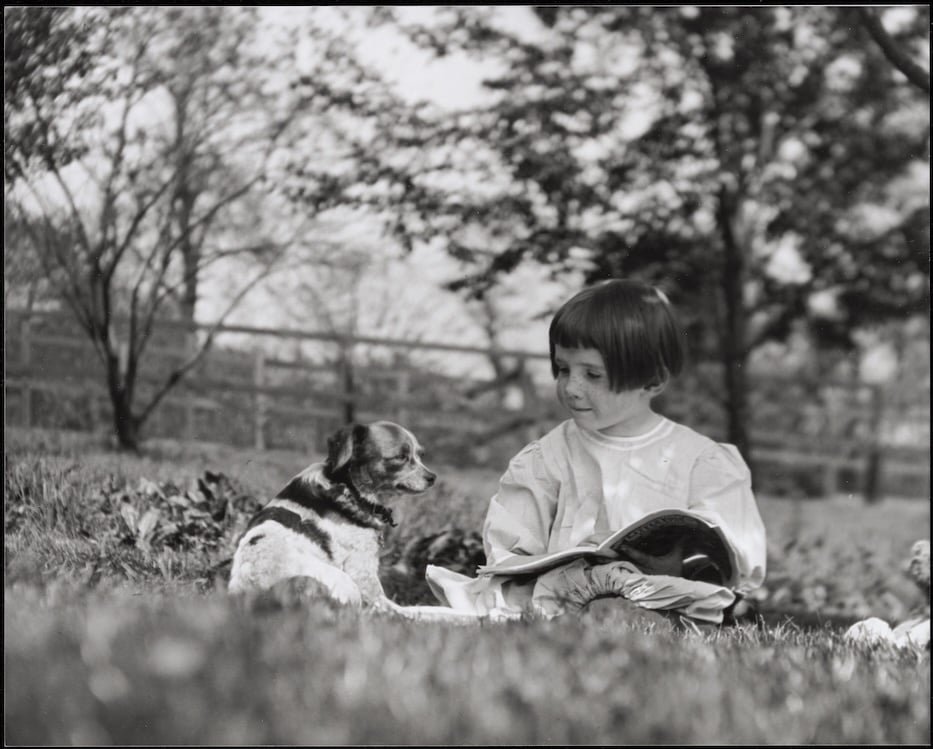
Rachel Carson reading to her dog, ca. 1912. Beinecke Rare Book & Manuscript Library. Courtesy of the Rachel Carson Estate. Courtesy of Yale University.
Beyond popular, Carson was also prescient—some of her early observations seem to predict climate change, according to the curators—but the show identifies gaps in her thinking. Namely, she lacked a more nuanced awareness of how class and race were and continue to be disproportionately impacted by environmental harm. Carson was often concerned with the rural landscape and her white, middle-class peers, more or less ignoring urban environments and their inhabitants.
A pamphlet produced on the occasion of a “Toxic Walking Tour” in Gainesville, Georgia, from 1993, demonstrates one example of environmental activism that occurred after her death. One photo portrays a large bow on a mailbox, of which there were numerous within the predominantly Black neighborhood. These prominent additions indicated residents who had been diagnosed with cancer, the same disease that ended Carson’s life in 1964 at the age of 56. Still, objects like this one feel tangentially related to Carson, at best.
While Carson’s concerns hemmed closely to her personal identity as a white woman, the exhibition thoroughly documents how her influence has extended into a vast network of contemporary nature writers. In 2006, when the first major show of materials from the Beinecke’s Rachel Carson Papers was mounted, the writer and activist Terry Tempest Williams visited Yale to deliver a speech. You can scan her handwritten notes for this lecture, which are underscored in the label with this passage: “How did she do it? I believe she did it through love—Do we dare to speak this word?”
Carson might not have uttered that word. She might have preferred “wonder.” Silent Springs, Windswept Seas presents a full and illuminating portrait of an imperfect and increasingly impassioned person—a subtle arc of the show. Few writers did more to catalyze the modern environmental movement, and her late speeches in particular have an urgency not found in her early career. The exhibition reminds us that had Carson’s words never been published or preserved, we know there would have been even less of this world to see, even more of it lost forever.
Silent Springs, Windswept Seas continues through October 4, 2026, at Beinecke Rare Book and Manuscript Library, 121 Wall St. in New Haven.