

Culture & Community | Arts & Culture | Visual Arts | Gateway Community College
Patrick Garcia Photos.
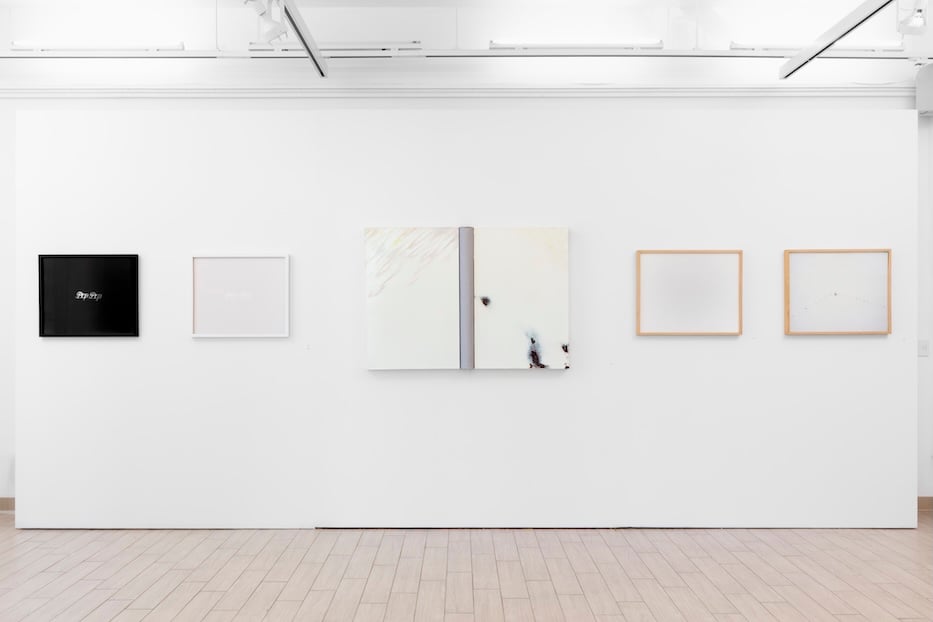
A pair of photographs—both compositions characterized by nearly complete fields of brilliant white—hang next to a set of modestly sized, bright paintings. In Sacandaga Blanket, a trail of dark, indiscernible shapes like little holes perforates the stark, snowy landscape. Subtle crisscrosses, likely from skis slicing through the snow, become faintly visible in Track, the work on the left. The gleam of the surfaces of the nearby paintings is mostly pristine, matching the subtlety of these photos. Selective interruptions reveal pockets of rich, blackish-brown abrasions across the diptych Willow to Blatchley. Here, the fine weave of the canvas emerges from under the heavy coating of paint.
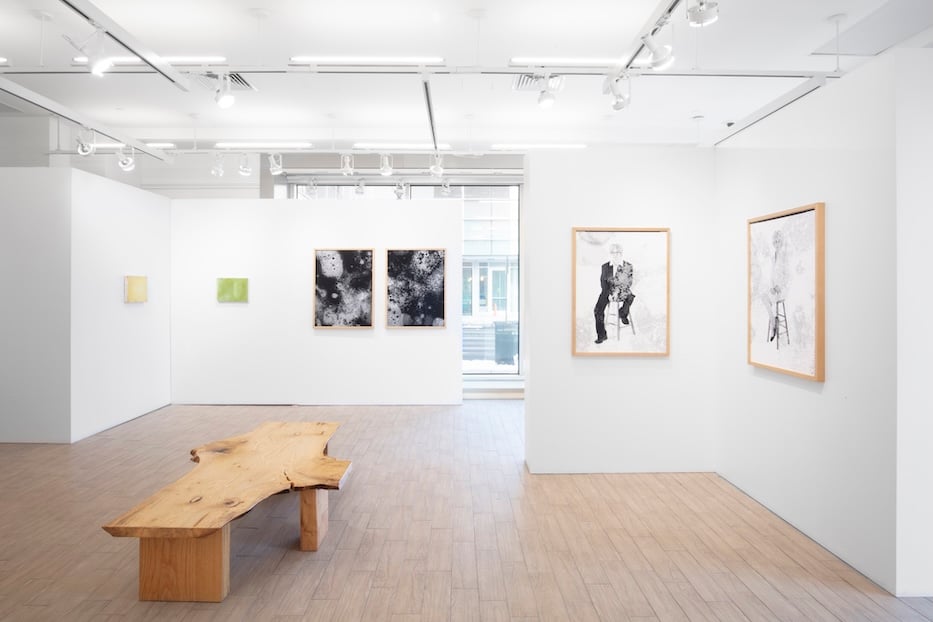
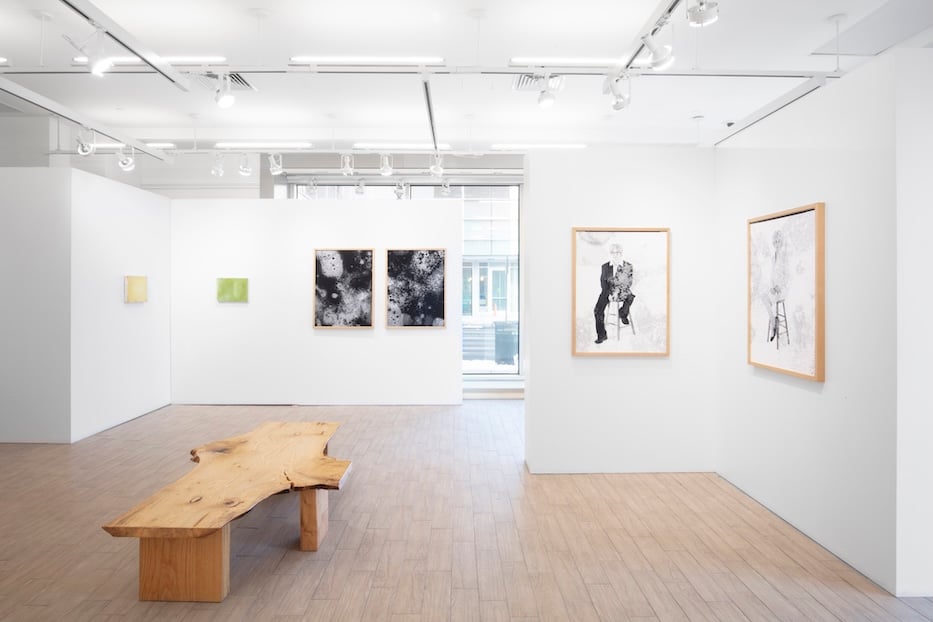
In You Will Be the Mirror: Hafsa Nouman & Sarah Phyllis Smith, the abstract space of painting meets the spatial uniformity of photography to open a dialogue about memory and materiality in the two-person show. Curated by Noé Jimenez, the exhibition pairs Nouman—a Pakistani-born artist and graduate student in the Yale School of Art—with Smith, an Associate Professor of Photography at Pratt Munson, Utica, New York. It continues at the NewAlliance Foundation Art Gallery at CT State Gateway through February 4.
“They both create images that extend beyond their personal intentions, and they both use blank space to glue their narratives together: sometimes literally using solid, blank, or transparent voids as narrative devices,” Jimenez said of his intention to bring these two artists—one primarily a painter, the other a photographer—together. Weaving the works together inside the gallery is a sparse or understated sensibility: paintings characterized by a single hue and photos whose imagery demands time to decode, for example.
Patrick Garcia Photos.
From the pristine cover of a frozen field to the skuzzy film of lake water, the shifting landscapes of upstate New York are a core part of the photos in this show. Smith has dedicated years of her practice to documenting these terrains, though viewers could easily project other locations onto her works. She returns to the same subjects, using photography as a means to unpack complicated family dynamics by excavating the places where these relationships have unfolded. Many of Smith’s works feel akin to textural swatches of specific spots, as if the artist is memorializing how the precise feel of a snowfall’s blinding light maps onto her own memories of a moment in time.
Nouman shares Smith’s desire to evoke haptic experiences through her practice as a painter. A statement on her website reads: “Making one's touch through representation as the point of contact, the blind spot, the lived experience of a sensation. This conceptual play that exists alongside the embodied experience of touch, when represented by the strangeness of how it is painted and gets read as abstraction, is what [Nouman] is invested in.”
Nouman’s finesse straddling the space between abstraction and nameable objects is restrained yet pleasurable to consume in places where she abandons those constraints. Paintings from her “What is the Desired Fruit?” series captivate viewers with the artist’s delicate web of layered brush strokes, confined within tightly-delineated shapes. While the negative space dominates the compositions, the organic forms feel unknowable, but at the same time, they are rendered with the kind of acute detail that most often results from sustained observation.
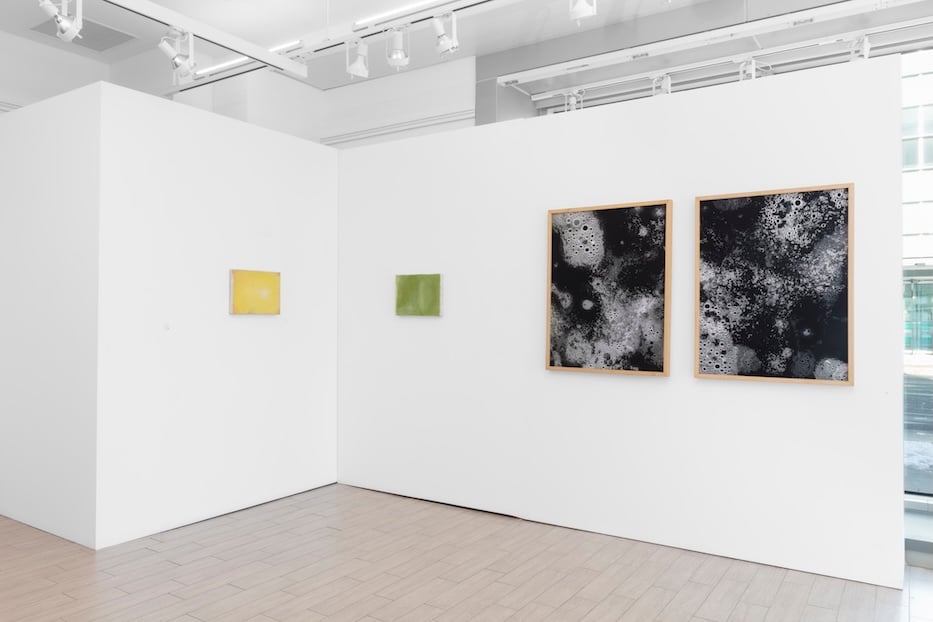
Near the back wall of the gallery are two works by Nouman that convey her spin on color field paintings—the compositions filled with a single color. The canvases are the same size, but one is a deep yellow, the other sap green. As with Nouman’s “Desired Fruit” paintings, the uniformity of the hue within these small canvases functions as a means for disruption or contemplation.
Patrick Garcia Photos.
To the right of these works are two large photographs by Smith—black voids with pools of small white bubbles. The effervescence of a carbonated beverage comes to mind, but it’s impossible to know if we are peering through or hovering over the liquid, creating this cascading effect. As with Nouman, Smith embraces ambiguity as a strategy for investigating memory or identity.
These connections, at times tenuous, between the two artists run throughout the exhibition, its title a possible riff on the song, “I’ll Be Your Mirror,” in which Lou Reed wrote:
I'll be your mirror
Reflect what you are, in case you don't know
I'll be the wind, the rain, and the sunset
The light on your door to show that you're home
When you think the night has seen your mind
That inside you're twisted and unkind
Let me stand to show that you are blind
Please, put down your hands
'Cause I see you
I find it hard to believe you don't know
The beauty you are
But if you don't, let me be your eyes
A hand to your darkness so you won't be afraid
Debuting on the 1967 album “The Velvet Underground & Nico,” this sweetly strange anthem, shaped by the German singer's discordant voice, asserts that we sometimes learn about ourselves through others. What you can’t see, another shows. Our relationships with one another help define who we are. In the show, the paintings are strengthened by the photos, and vice versa.
For Jimenez, the title alludes to a viewer’s physical experience of light. “It is my way of saying that these are artworks meant to be seen in person, and the reason they exist is to be seen,” he said. The subtle surface qualities of these works—the way the light refracts on Nouman’s glossy paintings or becomes absorbed into Smith’s dark voids—are best experienced inside the gallery space. Digital reproductions are a disservice to the art.
The title also suggests another way to interpret this show: when you stand in front of these works, you bring your own bias. Viewers complete the empty spaces within these works as they see fit. In this way, You Will Be the Mirror stresses a shared, and sometimes overlooked, attribute between the two media, painting and photography: their mutability.
While paintings are often seen as inherently emotionally charged or imbued with idiosyncratic meaning by dint of the process—the evidence of the hand, the manipulation of the materials—photographs are sometimes interpreted as scientific or rational, somehow closer to reality, even in a world decades out from the advent of Photoshop. Taken together, Smith’s photos and Nouman’s paintings become emboldened as empathic objects, both optical and emotional mirrors for viewers.
You Will Be the Mirror: Hafsa Nouman & Sarah Phyllis Smith continues through February 4, 2026, at NewAlliance Foundation Art Gallery, 20 Church Street, New Haven.